Business
Column: On Harvard, plagiarism, and the racist right-wing attack on university education

You may have heard during the last few days about the resignation by the president of a smallish university in New England.
Pundits, politicians and alumni are currently locked in a debate over whether Claudine Gay’s decision to step down after only a months-long tenure as president of Harvard was due to accusations that she was a serial plagiarist or her maladroit performance last month at a congressional hearing about a surge of antisemitism on American college campuses.
A few things about this: That some of Gay’s academic writings crossed the line into plagiarism is indisputable. That she, along with the presidents of the University of Pennsylvania and MIT, failed to knock the “gotcha” questions about antisemitism back down the throats of the cynical, preening Republican interrogators at the hearing is also indisputable.
The biggest story about higher education over the last decade has been increased politicization, not wokeness.
— Don Moynihan, Georgetown University
What’s important is that neither of those facts has anything to do with what was really behind the campaign to force Gay out of her job. To put it simply, the press has completely missed the real story. To be precise, the debate about her resignation has ignored the noxious context, which is a concerted attack on American higher education — indeed, all education — by a right-wing cabal.
Gay, whatever her faults, is clear-eyed about this context. In an op-ed published Wednesday, she warned that her case “was merely a single skirmish in a broader war to unravel public faith in pillars of American society.”
Such campaigns, she added, “often start with attacks on education and expertise, because these are the tools that best equip communities to see through propaganda. … Trusted institutions of all types — from public health agencies to news organizations — will continue to fall victim to coordinated attempts to undermine their legitimacy and ruin their leaders’ credibility. For the opportunists driving cynicism about our institutions, no single victory or toppled leader exhausts their zeal.”
What’s most shocking about the failure of the press to recognize what’s happening is that the leaders of the cabal are completely open about their goals and their methods. Here, for instance, is a manifesto by the odious Christopher F. Rufo, the leader of the braying mob that chased after Gay:
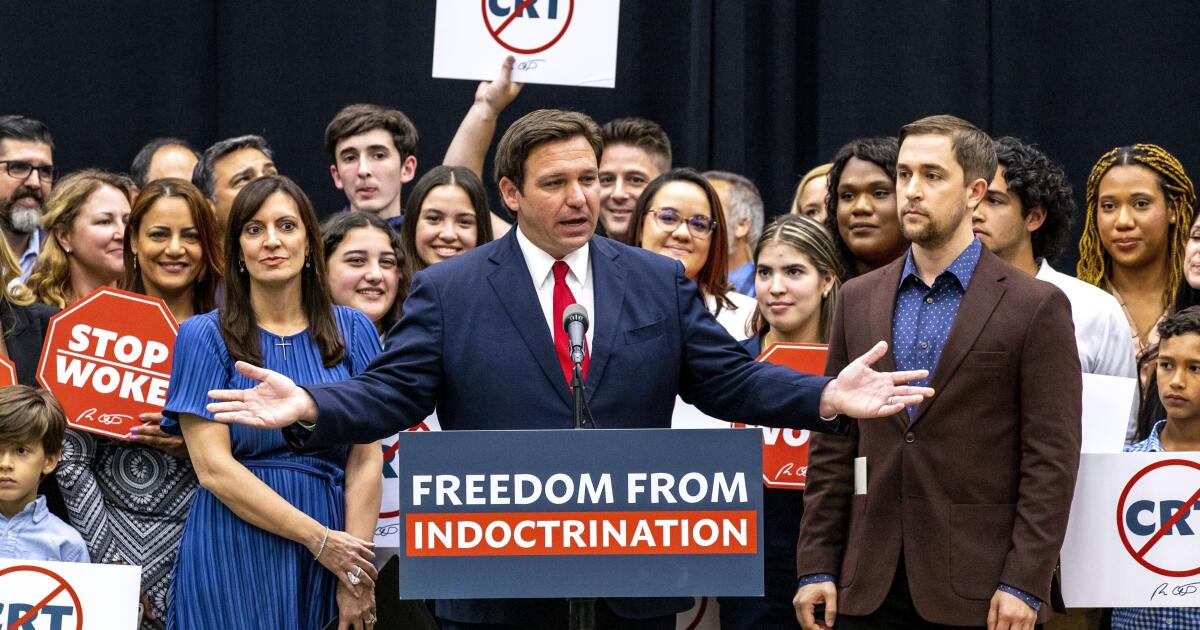
“We launched the Claudine Gay plagiarism story from the Right,” he stated on X-formerly-Twitter on Dec. 19. “The next step is to smuggle it into the media apparatus of the Left, legitimizing the narrative to center-left actors who have the power to topple her. Then squeeze.” This is a replication of his campaigns to turn “critical race theory” (CRT) and “diversity, equity and inclusion” programs (DEI) into dog whistles for the reactionary Republican voting bloc.
The problem is that all the focus is on Harvard, for at least a couple of reasons: It’s the most prestigious university in the country and lots of journalists at agenda-setting news organizations such as the New York Times are alumni, and thus believe that culture and society revolve around the place (or similar Ivy League institutions).
“The obsessive culture war coverage of the Ivies hurts other institutions,” observes Don Moynihan, a public policy professor at Georgetown University. Those elite private schools have the money and connections to survive whatever partisan politics throws at them.
Not so the public institutions that educate the vast majority of Americans. (Harvard’s enrollment, including its graduate and professional schools, is about 30,000; at Florida’s three main campuses, which are under intense partisan threat from Gov. Ron DeSantis, it’s a combined 185,000.)
“The biggest story about higher education over the last decade has been increased politicization, not wokeness,” Moynihan writes. “The biggest threats to speech are coming from people who write the laws and set the budgets, not from students. … University trustees in public institutions are increasingly political appointees determined to impose right wing values.”
He’s right. Yet coverage of the crisis in public schools pales in comparison to the obsessive reportage about Harvard and the Ivies.
The model for eviscerating the independence of public university systems was set by Republican Gov. Scott Walker of Wisconsin. By the end of his two terms in 2019, reported Karin Fischer of the Chronicle of Higher Education in 2022, “Walker had slashed college budgets, stripped tenure protections and university autonomy, and proposed gutting the Wisconsin Idea, enshrined in state law, that stresses higher education’s importance to the state and society.”
According to Barrett J. Taylor, the author of “Wrecked: Deinstitutionalization and Partial Defenses in State Higher Education Policy,” a book about the Wisconsin experience, “Walker went after higher ed to rally his base: ‘Universities were too liberal! Professors had too good of a deal!’ It was something to oppose. And higher ed is still a useful political tool.”
Other state universities were targeted by partisan activists. The University of North Carolina was bedeviled by conservatives on its Board of Governors claiming to find ideological bias campuswide. The board’s real agenda was to shut down progressive activities, which it did by closing a poverty law center at the main campus at Chapel Hill led by “a vocal critic of conservatives,” according to Inside Higher Ed, as well as an environmental science program and a center on social change at satellite campuses.
In December, Kevin Guskiewicz left his job as chancellor of UNC Chapel Hill to become president of Michigan State University. The mostly Republican board replaced him with Lee Roberts, a Republican functionary who had no experience running a major university.
At Texas A&M, conservatives influential within the university system interfered with the hiring of a distinguished journalist, Kathleen McElroy, to head its journalism school.
Over a period of weeks, the terms of her employment were reduced to a one-year non-tenured appointment from a tenured chair. The reason, McElroy was told by the university’s dean of arts and sciences, was that “you’re a Black woman who worked at The New York Times.”
The fiasco led to the resignation of A&M President Katherine Banks after a faculty meeting in which she defended the fiasco clumsily. McElroy chose to stay at the University of Texas and obtained a $1-million settlement from A&M over the altered offer.
Florida remains ground zero of the reactionary attack on public higher education. DeSantis has installed Ben Sasse, a former Republican senator from Nebraska, as president of the flagship University of Florida (enrollment: 60, 795); never mind that Sasse had zero experience running a major university.
The highlight (or lowlight) of DeSantis’ campaign against Florida universities involves New College of Florida, a Sarasota institution that possessed a well-deserved reputation as one of the nation’s outstanding havens for talented, independent-minded students. DeSantis fired its board of trustees and replaced it with a clutch of right-wing stooges including Rufo.
They promptly fired the college’s president and replaced her with Richard Corcoran, a former GOP state legislator, while nearly doubling his salary to $700,000, plus more than $200,000 in perks.
Corcoran moved to turn New College into a fourth-tier institution of zero distinction. He recruited 70 baseball players even though the campus has no playing fields. Existing students fled, and the average SAT and ACT scores and high-school grade point averages of the incoming class have plummeted.
That brings us back to Rufo and his campaign against Claudine Gay. Does any person past the age of playing with their toes really believe that he cares one whit about plagiarism and antisemitism, the ostensible rationales for her departure? Does anyone believe his purpose is to heighten the integrity of prose in academia, or ensure that university campuses remain refuges for pro-Israel policy?
Of course he doesn’t — at least not beyond using these issues to conceal his real goal, which is to make university administrators and faculty terrified of being caught allowing progressive thoughts into the classroom.
Here he was on Twitter, on March 15, 2021, at the height of his fabricated campaign against “critical race theory,” which became conveniently truncated as “CRT,” the better to put it over on rubes without explaining what it is:
“We have successfully frozen their brand — ‘critical race theory’ — into the public conversation and are steadily driving up negative perceptions. We will eventually turn it toxic, as we put all of the various cultural insanities under that brand category.”
“Brand category,” “negative perceptions.” … This is the language of advertising, not serious political discussion.
Having achieved his purpose by demonizing CRT, Rufo and his sycophants turned to DEI. Right-wing politicos unwilling or unable to even feign interest in making public policy scurried to get in front of this parade.
GOP legislators in Wisconsin held hostage $800 million in funding for the state university and blocked all staff pay raises unless the university cut back DEI programs. The university agreed. Oklahoma’s Republican governor, Kevin Stitt, signed an order defunding DEI departments in all state agencies, including the state’s 50 public university campuses.
Did anyone stop to inquire what it means to reverse DEI? The antonyms of diversity, equity and inclusion are uniformity, inequality and exclusion. In context, this translates into white supremacy. For who is on the outside looking in when the rules promote uniformity, inequality and exclusion? In our society, it’s everyone but whites — especially white males.
Of course, once you’ve reduced these principles to “DEI,” no one has to stop and think about meaning. But it’s no secret to those on the firing line. The assault on DEI programs, observed a report on Florida’s anti-DEI campaign by the American Assn. of University Professors, is “emblematic of how civil rights discourses get co-opted by the far right to promote misogynistic (and/or racist) agendas.”
Gay’s sloppiness in citing others’ words in her academic oeuvre was a dormant bomb, awaiting someone looking for a flaw in her record to light the fuse. That doesn’t mean that it fails to qualify as plagiarism; it does, according to Harvard’s own written standards.
Nor does it mean that her offenses would have necessarily prompted her resignation, if not for the miasma of ideological controversy stirred up by Rufo and his detestable henchwoman, Rep. Elise Stefanik (R-N.Y.).
It was Stefanik who set the rhetorical trap that Gay stupidly walked into at that Capitol Hill hearing, along with Penn President Liz Magill (who has also resigned, more directly as a result of a campus controversy over antisemitism) and MIT President Sally Kornbluth (who still has her job).
The sad truth is that plagiarism standards are dynamic, with punishment dependent on the prestige of the accused and the willingness of an institution to stand by them. As Timothy Noah of the New Republic has pointed out, Harvard faculty member Doris Kearns Goodwin committed arguably more egregious examples of plagiarism in 2002 and emerged with her employment and reputation intact, with Harvard’s help.
Rufo and Stefanik are taking victory laps over Gay’s resignation. Stefanik, who never lets an opportunity slip by to display crass vulgarity, tweeted “Two Down,” referring to Gay and Magill. Perhaps his incident will open people’s eyes to the dishonesty of their campaign and the hollowness of their triumph. Wouldn’t that be justice?


Federal Bureau of Investigation officers served a search warrant Wednesday at the Garden Grove chemical plant, where a compromised tank containing toxic chemicals threatened to leak or explode, resulting in the evacuation of nearby residents in May.
“We are cooperating with authorities at our Garden Grove facility and will continue to do so,” a spokesperson of GKN Aerospace, which operates the facility, said in an email statement.
Laura Eimiller, an FBI spokesperson, said FBI agents are serving a search warrant as part of an ongoing investigation into the Garden Grove aerospace business.
GKN Aerospace is a division of Melrose Industries, a U.K.-based aerospace company that manufactures aircraft parts.
In May, at the manufacturing facility, which stores thousands of gallons of toxic chemicals in pressurized tanks used to produce materials such as plexiglass for fighter jet and commercial aircraft windows, one tank threatened to leak or explode.
Over 50,000 residents were temporarily evacuated as officials investigated the potential for an explosion for days. They found that a crack in the compromised tank released the pressure buildup inside the storage unit, which ruled out the possibility of an explosion, and allowed residents to return to their homes.
The compromised tank threatened to blow up, affecting adjacent tanks also containing the toxic chemical methyl methacrylate which could have caused a large-scale public safety emergency. Still, plans to remove the remaining MMA chemical tanks from the facility have been postponed, and no new date has been announced yet.
Residents who were impacted by the evacuation have already filed multiple class action lawsuits against the company, alleging negligence at the manufacturing facility and seeking compensation for loss of use of homes and diminished property value. Now, federal officials will investigate possible violations and factors that could have contributed to the incident.
According to the FBI warrant, the officers will seize items in violation of measures to prevent the accidental release of hazardous substances into the air.
The warrant allows FBI officers the discretion to search digital devices or seize and transport them as part of the investigation.

Electric-vehicle maker Rivian began delivery of a cheaper SUV on Tuesday as it aims to take customers from Tesla and others.
The long-anticipated R2, which will eventually be available for less than $45,000, could help boost the market share of the Irvine company better known for vehicles priced around $77,000.
The first R2s to roll off the company’s production line in Normal, Ill., are the performance version, starting at $57,990. Rivian said the R2 Premium will arrive in late 2026 for around $54,000, followed by an R2 Standard version in 2027 priced at $44,990.
“Rivian is really trying to prove its worth,” said Ivan Drury, director of insights at Edmunds. “They’ve gone past that initial stage and are hoping to move on to mass market products.”
The R2 Performance is still an expensive vehicle for many Americans, but it’s a step down from Rivian’s nearly $77,000 R1S. It’s typical for an automaker to launch the most expensive version of a new vehicle first, experts said.
Whether the R2 will be the success Rivian is hoping for won’t become clear until late 2027, once the standard versions are widely available. Chief Executive RJ Scaringe said the company is aiming to compete with not just other EV makers, but also traditional auto companies such as Jeep and Subaru.
“More mainstream people are going to be in on the R2, especially for the lower-priced models,” auto analyst Brian Moody said. “You’re always going to have early adopters, but there’s a lot more customers to go around in the $45,000 to $55,000 range.”
According to Cox Automotive, the average transaction price for a new EV in the U.S. is $55,000, compared with $49,000 for a gas-powered vehicle. Used EV sales have been surging lately because of their value, with an average transaction price of around $36,000.
Though there’s significant hype surrounding the launch of R2, investors have been unimpressed. Rivian shares fell 7% on Tuesday.
There has been a broad cooling of the EV market. Major automakers including Honda and Ford have cut back their EV options as excitement for the vehicles has fallen under the Trump administration. A $7,500 EV tax credit for new vehicles expired in September.
Drury added that an announcement of a new product would generally generate more buzz than the first deliveries of a vehicle that’s already been in the public eye.
“This is simply them delivering on a promise, and the market itself is not what it was when they had first conjured up the vehicle,” Drury said.
Rivian lost $3.6 billion last year and hasn’t been profitable since its founding in 2009. Scaringe said the company will reach profitability on a per-unit production basis with the R2 this year, but estimated that the company won’t turn an overall profit until closer to 2030.
Karl Brauer, an auto industry expert at ISeeCars.com, said the premium and standard versions of the R2 probably will sell in much higher volumes than the performance version.
“It’s in theory an exciting moment, because they’re launching this new version, but it’s the expensive one,” Brauer said. “There’s no indication in my mind that there will be huge, high-volume sales.”

A month away from its closure, onetime gambling oasis Primm, Nev., located along the state border with Southern California, has a new lease on life.
The Primm family, owners of the land that includes three casino resorts and other businesses along the 15 Freeway, announced Tuesday a partnership intended to save the struggling state-line strip and hundreds of jobs.
The deal allows Las Vegas-based Terrible’s, owned by the Herbst family and perhaps most famous for a string of gas stations and convenience stores, to operate the properties.
“What we saw with them is the same energy that we had in rebuilding Primm,” said Cory Clemetson, describing the new deal with Terrible’s in an interview with The Times. Clemetson is president of Primm South Real Estate Co. and a grandson of Primm founder Ernie Primm, who made a name for himself in Southern California in the 1930s and ’40s with his Gardena card rooms.
In the summer of 2025, signage blocks an entrance at Primm Mall, a once-popular site along with the trio of casinos at the California-Nevada state line.
(Bridget Bennett / For The Times)
“Primm has long been one of Nevada’s most recognizable destinations,” said Tim Herbst, president of Terrible’s, in a statement. “This partnership reflects our commitment to preserving that legacy while creating new opportunities for growth, investment, and tourism for decades to come.”
Terrible’s takes over for Affinity Gaming, owned by private equity company Z Capital Partners, in the full-circle world of southern Nevada gaming. In 2010, Herbst Gaming declared bankruptcy and saw Primm taken over by Z Capital Partners.
An email to representatives for Affinity Gaming was not immediately returned.
The process for the return of Terrible’s to Primm kick-started May 5, when Affinity confirmed the closure of Primm Valley Casino Resorts.
Affinity’s subsidiary, Primadonna Co. LLC, sent termination notices to more than 300 employees effective July 4.
The closure was devastating, Clemetson said.
“It felt like a gut punch,” he said. “I mean, you’ve got to be kidding me that they would announce something like that for the Fourth of July. Laying off in excess of 300 Nevadans who are mostly paycheck to paycheck with nowhere to go didn’t sit well with my family.”
Primm Valley was the last of three resorts built between 1977 and 1994 at the site that remained in full operation.
Buffalo Bill’s, the largest of the three resorts, closed 24-7 operations in July 2025, after Whiskey Pete’s, the original casino, shuttered in December 2024.
Affinity Gaming declined multiple requests from The Times to speak about Primm’s struggles.
In a letter presented at a Clark County Board of Commissioners meeting, Erin Barnett, Affinity’s vice president and general counsel, wrote in October 2024 that “traffic at the state line has proved to be heavily weighted towards weekend activity and is insufficient to support three full-time casino properties.”
Scott Butera, Affinity’s chief executive and president, offered a few comments about the closure at the May 21 Nevada Gaming Commission meeting.
“As a tenant with a difficult lease and an expensive property and increased competition every day in California … it just became a very difficult thing,” he said, “and we’ve been losing money for years there.”
Clemetson said that Affinity asked for help over the years, such as potential rent reductions, but that the Primm family was unaware of Affinity’s finances.
As for the future, Clemetson said Terrible’s was in the process of reacquiring a gaming license for Primm, which he hoped would happen in the next three weeks.
He also said it was the goal of the Herbst and Primm families to try to keep all workers who received a termination notice employed.
Clemetson said he was excited about Primm’s future under Terrible’s and chalked up its bankruptcy in 2010 to the Great Recession.
“They suffered a similar fate of many big brands like MGM and Caesar’s,” Clemetson said.
“They’re very well thought of in Nevada and they’re a very successful family who’s done well,” he added.
Speaking of Primm’s chances of regaining its former glory, Clemetson reached back into his own past as a young sports agent for players on the L.A. Galaxy soccer team.
“I can’t tell you how many people told me I was dumb to get involved representing soccer players because soccer would never make it here,” he said. “Now, Major League Soccer has a few franchises over a billion dollars.”
As for Tim Herbst and his family, “we believe Primm’s best days are still ahead.”
-

 South Dakota5 minutes ago
Strong winds, rain expected Thursday across South Dakota
-

 Tennessee12 minutes ago
Tennessee’s Ban on THCA
-

 Texas15 minutes ago
Texas confirms five new world screwworm cases, sets infested zones to contain spread
-

 Utah20 minutes ago
Utah couple fights human-trafficking through Salt Lake-based nonprofit
-
Vermont27 minutes ago
VT Lottery Powerball, Gimme 5 results for June 10, 2026
-

 Virginia30 minutes ago
Virginia Lottery Powerball, Pick 3 Night results for June 10, 2026
-

 Washington35 minutes ago
Washington paper mills mum about chemical safety after Longview disaster
-

 Wisconsin42 minutes ago
Thousands remain without power after Wisconsin storms

