Business
Column: As measles spreads, 'herd stupidity' grips Florida's government

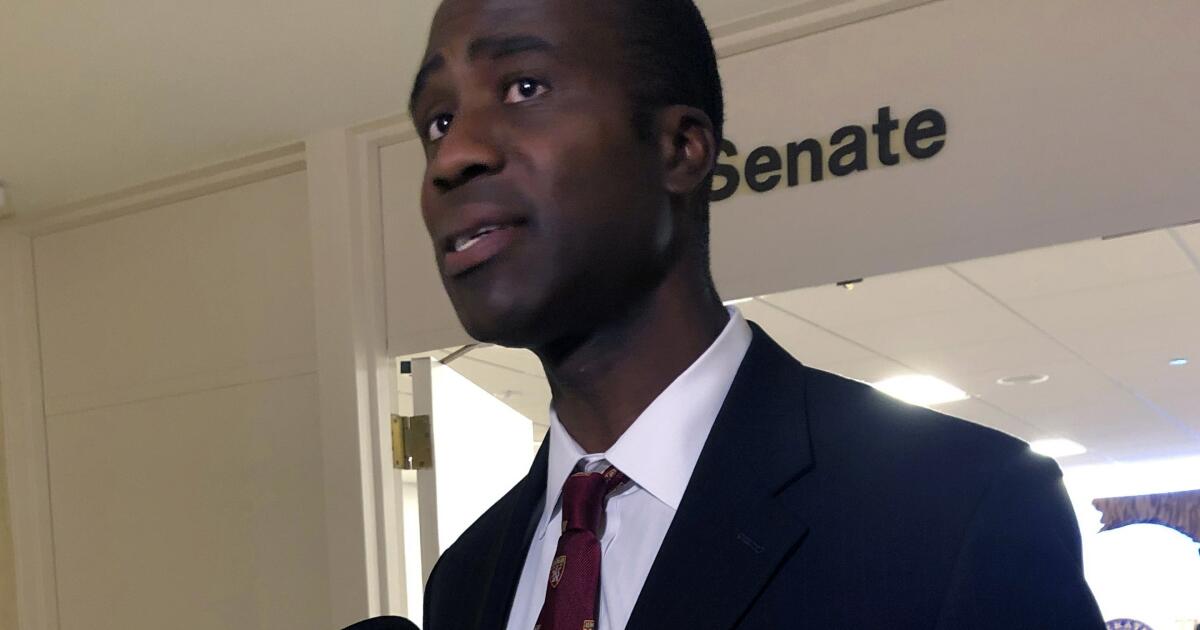
As of this writing, the measles outbreak in Florida is up to nine cases, including the first one recorded outside the epicenter in Broward County, in the vicinity of Fort Lauderdale.
Nine cases may not seem like a lot, but it’s enough to alarm epidemiologists. They point out that measles is among the most contagious viruses known to humankind, which means that the cases identified thus far are likely to be the tip of the iceberg.
Who’s unconcerned? The chief public health official of the state of Florida, that’s who. He’s Joseph Ladapo, whom I earlier identified as “the most dangerous quack in America.”
That was before the measles outbreak, when Ladapo was known chiefly for opposing COVID vaccination despite incontrovertible evidence that it saves lives.
1 in 5 will be hospitalized, 1 in 20 will develop pneumonia (the most common way measles kills young kids), 1 in 1,000 will develop encephalitis (infection of the brain, sometimes causing permanent brain damage), and 1-3 in 1,000 will die.
— Epidemiologist Katelyn Jetelina on measles
Ladapo has now cemented his position at the top of the list of public officials hazardous to your health. He did so with a letter issued Feb. 20 to parents with children at the elementary school suffering the outbreak.
The letter noted that it is “normally recommended” that children stay home until the end of the infectious period, which he pegged at March 7.
But he added: “Due to the high immunity rate in the community, as well as the burden on families and educational cost of healthy children missing school,” his agency would let parents or guardians make their own decisions about sending their kids to school.
The letter was also notable for what it did not say. It did not recommend that parents of nonimmunized children get them vaccinated immediately.
Ladapo was installed as surgeon general by Republican Gov. Ron DeSantis, largely because he mouthed the same propaganda opposing anti-COVID measures, including the vaccines, as the governor. DeSantis hasn’t spoken in public about the measles outbreak, but make no mistake: He deserves equal blame for the consequences.
To say that Ladapo’s advisory left physicians and epidemiologists aghast would be a massive understatement. Allowing unimmunized children to go to school where they could be exposed to measles contradicts every responsible recommendation from medical science.
Ladapo tried to justify the decision to let unimmunized children exposed to measles go to school by asserting that the vaccination rate is high enough.
But as epidemiologist Katelyn Jetelina observed on her blog, Your Local Epidemiologist, while the vaccination rate in Florida is just over 90%, that’s “not high enough — because measles is so contagious, the threshold for herd immunity against measles is 95%. This means there are pockets in the school, other schools, and a community that measles could burn through.”
Measles is already on the march in the U.S. in 2024. Case numbers are current to Feb. 22.
(Centers for Disease Control and Prevention)
To put it another way, Ladapo’s appeal to the principle of “herd immunity” is outweighed by the herd stupidity of the anti-vaccination movement that he is a part of.
She also points out that “unvaccinated kids can still get protection from a vaccine within 72 hours of exposure.” That generally reduces the severity of symptoms. But Ladapo didn’t point that out.
Ladapo also minimized the consequences of measles infection. The rate of measles in the U.S. has been so low in recent years that the severity of the disease for the unimmunized can be deadly. Ladapo advised parents to be on the lookout for “a rash that often develops on the face and neck before spreading to the rest of the body as well as “high fever, which can reach 105°F, cough, runny nose, and red, watery eyes.”
Is that sufficient warning? No. The Centers for Disease Control and Prevention reports that among the unimmunized, 9 out of 10 people exposed will get infected.
Jetelina adds that among the unimmunized, “1 in 5 will be hospitalized, 1 in 20 will develop pneumonia (the most common way measles kills young kids), 1 in 1,000 will develop encephalitis (infection of the brain, sometimes causing permanent brain damage), and 1-3 in 1,000 will die.”
Also, measles can “cause ‘immune amnesia,’ where the immune system loses its ability to fight other viruses that people were previously immune to.”
In other words, measles is not something to view casually. The CDC has identified 35 cases nationwide this year so far. That’s more than half the total of cases in all of 2023, registered after less than two months of 2024. This figure is certain to rise as public health officials such as Ladapo fail to do their jobs.
The measles vaccine — MMR, which includes immunity for mumps and rubella — has been a prime target of the anti-vaccination cabal ever since the British physician Andrew Wakefield published a fraudulent and long-debunked report in 1998 linking it to autism. Wakefield lost his medical license in Britain as a result, but his work has remained a blot on public health ever since.
Ladapo has made common cause with the anti-vaccine movement over COVID vaccines. Doubts about the MMR shots may have infected his judgment in the measles outbreak.
His inadequate response to the outbreak finally has some Floridians and the state’s media taking note of the danger his policies represent to the health and well-being of Florida’s children and others. But given the virulence of measles, it may be too late.



Dear Mr. Pelley:
I meant what I said in my letter last week to the 60 Minutes team: joining 60 Minutes is the honor of my career and I am grateful to be working alongside the people who have contributed to the most important television journalism brand this country has ever produced. While I’m new to 60 Minutes, I’ve devoted my career to investigative journalism and storytelling. I started this job excited to collaborate and to benefit from the wisdom and experience of the 60 Minutes veterans, with you among them. For that reason, one of the first things I did in my new role was call you to talk and invite you to dinner. It is a profound disappointment that you rejected that overture and chose ambush instead. Yesterday, you hijacked my first meeting with staff to disparage me, my qualifications, and my intentions with remarkable incivility and contempt. I welcome a diversity of viewpoints and respectful debate among the team, but this was nothing of the sort. Yesterday’s performative display of hostility enacted in front of the staff instead of in a civil, private conversation-demonstrated that you have no interest in contributing to the future success of the show, or approaching my new tenure with a mind open to collaboration and progress. I am here to deliver first-in-class news programming, not to make headlines about newsroom drama. I am eager to work alongside those who share this goal.
Despite yesterday’s misconduct, I had hoped that in sitting down with you today we could find a path forward together. You made clear that you are not interested in such a path.
Your antipathy to the future of the show has come through loud and clear. And I have heard you. I therefore write on behalf of CBS News, Inc. (“CBS”) to inform you that your employment with CBS is terminated for cause effective immediately. Enclosed is your formal termination letter.
Sincerely,
Nick Bilton
Executive Producer, 60 Minutes

The co-founder of Aspiration, Joseph Sanberg, was sentenced to 14 years in prison on Monday after defrauding investors and lenders of over $248 million.
The startup, an eco-friendly digital banking company boasting fossil fuel-free investments, carbon offsets for gas purchases, and a debit card with cash-back benefits for shopping at clean companies, was founded by Sanberg and Andrei Cherny. Cherny left the company in 2022 and has not been charged.
Sanberg, an Orange County native, pleaded guilty to wire fraud in October after being arrested in March last year. Aspiration subsequently filed for bankruptcy and liquidated all of its assets by July.
Sanberg and venture capitalist Ibrahim AlHusseini, who also faces charges, together forged a series of bank statements in order to obtain loans. From 2020 to 2021, the pair forged AlHusseini’s bank statements to show millions of dollars in assets in order to obtain millions of dollars from lenders.
Additionally, they forged a letter from their audit committee stating that $250 million in funds were available, when in reality Aspiration had less than $1 million. The amount of loans defrauded exceeded $248 million.
In 2021, Sanberg artificially inflated Aspiration’s 2021 revenue by $44 million by recruiting 27 fake customers to sign letters of intent pledging tens of thousands of dollars per month for tree planting services. Sanberg himself funded the contracts and used the inflated revenue numbers to obtain more loans.
The charges sparked an NBA investigation into salary cap allegations due to Aspiration’s connections with Clippers owner Steve Ballmer.
Ballmer personally invested $60 million in Aspiration, all of which was lost. He is now the target of a civil lawsuit alleging his participation in the scheme. Ballmer denies the allegations.
The team announced a $300-million sponsorship deal with Aspiration, and Clippers player Kawhi Leonard signed a four-year, $28-million marketing contract with the company, which reportedly performed no duties. The issue has raised concerns about how players are circumventing the NBA’s salary cap.
The team lost the $300-million sponsorship deal and an additional $20 million paid for carbon offset purchases.
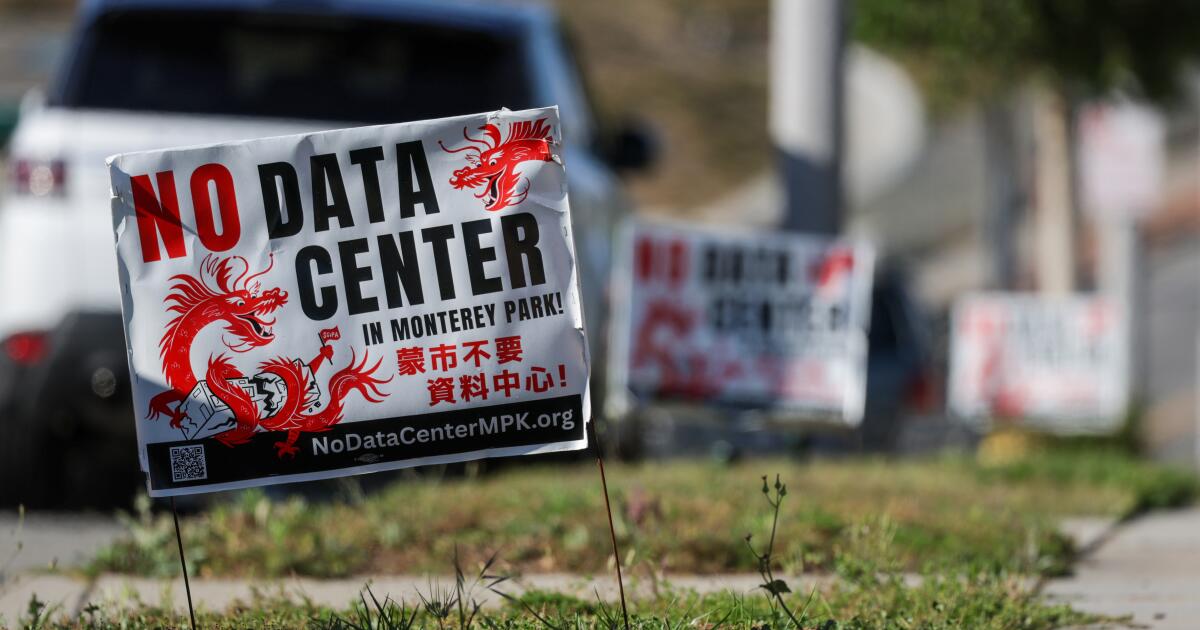
Residents in the city of Monterey Park will be the first in the nation to vote on a permanent ban on data centers Tuesday.
If approved, Measure NDC would prohibit data centers within the city limits and could only be overturned by another vote.
Yard signs saying “No Data Center” in English and Chinese with images of dragons line sidewalks in the San Gabriel Valley city.
As a wave of data center opposition sweeps the country, numerous towns and counties across the U.S. have instituted temporary moratoria and other restrictions on the facilities. But only a handful have instituted indefinite bans, and just four other towns have sent related matters to the ballot.
Supporters are hoping the vote will set a precedent for the rest of the region, where residents are fighting proposals in Vernon and City of Industry.
“This is about as permanent a ban as we can get,” said Steven Kung, co-founder of the group No Data Center Monterey Park. “Winning Measure NDC would send a huge message to the rest of the San Gabriel Valley about how residents don’t want data centers.”
The ballot measure emerged from the fight against a 247,000-square-foot center proposed in 2024 by the Australian-owned investment firm HMC StratCap for a residential area in Monterey Park.
The facility would have sat less than 500 feet away from the nearest home and used three times the electricity of the 60,000-person, predominantly Asian American city.
While the developer touted the potential for jobs and tax revenue, residents expressed concerns about noise and air pollution, rising electricity rates and a potential to lower property values.
The company pulled its plans in late March following public outcry and a March 4 city council vote to extend a temporary data center moratorium and place a ban on Tuesday’s ballot.
In a letter to the city council, HMC StratCap said it would pursue a different use for the land and would not engage in a ballot measure fight.
The city council later banned data centers indefinitely, the first in California to do so, said Mayor Elizabeth Yang. But she’s still been out campaigning for the measure with all four other council members.
“If a council puts in an ordinance, a future council can reverse it too,” said Yang. “With the ballot measure, unbanning it is a lot harder because you need the entire city to vote on it.”
The measure proposes the ban “to protect air quality, drinking water resources, and public health” and “prevent impacts to electricity and water rates.”
While California places third in the country for existing data centers with about 300 facilities, it hasn’t been a hot spot in the recent AI-driven data center boom. High electricity rates, expensive land and regulatory hurdles mean that fewer, and smaller, facilities are currently planned than in Virginia, Texas, Georgia, Illinois or Arizona.
“Most of California’s data centers are small by today’s standards,” said Shaolei Ren, an engineering professor at UC Riverside who studies how to reduce the environmental impacts of data centers. “Ten years ago, they would be medium-sized, but the power demand for new AI data centers has increased a lot.”
The average operating data center demands 45 megawatts, according to the Washington Post, while the average planned one would draw 430 MW. The one proposed for Monterey Park would have required about 50 MW at peak demand.
As proposals crop up in SoCal, they’re met with fierce opposition. Montebello, El Monte and Baldwin Park have all enacted temporary moratoria, and Alhambra recently banned data centers as part of a zoning code update. City of Industry, Vernon, City of Commerce and Santa Fe Springs are moving in the other direction, trying to court developers and streamline data center approvals. Community groups are fighting that.
Outside the San Gabriel Valley, residents of Coachella and Imperial County are showing up in droves to protest local proposals.
Matthew Shaw, a volunteer with the Coalition for Responsible Data Center Development, who recently published a report on opposition to AI data centers, said a vote to ban them in Monterey Park “would lead to copycats, partially because so many groups are just opposed to any data center development at all.”
While there is no formal opposition to Measure NDC, some building trades like Ironworker Local 433 supported the Monterey Park data center when it was still live before city council. Those in the data center industry are lamenting the state of public opinion.
“These are multi-billion-dollar assets that are built by multi-trillion-dollar companies. These things will get done,” said Mehdi Paryavi, chairman of the International Data Center Authority. “My biggest problem is that our industry does not invest enough in community engagement.”
Paryavi said towns that seek to limit data centers are missing out on thousands of jobs generated by data center construction, operations and customers, as well as faster artificial intelligence speeds and better performance.
Kung said local community organizers are “looking at the empirical evidence” and seeing a ban as a win.
“We’ve never seen a city that embraces a data center and is like, ‘Look how our quality of life has increased, look how all the revenue has gone into citywide improvements,’” he said. “That just doesn’t exist.”
-

 San Diego, CA50 seconds ago
Morning Report: Runoffs Largely Set
-

 Milwaukee, WI6 minutes ago
MPS staffer who got plea deal in slapping case had earlier incident
-

 Atlanta, GA13 minutes ago
19 new metro Atlanta restaurants opened in May, but 11 closed
-

 Minneapolis, MN16 minutes ago
Motorcyclist seriously injured in north Minneapolis hit-and-run
-

 Indianapolis, IN21 minutes ago
New stores in Indianapolis include indoor kid’s playground, cafe
-

 Pittsburg, PA28 minutes ago
Blanche says DOJ
-
Augusta, GA31 minutes ago
Amy Elizabeth Black Obituary May 29, 2026 – Platt’s Funeral Home
-
Washington, D.C31 minutes ago
Sherry Abedi has been appointed as General Manager at LINE DC


