Business
Column: 60 years ago in Los Angeles, piano virtuoso Glenn Gould revolutionized the music industry by ending his concert career

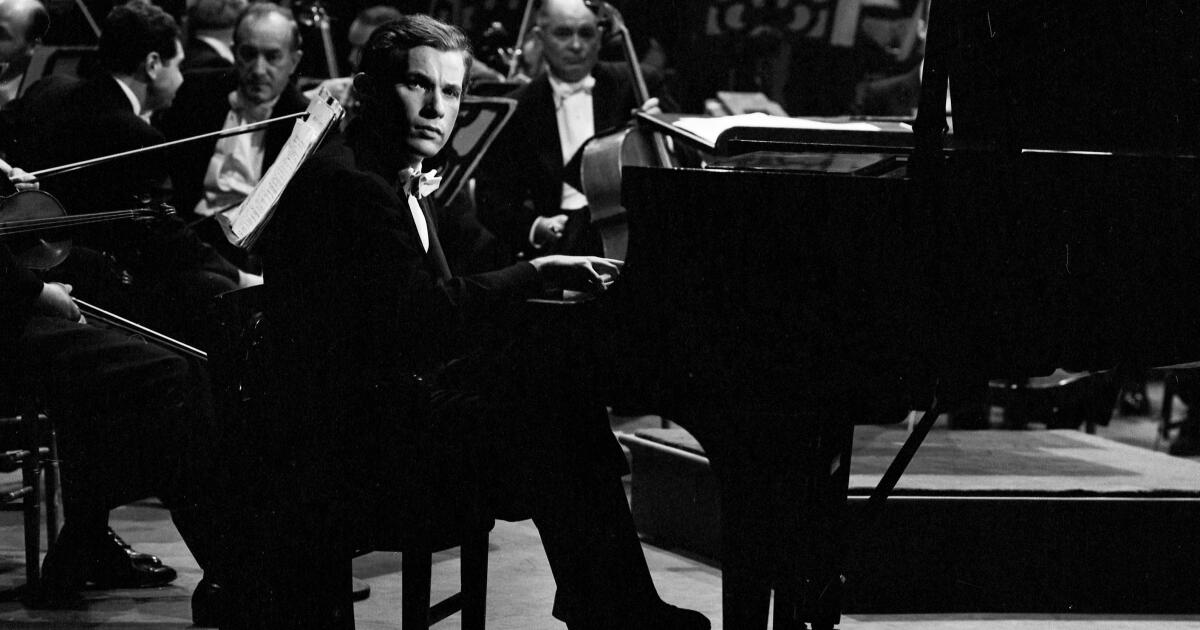
On the evening of April 10, 1964 — that is, 60 years ago Wednesday — the Canadian virtuoso Glenn Gould stepped away from the piano at the end of his concert at the Wilshire Ebell Theatre in Los Angeles and revolutionized the recording industry.
There was no announcement at that landmark moment in L.A.; only the ensuing circumstance would tell the story. For the Wilshire Ebell recital marked the end of the 31-year-old star’s performing career. He would never play another note in public.
He was the first — and possibly the only — classical musician to shun public performances entirely. Henceforth, his entire output would be heard only via records and videos.
Dial twiddling … is an interpretive act.
— Glenn Gould grants listeners the right to manipulate recorded sound
Gould was then a world-famous exponent of the music of J.S. Bach. His debut recording on Columbia, released in 1956, was an electrifying performance of Bach’s Goldberg Variations, which had been consigned to academic obscurity.
The album was a monster hit and established Gould’s worldwide reputation. In a doleful irony, his digital rerecording of the piece, taken at a more stately tempo and with other changes, would be the last Gould album released by Columbia before his untimely death at age 50 in 1982.
At the time Gould shifted to a recording-only career, his fellow artists doubted that he would stand by his decision. As late as 1971, Arthur Rubinstein told him, “You will come back to it, you know.” Gould replied, “If this is a bet, maestro, you will lose it.”
Gould demonstrated that recording technology need not come between artists and their listeners; in fact, it could enhance their relationship. His fans, of which I am one, find themselves in a uniquely intimate connection with the artist, in part because his astonishing technique and superb musical intelligence comes through so vividly in his recordings.
Gould in effect turned the economics of the music industry upside-down. Rather than seeing records as marketing adjuncts to concert tours, he showed that recordings could be the principal point of contact — in his case, the only point — between musicians and their fans.
Gould became the chief herald of the new era of digital recording, and of the power it gave artists — and audiences — to reconfigure even the most familiar classical warhorses to their individual tastes.
He foresaw that new technologies — including those not yet invented — could put creative decisions in listeners’ hands, allowing them to adjust the tempi and mixes of recorded pieces in the home, adjust the sound mix to individual preference and even splice a section from one conductor’s performance of a familiar piece into another’s. “Dial twiddling,” he wrote, “is an interpretive act.”
Recording could rescue whole musical genres from oblivion; Gould pointed out that recordings were a major factor in the postwar restoration of baroque music, especially on original instruments, to the marketplace.
“This repertoire — with its contrapuntal extravaganzas, its antiphonal balances, its espousal of instruments that chuff and wheeze and speak directly to a microphone — was made for stereo,” he wrote. Only after that pre-classical repertoire established its popularity in records did it find its way to the concert stage.
Gould was not exactly a pioneer in what his longtime producer, Andrew Kazdin, termed “creative lying.” The most famous early case involved a 1952 recording of Wagner’s “Tristan und Isolde” in which the aging soprano Kirsten Flagstad was unable to hit a high C.
The producer, Walter Legge, called on his wife, soprano Elisabeth Schwarzkopf, to record the note, which was dubbed in. The subterfuge was made public only years later.
Before Gould, such splices, inserts, dubbings and other tools of the recording engineers were generally seen as remedies for brief mistakes, sometimes of a single note. But he used them to fashion something new.
In 1966 he wrote of overcoming his dissatisfaction with two takes of a fugue from Book 1 of Bach’s Well-Tempered Clavier, one take he considered “rather pompous” and the other overly jubilant — and both “monotonous.”
He solved the problem by using the first for the fugue’s opening and conclusion, and splicing in the second for the midsection, producing a version “far superior to anything we could at the time have done in the studio.”
Gould’s decision to abandon public recitals was brewing for years, possibly since the launch of his international performing career, which began in January 1955 with concerts in Washington and New York and would carry him across the U.S. and to Europe.
He had always detested traveling except by train, but hated even more what he saw as a “blood sport” pitting performer against audience. He saw concerts as “the frantic pursuit of a succession of daily events, momentary, ephemeral,” forcing performers to “calcify” their interpretations so they could be repeated over and over.
The recording studio, he felt, afforded artists the opportunity to perfect their vision of a piece in splendid isolation, and to rectify any flaws — and not only technical mistakes — in post-production.
Even while he was still giving concerts, Gould was known as an unreliable booking, prone to last-minute cancellations — he skipped a 1964 concert in Chicago three times before finally showing up. (It was his final public performance other than the Los Angeles recital.)
Indeed, when Leonard Bernstein came out on stage alone at the start of a performance with the New York Philharmonic on April 8, 1962, he felt constrained to notify the audience, “Don’t be frightened — Mr. Gould is here.”
The event became the most famous of Gould’s performing career. Bernstein’s purpose was to disavow Gould’s “unorthodox” interpretation of their program piece, Brahms’ Piano Concerto No. 1, though he said Gould was so important a musical thinker that he would perform it to Gould’s specified tempi anyway.
(Bernstein later revealed that when Gould visited him at his New York apartment before the performance, his appearance was so slovenly — another personal quirk — that his then-wife, Felicia Montealegre, pulled him into the bathroom to shampoo his matted hair and give it a trim. Moviegoers might recognize Montealegre as the character portrayed by Carey Mulligan in the 2023 Bernstein biopic “Maestro.”)
Gould’s onstage behavior tended to provoke controversy. He slouched at the piano, left leg crossed over the right, seated on an ancient piano chair that his father had built, which placed him so low that he almost had to stretch his hands higher to reach the keyboard.
During a concerto performance, when not actually playing he waved his hands about as though conducting the piece, enraging music critics accustomed to a more solemn bearing from tuxedo-clad soloists. Ever willing in his earlier years to critique himself with a self-effacing grin, he referred in a 1959 documentary by the Canadian Broadcasting Corp. to “the justifiable complaints that I sometimes hear about my platform manner.”
As it happens, some of those tics transferred themselves to his recordings. On many albums one can hear the creaking of his chair, or a “hiccup” in some notes produced by the tight keyboard action he demanded from his pianos to produce the percussive, almost harpsichord-like sound that was his hallmark. Above all, there is his humming and singing audible in the background.
Columbia technicians spent years trying to suppress these artifacts in post-production, without notable success. In another 1959 CBC documentary, Columbia recording director Howard Scott is seen pleading with Gould before a take of Bach’s Italian Concerto for “a straight piano solo, without vocal obbligato.” A hearing of the recording proves that he didn’t get it.
But those were all part of the Gould mystique, accepted and appreciated by his listeners as though they brought them face-to-face with the artist himself. When they were heard on a Gould take, Kazdin reported, “Glenn always greeted them as one would long-lost friends.”
The influence Gould exerted on his fellow artists and the recording industry generally is incalculable. Columbia and its successors have never let the Gould library go out of print; with every advance in technology, the company remasters the recordings (most recently in 2015) and they always sell.
It’s as if by forswearing the evanescent experience of real-life performing, Glenn Gould gave himself eternal fame. And it happened in Los Angeles, where he ended one chapter of his career so he could embark on the next.
shared


SpaceX stock dropped below its initial public offering price for the first time on Wednesday, signaling dwindling hype around the Elon Musk company.
Shares dipped below their IPO price of $135 on Wednesday morning for the first time since listing, a humbling loss for the stock, which had skyrocketed more than 50% in its first days of trading last month.
The shares regained some ground later in the day, closing at $135.27.
The initial offering gave the company a market cap of $2.2 trillion, making it one of the world’s most valuable public companies. For a short period, the IPO also made owner Elon Musk the world’s first trillionaire, though his net worth now is about $800 billion.
On July 7, the company was added to the Nasdaq-100 after a rule change allowed companies to join 15 days after their IPOs.
SpaceX raised a total of $86 billion after underwriters exercised their right to sell additional shares, on top of the $75 billion initially raised. It was the largest IPO in history.
SpaceX, based near Austin, Texas, is the leading launch services company in the world, with its Falcon 9 rocket accounting for the vast majority of satellites launched last year.
It is also the leading satellite-based broadband provider with its Starlink service. The extraordinary interest in the IPO was driven by Musk’s plans to make the company an AI leader — including plans to launch orbiting satellite data centers powered by the sun that crunch AI data.
The company’s headquarters moved from Hawthorne to Texas in 2024, but it retains large operations in the South Bay city and blasts off regularly from Vandenberg Space Force Base in Santa Barbara County.
Since the IPO, SpaceX has used its newfound wealth to expand in the AI space.
It announced last month that it was acquiring the AI coding startup Cursor for $60 billion, with the deal expected to close in the third quarter. The San Francisco company, founded in 2022, enables engineers to instruct software in English to run coding tasks autonomously.
Musk also merged his xAI artificial intelligence company into SpaceX earlier this year. The combined entity recently announced it was leasing computing power to rivals Anthropic and Google at two terrestrial data centers it has constructed.
Since the IPO, investors have expressed concerns about the company’s spending plans and debt load.
Even with the volatility of the last month, there’s still more uncertainty to come.
The stock could fall further as locked-up shares held by current and former employees are released.
At least 20% of the shares will be released after second-quarter results are disclosed sometime in the coming months, with all the lockups expiring in December.
But Space X isn’t the only megacap stock to experience ups and downs early on.
Shares of Meta, then named Facebook, fell significantly below the IPO price of $38 before recovering. After its May 2012 launch, shares plummeted by nearly 50% and hit a record low of $19.69 in August 2012.
The company took more than 14 months to rebound, finally surpassing its $38 IPO price in July 2013.

In the latest lawsuit against Paramount Skydance, a corporate shareholder has alleged corruption at the highest levels of the company, which is battling to complete its $111-billion takeover of rival Warner Bros. Discovery to create a new media behemoth.
Controlling shareholders Larry Ellison and his son David have presided over a firm that allegedly made “illegal promises and payments to secure regulatory approval,” for the Ellison family’s Paramount purchase last summer, according to the shareholder lawsuit filed this week in Delaware court.
Larry Ellison allegedly discussed with President Trump how Paramount’s pending Warner Bros. acquisition would result in a shake-up at CNN, states the lawsuit filed by Paramount shareholder Paul Robbins.
“The Ellisons [won] the bidding war for Warner Bros. by promising sweeping changes at CNN and other personal benefits to President Trump,” according to the 59-page complaint.
The case was brought on Robbins’ behalf by the nonprofit Public Integrity Project and the advocacy group Freedom of the Press Foundation, which has been critical of the Trump administration‘s policies toward the media.
The complaint noted that Netflix withdrew from the bidding in February — the same day Co-Chief Executive Ted Sarandos met at the White House with then-Atty. Gen. Pam Bondi and another top official.
The lawsuit suggests Netflix dropped out after recognizing the challenges of dealing with the Trump administration and that Trump always wanted to see the prize go to Paramount because of his close ties to the Ellison family, who have ushered in more favorable news coverage of Trump and the departure of late-night comedian Stephen Colbert.
Robbins does not appear to have firsthand accounts supporting his claims, which are based on public documents and media reports about dealings between the Ellisons and Trump. He has owned Paramount stock since 2021, but the lawsuit does not say how many shares he owns.
He could not be reached for comment.
Paramount, in a statement, pushed back against his claims, saying the “lawsuit recycles allegations that have already been reported and already addressed.”
“As we’ve said consistently: No commitments from either David or Larry Ellison have been made to any government body, state AG or federal agency regarding the future of CNN or any other news property, other than the goal to deliver truth-based journalism,” Paramount said.
It’s the third lawsuit lobbed at Paramount this week. On Monday, California Atty. Gen. Rob Bonta led a coalition of 12 Democratic state attorneys general that filed a federal antitrust lawsuit seeking to block the Paramount-Warner merger due to concerns about consolidation in movie distribution and cable channels.
The Writers Guild of America added another antitrust lawsuit against Paramount on Tuesday, alleging the massive merger would result in fewer jobs and lower pay for writers.
Many in Hollywood are opposed to the deal due to fears that another studio consolidation would bring more layoffs, programming cutbacks and a fragile business environment due to the heavy debt burden — nearly $80 billion — that Paramount would have to take on to buy Warner Bros.
The shareholder lawsuit noted that Paramount participated in a raucous event with UFC fighters on the White House lawn in June to celebrate Trump’s 80th birthday and the nation’s 250th anniversary. Paramount has UFC broadcast rights.
The event came two days after Trump’s Justice Department wrapped its regulatory review of Paramount’s Warner Bros. proposal, giving the merger a key green light.
Justice Department investigators reportedly did not have a chance to express potential antitrust concerns when high-level Justice Department officials closed the inquiry — a major win for Paramount and the Ellisons, the lawsuit states.
“There have been some line attorneys in the DOJ that have reviewed this [merger] and have some concerns,” New York Atty. Gen. Letitia James said Tuesday during a virtual town hall with opponents of the merger. “Their analysis of this particular case was ignored by the front office, if you will, at 1600 Pennsylvania Ave. [the White House] That’s the front office.”
Ellison’s Skydance Media emerged with its deal to buy Paramount two years ago. Previous controlling shareholder Shari Redstone was desperate for an exit and Trump was mounting his White House comeback by battling then-President Biden, then Vice President Kamala Harris.
Trump declined an invitation to appear on CBS’ “60 Minutes,” then under Redstone control. He became infuriated by an October 2024 interview with Harris on “60 Minutes.”
Trump filed a $10-billion lawsuit against CBS (he later upped it to $20 billion). After Trump won the election, he had considerable sway over Paramount because it needed his administration’s approval for the sale to the Ellisons.
Paramount agreed to pay Trump $16 million to end his “60 Minutes” lawsuit, allowing the sale to go forward. The Ellisons acquired Paramount in August, then set their sights on Warner Bros. Discovery, which owns CNN.
“The Ellisons proceeded to remake CBS in the President’s image, bought properties he enjoyed, and even hosted events to honor him,” the lawsuit said. “This helped the Ellisons, but it appears to have hurt Paramount and its media outlets.”
On Wednesday, Paramount said Ellison and other high-level executives had dealings with administration officials but “throughout … the review of the proposed acquisition of Paramount, Skydance has fully complied with all applicable laws, including our nation’s anti-bribery laws.”
In late April, David Ellison hosted an elaborate dinner in Washington to honor the “Trump White House,” according to invitations to the event, “even though President Trump continually insulted journalists at CBS and elsewhere,” the lawsuit said.
On Wednesday, during a confirmation hearing on Capitol Hill, Sen. Cory Booker (D-N.J.) blasted acting Atty. Gen. Todd Blanche for his attendance at the dinner while his agency was reviewing the Paramount deal.
Also on Wednesday, the nonprofit news site ProPublica reported Federal Communications Commission Chairman Brendan Carr has accepted $63,000 in free tickets from CBS in recent years — while Paramount mergers were pending.
Times staff writer Ben Wieder contributed to this report.

Grocery Outlet is opening new locations across California, rebuilding its network in the Golden State after closing stores early this year.
A new branch in Ontario Ranch is scheduled to open July 23, and more openings are planned for later this summer.
The location will be operated by independent owners Gloria and Jason Pineda. By the end of August, the discount grocery retailer plans to open stores in Ramona, San Francisco, Clovis and Petaluma as well.
The Emeryville, Calif.-based chain announced the closure of 36 stores in March, including nine California locations. The closures were an attempt to roll back an overexpansion in the wrong markets, resulting in a loss in 2025. Grocery Outlet did not announce which locations would be closed at the time, but they were listed for sublease by advisory firm Gordon Bros.
Among those listed was an Ontario location closer than seven miles from the soon-to-open site.
Five other Southern California locations were marked for closing in Azusa, Brawley, El Cajon, La Habra, Ontario and Poway. In Central California, the Kerman, Patterson and Ridgecrest stores were also listed for sublease. Outside of California, stores in Idaho, New Jersey, Maryland, Ohio and Pennsylvania also were listed.
In an earnings call in May, Grocery Outlet Chief Executive Jason Potter said the restructuring was helping boost the company’s profit.
“These closures are now complete and have improved fleet quality and will strengthen the earnings profile of the business over time,” he said.
Grocery Outlet was founded in San Francisco in 1946 as a discount grocery store chain selling overstock of limited-time or holiday food items. There are about 280 Grocery Outlet locations in California, accounting for more than half of its total store count.
Though Grocery Outlet has cultivated a dedicated consumer base on TikTok and other social media posts from grocery bargain hunters, it faces fierce competition from other budget grocery chains, including Aldi, which is set to open 180 stores in 2026. It also competes with Trader Joe’s, Walmart and Amazon, which have steadily gained customers.
Last year it was also hurt by the lapse in federal food assistance during the 43-day government shutdown.
In the wake of rising grocery prices and economic anxiety, some low-income customers who would once have shopped at budget grocery chains such as Grocery Outlet are turning to food banks instead. According to Los Angeles Regional Food Bank, 1.2 million people visit its food banks per month.
Grocery Outlet’s net sales rose 4% in the first quarter from a year earlier to $1.17 billion. It recorded a net loss of $180 million for the period.
It said it had closed locations as part of its optimization plan. It also underwent a store refresh program, changing products and is clustering locations to boost profit and customer traffic.
“Our value-oriented product offering continues to resonate with consumers. While we’re encouraged by the progress we’re beginning to see, we’re not satisfied with our current level of performance and are focused on the work we have in front of us,” Potter said on the earnings call.
Grocery Outlet shares have fallen more than 25% over the last 12 months. The Dow Jones industrial average has climbed more than 15% during the same period.
-
 News11 minutes ago
Flood sirens blare in South Central Texas as rivers reach perilous heights
-

 Los Angeles, Ca2 hours ago
Arrest made in deadly shooting at 4th of July gathering in Compton; search for 2nd suspect continues
-

 Detroit, MI2 hours ago
Detroit crime hits decades-low as Michigan governor candidates debate how to keep progress going
-

 San Francisco, CA2 hours ago
Operator of boat that capsized near Alcatraz mourns brother as search continues
-

 Dallas, TX2 hours ago
Mavericks vs Thunder Game Preview and Injury Update
-

 Miami, FL3 hours ago
Miami Dolphins Fans Vs. The Media
-

 Boston, MA3 hours ago
Man who allegedly shot at Boston Police officers arrested after foot chase in Dorchester
-

 Denver, CO3 hours ago
Swan, dragon and duck boats are back pedaling around City Park

