Business
Café Tropical closed 8 weeks ago. Employees say they're still missing thousands in pay

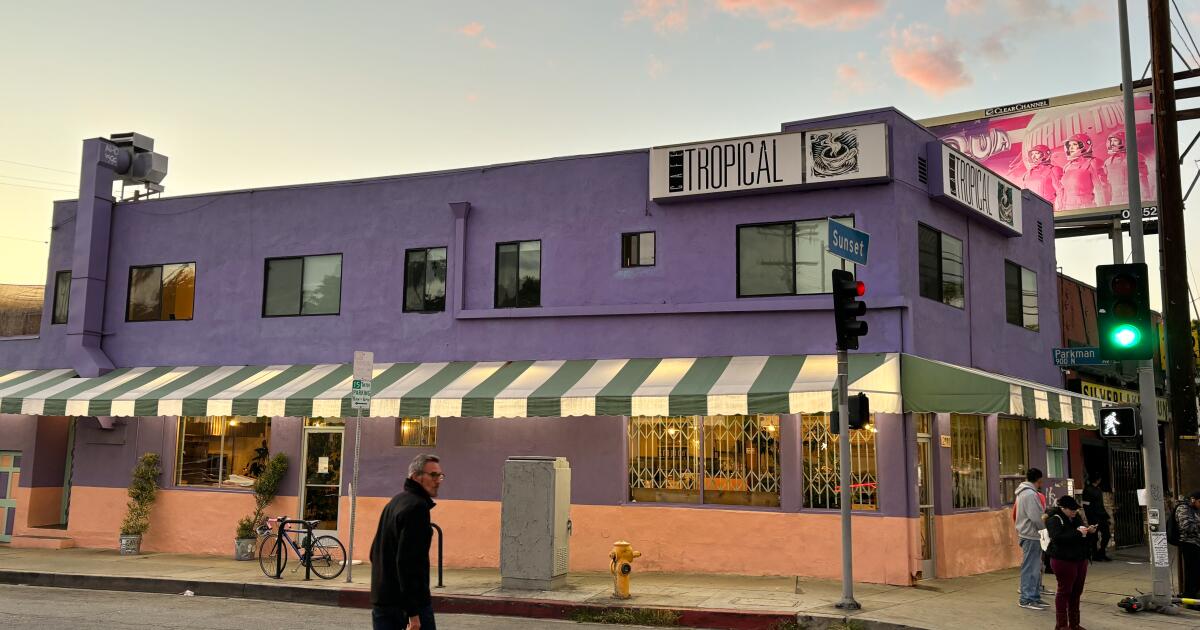
Almost two months after Silver Lake coffee shop Café Tropical shut its doors, former employees who worked there say they are still missing hundreds or thousands of dollars in final paychecks that never went through.
The nearly 50-year-old Sunset Boulevard restaurant closed suddenly in late November as debts and a bitter family dispute ravaged the company that owned the Cuban coffee shop. But the out-of-the-blue decision to close left baristas and cooks out of work and missing paychecks they were still owed.
“It’s sad the way they just threw us away,” said Miguel Alarcon, 44, a barista who worked at Café Tropical for a dozen years until it closed on Dec. 1. “I told them I have kids, I have a family. … You have to pay me.”
Alarcon and other employees said that problems began at Café Tropical months before the shuttering. Checks to employees were bouncing and vendors were complaining about not getting paid.
The issues came amid a lawsuit that owner Daniel Navarro’s mother filed against him in 2022. Gladys Navarro claimed in the suit that her son illicitly used money from the family business to fund Café Tropical. Daniel Navarro has failed to pay his mother and sister more than $350,000 he owes in connection with the suit, according to court documents.
The dispute left the workers in the lurch.
Alarcon is owed about a week of pay, amounting to around $900, he said. Other employees are owed even more. Another woman at the company was missing three paychecks, Alarcon said.
Jasmine Perez, who started at Café Tropical in September, said she was owed about $1,000. By the time she started at Café Tropical, issues already abounded.
“The first thing someone asked me was did your check go through?” she said. “It just became an absolute nightmare to ever get paid on time. There would be times where I’d be missing paychecks for two consecutive pay periods. It was very uncomfortable to try to ask for the money you already earned.”
A group is raising money on GoFundMe to try to pay employees who have struggled to get answers from the owner. Ciara Keane, a Silver Lake resident who organized the GoFundMe, said Navarro changed his number after the closure.
“Employees are still out of work and are having difficulty finding employment. They’re in need more now than ever,” Keane posted on GoFundMe.
The group has raised nearly $10,000, but says it still needs more than $50,000 in additional contributions to pay the 33 employees who lost their jobs and had their final paychecks bounce.
The goal is to pay the employees the $1,000 many are owed as well as another $1,000 for the time they were unemployed after the closure.
“I really wanted [the staff] to be able to feel how much the community loved and supported them, even though they didn’t get the same support from Daniel,” Keane said.
Keane moved to Los Angeles from Miami four years ago and although she is not Cuban, Café Tropical reminded her of the Cuban culture of the city she grew up in.
She also recognized the important role that Café Tropical played for the sober community as well as for older generations of Silver Lake residents who saw the restaurant as one of the last vestiges of the pre-gentrification days in the trendy neighborhood.
Keane and her friends printed out posters that link to the GoFundMe across Silver Lake, Los Feliz and Echo Park, but they still have not been able to raise enough money to make all the employees whole.



new video loaded: How the Iran War Is Affecting Inflation

By Ben Casselman, Nour Idriss, Stephanie Swart and Sutton Raphael
April 11, 2026

A man was arrested Friday morning after he set multiple fires inside stores at the Ontario Mills mall, officials said.
Ontario police said they responded to the mall at about 10:30 a.m. after callers reported that a man with a lighter and a backpack was intentionally setting fires.
Officers found the suspect, who they identified as 28-year-old Luis Javier Gallegos Jr. of Rancho Cucamonga.
The police said in a statement that Gallegos did not comply with their requests, and they used force to arrest him.
Both Gallegos and an officer suffered non-life-threatening injuries during the arrest, the police said.
After being treated at a hospital, Gallegos was booked into the West Valley Detention Center and charged with felony arson, the police said.
Police said they are working to identify a motive for the crime and whether there is any connection to the April 7 arson at the Kimberly-Clark warehouse in Ontario.
Prosecutors say the inferno destroyed the 1.2 million square-foot warehouse and the paper products inside, resulting in $500 million in damages.
Chamel Abdulkarim, a Highland resident who worked at the warehouse, is facing both state and federal arson charges for setting the fire.
Abdulkarim, 29, filmed himself setting fire to multiple pallets of paper goods, according to the U.S. attorney’s office for the Central District of California.
In the video, he says, “If you’re not going to pay us enough to [expletive] live or afford to live, at least pay us enough not to do this [expletive].”
Anyone with information about the fires Friday at Ontario Mills Mall is asked to contact the city’s police department at (909) 986-6711.
Business
‘It’s killing everything.’ California’s truckers are buckling under country’s priciest diesel
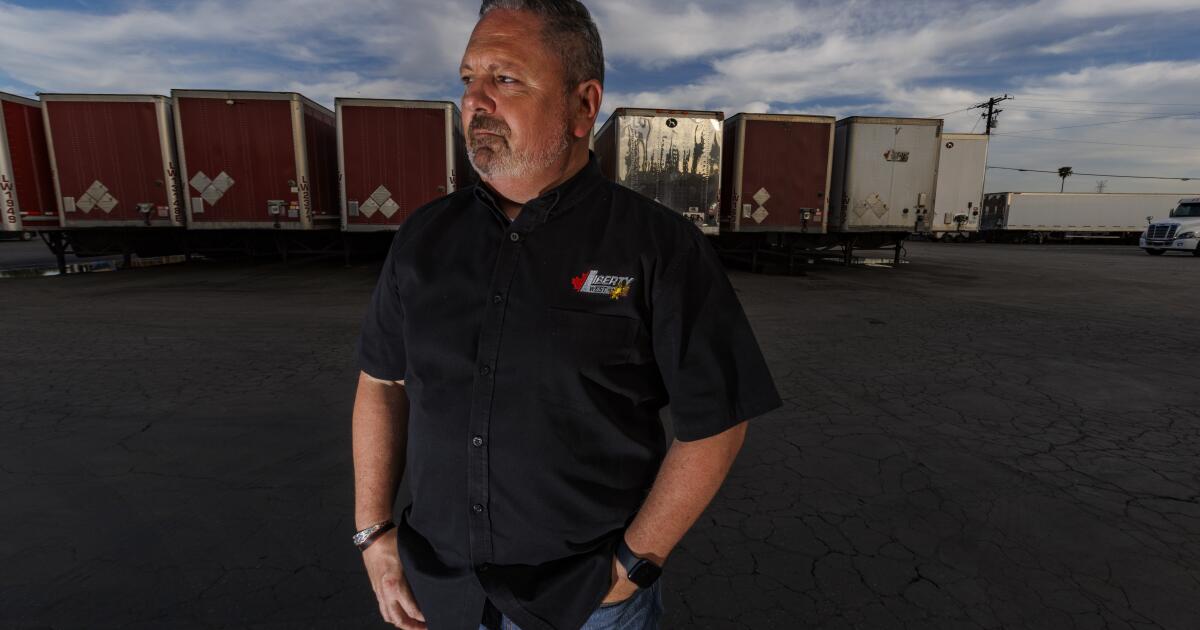
Record diesel prices are crushing California’s truckers, forcing them to adjust to avoid losses as they grapple with the most expensive pump prices in the country.
Greg Dubuque’s 40 drivers are in a constant diesel-devouring loop. Their big rigs pick up loads of electronics, office furniture and other goods around Los Angeles. They drive close to 1,000 miles through the Mojave Desert and over the Rocky Mountains to Denver. They bring back containers full of everything from pinto beans to home remodeling products.
One tank of gas for his vehicles cost $600 a couple of months ago. Today it costs $1,000. That’s a record high and more than 35% above the country’s average.
“California sets itself apart from the rest of the country when it comes to pricing,” said Dubuque, a third-generation trucker and general manager of Liberty Linehaul West. “Now it’s really out of control.”
The average price of a gallon of diesel in California got close to $7.75 this week, up 50% from a month ago, according to the American Automobile Assn. The national average of diesel is closer to $5.65 at recent peaks.
Dubuque, general manager of Liberty Linehaul West, says small truckers are hurting with out-of-control gas prices.
(Gina Ferazzi / Los Angeles Times)
The trucking industry was already reeling from a prolonged freight recession, a crackdown on immigrant drivers, and the adverse impacts of tariffs, all of which contributed to a significant increase in bankruptcy filings in the industry.
Now, the price shock from the war with Iran has become yet another headache for the beleaguered industry that hauls 70% of all freight in America.
“It’s got a tremendous impact on the industry,” said Eric Sauer, the chief executive of California Trucking Assn.
And it is not just truckers being affected. The rising prices of ground and air transportation will eventually be paid for by consumers.
The biggest companies are already passing the extra transportation costs on to consumers. FedEx, United Parcel Service, the U.S. Postal Service and Amazon said they will all start charging an extra fee. Amazon said it would apply a 3.5% charge to merchants for its fulfillment service. USPS will charge an 8% delivery fee for certain packages.
“The longer energy prices remain elevated, the more households will need to confront tradeoffs,” said Philip N. Jefferson, vice chairman of the Federal Reserve, at a recent lecture.

Liberty Linehaul West trucking company keeps a daily list of fuel prices to help its truckers on April 3 in Montebello, Calif.
(Gina Ferazzi / Los Angeles Times)
This could eventually dampen demand for other products and further hurt the economy, Jefferson noted.
“Families who depend on petroleum products to commute to jobs and school and to heat their homes may need to pull back on more discretionary forms of spending,” he said. “That could potentially result in lower spending at restaurants or retailers. It could also result in households carrying elevated levels of debt.”
Truckers often rely on fuel surcharges to cover rising fuel costs. It’s an industry practice for customers to pay a fuel surcharge, on top of the base freight rate, to offset unexpected fuel price increases. The fee is calculated based on a weekly diesel price index.
Sukhdeep Singh, who owns Merced County-based Cali Brothers Truck Lines, said standard surcharge policies are insufficient when there are wild swings in fuel prices.
“It’s killing everything,” he said.
Singh’s business faced challenges earlier this year when a crackdown on immigrant drivers led to sudden departures, shrinking the available labor pool and leaving 15 of his trucks unused. Despite the diminished fleet, his weekly fuel expenses have surged from $80,000 to $130,000.
Smaller trucking companies are getting hit first.
Major carriers with thousands of trucks have different ways to hedge against price fluctuations that insulate them from temporary volatility. They have long-term shipping contracts and have greater flexibility in surcharges.
Smaller carriers are often paid at a flat rate and have no certainty about whether they will recover the higher fuel costs.
On a recent trip to Denver, one of Dubuque’s trucks had to consider returning empty, as the going rate barely covered gas to get back to Los Angeles.
“I wouldn’t be able to cover my cost,” he said.
He has been instructing drivers to save on fuel by planning their routes, finding truck stops with the best rates, and avoiding California when possible.
“Where we’re trying to avoid buying fuel is here in the state of California,” he said.
He is also asking his regular customers to pitch in.

A Roadies Inc. truck, right, leaves for a delivery in Bakersfield on Nov. 29.
(Myung J. Chun / Los Angeles Times)
Liberty Linhaul West’s fleet also works with L.A.’s entertainment and event industries, transporting staging, lighting and other equipment for events such as the Oscars, Grammys and Country Music Awards. He’s started calling customers with whom he had flat rates to renegotiate prices.
“We started calling customers, saying, ‘Okay, we need some emergency help here,’” Dubuque said.
While he appreciates that the extra fees and restrictions on fuel help build roads and protect the environment in California, he would love to see more support from the state.
“I think the government needs to interact with the oil and fuel world and talk about how they can take this pain away from us, or at least try to lessen this blow,” he said.
Without an end to high oil prices or some help from the government, customers can expect the same sticker shock the trucking industry is struggling with.
“Whether you’re a grocer, a meatpacking plant, a vegetable grower, that cost has to be factored in, because it doesn’t matter who you are, you’re faced with it,” Dubuque said. “The impact was so hard and so fast, I would think we’re going to start seeing just another increase to the cost of goods for people.”

Benin finance minister expected to coast to presidential election win

Recovery Tools are a Wellness Non-Negotiable—8 Expert-Approved Essentials

Michael Movie Review: Did Jaafar Jackson Stuns as MJ?

Artemis II’s moon-traveling astronauts return home to cheers after a record-breaking trip

Video: Police Fatally Shoot Man After Stabbings at Grand Central Subway Station

Florida High School Football Rankings: Top 25 teams – Oct. 21

How old is Bo Nix? What to know about Oregon quarterback ahead of 2024 NFL Draft

Cleary's 21 help Le Moyne down Central Connecticut State 69-64 in OT

99th annual Pony Swim held in Virginia

Indiana Members Credit Union announced as new anchor tenant at Bottleworks District
Video: Police Fatally Shoot Man After Stabbings at Grand Central Subway Station

Trump blasts Spanberger ahead of Virginia meetings, says state faces tax base exodus like New York, California

Pope Leo urges world leaders to reject war and negotiate peace

Manhattan DA’s office to investigate Swalwell sexual assault allegation

NASA’s Artemis II mission in 20 minutes
-

 Atlanta, GA7 days ago
1 teenage girl killed, another injured in shooting at Piedmont Park, police say
-

 Movie Reviews1 week ago
Vaazha 2 first half review: Hashir anchors a lively, chaos-filled teen tale
-

 Georgia4 days ago
Georgia House Special Runoff Election 2026 Live Results
-

 Pennsylvania5 days ago
Parents charged after toddler injured by wolf at Pennsylvania zoo
-

 Arkansas1 day ago
Arkansas TV meteorologist Melinda Mayo retires after nearly four decades on air
-
 Milwaukee, WI5 days ago
Potawatomi Casino Hotel evacuated after fire breaks out in rooftop HVAC system
-
 Entertainment1 week ago
Inside Ye’s first comeback show at SoFi Stadium
-

 Indianapolis, IN1 week ago
Fighting Illini begin Final Four preparations in Indianapolis