Business
Bitten by a billionaire's dog? Or a case of extortion? A legal saga from an L.A. dog park

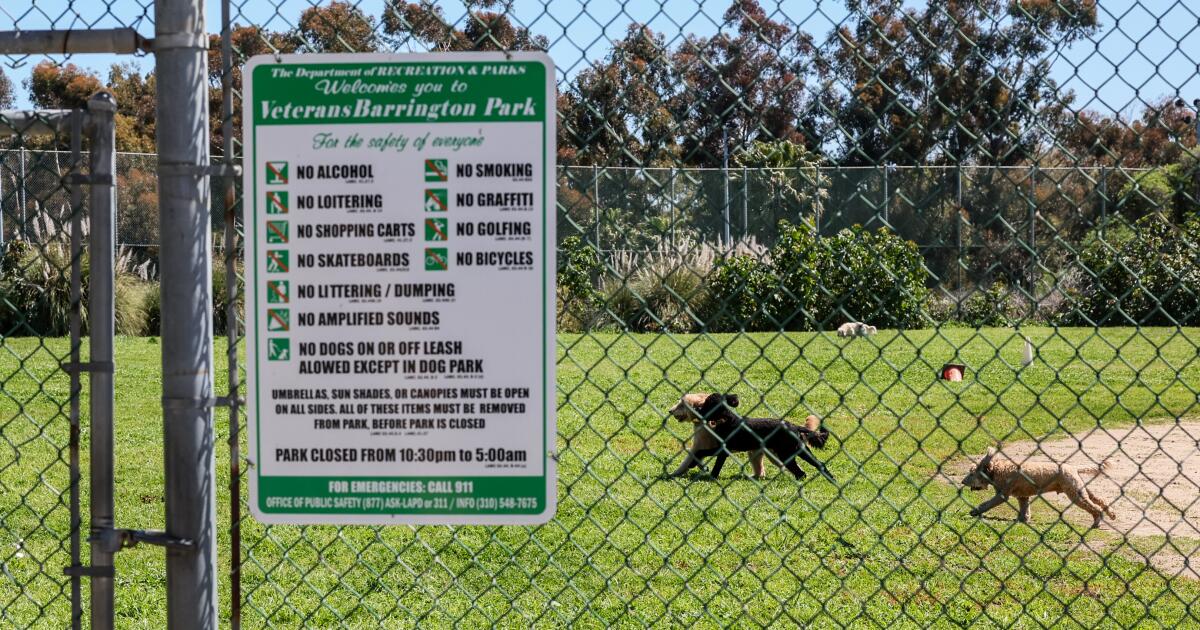
A dog-bites-woman story usually isn’t much of a story at all. But an incident in one of L.A.’s wealthiest enclaves has become something else entirely.
What began in a Brentwood park on a summer day in 2022, when a dog owned by billionaire surgical-device inventor Gary Michelson allegedly bit another pet owner, has turned into dueling lawsuits and an allegation of blackmail.
Michelson claims it’s a simple case of extortion. He says interior designer Sandra Evling tried to force him to pay her $85,000 by threatening to publicly humiliate him and report his dog to authorities, which she claimed would lead to the pet being put down. He filed suit first, seeking damages in excess of $250,000.
From Evling’s perspective, he should have known better. She alleged Michelson, a philanthropist prominent in animal welfare circles, let his dog run free despite knowing it had bitten other animals and one other person — traumatizing her and causing severe injuries, according to a personal injury lawsuit she filed in response seeking unspecified damages.
In a town where the rich have legitimate fears of extortion, is this a case of a person seeking a payday? Or a billionaire using his wealth and legal savvy to protect himself from responsibility for an aggressive animal?
Dr. Gary Michelson at a 2019 gala for his Michelson Found Animals Foundation in Beverly Hills.
(Albert L. Ortega/Getty Images)
Michelson, 75, seems an unlikely antagonist in a dog-bite case. After reaching a $1.35-billion patent dispute settlement with medical device maker Medtronic two decades ago, he has made a name for himself as a philanthropist in animal welfare and other fields.
After Hurricane Katrina in 2005 orphaned more than 100,000 pets, he established the nation’s first free microchip pet registry. He has a standing prize offer of $25 million for the development of a single-dose medication that can permanently and safely sterilize both cats and dogs.
Michelson’s devotion to animal welfare extended to his own pet Blue, a beige-and-white dog with droopy eyes he celebrated on Instagram with the tongue-in-cheek handle @scarypitbully. The page, since taken down, documented the maturation of the American bully XL, the largest of a muscular breed derived from the American pit bull terrier that the United Kennel Club describes as more gentle and playful, making it an excellent family dog.
Michelson and Evling, 37, an immigrant from Sweden, were regulars at Veterans’ Barrington Park. They lived nearby: Evling in an apartment and Michelson in a $24-million mansion.
The incident took place Aug. 9, 2022, just outside a fenced-in dog park on ball fields where owners let their dogs run free.
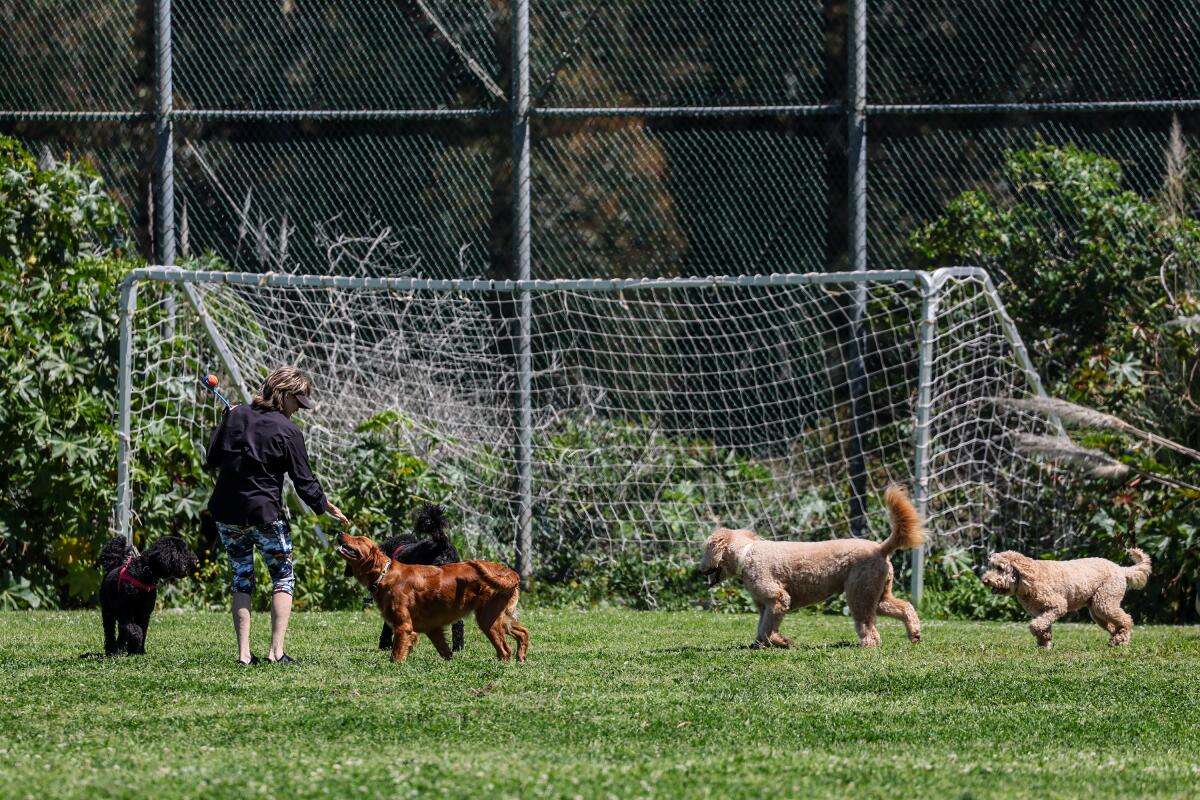
Dogs tend to play off-leash on a sports field adjacent to the dog park at Veterans’ Barrington Park.
(Robert Gauthier/Los Angeles Times)
Evling, in her lawsuit, said that she was walking with her dog Neo, a tamaskan, when Blue charged her pet, and that she was bitten trying to protect it. She sought treatment that evening at an urgent care clinic complaining of pain in her left hand from a crush injury and an abrasion to her right elbow, according to medical records reviewed by The Times.
An X-ray found no fractures or vascular injuries in her hand, which was put in a finger splint. She was given a tetanus shot and prescribed antibiotics, the records show.
In messages sent to The Times, Michelson said the records are not evidence of dog bites, claiming instead she might have twisted her finger on her dog’s collar and scraped her elbow while falling. He said that afterward he checked on Evling “for days” and offered to pay her medical bills. He said that the calls were cordial and that she “seemed ok.”
Michelson said he also set up a session at his house with celebrity dog trainer Cesar Millan, a longtime friend, to work with Neo and Blue together so that “Sandra could feel comfortable at the dog park with Blue around.”
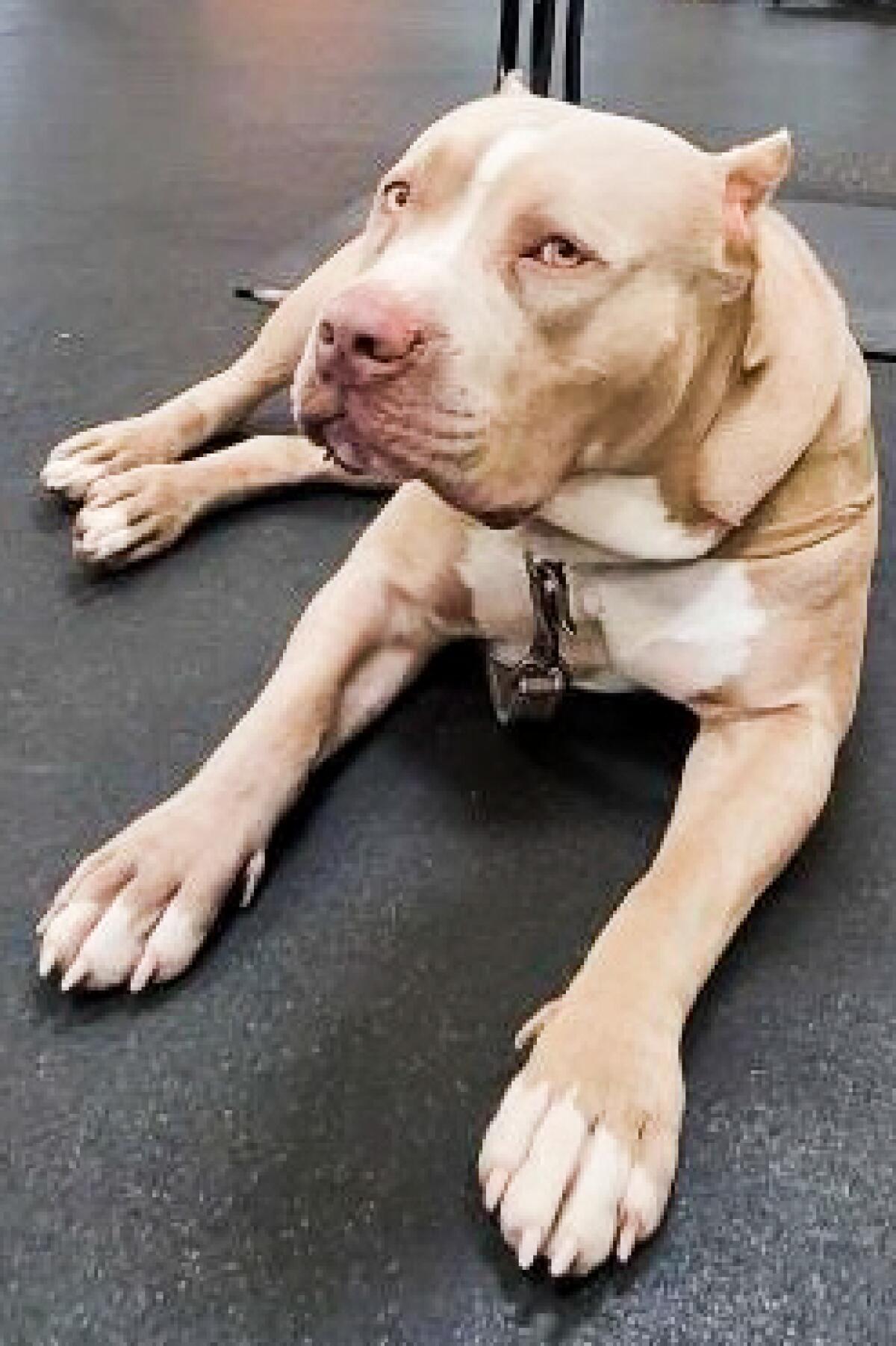
Gary Michelson’s dog Blue.
(Courtesy of Gary Michelson)
After the session, Michelson said, he and Evling would see each other at Gold’s Gym Venice, where they both brought their service-dog pets. He said that “things were always quite friendly” and that Evling never complained of being bitten until she learned of his wealth.
Attorney Benjamin Taylor, who represents Evling in the extortion lawsuit, said Evling knew Michelson’s background “well before this incident.”
On April 20, 2023, eight months after the alleged attack, Evling texted Michelson asking to meet the next day at the gym, according to a copy of the pair’s text string provided by former Los Angeles County Dist. Atty. Steve Cooley, a friend of Michelson’s who is listed as one of his attorneys in the extortion lawsuit.
Their conversation continued via texts. Evling complained she was suffering from “severe PTSD” and a lifelong scar from the attack, and chastised Michelson about another alleged incident at the park involving Blue.
“When I was told that you had taken Blue off leash at the park this week and that he had attacked another dog all my trauma came back (like it happened all over again) and a severe anger that you’re not taking this problem seriously. Is it going to take someone getting killed before you realize how serious this is?” she texted. (Michelson denied Blue ever attacked another dog or person in answers to a list of questions sent to Cooley in February.)
Evling, who had stated she didn’t want to involve attorneys, laid out two options.
If Michelson chose Option A, she would have him and his dog expelled from the gym, file a report with police and animal control that would result in the dog being put down, and file a class-action lawsuit with other parkgoers that “will cost you a loooot of money.”
If Michelson chose Option B, Evling texted, he could keep Blue as long as he paid her $85,000, kept his dog on a leash and didn’t bring it to the park. She promised not to file a complaint with the gym so long as Michelson kept Blue away from her while she was training. She added she would sign a nondisclosure agreement that would be voided only if Blue attacked her or her dog again, not if Blue was aggressive with others.
“It is time for you take responsibility and suffer the consequences of your actions,” she texted.
Several days later, Michelson asked Evling how she arrived at the compensation figure and how he and his wife, recording artist Alya Michelson, could trust that she wouldn’t carry out her threats anyway.
Evling said she had consulted with several law firms and claimed the $85,000 would be less than a court judgment. She assured him she wouldn’t talk to anyone or file legal action. “I AM a person of my word and just want to move on as much as you do and leave this in the past,” she texted on April 27.
The negotiations then turned sour. Michelson told Evling he had just learned from several dog park friends that she was recruiting plaintiffs for a lawsuit, accusing her of “already breaking your promise.” However, he said he was immediately sending a “good faith” payment of $10,000 if she would not take the steps she had outlined. “Hopefully, this small measure of restraint will be acceptable to you,” he texted.
Evling disputed that she was preparing a lawsuit, contending she had only learned of the new alleged attack through a dog park chat group.
After being assured the $10,000 was a partial payment, Evling said she would not take further action as long as she received a contract by May 15 for the remainder of the $85,000. Michelson filed his extortion lawsuit days later on May 3.
Taylor said Evling had sought payment to resolve the matter informally without attorneys in the hopes of avoiding a “spectacle.” “Now that Dr. Michelson decided to sue her first, she looks forward to her day in court,” he said.
Attorney Ryan Baker, a founding partner of L.A. law firm Waymaker, reviewed the exchange to offer an opinion on whether it amounted to civil extortion, which under California law includes receiving a benefit such as money through the threatened exposure of any “disgrace or crime” even if falsely alleged.
Baker said that Evling had the right to pursue a private settlement under the threat of her own lawsuit, but if she threatened to report Michelson unless he met her demands she crossed a “bright line.” “She can’t become her own private judge, jury and executioner,” he said.
Michelson was “extremely shrewd,” he said, to seek the demands in writing and send the $10,000, since receiving it would be a key element of civil extortion.
Baker said a “critical question” a jury would have to decide was whether Evling had extorted the money or had simply received and kept it.
After Evling was sued, she filed a personal injury lawsuit that claimed Blue had bitten four dogs and one person in 2022 before the attack on her, and one poodle afterward.
Her lawsuit provided few details about the other alleged attacks. Blue, though, was a topic of a dog park group chat on April 17, 2023 — the day of the alleged poodle attack. Multiple members of the chat alleged that Michelson brought his dog to the park and that his dog had repeated altercations with other animals.
Michelson denied Blue has a history of aggression, contending “chat rooms are not acceptable or reliable sources of factual information,” in response to the questions sent Cooley. He said that Evling’s characterization of his pet, which is referred to as a “vicious animal” in her lawsuit, “reeks of outdated stereotypes.”
Michelson pointed to a lack of complaints with Los Angeles Animal Services as evidence, which the department confirmed in February in response to a California Public Records Act request.
Judie Mancuso, the founder of Social Compassion in Legislation, a public policy group that advocates for animals in Sacramento, said Blue was “super well behaved” at a fundraiser Michelson and his wife hosted for the nonprofit in July at the couple’s Brentwood home.
“The dog didn’t even bark at anyone,” Mancuso said.
At the time of the dog park incident, neither of their dogs were neutered. Michelson said in a text this was to allow Blue to compete as a purebred show dog. He said he opted to have Blue neutered last month because of the difficulty of participating in competition with a dog whose breed is not recognized by the American Kennel Club. “As I am a champion for S&N [spay and neuter], I gave up and had him neutered,” he texted.
Evling’s dog was 8 months old at the time. He has since been neutered, according to Taylor.
In support of her allegations that Blue was aggressive, Evling collected the names and numbers of some two dozen people she alleged had witnessed attacks, including 12 chat group members, whose identities were disclosed in court filings. The Times attempted to contact all of them; most did not respond or would not comment publicly.
Syed Ahmed, a Brentwood data analyst, was an exception. He said that his dog Turbo, a male 70-pound Doberman pinscher, and Blue got into a fight in March 2022 and that Michelson’s dog “ended up grabbing my dog by the throat.” Evling’s lawsuit alleged a dog of that name was bitten that month.
Turbo was treated for puncture wounds, according to a veterinary bill provided to The Times, along with photos of the bite wound.
Ahmed said he didn’t ask Michelson to reimburse him for his $908.10 bill. Michelson “was very apologetic, and that’s why I didn’t pursue anything. I was like, OK, you know, s— happens,” he said.
After Michelson learned from The Times last month that the dog had been injured, he reimbursed Ahmed for his veterinary bill.
Michelson said that he believed Turbo just wanted to play, but that Blue bit the dog because he had been attacked several times by other male dogs. “Blue misread the dog’s intent and reacted to protect himself. I was very upset that it happened,” he emailed. “I will testify under oath that I have never seen Blue attack anyone, ever.”
Michelson’s and Evling’s lawsuits are wending their way through Superior Court. Trial dates for each have been set for next year.
In early December, Evling saw Westside plastic and reconstructive surgeon Michael Zarrabi to examine the scar allegedly left by the dog bite on her right elbow. Zarrabi called the injury “disfiguring” and recommended surgery, multiple laser treatments and topical ointments that he anticipated would improve the appearance 80%, according to medical records reviewed by The Times. The estimated cost: $41,900.
Michelson, in a text, called the estimate “beyond absurd.” He said in an email that he consulted a “well-regarded” Beverly Hills plastic surgeon who, after seeing pictures of the abrasion, said the scar tissue could be removed for $5,000 — half the $10,000 he had already sent her.
As the two parties await trial, Evling has started a business selling Swedish cookies, while Michelson has remained active in civic and philanthropic circles. He rubbed elbows with Gov. Gavin Newsom at an event announcing UCLA’s acquisition of the former Westside Pavilion mall, which the university is converting into a research park. It will house the California Institute for Immunology and Immunotherapy, which Michelson chairs and has pledged $120 million toward.
One place he apparently has not been in a long while is the Barrington dog park.
After the alleged poodle attack, Michelson texted Evling that he was never going to the dog park again and “it is my intention to stay as far away from you as possible.”
Taylor said she had stopped going there too.



Disneyland Resort President Thomas Mazloum has been named chairman of Walt Disney Co.’s experiences division, the company said Tuesday.
Mazloum succeeds soon-to-be Disney Chief Executive Josh D’Amaro as the head of the Mouse House’s vital parks portfolio, which has become the economic engine for the Burbank media and entertainment giant. His purview includes Disney’s theme parks, famed Imagineering division, merchandise, cruise line, as well as the Aulani resort and spa in Hawaii.
Jill Estorino will become the head of Disneyland Resort in Anaheim. She previously served as president and managing director of Disney Parks International and oversaw the company’s theme parks and resorts in Europe and Asia.
Estorino and Mazloum will assume their new roles on March 18, the same day as D’Amaro and incoming Disney President and Chief Creative Officer Dana Walden.
“Thomas Mazloum is an exceptional leader with a genuine appreciation for our cast members and a proven track record of delivering growth,” D’Amaro said in a statement. “His focus on service excellence, broad international leadership and strong connection to the creativity that brings our stories to life make him the right leader to guide Disney Experiences into its next chapter.”
Mazloum had been about a year into his tenure at Disneyland. Before that, he was head of Disney Signature Experiences, which includes the cruise line. He was trained in hospitality in Europe.
In his time at Disneyland, Mazloum oversaw the park’s 70th anniversary celebration and recently pledged to eliminate time limitations for park-hopping, which are designed to manage foot traffic at Disneyland and California Adventure.
Mazloum will now oversee a 10-year, $60-billion investment plan for Disney’s overall experiences business, which includes new themed lands in Disneyland Resort and Walt Disney World. At Disneyland, that expansion could result in at least $1.9 billion of development.
The size of that investment indicates how important the parks are to Disney’s bottom line. Last year, the experiences business brought in nearly 57% of the company’s operating income. Maintaining that momentum, as well as fending off competitors such as Universal Studios, is key to Disney’s continued growth.
In his new role, Mazloum will have to keep an eye on “international visitation headwinds” at its U.S.-based parks, which the company has said probably will factor into its earnings for its fiscal second quarter. At Disneyland Resort, that dip was mitigated by the park’s high percentage of California-based visitors.
Times staff writer Todd Martens contributed to this report.

It has been a bumpy road for the electric vehicle market as declining federal support and plateauing public interest have eaten away at sales.
But EV sellers could soon receive a boost from an unexpected source: The war in Iran is pushing up gas prices.
As Americans look to save money at the pump, more will consider switching to an electric or hybrid vehicle. Average gas prices in the U.S. have risen nearly 17% since Feb. 28 to reach $3.48 per gallon. In California, the average is $5.20 per gallon.
Electric vehicles are pricier than gasoline-powered cars and charging them isn’t cheap with current electricity prices, but sky-high gas prices can tip the scales for consumers deciding which kind of vehicle to buy next.
“We probably will see an uptick in EV adoption and particularly hybrid adoption” if gas prices stay high, said Sam Abuelsamid, an auto analyst at Telemetry Agency. “The last time we had oil prices top $100 per barrel was early 2022 and that’s when we saw EV sales really start to pick up in the U.S.”
In a 2022 AAA survey, 77% of respondents said saving money on gas was their primary motivator for purchasing an electric vehicle. That year, 25% of survey respondents said they were likely or very likely to purchase an EV.
As oil prices cooled, the number fell to16% in 2025.
In California, annual sales of new light-duty zero-emission vehicles jumped 43% in 2022, according to the state’s Energy Commission. The market share of zero-emission vehicles among all light-duty vehicles sold rose from 12% in 2021 to 19% in 2022.
“Prior to 2022, we didn’t really have EVs available when we had oil price shocks,” Abuelsamid said. “But every time we did, it coincided with a move toward more fuel-efficient vehicles.”
Dealers are anticipating a windfall.
Brian Maas, president of the California New Car Dealers Assn., predicted enthusiasm for EVs will rebound across California if oil prices don’t come down.
“If prior gasoline price spikes are any indication, you tend to see interest in more fuel-efficient vehicles,” he said.
Rising gas prices could be a lifeline for EV makers at a time when federal support for green cars has been declining.
Under President Trump, a federal $7,500 tax incentive for new electric vehicles was eliminated in September, along with a $4,000 incentive for used electric vehicles.
In California, the zero-emission vehicle share of the total new-vehicle market was 22% through the first 10 months of 2025, then dropped sharply to 12% in the last two months of the year, according to the California Auto Outlook.
Meanwhile Tesla, the most popular EV brand in the country, has grappled with an implosion of its reputation with some consumers after its chief executive, Elon Musk, became one of Trump’s most vocal supporters and helped run the controversial Department of Government Efficiency.
Over the last several months, Ford, General Motors and Stellantis have pared back EV ambitions.
Other automakers, including Nissan, announced plans to stop producing their more affordable electric models.
The Trump administration has moved to roll back federal fuel economy standards and revoked California’s permission to implement a ban on new gas-powered car sales by 2035.
David Reichmuth, a researcher with the Clean Transportation program in the Union of Concerned Scientists, said the shift in production plans will affect EV availability, even if demand surges.
That could keep people from switching to cleaner vehicles regardless of higher gas prices.
“This is a transition that we need to make for both public health and to try to slow the damage from global warming, whether or not the price of gasoline is $3 or $5 or $6 a gallon,” he said.
According to Cox Automotive, new EV sales nationally were down 41% in November from a year earlier. Used EV sales were down 14% year over year that month.
To be sure, oil prices can fluctuate wildly in times of uncertainty. It will take time for consumers to decide on new purchases.
Brian Kim, who manages used car sales at Ford of Downtown LA, said he has yet to see a jump in the number of people interested in EVs, hybrids or more fuel-efficient gas-powered engines.
Still, if the price at the pump stays stuck above its current level, it could happen soon.
“Once the gas prices hit six [dollars per gallon] or more and people feel it in their pocket, maybe things will start to change,” he said.

A total of 59 gigawatts of U.S. clean energy projects are facing delays at a time when demand for power from AI data centers is surging, according to a trade group study.
Developers are seeing an average delay of 19 months over issues such as long interconnection times, supply constraints and regulatory barriers, the American Clean Power Assn. said in a quarterly market report.
The backlog is happening despite the growing need for power on grids that are being taxed by energy-hungry data centers and increased manufacturing. The Trump administration has implemented a slew of policies to slow the build-out of solar and wind projects, including delaying approvals on federal lands.
The potential energy generation facing delays is the equivalent of 59 traditional nuclear reactors, enough to power more than 44 million homes simultaneously.
“Current policy instability is beginning to impact investor confidence and negatively impact project timelines at a time when demand is surging,” American Clean Power Chief Policy Officer JC Sandberg said in a statement.
Despite the hurdles, developers were able to bring more than 50 gigawatts of wind, solar and batteries online in 2025, accounting for more than 90% of all new power capacity in the U.S., the report found. Clean power purchase agreements declined 36% in 2025 compared with 2024, signaling that the build-out of clean power in the U.S. could be lower in the 2028 to 2030 time period, according to the report.
Chediak writes for Bloomberg.

The Good, the Bad and the Ugly from Virginia Tech’s 95-89 Loss to Wake Forest

Western Washington braces for wind, rain and hazardous Cascade travel through Thursday

‘Not a hiding place’: Ogden police lauded for role in catching Nevada, Wisconsin murder suspects

W.Va. lawmakers push through multiple bills as Saturday deadline nears

Wyoming Coaches Pick the Best of 1A & 2A Boys Basketball in 2026

Florida High School Football Rankings: Top 25 teams – Oct. 21

Cleary's 21 help Le Moyne down Central Connecticut State 69-64 in OT

How old is Bo Nix? What to know about Oregon quarterback ahead of 2024 NFL Draft

99th annual Pony Swim held in Virginia

Indiana Members Credit Union announced as new anchor tenant at Bottleworks District

EXCLUSIVE: ICE says El Paso detention facility will stay open under new contractor after $1.2B deal scrapped

Von der Leyen ‘acting outside of competence,’ Araud tells Euronews

Wheelchair curler Steve Emt’s path from drunk driver to three-time Paralympian

Map: 2.3-Magnitude Earthquake Reported North of New York City

Trump stirs GOP primary drama with visit to Massie’s Kentucky home turf
-

 Wisconsin1 week ago
Setting sail on iceboats across a frozen lake in Wisconsin
-

 Massachusetts1 week ago
Massachusetts man awaits word from family in Iran after attacks
-

 Pennsylvania6 days ago
Pa. man found guilty of raping teen girl who he took to Mexico
-

 Florida1 week ago
Florida man rescued after being stuck in shoulder-deep mud for days
-

 Detroit, MI5 days ago
U.S. Postal Service could run out of money within a year
-

 Miami, FL6 days ago
City of Miami celebrates reopening of Flagler Street as part of beautification project
-

 Sports6 days ago
Keith Olbermann under fire for calling Lou Holtz a ‘scumbag’ after legendary coach’s death
-

 Virginia7 days ago
Giants will hold 2026 training camp in West Virginia