Business
As Gen Z and millennial women look to get money-smart, Dow Janes is trending upward


After Britt Baker graduated from Harvard Business School in 2016, her friends back in California begged for a souvenir: the best investment advice she’d learned.
Baker, 37, indulged them, starting out of her Fairfax, Calif., living room a finance club that eventually became her present-day financial education startup, Dow Janes — which boasts an Instagram following of nearly half a million. But the wisdom she doled out at those early club meetings didn’t actually come from business school, she said. It came from her parents and grandparents, who instilled in her from childhood the importance and mechanics of managing money wisely.
Not all of Baker’s peers were so fortunate, she said. Indeed, research has shown that many parents in the U.S. are unlikely to teach their children, particularly their daughters, about managing money beyond packing a piggy bank.
More than half of Americans said their parents never discussed money with them in a 2024 Fidelity survey. Additionally, a 2021 CardRatings.com survey revealed a significant gender gap when it came to early financial education, with 22% of female respondents never having received such education from their parents compared with 15% of male respondents. A 2024 PNC Investments survey similarly found that at a young age, female respondents received less instruction about wealth-building strategies than their male counterparts.
These education gaps have led to low financial literacy rates among women in the U.S., especially those belonging to Gen Z. But social media-savvy money experts like Baker in recent years have aimed to change that with accessible financial education content.
Their engagement has surged as a volatile stock market and global turmoil surrounding Trump’s tariffs have left American consumers, especially those new to managing their money, desperate for guidance.
On Instagram, finance education accounts like Dow Janes use anything from infographics to trending meme formats to repackage complex economics concepts for public consumption. In recent months, special interest topics like Trump’s tariffs and recession threat have gotten more attention.
The goal, Baker said, is to get more finance-related content in front of more eyes.
“The more people are talking about money, the better, because it gets less serious,” Baker said. “It’s like, ‘Oh, I’ve heard about a high-yield savings account because of some influencer, so now I’m going to look it up.’
“It’s less scary because [they’ve] heard it mentioned so many times,” she said.
Dow Janes’ YouTube and social media posts consist mainly of what Baker called “building block content,” covering finance essentials from creating a budget to improving a credit score. Anyone can access those materials for free.
But for those looking for more personalized coaching and guided learning, the startup offers a 12-month financial literacy course, Million Dollar Year. Priced at $4,000 — discounted 50% for those who opt to join after attending a Dow Janes webinar — the program is a self-study video curriculum, Baker said, with corresponding fill-in-the-blank workbooks covering financial concepts “broken down into bite-sized pieces.”
Million Dollar Year is Dow Janes’ primary revenue stream, supplemented by occasional live events and Zoom retreats throughout the year. Baker declined to disclose financial details about the company, but she said Dow Janes is a full-time gig for both herself and co-founder Laurie-Anne King.
“We really hold your hand through the whole process,” Baker said. On top of completing their solo homework, participants attend weekly office hours and coaching calls as well as a monthly “mindset call,” wherein participants practice positive thinking and self-compassion when they’ve failed to meet certain financial goals.
“It’s not just, ‘How to save an emergency fund and where to save it,’” Baker said. Instead, Dow Janes encourages its members to shift their long-term habits by healing their relationship with money.
For program participant Meg Collins, 72, that psychologically informed approach was the thing she felt was missing from the series of financial courses she completed before finding Dow Janes.
Collins is no longer just tracking her spending, she said, “but I’m understanding why I’m purchasing things, what the triggers are for me.”
During a program exercise wherein Collins wrote a letter to “Mr. Money,” she discovered she blamed her father for not teaching her everything he knew about saving and investing, which was a lot. Then, she blamed the education system for failing to catch her up.
“Somehow or other, the guys will get together and talk about investments,” Collins said, but young women are rarely included in those conversations, and they fall behind.
This pattern of women not having agency over their finances is rooted in history, said financial educator Berna Anat.
A self-professed “financial hype woman” and the author of “Money Out Loud: All the Financial Stuff No One Taught Us,” Anat, 35, said she aims with her beginner-friendly financial content to empower people, especially first-generation women, to build sustainable wealth.
Anat makes anywhere from $65,000 to $125,000 per year as a “finfluencer,” or finance influencer, primarily through speaking engagements and brand partnerships.
The Bay Area-based creator doesn’t have any finance certifications or a business degree, a fact she’s transparent about on social media. But over the years, she’s built a following of more than 100,000 on Instagram and brought finance content to a younger demographic than most finance gurus typically reach.
As a first-generation daughter of Filipino immigrants, Anat said she is familiar with the obstacles women like her have historically faced in their pursuit of financial freedom.
“It was, like, a generation and a half ago that we couldn’t even get our own credit cards,” she said. “So there’s so much catching up that women have to do, not because we’re worse at money or we’re worse at logistics or math, [but] because we were structurally, purposefully held back from understanding money, accessing our own money and becoming empowered with our own money.”
Yet women tend to internalize that knowledge gap, leading them to adopt the identity of being “bad at money,” Anat said.
“We blame ourselves for not being as good at money as some of our male peers,” Anat said, “not remembering that a lot of these men have had generations of financial confidence and generations of secrets and knowledge being passed [down] in boys clubs, from father to son, grandpa to whoever.”
Anat acknowledged that “finfluencers” alone cannot and should not close that gap, given they are not held to the same legal and ethical standards as accredited financial planners, certified public accountants or tax attorneys.
Regulatory bodies including the Securities and Exchange Commission Investor Advisory Committee in recent years have pushed for broader classification of “finfluencers” as statutory sellers and investment advisors, which would in turn subject them to higher codes of conduct. However, many are still protected via regulatory loopholes, such as exemptions for those providing only impersonal advice not tailored to any particular client or issuing such advice for free.
Even “finfluencers” who are technically subject to Federal Trade Commission and SEC guidelines, Baker said, often simply don’t follow them and benefit from regulatory bodies lacking the bandwidth to rectify that.
After graduating from Cal State Fullerton in 2022, Alice Samoylovich, 25, felt she had a decent handle on her savings. But when she began hearing “finfluencers” like Tori Dunlap of @HerFirst100K talk about wealth-building strategies and investing, she thought, “Oh s—, I need to catch up.”
That feeling of panic worsened when she and her peers recently began seeing sharp drops in their 401k plans due to fluctuations in the stock market.
Everyone was thinking, “Why is that so much lower than it was before?” Samoylovich said.
As the daughter of immigrants growing up in Orange County, Samoylovich said she wasn’t taught much about money management: “It was only the kids of, like, the uber-rich get to get that education.” Even now, her friends rarely speak about finances.
But with the current administration “getting more and more into heated situations internationally,” and Gen Z falling further into debt with little prospects for home ownership or sustainable retirement, Samoylovich is fearful about the economic future of the U.S.
In a recent Advisor Authority study, 40% of surveyed Gen Z investors said they felt worried about their ability to pay their bills in the next 12 months, citing loans and debts as a competing financial priority. Additionally, 77% of the GenZers reported being concerned about a U.S. economic recession in the same time frame.
Anat said people have even started leaving comments on her years-old videos asking her to explain what stagflation is or how to prepare for a recession.
Given the widespread panic, she said it’s “all hands on deck” for online finance educators.
Baker has also seen increased traffic on Dow Janes’ socials, with the Million Dollar Year program’s enrollment on the rise and skewing younger than in previous years. (The startup’s typical demographic is women between 30 and 50 years old.)
Among Dow Janes’ 8,000 current program members, Baker said anxiety is mounting.
As for what they should do in the face of all this economic uncertainty, Baker said, “What we always come back to is, control what you can control.”
Maybe tariffs do upend the market, she said, but “if you’re investing for a long enough time horizon, generally, historically, the market is up over time.”


The recall of a popular chip brand over salmonella concerns was recently upgraded to the U.S. Food and Drug Administration’s highest level, just ahead of the Fourth of July holiday and countless backyard barbecues.
On June 24, the FDA designated the recall of several varieties of Zapp’s and Dirty brand potato chips as Class I, meaning it’s “a situation in which there is a reasonable probability that the use of or exposure to a violative product will cause serious adverse health consequences or death.”
FDA has classified the following items as Class I:
Zapp’s
- 1.5-ounce Zapp’s Bayou Blackened Ranch Kettle Chips
- 2.5- and 8-ounce Zapp’s Bayou Blackened Ranch Potato Chips
- 1.5- and 8-ounce Zapp’s Big Cheezy Potato Chips
Dirty
- 1.5- and 2-ounce Dirty Brand Salt and Vinegar Potato Chips
- 2-ounce Dirty Maui Onion Chips
- 2-ounce Dirty Sour Cream and Onion Potato Chips
The chips are produced by Utz Quality Foods, LLC, which on April 28 issued a recall after learning “that a seasoning containing dry milk powder, sourced from California Dairies, Inc. and supplied by a third-party supplier, may contain the presence of Salmonella.”
Salmonella can lead to sometimes deadly infections in elderly people, young children and those with weakened immune systems, according to the FDA.
More than 680,000 bags are included in the recall.
Anyone who has these products should not eat them and should discard them immediately.
What to look for
Salmonella is a foodborne illness that can be fatal to young children, pregnant women, older adults and people with weakened immune systems, according to the National Institutes of Health.
Symptoms may develop 12 to 72 hours after infection, according to the FDA.
The FDA said that people with strong immune systems infected with salmonella may experience fever, diarrhea (which may be bloody), nausea, vomiting and abdominal pain. The illness can last four to seven days.
In rare cases, the infection may produce more severe illnesses such as arterial infections, endocarditis and arthritis, the agency added.
What to do if infected
If you contract salmonella, the Centers for Disease Control and Prevention recommends drinking plenty of fluids to prevent dehydration.
The CDC advises consulting a doctor before taking antidiarrheal medicine or antibiotics. If severe symptoms continue after two days, seek medical help, the agency says.
Because those with diarrhea can spread salmonella to others, it’s also recommended to avoid sharing food or preparing meals for others, sexual contact and swimming in public pools, and to stay home while sick.
Times staff writer Jasmine Mendez contributed to this report.

The Minions took over theaters this weekend as Universal Pictures and Illumination’s “Minions & Monsters” won the top spot at the box office, though with a lower-than-expected domestic haul.
The animated movie, which follows the Minions’ takeover of Hollywood, took in $61.4 million in the U.S. and Canada for the five-day Fourth of July holiday weekend, according to studio estimates. That haul was lower than analysts’ expectations for a domestic opening of about $68 million. The movie’s three-day total was $36.4 million.
But the Minions performed well internationally, bringing in about $85 million. In total, “Minions & Monsters” made $159.9 million worldwide on a production budget of about $85 million.
The film is the latest in the powerhouse franchise that began with “Despicable Me” in 2010. Across its previous six installments, the “Despicable Me” and “Minions” franchise has made more than $5.6 billion at the global box office. The last movie, 2022’s “Minions: The Rise of Gru,” made more than $940 million worldwide.
“Minions & Monsters” marks the lowest opening for the franchise. Part of the issue could be timing — the box office can be negatively affected when the Fourth of July lands on a Saturday, said Paul Dergarabedian, head of marketplace trends at Rentrak.
Walt Disney Co. and Pixar’s “Toy Story 5” came in second at the box office this weekend with a domestic three-day gross of $31 million. Angel Studios’ biopic “Young Washington” ($20.8 million), Warner Bros. and DC Studios’ “Supergirl” ($9.6 million) and Universal’s “Disclosure Day” ($6 million) rounded out the top five, according to Rentrak.
The haul for “Minions & Monsters,” coupled with the strong holdover performance of “Toy Story 5,” proved again that family films are making a dent in the summer box office.
“Toy Story 5” has now brought in a total of $764.3 million worldwide, and last month, Universal, Illumination and Nintendo’s “The Super Mario Galaxy Movie” crossed $1 billion at the global box office, becoming the first film of any kind to do so this year.
The rest of the summer theatrical lineup is also expected to bring in audiences and push domestic box office totals closer to pre-pandemic figures. Next week, Disney will release its live-action “Moana,” followed by Christopher Nolan’s “The Odyssey” and Sony Pictures’ “Spider-Man: Brand New Day.”
To date, the summer box office is now about $2.3 billion, a nearly 12% increase compared with the same period a year ago, according to Rentrak data. Compared with pre-pandemic 2019’s numbers, however, it is still down about 7%.
Earlier this year, a widely circulated 15-second AI-generated video of Brad Pitt fighting Tom Cruise on a rooftop sparked outrage across Hollywood. One screenwriter called the cinematic clip “terrifying.” The Motion Picture Assn. demanded the company behind the artificial intelligence tool — Chinese tech giant ByteDance — halt its “infringing activity.”
Despite the uproar, the former majority owner of TikTok has quietly continued to court filmmakers, independent artists and executives who are eager to adopt the AI video generation model called Seedance.
Seedance was launched in the U.S. this spring at a Santa Monica event hosted by a group linked to the Chinese government.
ByteDance began hiring for 100 open roles, signed multiple independent filmmakers and artists and held private conversations about financing AI films. The company threw a lavish caviar party at Cannes and in May hosted panels promoting its cinematic tool at Amazon’s AI on the Lot event in Culver City.
“Like any new technology, Hollywood ultimately has no choice but to react to market realities. And that reality is that the new crop of AI-empowered Hollywood creatives see Seedance as having the most powerful video generator in the market right now,” said Peter Csathy of Creative Media, an entertainment and AI business advisory firm.
Joel Kuwahara, the animation producer on early seasons of “The Simpsons,” echoed Hollywood’s quiet embrace.
“Within the industry, I know that a lot of studios haven’t approved Seedance, but yet with a wink and a nod, they’re allowing Seedance to be used. … It’s kind of like a ‘don’t ask, don’t tell’ kind of a thing,’” Kuwahara told The Times.
ByteDance declined to comment on its U.S. expansion.
The race to build the dominant AI video model has created a fierce rivalry, pitting U.S. companies against the fast-closing Chinese competitors. On the American side, there are Google Veo and startups such as Runway and Luma. OpenAI’s Sora has discontinued its video tool.
The Chinese challengers Seedance, Kling and Alibaba’s HappyHorse have rapidly closed the gap on cinematic realism and have upstaged their American rivals by undercutting them on cost.
According to Artificial Analysis, a company that tracks cost and performances of different AI models, China’s Seedance is currently the most cost-effective and high-quality option compared with U.S. competitors. Seedance costs $9 per minute for video with audio generation, significantly lower than the $24 per minute required by Google’s Veo model.
That makes it an attractive tool for independent filmmakers like Rupert Wainwright, who recently met with Seedance executives at AI on the Lot.
He wants to use the the tool to help make his feature-length film called “Sebastian,” about a Christian saint set in 3rd century Rome. The hybrid AI film will be shot partly on location in Europe and partly generated with artificial intelligence.
“It’s the equivalent to when streaming a movie over the internet onto your TV finally became possible,” Wainwright said.
Kavan Cardoza.
(Kayla Bartkowski/Los Angeles Times)

A scene from “The Chronicles of Bone.”
(Kayla Bartkowski/Los Angeles Times)
In May, Steven Schneider, the producer of “Paranormal Activity,” famous for its handheld grainy footage-style filmmaking, announced “Terrarium,” his first hybrid AI horror production. The film’s director, Jason Zada, said it will be entirely generated using Seedance’s model.
Zada’s filmmaking workflow involves writing, casting, prompting and editing all simultaneously, allowing him to rewrite scripts based on “dailies” generated by AI that day.
He estimates that generating 15 seconds of high-definition video costs only $5.
“We could go from a very detailed outline, very detailed characters and have it be a bit more fluid, because we could regen[erate] as much as we want,” Zada said.
Zada plans to shoot the movie first on a soundstage with real actors and will decide later which parts work better traditionally and what should be done synthetically. He’s a member of the Directors Guild of America and said he will be employing union actors for his hybrid AI film.
Seedance also has continued building ties by offering indie creators, AI-native studios and filmmakers free monthly credits and access to unreleased features. These “tastemakers” beta test its models, offer feedback on what works, and use it for their personal filmmaking projects — which creates corporate brand awareness.
Kavan Cardoza is one such breakout filmmaker. His AI fantasy series, “The Chronicle of Bones,” which uses Seedance, features half a dozen distinct storylines and an ensemble of characters. New episodes, each not more than 30 minutes, are released on YouTube once a month. The solo filmmaker averages 3 million views per episode and has cultivated a YouTube audience of 500,000.
Most filmmakers are tool agnostic, but lately Cardoza has become completely dependent on Seedance, he said, because it solves a persistent problem: maintaining character consistency between shots.

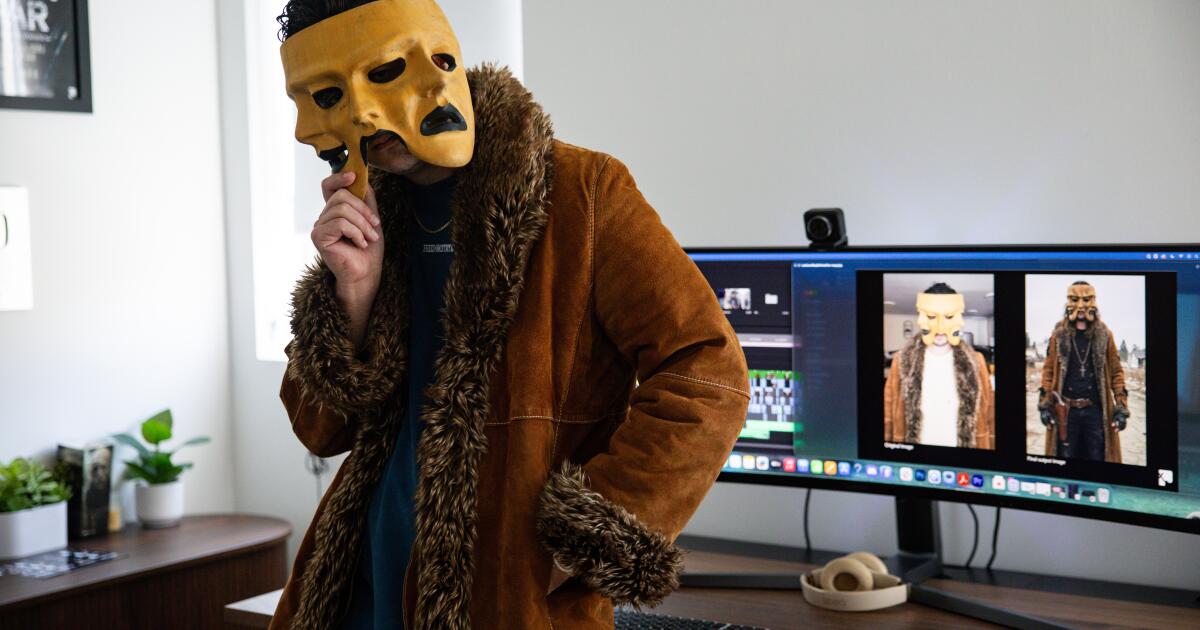
Kavan Cardoza unmasked.
(Kayla Bartkowski/Los Angeles Times)
To create one of his characters, “the last lost boy,” Cardoza took self-portraits wearing a three-faced mask and a tattered brown jacket. He used those reference images for the AI character and transforms them into a stylized person, with a personality, backstory and visual details. He fed those images back to Seedance to get consistent characters — repeating the process for each member of the cast.
“I can’t go get Brad Pitt because he costs like $5, 10, 20 million to be in my film,” Cardoza said. “I can probably get a synthetic actor that will act just as good as Brad Pitt in the future. That’s crazy to me.”
Cardoza has copyrighted his script and characters, and aims to eventually attract major studio interest to turn his intellectual property into a film which comes with a built-in fan base.
Such plans are likely to face resistance from the performers union SAG-AFTRA, which has decried the use of synthetic actors such as Tilly Norwood.
“The rise of Seedance comes down to [its] focus on pleasing filmmakers and making things that look filmic,” said Stephan Vladimir Bugaj, senior vice president of JioStar, a joint venture between Disney and India’s Reliance Industries.
ByteDance introduced timeline-based prompting so filmmakers can actually pick specific moments and tweak them, and improved the understanding of camera direction, physics, lighting and fluidity of action. All of this, Bugaj said, “unlocked a kind of spectacle filmmaking that the other models are not delivering quite as well.”
The company’s tool has been in such high demand, Zada said, that Seedance has been quoting some major Hollywood studios $2 million for unrestricted special access.
While acknowledging Seedance’s popularity and its U.S. expansion, Amit Jain, chief executive of Luma, said its ceiling in Hollywood is severely limited. Traditional studios might adopt Chinese models for some preproduction tasks such as concepting, but the geopolitical and intellectual property risks for commercial generations are too prohibitive.
“Can you imagine Disney using the ByteDance model for the next ‘Snow White’? No way,” Jain said. “This is not even a technical argument, really. That’s the reality.”
Luma has been making inroads into Hollywood selling its software but has separately funded a production service company to teach filmmakers to make hybrid AI films using its tools.
Despite conservative production budgets, AI spending by media companies is projected to grow from $2.6 billion to $12.5 billion from 2024 to 2029, according to a State of Generative AI Media report.

Kavan Cardoza flips through pages of his fine-art photography book.
(Kayla Bartkowski/Los Angeles Times)
Bugaj warned that the quality and competitive price of Chinese models should be a “wake-up call” for American players fighting for market share.
“We’re not loyal,” said Zada, the filmmaker. “Whatever is the best, we’re going to use it.”
-
 Entertainment21 seconds ago
AI actor Tilly Norwood to star in first movie
-
 Politics12 minutes ago
Trump says he disputed U.S. star player’s suspension, calling it ‘stain’ on World Cup
-
 Science15 minutes ago
14 propositions that could remake California taxes, housing, healthcare and elections
-
 Sports20 minutes ago
Lakers lose Rui Hachimura, who signs two-year deal with the Clippers
-

 World30 minutes ago
Hungary could vote to oust president as early as next week
-

 New York2 hours ago
How a Museum Security Guard and Artist Lives on $51,000 in Parkchester
-

 Los Angeles, Ca2 hours ago
Heat advisory issued as Southern California temps near triple digits this week
-

 Detroit, MI3 hours ago
Detroit Battery Safety Provider Reaches to the Skies with Med Hawk

