Business
Apple at 50: How a garage startup became a $3.5-trillion titan

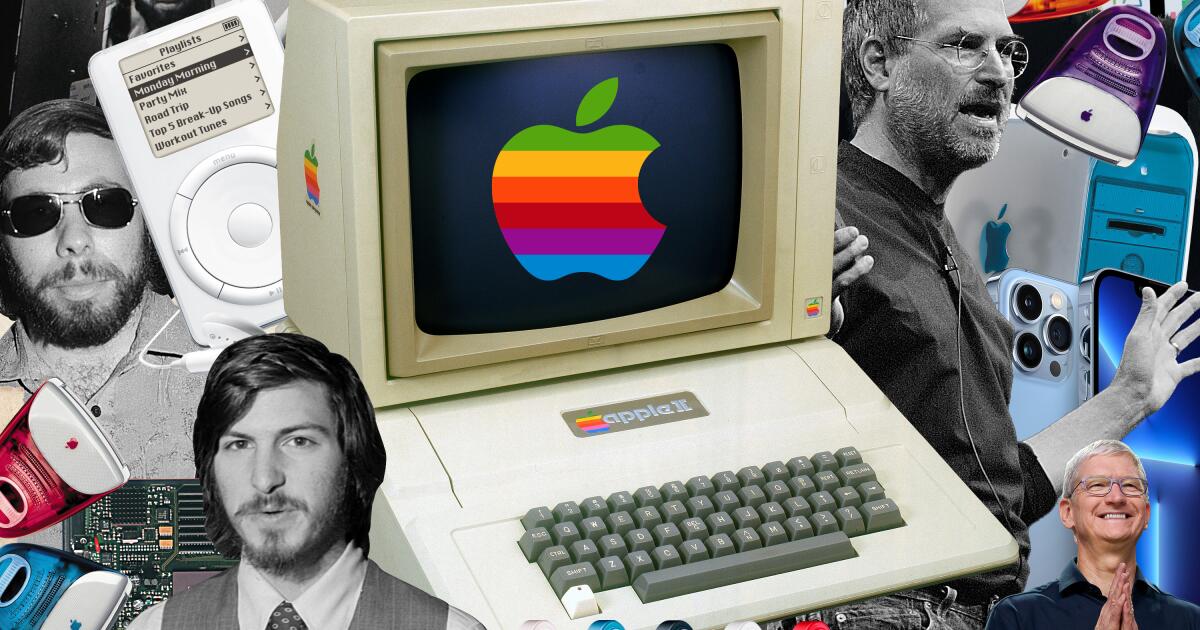
Fifty years ago, Steve Wozniak knew he built a great personal computer, but the young engineer couldn’t convince his employer, Hewlett-Packard, to buy into the big idea.
“Five times they turned me down for the personal computer. I wanted Hewlett-Packard to do it. I loved my company, but now Steve Jobs and I had to go into business,” Wozniak told The Times.
Wozniak and Jobs, both in their 20s, co-founded Apple with Ron Wayne on April 1, 1976.
Back then, personal computers were very expensive and rare. Apple would go on to revolutionize the tech industry, creating innovative, intuitive and beautiful gadgets billions of people would buy again and again.
Apple Inc.’s then-CEO Steve Jobs speaks in front of an early image of himself and Steve Wozniak during an Apple event on Jan. 27, 2010, in San Francisco.
(Justin Sullivan / Getty Images)
Apple, now one of the world’s most valuable and powerful companies, turns 50 this week.
From its humble beginnings when the founders worked out of Jobs’ family garage, Apple has ballooned over the last five decades, opening a sprawling ring-shaped headquarters in Cupertino, Calif., and employing roughly 166,000 workers.
Its market value has surpassed $3.5 trillion, making it the second-largest company in the world after Nvidia. In the fiscal year ending in September, Apple reported revenue of $416 billion and a net income of $112 billion. The company has attracted a large loyal fan base with more than 2.5 billion active Apple devices worldwide.
“Apple is more than just a technology company. It’s really a cultural icon,” said Jacob Bourne, a technology analyst at eMarketer.
By creating well-designed products that blur the lines between work and enjoyment, Apple helped foster an emotional connection to the brand, he said. The company’s strong stance on privacy and security has cultivated trust among legions of its fans who line up at Apple’s retail stores to buy its latest products.
“Every company claims to strive for excellence. It’s just a trope. But, man, you go inside Apple and talk to these people, and it’s almost a mania. It’s intense to work at Apple. A lot is expected of you,” said David Pogue, a journalist and author of “Apple: The First 50 Years.”
This attention to detail is apparent in Apple’s products.
When Apple built a way for people to unlock their devices with their faces, the company tested the technology at Harley-Davidson motorcycle rallies and even hired Hollywood special effects artists to ensure life-like masks couldn’t spoof its facial recognition system, Pogue said.
Pogue’s book, released ahead of Apple’s anniversary, goes through Apple’s long history, chronicling the company’s key players — including Jobs’ leadership style and temper — and the challenges it faced as it rose to the top.
“Apple’s story is an epic tale of frenetic all-nighters and creative rebellion,” he wrote in his book. “Of titanic successes (iPods, iPhones, iPads) and instructive failures (Lisa, Apple III, MobileMe). Of funny, idealistic, scary-smart workaholics — coming up on three generations of them — who want to make things better by making things better. It’s about management, marketing, and strategy — and also about creativity, drive, and obsession.”

Jobs shows an Apple iPhone at the MacWorld Conference in San Francisco on Jan. 9, 2007.
(Paul Sakuma / Associated Press)
Apple went through periods of financial trouble and uncertainty.
In the 1990s, the company laid off a third of its workforce and was days away from bankruptcy before the return of Jobs, who left the company in 1985 after clashing with the board and then-Chief Executive John Sculley.
In 2011, Jobs died of pancreatic cancer at 56, fueling more uncertainty around the company’s future. Apple has faced scrutiny over working conditions at Chinese factories where Apple devices and other electronics are produced.
The company had massive breakout moments of success, including the release of the iPhone in 2007, outpacing rivals such as BlackBerry and sparking the shift to smartphones.
“Apple kept up with it all. Apple was always flexible,” Wozniak said. “Now we’ve got so many different avenues, from the surfaces to other machines and AirPods and all that.”
The secret to the company’s success was it managed its brand well and didn’t make “lousy junk” that breaks down, he said.
The tech giant — which is building a new office complex in Culver City — also expanded its footprint into Hollywood in 2019 with the launch of Apple TV+, the streaming service known for such TV shows as “Severance,” “The Morning Show” and the comedy “Ted Lasso.” In 2022, it became the first streamer to win an Academy Award for best picture for family drama “CODA.”
Apple, known for looking forward, took time to reflect and celebrate its half-century.
Earlier in March, Apple held a surprise concert featuring artist and producer Alicia Keys, who performed at its Grand Central Store in New York.
The company has held celebrations in different parts of the world, showcasing artists in China, Korea, Thailand, the United Kingdom and Mexico as well.
Apple worked with artists to light up the Sydney Opera House in Australia with art designed on the iPad.

Apple Chief Executive Tim Cook with Alicia Keys at a 50th anniversary celebration at Apple Grand Central in New York on March 13.
(Theo Wargo / Getty Images for Apple)
“Through every breakthrough, one idea has guided us — that the world is moved forward by people who think different,” wrote Tim Cook, Apple’s chief executive, in a public letter about the milestone.
It’s not just Apple that’s been celebrating.
In January, RR Auction held an auction to celebrate the anniversary that included rare items such as Jobs’ bedroom desk and bow ties. A 1976 check signed by Jobs and Wozniak before the founding of Apple and an Apple I computer prototype board each sold for more than $2 million, according to the auction’s website.
The Computer History Museum in Mountain View, Calif., has been hosting events and opened a new exhibit to celebrate Apple’s anniversary.
Inside the museum, rare prototypes of Apple products, including its personal computers and smartphones, were on display to showcase the Silicon Valley powerhouse’s long journey. A wooden Apple I case, a clear acrylic Macintosh, a large iPod prototype and other items from Apple’s past fill the room.
Earlier this month, Pogue hosted a sold-out evening event that featured key people in Apple’s history, including its former chief executive Sculley.
Wayne, the Apple co-founder who left the company days after its founding, also made a rare appearance. He departed from Apple early, he said, because he thought it was too financially risky.
“If the whole thing came unglued, Jobs and Woz didn’t have two nickels to rub together, so who are they going to come after? Obviously. And I didn’t feel that I could stand the risk of such a disaster,” he said.
Sculley, who became Apple’s chief executive in 1983 and held the position for a decade, was initially reluctant to leave PepsiCo, but Jobs eventually persuaded him.
“He said, ‘Do you want to sell sugar water for the rest of your life, or do you want to come with me and change the world?’” Sculley said on stage.
Today, the world is very different, and technology has evolved.
The rise of artificial intelligence that can generate text and images has prompted anxiety about the future. And it’s spurring the creation of hardware such as smartglasses and robots.
But AI can also create problems such as “deepfakes” that make it seem like a person is saying something or doing something they’re not, Wozniak noted.
People spend a lot of time scrolling through videos on social media, addicted to their phones instead of interacting with their friends and family.
“The world is run by people who want to sell things,” Wozniak said. “They’re not going to let us get away from that.”
Apple is also contending with the AI race and is seen to be trailing. Its shares rose more than 55% over the last three years but the broader Nasdaq Composite index rose more than 75% and it ceded its throne as the world’s largest company by market value to Nvidia.
Meanwhile, there are questions swirling around when Cook, 65, will retire.
For now, Apple appears positioned well, analysts said.
“I see Apple being able to weather the current pressures at least for the foreseeable future,” said Bourne, the eMarketer analyst.


A rule intended to prevent rent gouging in the wake of the Eaton and Palisades fires has lapsed in Los Angeles County, possibly exposing some renters to hikes.
The executive order that blocked rent increases was issued by Gov. Gavin Newsom amid the devastating wildfires last year. Under the order, landlords couldn’t increase rents by more than 10% above their prefire levels.
The rule, which was supposed to be temporary and was repeatedly extended, ended Friday after a vote to extend it again failed to garner enough votes. Supervisor Lindsey Horvath, whose district includes Pacific Palisades, sounded the alarm in a motion to extend price protections that failed to pass at the Board of Supervisors’ May 19 meeting.
“These price gouging protections continue to be necessary as construction and rebuilding continue, and as thousands of people remain displaced,” the motion said. “Families which signed short-term leases could face drastic price increases of 50% or more without further price gouging protection.”
Los Angeles County is home to more than 1 million rental properties, though not all of them needed protection from the new rule. There are already stricter rent increase caps for many residences, depending on the location, type and age of the building. Despite the rent control in the region, the people of Los Angeles pay among the highest rents in the country.
It is uncertain whether renters will face rapidly rising rents now that the protection has lapsed. But some real estate experts and policymakers said there was no need for the temporary rule that was part of the governor’s state of emergency.
Supervisors Kathryn Barger, Janice Hahn and Holly Mitchell abstained from voting on the motion to extend the protection, while Supervisors Hilda Solis and Horvath supported it.
“I abstained because I did not see sufficient evidence to justify extending this emergency ordinance, nor did I see evidence to eliminate it entirely,” Hahn said.
Barger’s office said she supported allowing the protections to sunset while waiting to see whether new information emerged.
“Market data already shows countywide rents are only about 2% above pre-emergency levels and rental inventory has grown,” Barger representative Helen E. Chavez Garcia said. “The Supervisor is also mindful of the burden these ongoing protections place on small property owners throughout the county.”
Mitchell did not immediately respond to a request for comment.
There haven’t been steep rent hikes in neighborhoods within three miles of the Palisades fire, according to a Times analysis of data from Zillow, the property listing company.
In ZIP Codes within three miles of the Palisades fire, rent increased 4.8% from December 2024 to April 2025. In areas around the Eaton fire, which destroyed swaths of Altadena, rent jumped 5.2% in the same period.
In L.A. County, ZIP Codes farther from the fires saw only about a 2% increase.
A landlords representative, Jesus Rojas of the Apartment Owners Assn. of Greater Los Angeles, told the supervisors during public comment at the meeting that the county’s rent-gouging rules have “long outlived the emergency they were intended to address” and are now being “wrongfully used to harm thousands of rental housing providers throughout the county.”
“There is no proof that multifamily rental housing providers are hugely increasing rents for impacted homeowners,” Rojas said.
Indeed, there are strong signs that the property market in the Los Angeles area has at last begun to cool.
L.A. metro-area rent prices recently fell to a four-year low, with the median rent slipping to $2,167 in December.
Meanwhile, condominium sales had their slowest start of the year in decades. Condo sales in Los Angeles have plummeted to a 20-year low, with fewer than 2,000 units sold in January and February — the worst start to the year since 2005.
Newsom defended the price-gouging protections shortly after they went into effect.
“In the days following the Los Angeles firestorms, we worked quickly to protect Los Angeles survivors from any form of exploitation,” he said in February 2025. “The state has the tools in place to not only block price gouging during this emergency, but also to prosecute bad actors.”
The Los Angeles County Department of Consumer and Business Affairs said it received more than 2,000 complaints after the fires, alleging that retailers and landlords were taking advantage of people put in hardship by their losses, and sent out more than 2,000 cease-and-desist letters to businesses and landlords for alleged price gouging, said Morine Merritt, who oversees department investigations into consumer and real estate fraud.
“Close to 90% of the complaints that we received involved allegations of rent increases,” Merritt said in an interview. Now that the fire-related protections have expired, existing laws and “regular market conditions determine price increases for goods and services, including rents,” she said.
Crackdowns on fire-related rent gouging have been rare, said Chelsea Kirk of the activist organization the Rent Brigade, which analyzed L.A. County’s rental market in the year after the fires. It reported 18,360 potential examples of price gouging in listings but said that few lawsuits had been filed by authorities so far.
Last week, Rent Brigade announced what it said was the first private civil lawsuit brought by a family that claimed to be rent-gouged in the aftermath of the wildfires. Plaintiffs Randall and Candy Renick, whose Altadena home was damaged, said they were charged nearly three times the maximum permitted rate for nearly 10 months. They seek restitution of $96,000 plus civil penalties and attorneys’ fees.
The rental market has probably stabilized since the fires, Kirk said, but other families may still be “locked into illegal rents” that they agreed to pay when they were in a rush to find housing after they were displaced.


Dear Mr. Pelley:
I meant what I said in my letter last week to the 60 Minutes team: joining 60 Minutes is the honor of my career and I am grateful to be working alongside the people who have contributed to the most important television journalism brand this country has ever produced. While I’m new to 60 Minutes, I’ve devoted my career to investigative journalism and storytelling. I started this job excited to collaborate and to benefit from the wisdom and experience of the 60 Minutes veterans, with you among them. For that reason, one of the first things I did in my new role was call you to talk and invite you to dinner. It is a profound disappointment that you rejected that overture and chose ambush instead. Yesterday, you hijacked my first meeting with staff to disparage me, my qualifications, and my intentions with remarkable incivility and contempt. I welcome a diversity of viewpoints and respectful debate among the team, but this was nothing of the sort. Yesterday’s performative display of hostility enacted in front of the staff instead of in a civil, private conversation-demonstrated that you have no interest in contributing to the future success of the show, or approaching my new tenure with a mind open to collaboration and progress. I am here to deliver first-in-class news programming, not to make headlines about newsroom drama. I am eager to work alongside those who share this goal.
Despite yesterday’s misconduct, I had hoped that in sitting down with you today we could find a path forward together. You made clear that you are not interested in such a path.
Your antipathy to the future of the show has come through loud and clear. And I have heard you. I therefore write on behalf of CBS News, Inc. (“CBS”) to inform you that your employment with CBS is terminated for cause effective immediately. Enclosed is your formal termination letter.
Sincerely,
Nick Bilton
Executive Producer, 60 Minutes

The co-founder of Aspiration, Joseph Sanberg, was sentenced to 14 years in prison on Monday after defrauding investors and lenders of over $248 million.
The startup, an eco-friendly digital banking company boasting fossil fuel-free investments, carbon offsets for gas purchases, and a debit card with cash-back benefits for shopping at clean companies, was founded by Sanberg and Andrei Cherny. Cherny left the company in 2022 and has not been charged.
Sanberg, an Orange County native, pleaded guilty to wire fraud in October after being arrested in March last year. Aspiration subsequently filed for bankruptcy and liquidated all of its assets by July.
Sanberg and venture capitalist Ibrahim AlHusseini, who also faces charges, together forged a series of bank statements in order to obtain loans. From 2020 to 2021, the pair forged AlHusseini’s bank statements to show millions of dollars in assets in order to obtain millions of dollars from lenders.
Additionally, they forged a letter from their audit committee stating that $250 million in funds were available, when in reality Aspiration had less than $1 million. The amount of loans defrauded exceeded $248 million.
In 2021, Sanberg artificially inflated Aspiration’s 2021 revenue by $44 million by recruiting 27 fake customers to sign letters of intent pledging tens of thousands of dollars per month for tree planting services. Sanberg himself funded the contracts and used the inflated revenue numbers to obtain more loans.
The charges sparked an NBA investigation into salary cap allegations due to Aspiration’s connections with Clippers owner Steve Ballmer.
Ballmer personally invested $60 million in Aspiration, all of which was lost. He is now the target of a civil lawsuit alleging his participation in the scheme. Ballmer denies the allegations.
The team announced a $300-million sponsorship deal with Aspiration, and Clippers player Kawhi Leonard signed a four-year, $28-million marketing contract with the company, which reportedly performed no duties. The issue has raised concerns about how players are circumventing the NBA’s salary cap.
The team lost the $300-million sponsorship deal and an additional $20 million paid for carbon offset purchases.
-

 Politics2 minutes ago
Video: Steve Hilton Holds Slim Early Lead in California Governor’s Race
-
 Lifestyle32 minutes ago
We’re having a main character summer. Are you? : It’s Been a Minute
-

 Technology40 minutes ago
Microsoft AI chief Mustafa Suleyman says there are three labs that matter — and he wants Microsoft to be the fourth.
-

 World47 minutes ago
US ally Kuwait condemns ‘brutal and ongoing Iranian attacks’ after airport was hit
-

 Politics50 minutes ago
Spencer Pratt surges to runoff in LA mayor’s race after angry voters send message to Karen Bass
-

 Health55 minutes ago
One extra serving of processed meat a day linked to higher cancer risk
-

 Sports1 hour ago
AJ Brown trade outcome: Dianna Russini paid a heavy price while Mike Vrabel emerged unscathed
-

 Technology1 hour ago
Could your Samsung phone replace your passport?

