Business
After years of rapid growth, California's almond industry struggles amid low prices

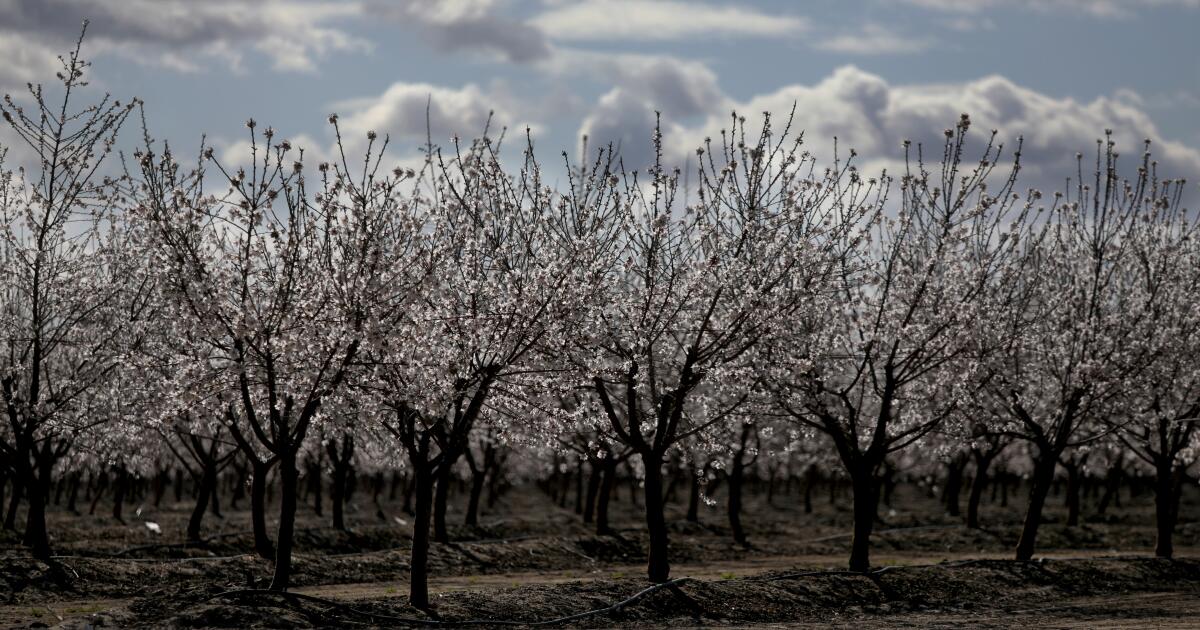
For much of the last decade, almonds have been such a lucrative crop that growers and investment firms have poured money into planting new orchards across vast stretches of California farmland.
Now, the almond boom has fizzled and the industry has entered a slump. Prices have dropped over the last several years, and the state’s total almond acreage has started to decrease as growers have begun to tear out orchards and plant other crops.
Aggressive and impactful reporting on climate change, the environment, health and science.
In a sign of the troubles besetting the industry, one large almond-growing conglomerate has declared bankruptcy.
In a series of Chapter 11 filings in federal bankruptcy court, Trinitas Farming and other affiliated companies said that record-low almond prices and high interest rates contributed to their “serious liquidity constraints.”
The group of companies said in a court document filed Feb. 19 that they own 7,856 acres of almond orchards in five counties, including Solano, Contra Costa, San Joaquin, Fresno and Tulare. As part of the bankruptcy proceedings, these orchards are expected to be put up for sale.
“When the price is low, now we start seeing the results of it. And certainly the fear is that Trinitas is the tip of the iceberg,” said Jake Wenger, general manager of the Salida Hulling Assn., which runs an almond-hulling plant in Modesto.
Prices for premium almonds have dropped from nearly $4 a pound a decade ago to about $2 a pound or less, Wenger said. Though the low prices are affecting all growers, those that are being hit especially hard are the many investor groups that bought land when prices were high and now have large debts, he said.
“The question becomes, do some of these banks call on some of these loans? And that’s really going to be a concern for a lot of people in the industry,” Wenger said. “Nobody got more indebted to the banks than a lot of these investor groups.”
A highway in Buttonwillow, Calif., bisects Kern County growing fields, with a large almond orchard on the left.
(Brian van der Brug / Los Angeles Times)
The group that filed for bankruptcy includes Trinitas Advantaged Agriculture Partners IV, LP, an investment fund that was formed and managed by Redwood City-based Trinitas Partners, a private equity investment company. It also includes the investment fund’s subsidiary Trinitas Farming, based in Oakdale, and 17 other subsidiaries.
The group’s lawyers said in court documents that the investment fund was organized by Trinitas Partners in 2015 to develop and operate almond farms in the Central Valley. It said the companies were ”well-positioned to become profitable ventures” but that they were ultimately “unable to raise necessary capital” through investments or from potential sales of assets. The entities’ reported debts total approximately $180 million.
Trinitas Partners itself was not among the companies that filed for bankruptcy. Representatives of the companies did not respond to requests for comments about the matter.
“I really firmly believe they’re not going to be the only ones facing financial struggles,” Wenger said.
The low prices appear to be making it difficult for some investments to pencil out. Wenger and others in the almond business have noticed some orchards abandoned in parts of the Central Valley over the last year, with rows of unkempt trees now filled with weeds.
“We’re already seeing people walk away,” Wenger said.
He said he believes almond prices will eventually rebound, but it’s not clear when that turnaround might come.
“I certainly don’t think we’ve seen the worst of it yet,” Wenger said.
While various factors have contributed to the situation, Wenger and others say some of the issues weighing on prices include an oversupply of almonds after years of rapid growth.
A grower examines a cluster of almonds in a Manteca, Calif., orchard in June 2022.
(Paul Kuroda / For The Times)
California produces about 80% of the world’s supply of almonds. And according to federal data, the state’s harvested almond orchards skyrocketed from 760,000 acres in 2011 to more than 1.3 million acres in 2022.
In the last two years, though, annual mapping of orchards has shown that California’s total almond acreage has started to decline.
Over the last decade, the almond boom coincided with growing concerns about water in California. When growers and investment companies bought land and drilled wells to pump groundwater in the Central Valley, the expanding nut orchards locked in long-term water demands and added to the strains on the state’s declining aquifers.
Wenger said he thinks it’s possible that if some of these orchards come out of production, groundwater levels could rise in places.
“It depends on what cropping patterns come in, and what happens next,” he said. “But it does have a potential that we could see benefits to groundwater.”
Critics who have questioned the amount of water dedicated to growing almonds include Bill Maher, who recently drew laughs on his show when he urged Gov. Gavin Newsom to “take on Big Almond.”
The environmental group Food and Water Watch has also urged the state to limit the expansion of almond orchards and other water-intensive crops such as alfalfa. Chirag Bhakta, the group’s California director, said the expansion of almonds has “locked us into a situation where we’re growing way too many of these thirsty tree nuts in parts of California,” adding to the problems of overpumping of groundwater.
Bhakta said it’s hard to know if the bankruptcy case points to more trouble ahead in the industry. But he said it represents an “opportunity for us to shift what’s been grown on that land to actually reflect what’s best for California” and the state’s water needs.
Representatives of the almond industry have defended the crop’s water use, pointing to agricultural statistics showing almonds cover 21% of irrigated agricultural land in California but account for 14% of agricultural water use. They have also noted that in addition to the nuts, almond hulls are used for cattle feed.
In the coming years, California’s agriculture industry will face water limits under the requirements of the state’s 2014 Sustainable Groundwater Management Act. The law requires local agencies in many areas to develop plans to curb overpumping by 2040.
Researchers with the Public Policy Institute of California have estimated that addressing the groundwater deficit in the San Joaquin Valley will probably require taking at least half a million acres of farmland out of production, and they’ve called for expanding efforts to help convert farmland to other uses, such as solar development or habitat areas.
Aside from water constraints, the almond industry has faced other challenges, including tariffs in China and other countries, as well as shipping bottlenecks during the COVID-19 pandemic.
“There has just been a glut in the almond market for a couple of years now,” said Caity Peterson, associate director of the Public Policy Institute of California’s Water Policy Center.
“It’s possible that we have hit peak almond,” Peterson said. “The industry will probably right-size itself to where the supply better meets the demand and it’s not oversupply, like we’ve got right now.”
Some experts say the almond industry is likely to bounce back. Analysts with Rabobank wrote in an analysis this month that “a strong rebound in almond prices is expected over the next 12 to 18 months.”
International markets have a big influence. According to the most recent crop data for the 12 months that ended in July 2023, 72% of the state’s almonds were exported, while 28% were sold domestically.
California’s total almond acreage has gone down the last two years mostly because of decreases in new plantings, said Rick Kushman, a spokesperson for the Almond Board of California.
“Orchards last about 25 years, then growers replant, if they decide to. It’s possible that financing has been harder to get and it is surely more expensive right now,” Kushman said in an email. “Shipments have been strong in recent months, but we are a long way from seeing if that will affect planting decisions.”
There are roughly 7,600 almond farms in the state, and about 70% of the state’s orchards are under 100 acres, according to the Almond Board of California.
Wenger said those who are better suited to weather this sort of downturn are family-run businesses that own their land debt-free.
Almond growers aren’t the only ones in agriculture who have been dealing with tough economic conditions.
“Walnut prices are terrible. Grape prices are terrible,” Wenger said. “Pistachios are not doing great. So we have all these crops that are starting to suffer.”
The fall of the Trinitas almond business follows the recent news that the large fruit grower Prima Wawona also filed for bankruptcy.
Some growers in the San Joaquin Valley have chosen to replace almond trees with pistachio orchards.
Blossoms fill an almond tree branch in an orchard near Sanger. California produces about 80% of the world’s supply of almonds.
(Gary Coronado / Los Angeles Times)
Still, most of California’s almond orchards remain, and almond trees have been blooming with white and pink flowers in the Central Valley.
“Agriculture in general is seeing some very difficult times,” said Bill Lyons, a farmer in Stanislaus County who once served as state agriculture secretary under Gov. Gray Davis.
On his family’s century-old ranch, they have a cattle operation and grow a wide variety of crops.
“We’ve been in the almond business for over 25 years, and we’re seeing unprecedented low prices for multiple years, and very high expenses,” Lyons said. “And when you combine the two, it’s extremely difficult for any almond farmer to make a profitable living.”
He said where some landowners have abandoned their trees, it’s a problem for neighboring growers because the untended orchards can harbor pests — such as navel orangeworm — that can spread to nearby orchards.
Lyons said his family plans to keep growing almonds.
“Hopefully, the almond price will gain momentum,” Lyons said. “I have confidence in the almond industry, but it’s definitely going to be a serious bump in the road as we travel through to next year or so.”
Times staff writer Kevin Rector contributed to this report.



In an expansion of its business of processing pharmaceuticals in Earth’s orbit, Varda Space Industries is renting a large El Segundo plant where toy manufacturer Mattel used to design Hot Wheels and Barbie dolls.
The plant in El Segundo’s aerospace corridor will be an extension of Varda Space Industries’ headquarters in a much smaller building on nearby Aviation Boulevard.
Varda will occupy a 205,443-square-foot industrial and office campus at 2031 E. Mariposa Ave., which will give it additional capacity to manufacture spacecraft at scale, the company said.
Originally built in the 1940s as an aircraft facility, the complex has a history as part of aerospace and defense industries that have long shaped the South Bay and is near a host of major defense and space contractors. It is also close to Los Angeles Air Force Base, headquarters to the Space Systems Command.
Workers test AstroForge’s Odin asteroid probe, which was lost in space after launch this year.
(Varda Space Industries)
Varda is one of a new generation of aerospace startups that have flourished in Southern California and the South Bay over the last several years, particularly in El Segundo, often with ties to SpaceX.
Elon Musk’s company, founded in 2002 in El Segundo, has revolutionized the industry with reusable rockets that have radically lowered the cost of lifting payloads into space. Though it has moved its headquarters to Texas, SpaceX retains large-scale operations in Hawthorne.
Varda co-founder and Chief Executive Will Bruey is a former SpaceX avionics engineer, and the company’s spacecraft are launched on SpaceX’s workhorse Falcon 9 rockets from Vandenberg Space Force Base in Santa Barbara County.
Varda makes automated labs that look like cylindrical desktop speakers, which it sends into orbit in capsules and satellite platforms it also builds. There, in microgravity, the miniature labs grow molecular crystals that are purer than those produced in Earth’s gravity for use in pharmaceuticals.
It has contracts with drug companies and also the military, which tests technology at hypersonic speeds as the capsules return to Earth.
Its fifth capsule was launched in November and returned to Earth in late January; its next mission is set in the coming weeks. Varda has more than 10 missions scheduled on Falcon 9s through 2028.
For the last several decades, the Mariposa Avenue property served as the research and development center for Mattel Toys. El Segundo has also long been a center for the toy industry as companies like to set up shop in the shadow of Mattel.
The Mattel facility “has always been an exceptional property with a legacy tied to aerospace innovation, and leasing to Varda Space Industries feels like a natural continuation of that story,” said Michael Woods, a partner at GPI Cos., which owns the property.
“We are proud to support a company that is genuinely pushing the boundaries of what’s possible, and are excited to watch Varda grow and thrive here in El Segundo,” Woods said.
As one of the country’s most active hubs of aerospace and defense innovation, El Segundo has seen its industrial property vacancy fall to 3.4% on demand from space companies, government contractors and technology startups, real estate brokerage CBRE said.
Successful startups often have to leave the neighborhood when they want to expand, real estate broker Bob Haley of CBRE said. The 9-acre Mattel facility was big enough to keep Varda in the city.
Last year, Varda subleased about 55,000 square feet of lab space from alternative protein company Beyond Meat at 888 Douglas St. in El Segundo, which it started moving into in June.
Varda will get the keys to its new building in December and spend four to eight months building production and assembly facilities as it ramps up operations. By the end of next year, it expects to have constructed 10 more spacecraft.
In the future, Varda could consolidate offices there, given its size. Currently, though, the plan is to retain all properties, creating a campus of three buildings within a mile of one another that are served by the company’s transportation services, Chief Operating Officer Jonathan Barr said.
“We already have Varda-branded shuttles running up and down Aviation Boulevard,” he said.

Ships near the Strait of Hormuz before and after attacks began
Every day, around 80 oil and gas tankers typically pass through the Strait of Hormuz, the narrow waterway off Iran’s southern coast that carries a fifth of the world’s oil and a significant amount of natural gas.
On Monday, just two oil and gas tankers appear to have crossed the strait, according to a New York Times analysis of shipping activity from Kpler, an industry data firm. Since then, one tanker passed through.
“It’s a de facto closure,” said Dan Pickering, chief investment officer of Pickering Energy Partners, a Houston financial services firm. “You’ve got a significant number of vessels on either side of the strait but no one is willing to go through.”
Tankers have been staying away from Hormuz since the U.S.-Israeli attacks on Iran that began on Saturday. A prolonged conflict could ripple broadly across the global economy, threatening the energy supplies of countries halfway around the world and stoking inflation.
International oil prices have climbed 12 percent since the fighting began, trading Tuesday around $81 a barrel, and natural gas prices have surged in Europe and in Asia.
A senior Iranian military official threatened on Monday to “set on fire” any ships traveling through the Strait of Hormuz. Vessels in the region have already come under attack. Several oil and gas facilities have also been struck or affected by nearby shelling, though the damage did not initially appear to be catastrophic.
Where ships and energy facilities have been damaged
A fire broke out Tuesday at a major energy hub in Fujairah, United Arab Emirates, from the falling debris of a downed drone, the authorities said. On Monday, Qatar halted production of liquefied natural gas, or fuel that has been cooled so that it can be transported on ships, after attacks on its facilities.
The sharp reduction in tanker traffic is reducing the supply of oil and gas to world markets, pushing up prices for both commodities. And the longer that ships stay away from the Strait of Hormuz, the less oil and gas get out to the world, which could raise prices even more.
Shipping companies have paused their tankers to protect their crew and cargo, and because insurance companies are charging significantly more to cover vessels in the conflict area.
On Tuesday, President Trump said that “if necessary,” the U.S. Navy would begin escorting tankers through the strait. He also said a U.S. government agency would begin offering “political risk insurance” to shipping lines in the area.
In addition to tankers, other large vessels regularly go through the strait, including car carriers and container ships. In normal conditions, nearly 160 make the trip each day.
Some ships in the region turn off the devices that broadcast their positions, while others transmit false locations — making it hard to give a full picture of the traffic in the strait.
The Shiva is a small oil tanker that has repeatedly faked its location, according to TankerTrackers.com, which tracks global oil shipments. It is suspected of carrying sanctioned Iranian oil, according to Kpler. The Shiva was one of the two tankers that crossed the strait on Monday.
The oil and gas that typically move through the strait come from big producing countries like Saudi Arabia, Iraq, Iran and United Arab Emirates, and are exported around the world.
Where tankers moving through the Strait have traveled
In 2024, more than 80 percent of the oil and gas transported through the Strait of Hormuz went to Asia. China, India, Japan and South Korea were the top importers, according to the U.S. Energy Information Administration.
Countries have energy stockpiles that could last them into the coming months, but a continued shutdown of the strait could damage their economies.
Several big disruptions have roiled supply chains in recent years, but the tanker standstill in the Strait of Hormuz could have an outsize impact.

Paramount Skydance’s jubilation over its come-from-behind victory to claim Warner Bros. Discovery has entered a new phase:
Call it the deal-debt hangover.
Two major ratings agencies have raised concerns about Paramount’s credit because of the enormous debt the David Ellison-led company will have to shoulder — at least $79 billion — once it absorbs the larger Warner Bros. Discovery, bringing CNN, HBO, TBS and Cartoon Network into the Paramount fold.
Fitch Ratings said Monday that it placed Paramount on its “negative” ratings watch, and downgraded its credit to BB+ from BBB-, which puts the company’s credit into “junk” territory. Fitch said it took action due to “uncertainty” surrounding Paramount’s $110-billion deal for Warner Bros. Discovery, which the boards of both companies approved on Friday.
S&P Global Ratings took similar action.
To finance the Warner takeover, Ellison’s billionaire father, Larry Ellison, has agreed to guarantee the $45.7 billion in equity needed. Bank of America, Citibank and Apollo Global have agreed to provide Paramount with more than $54 billion in debt financing.
“Potential credit risks include the prospective debt-funded structure, Fitch’s expectation of materially elevated leverage and limited visibility on post-transaction financial policy and capital structure,” Fitch said.
Late last week, Paramount sent $2.8 billion to Netflix as a “termination fee” to officially end the streaming giant’s pursuit of Warner Bros. That payment paved the way for Warner and Paramount’s board to enter into the new merger agreement.
Paramount hopes the merger will be wrapped up by the end of September. It needs the approval of Warner Bros. Discovery shareholders and regulators, including the European Union.
Paramount executives acknowledged this week the new company would emerge with $79 billion in debt — a considerably higher total than what Warner Bros. Discovery had following its spinoff from AT&T. That 2022 transaction left Warner Bros. Discovery with nearly $55 billion of debt, a burden that led to endless waves of cost-cutting, including thousands of layoffs and dozens of canceled projects.
Warner still has $33.5 billion in debt, a lingering legacy that will be passed on to Paramount.
Paramount plans to restructure about $15 billion in Warner Bros. Discovery’s existing debt.
Paramount CEO David Ellison at a 2024 movie premiere for a Netflix show.
(Evan Agostini / Invision / AP)
Paramount told Wall Street it would find more than $6 billion in cost cuts or “synergies” within three years — a number that has weighed heavily on entertainment industry workers, particularly in Los Angeles.
Hollywood already is reeling from previous mergers in addition to a sharp pullback in film and television production locally as filmmakers chase tax credits offered overseas and in other states, including New York and New Jersey.
Some entertainment executives, including Netflix Co-Chief Executive Ted Sarandos, have speculated that Paramount will need to find more than $10 billion in cost cuts to make the math work. More recently, Sarandos went higher, telling Bloomberg News that Paramount may need $16 billion in cuts.
Cognizant of widespread fears about additional layoffs, Paramount Chief Operating Officer Andrew Gordon took steps this week to try to tamp down such concerns.
Gordon is a former Goldman Sachs banker and a former executive with RedBird Capital Partners, an investor in Paramount and the proposed Warner Bros. deal. He joined Paramount last August as part of the Ellison takeover.
During a conference call Monday with analysts, Gordon said Paramount would look beyond the workforce for cuts because the company wants to maintain its film and TV production levels.
Paramount plans to look for cost savings by consolidating the “technology stacks and cloud providers” for its streaming services, including Paramount+ and HBO Max, Gordon said. The company also would search for reductions in corporate overhead, marketing expenses, procurement, business services and “optimizing the combined real estate footprint.”
It’s unclear whether Paramount would sell the historic Melrose Avenue lot or simply centralize the sprawling operations onto the Warner Bros. and Paramount lots in Burbank and Hollywood.
Workers are scattered throughout the region.
HBO, owned by Warner Bros. Discovery, maintains its West Coast headquarters in Culver City; CBS television stations operate from CBS’ former lot off Radford Avenue in Studio City; and CBS Entertainment and Paramount cable channels executive teams are located in a high-rise off Gower Street and Sunset Boulevard, blocks from the Paramount movie studio lot.
“The combination of PSKY and WBD could create a materially stronger business than either individual entity,” Standard & Poor’s said in its note to investors. “However, this transaction presents unique challenges because it would involve the combination of three companies, with the smallest, Skydance, being the controlling entity.”
David Ellison’s production firm, Skydance Media, was the entity that bought Paramount, creating Paramount Skydance.
Ellison has not announced what the combined company will be called.
Paramount shares closed down more than 6% Tuesday to $12.45.
Warner Bros. Discovery fell 1% to $28.20. Netflix added less than 1% to close at $97.70.

Maxime Giroux – ‘In Cold Light’ movie review

The sea is higher than we thought and millions more are at risk, study finds

Video: U.S. ‘Accelerating’ Military Assault in Iran, Hegseth Says

On the brink of death, a woman is saved by a stranger and his family

MacBook Neo versus an old MacBook Air: good luck

Florida High School Football Rankings: Top 25 teams – Oct. 21

Cleary's 21 help Le Moyne down Central Connecticut State 69-64 in OT

How old is Bo Nix? What to know about Oregon quarterback ahead of 2024 NFL Draft

99th annual Pony Swim held in Virginia

Indiana Members Credit Union announced as new anchor tenant at Bottleworks District

US submarine sinks Iranian warship by torpedo in a first since World War II

Which oil and gas facilities in the Gulf have been attacked?

Mojtaba Khamenei, son of former supreme leader, tipped to become Iran’s next head of state

Video: Senators Question Kristi Noem on ICE Immigration Tactics

Combustible Republican Senate primary in Texas heading into overtime
-

 World7 days ago
Exclusive: DeepSeek withholds latest AI model from US chipmakers including Nvidia, sources say
-

 Massachusetts7 days ago
Mother and daughter injured in Taunton house explosion
-

 Denver, CO7 days ago
10 acres charred, 5 injured in Thornton grass fire, evacuation orders lifted
-

 Louisiana1 week ago
Wildfire near Gum Swamp Road in Livingston Parish now under control; more than 200 acres burned
-

 Florida3 days ago
Florida man rescued after being stuck in shoulder-deep mud for days
-

 Oregon5 days ago
2026 OSAA Oregon Wrestling State Championship Results And Brackets – FloWrestling
-

 Maryland3 days ago
AM showers Sunday in Maryland
-

 Wisconsin2 days ago
Setting sail on iceboats across a frozen lake in Wisconsin