Entertainment
Las Culturistas Culture Awards: 6 best moments from the show


Best new artist. Best vibes, hands down. Eva Longoria Award for Tiny Human, Huge Impact.
These were just a few of the categories presented at the 2026 Las Culturistas Culture Awards, which aired on Bravo and streamed Wednesday on Peacock and were held at the United Theater in L.A. last month. The show, co-hosted by Bowen Yang and Matt Rogers of the “Las Culturistas” podcast, honored some of the best moments in pop culture — and created some of its own, including a gay-tastic opening musical number performed by Yang and Rogers that paid homage to “Heated Rivalry” and a sexed-up Shrek — yes, your favorite green ogre — courtesy of “Hacks” co-creator and star Paul W. Downs.
Needless to say, it’s not your typical awards show. And winning isn’t the point, as Yang and Rogers told The Times earlier this month. “Presenting is just as good as winning, just as good as performing. But I think it’s weird that we have been so late to stumble on what the show really is, which is it’s a variety show,” Rogers said.
For anyone happy to take themselves a little less seriously, have some fun and potentially get a Cultch, as the golden statue is called (what is it exactly, we’re not really sure — RuPaul said he’d use it as a door stop), this awards show is for you. Here are some of our favorite moments from the show, which might be the best awards show on TV.
Music and dance performances by the co-hosts, Rachel Zegler and … Pikachu?
Rachel Zegler performs Addison Rae’s “Fame Is a Gun.”
(Monty Brinton / Bravo)
The show began with a rousing number featuring Yang and Rogers that was themed to one of the biggest TV shows of the past year, “Heated Rivalry.” It led into a performance of t.A.T.u.’s “All the Things She Said,” a record of the year nominee and the song that became a hit (again) thanks to a sexy club scene in the hockey-themed gay romance series, and it included vocals from another pair of gay icons, Malin Akerman and Brittany Snow of “The Hunting Wives.”
And yes, Rogers and Yang did attempt to enlist “Heated Rivalry” stars Connor Storrie and Hudson Williams, but the duo were out of town attending the 2026 Canadian Screen Awards, where the show broke records for most wins in a single year. But Akerman and Snow brought as much power to the moment, Yang said.
“That somehow felt like just as if not more important, to have those things live side by side,” he told us after the show. “We did our best to crudely represent this moment of ‘Heated Rivalry’ within the song, within us being a white gay man and an Asian gay man. And then bring Malin and Brittany in, to have these two be like companion pieces in the culture in the past year.”
But that was just the beginning. The show also featured performances by “Hacks” star Megan Stalter, who performed her single “Prettiest Girl in America,” and Mandy Moore, who sang “Only Hope,” her cover of the Switchfoot song. However, there were two performances that stole the show: Rachel Zegler’s “Evita”-inspired rendition of Addison Rae’s “Fame Is a Gun” and Yang and Rogers’ performance of the Pokémon theme song. One was an awe-inspiring and vocally perfect rendition of a pop song, the other a millennial dreamscape of Pokémon ephemera featuring the star of the animated show, Pikachu, dancing alongside Yang and Rogers as they sang the number. (Pikachu’s pronouns are it/that, according to Yang and Rogers, in case you were wondering.)
Zegler’s performance, Rogers said, was not only an early idea for the show, but one that felt meaningful despite the camp. The actor played the titular character in the West End revival of “Evita” and will reprise the role on Broadway next year.
“The only idea I had right away last year was I knew I wanted Rachel — and I told you this [turns to Yang] — in the style of Evita singing something,” he said. “Then we were at Coachella watching Addison Rae and she was doing ‘Fame Is a Gun’ and we were like, ‘It has to be this.’ We pitched it to Rachel, and she goes, ‘You’re not gonna believe this, but ‘Fame Is a Gun’ was No. 1 on my playlist when I was studying to play Eva Peron.’”
It was kismet.
Miss Piggy, cat marionettes and a very ripped Shrek

Miss Piggy, honored for her excellence in divahood, was among the childhood characters that made an appearance at the show.
(Monty Brinton / Bravo)
Pikachu wasn’t the only childhood character to make an appearance at the Culture Awards. The “grand dame diva of culture, divahood and porcine glamour” Miss Piggy, was honored at the show, where she showed up, naturally, in a pink dress and feather boa.
“She’s one of the most beloved pop culture figures of all time,” Yang said about her surprise appearance.
“It’s indisputable,” Rogers added.
We also got a performance of the “Meow-ionettes,” the feline troupe from the Bob Baker Marionettes, an L.A. institution, who accompanied Broadway star Ben Platt as he sang “Smelly Cat,” the song made famous by Lisa Kudrow’s Phoebe Buffay on “Friends.” (It was a lead-in to her receiving the lifetime of culture award.)
While those characters mostly stayed in, well, character, one appeared in a completely new light: Shrek. So you might remember Shrek as a big, green ogre, and while this Shrek was green, he was also extremely ripped and libidinous. Downs appeared as Shrek onstage to accept the award for the Shrek Award for Top Thing We Want to Do to That Green Guy, a category with very explicit nominees. Hints of a Shrek surprise appeared early on, when Miss Culturista Patti Harrison revealed she was pregnant, showing her sonogram with a green, Shrek-like fetus. It ended in Harrison telling Downs’ Shrek that it was his baby and they walked off the stage as a family. That’s one way to get a happily ever after.
‘War is Bravo for men’

Ziwe, left, looks on as Ciara Miller of “Summer House” accepts the trophy for the Rob Rausch Award for Excellence.
(Griffin Nagel / Bravo)
Who can actually enjoy escapist entertainment when every other day brings news alerts that trigger mental anguish? Bowen and Rogers acknowledged the dueling emotions at the start of the show by cheekily breaking down important current events for two camps: the people who don’t watch Bravo at all, and those who only watch Bravo. For the Bravo-agnostics, the hosts summarized the “Summer House” cheating scandal; meanwhile, Bravo obsessives were informed by Rogers: “Our country is at war.”
It prompted Yang to make the joke about one of the rules of culture: “War is Bravo for men.”
“Our show is trying to remind people that there’s a lot of fun and joy to be had,” Rogers told us. “We’re not dwelling, but also it would be unlike us and dishonest to ignore [what’s going on in the world]. It’s not a denial of the fact that we’re in this place, it’s an acknowledgment — but also an acknowledgment of everything else. It’s a night to say, we feel good.”
(Another rule of culture, in case you’re wondering? “Peacock is Netflix for the Olympics.”)
Imitation is flattery, honey!

Nominees for outfit of the year at this year’s Las Culturistas Culture Awards were re-created and modeled on stage by Lisa Rinna, seen here in a look made famous by horror villain Aunt Gladys in “Weapons.”
(Monty Brinton / Bravo)
Lisa Rinna knows how to gag an audience with her fashions — whether she’s peddling cozy duster cardigans on QVC or dressing in outré sets by conceptual designers like Jean Paul Gaultier, Christian Cowan or Maximilian Raynor. And she brought that dedication to Las Culturistas Culture Awards for the second consecutive year. She had attendees roaring with stunning transformations as she modeled the nominees for outfit of the year, which included her take on the extremely terrifying look of Aunt Gladys of “Weapons” (complete with an offset-styled wig, large vintage sunglasses and smeared lipstick); Jacob Elordi leaving an airport while wearing headphones, sunglasses and a stone-faced expression; Carolyn Bessette’s “argument chic” attire — oversized sweaters, a ponytail wig and white sneakers — during the much-publicized spat with John F. Kennedy Jr. in Battery Park; Billie Eilish as a visibly overwhelmed “One Less Lonely Girl” at Coachella, donning a black and purple track suit ensemble; and Jeff Probst for the last 50 seasons of “Survivor,” which boiled down to a blue button-up shirt and khakis (he won).
“She is so down to clown,” Rogers told us after the show. “And I truly mean clown because what she’s doing is clowning.”
Yang added: “She’s such a seasoned actor, performer. She knows entertainment. And she looked as hot as Jacob Elordi.” Rogers confessed he missed Rinna’s heightened turn as Bessette because he and Yang were talking to Lisa Kudrow backstage. But they at least got to witness a pop culture collision take place.
“Lisa Kudrow clocked who was on stage and she goes, ‘Oh my god, it’s Lisa F—ing Rinna?’” Yang recalled. “I was like, ‘This is heaven.’”
Rogers added: “Lisa Rinna as Carolyn Bessette comes off the stage and Lisa Kudrow turns to her and says, ‘We’ve known each other since our kids were 2!’” Rogers recalled. “And Lisa Rinna was like, ‘Yes, we have!’ We were just watching this interaction between the Lisas.”
Nods to Pride: Gay icons and allies

“The Hunting Wives” stars Brittany Snow and Malin Akerman, center, join Bowen Yang and Matt Rogers during the “Heated Rivalry”-inspired opening number.
(Griffin Nagel / Bravo)
The Culture Awards are not just inclusive, they’re unapologetically gay, from the categories to the nominees to the presenters. June is Pride Month after all, and we’d be remiss if we didn’t mention the timeliness of this show — hosted by a pair of gay men — and the awards bestowed upon LGBTQ+ icons and allies over the course of the night.
Among the winners this year were Hannah Einbinder for the all good either way award for bisexuality in media, RuPaul for the artist of the millennium award and Will Ferrell, who was awarded the titan of culture award. Upon accepting his award, he unfurled a Pride flag and declared that “gay pride is the most important thing to me.” Is Ferrell gay? No, but allies are always welcome. After all, he is Yang’s and Rogers’ boss.
‘And the award for best sauce goes to …’

“Hacks” co-creator and star Paul W. Downs appears on stage as a ripped Shrek during this year’s Las Culturistas Culture Awards.
(Monty Brinton / Bravo)
This year’s show was stuffed with a whopping 100 categories — and still, the ceremony managed to not be three hours-plus (take note, Oscars). It’s the only place where you can revel in the tight races of categories like most triggered, activated and dysregulated I was this year; best Disney hotel for intercourse, sex, or lovemaking; or best part of “WHERE IS MY HUSBAND!” song. About 30 previous categories returned, including the Allison Williams Cool Girl Award, which was given to “Summer House’s” Ciara Miller, who continues riding high following her messy and highly publicized breakup.
Maira’s favorite category: Record of the year would take the cake for me in terms of the showstopping performances, but in terms of category originality, I’ll have to go with the Fantasia Barrino Award for Vocal Oomph, which was presented by comedian Julio Torres, and went to the Bene Gesserit of “Dune.” I’m not even a “Dune” person, but I can appreciate the effort. Of the nominees, Charlotte screaming “NO!!!” at Mr. Big was my winner.
Yvonne’s favorite category: The Shrek Award for Top Thing We Want to Do to That Green Guy. Among the nominees is: “I get as close as possible to his lips without kissing him at a restaurant in public. Maximum romance, with everyone watching. He smells like onions.” The other contenders are NSFW, unfortunately, but that’s exactly what makes it so perfectly ridiculous. And to top it all off with Downs, and his insanely cut abs, slathered in green paint to accept the award as Shrek (while being revealed to be a baby daddy) elicited the sort of gasps last felt when “La La Land” was mistakenly awarded the best picture Oscar in 2017.

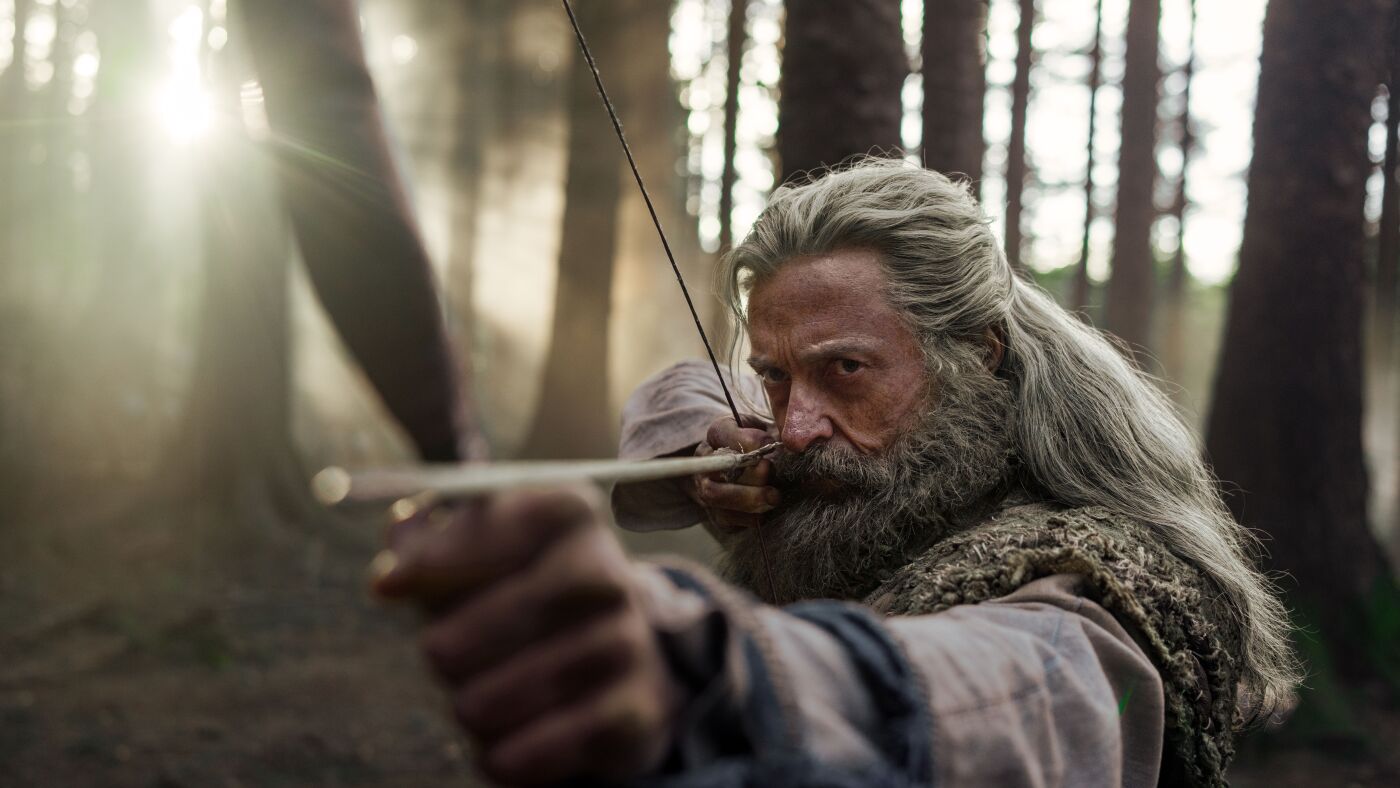
Hugh Jackman as Robin Hood.
A24
hide caption
toggle caption
A24
Gunmetal gray sky, barren muddy terrain, a half-starved child begging a wizened title character for a scrap of food moments before he slashes her throat. It’s hardly the opening you imagine for a film about a folk hero — especially one who robs the rich and gives to the poor. But then, The Death of Robin Hood is the brainchild of Michael Sarnoski (Pig, A Quiet Place: Day One), so maybe leave expectations in the lobby.
Sarnoski gives us Hugh Jackman’s battle-scarred, gray-bearded Robin as a tormented wretch, not the brash strapping outlaw of legend — alone, wracked by regret over the countless lives he’s ended or ruined. When we meet Robin in 1247 A.D., he seems pursued as much by his own guilt as by avenging relatives of the innocents he murdered in younger days (say, that half-starved but surreptitiously knife-clutching little girl).
So he tries to beg off when Little John (Bill Skarsgård, unrecognizable) approaches him with the promise of one more “adventure” — to rescue the wife John’s claimed after killing her husband, from the neighbors who then rescued her from John. Robin notes correctly that she’s not really John’s wife, yet he reluctantly brings his quiver, and an arm that can still shoot an arrow through a skull and out an eye socket at 50 paces.

He proves formidable, but not immortal. This “adventure” leaves him gravely wounded, dragged across forbidding terrain to a remote, cliff-top convent, where a prioress (Jodie Comer) with a curative touch and a marginally gentler way with a knife will attempt to bleed him back to health.
Sarnoski’s indie-realist approach to blood-letting — whether Pitt-ishly clinical, or Game of Thrones-esque in its brutality — is never less than arresting, and Jackman’s certainly up for the gore, extinguishing his torch in one opponent’s mouth and burying a hatchet in another’s back.
But it’s in the film’s later stages, where the character grapples with what his youthful righting of wrongs has cost both him and bystanders, that the actor and this medieval thriller find their emotional footing. Sarnoski is exploring the way we edit and augment the tales we tell about ourselves as we pass through the world, noting that hedges and embellishments will ultimately be laid bare.
If we live long enough, we’ll face a reckoning, a lesson Jackman’s delivered before as Logan, another troubled figure of legend. This film’s latter moments have a similarly eulogistic quality, augmented by Comer’s affecting turn as an accepting if anguished guardian at the hour when life ends, and myth takes flight.
Movie Reviews
‘Dreams of Violets’ Review: What Does a Film Made Entirely with AI Look Like? Ash Koosha’s Iranian Protest Drama Is Dramatically Numbing, but It’s Still a Startling Portent of the Future

“Dreams of Violets,” which premiered last week at the Tribeca Festival, is the first movie generated entirely by AI to be programmed at a major film festival — and it’s also the first movie generated entirely by AI that I’ve seen. As such, those of us at the premiere were really watching — and evaluating — two films at once. The first is a drama, set in Tehran, written and directed by the expatriate Iranian Ash Koosha (who is now a London-based tech entrepreneur), that depicts the days of protest and crackdown and state-sanctioned killing that took place five months ago, in January, as waves of Iranian citizens poured into the streets to register their anger at the country’s theocratic regime. I didn’t find that movie to be particularly effective. In fact, after a while I thought it was stultifying.
But the other movie, which is far more interesting and significant, is the one that demonstrates, simply by virtue of its existence, what some of the possibilities might be for the use of AI within the world of feature filmmaking. This is a delicate and dicey subject to even bring up, since the industry right now is in the grip of multiple perceptions and anxieties about what AI portends for the future of entertainment. And all of this is changing by the week. Just look at how quickly we went from Steven Soderbergh, in April, ruffling feathers for admitting that he used AI to craft fantasy sequences for his documentary “John Lennon: The Last Interview” to Martin Scorsese — as moral and respected a voice as there is in the industry — signing on, at the beginning of June, to partner with the German generative-AI firm Black Forest Labs in order to speed up the storyboarding process. Darren Aronofsky has now crossed the AI barrier as well, using it to make a series of web videos about the Revolutionary War.
These, of course, are all baby steps. But the baby is going to grow up. And what will it look like when it does? “Dreams of Violets” offers indications of at least a few of the places that AI, as its symbiosis with the industry grows and gathers force (which it surely will), might go.
But first, an aesthetic question: Is “Dreams of Violets” a weirdly distant and unsatisfying movie because it was made with AI? The strange answer to that is yes, but not really. It’s actually the form of the movie that’s odd and off-putting: a barely scripted series of anecdotes, or mere moments, with little in the way of dramatic development. Ash Koosha based the film on journalistic reports, photographs, and eyewitness accounts, and it’s clear that he wanted it to feel like we were watching scenes from a documentary, which sounds like a valid impulse. (Plenty of movies, including last year’s combat docudrama “Warfare,” have been staged that way.) But though the characters in “Dreams of Violets” look and talk like real people, and the rubble-strewn urban streets look and feel like real rubble-strewn urban streets, we’re barely given a context for what we’re seeing: soldiers killing civilians with random cruelty, which is the heart of the movie — at least, for the first half, after which it becomes less severe and even less interesting.
If you see a soldier killing a civilian in a documentary, it’s horrifying, but the effect is 100 times less powerful in a film that simply looks like a documentary, since we know, in our gut, that we’re not watching reality. That’s why the quality that draws us into a movie, even if it is a documentary, is the connection we feel to the people we’re watching. But Ash Koosha hasn’t scripted “Dreams of Violets” that way. He has made a movie with an uncanny-valley problem, an “existential” drama that’s all “authentic” but abstract moments: the vérité political-war-movie equivalent of calendar art. It’s like synthetic prize-winning photojournalism that moves.
At the time of the January protests, some observers thought the Iranian regime would topple (the Iran War has now made it clear what a naïve belief that was). But “Dreams of Violets” is not a days-of-rage tale of inspiration. It’s set after the protests have already been contained (the country’s police are doing a clean-up operation), and what it offers, mostly, is raw snapshots of state-sanctioned murder and political oppression. Yes, we “get to know” half a dozen characters — a boy in a wheelchair, his physician older brother, a reminiscing old woman, a music student, and several others. But Koosha doesn’t create fully realized scenes.
When “Dreams of Violets” played at Tribeca, the justification for the film — the reason given by Koosha to make it entirely with AI — is that it couldn’t have existed otherwise, and that the figures we’re seeing onscreen are all based on real people. Maybe that’s true, but effective art needs no justification. If you wanted to be cynical about it, you could say that Ash Koosha is exploiting the tragedy of his homeland to have the best possible excuse to craft an AI showreel. His company builds AI-based characters and has also played with using AI to generate pop music. In “Dreams of Violets,” he’s like the creator of Tilly Norwood pretending to be the director of a movie like “No Other Land.”
But if “Dreams of Violets,” as a movie, is mostly a bust, as an AI showreel it’s something more. Several critics have nitpicked visual flaws in the film’s design, but from moment to moment what I saw in “Dreams of Violence” looked plenty textured and realistic. Does this mean that AI can “make a movie”? No. But it does mean that AI can give you scenes of roiling tumultuous Civil War set in the hurly-burly of Tehran at sunset, with soldiers roaming the streets and forcing citizens into vans as others scurry out of the way, and it can make you believe your eyes. And here’s the buried lead: The film’s entire budget was $2,000. I don’t want to be the bearer of bad news, but the most powerful message to emerge from
“Dreams of Violets” isn’t that the Iranian regime is a ruthless pack of totalitarian oppressors. It’s that $2,000 can now buy a hell of a lot of motion picture.

Walter Parazaider, the saxophonist and co-founder of the rock group Chicago, has died. He was 81.
Parazaider died June 17 of complications from Alzheimers disease. In a statement posted to social media on Wednesday, the band said that “Chicago is heartbroken at the sad news of Walter Parazaider’s passing this morning. We extend our deepest condolences to his family, friends and countless Chicago fans who are all grieving his loss today.”
His daughter, Felicia Helen Parazaider, also posted on Facebook that “I love you poppy, my Pal…You coloured our world.”
Born in Maywood, Ill., Parazaider began his music career as a clarinetist, before founding Chicago with childhood friends in the group’s namesake city. The band’s pop hits like “25 or 6 to 4” and “Saturday in the Park” were staples of the ‘70s and remain beloved fixtures of classic rock. His diverse woodwind skills helped give the band its regal sound, adding saxophone riffs to hits like “Just You ‘n’ Me” and a poignant flute solo on “Colour My World.”
While Chicago’s lineup changed often, Parazaider remained with the group until retiring in 2018. In April of 2021, Parazaider wrote in a statement on Chicago’s website that “I was diagnosed with Alzheimers disease. Needless to say, my wife, daughters and myself were shocked and devastated. It has taken awhile to process this news and the fact is, we still are. The good news is we have a wonderful medical facility here and I have a very good doctor. I am working hard and not going to give up.”
Chicago gave credit to Parazaider for conceiving of the band’s distinct instrumentation, and the work ethic that made them stars. “A Rock & Roll band with horns was Walt’s idea,” Chicago’s statement continued. “He put the band together and they rehearsed in the basement of his mother’s home. He is also the one who did the hard work to book shows for the young, unknown band, performing top 40 covers at local bars in and around Chicago.
“We are forever grateful for his contribution,” they continued. “Perhaps his greatest gift was bringing people together. This amazing music may have never been heard had it not been for Walt’s vision.”
Parazaider is survived by wife JacLynn and daughters Laura and Felicia.
-

 West Virginia2 minutes ago
What UNC Head Coach Scott Forbes Said About West Virginia
-

 Wyoming6 minutes ago
The Flybrary Connects Fly Fishers With Shared Resources
-

 Crypto14 minutes ago
IMF Warns Nigeria’s Stablecoin Boom Could Weaken Local Currency Demand
-

 Finance16 minutes ago
How US-Iran peace deal will affect our cost of living
-

 Fitness22 minutes ago
Alison Hammond lost 11st and transformed her health by quitting these 3 habits – here’s how
-
Movie Reviews31 minutes ago
Hugh Jackman’s tormented ‘Robin Hood’ faces a reckoning
-

 World44 minutes ago
‘A Brighter Word Than Bright,’ From Turkish Director Belkis Bayrak, Explores Grief, Resilience in Lives Shattered by Suicide
-

 News46 minutes ago
Video: Obama Presidential Center Opens in Chicago

