News
As America turns 250, one museum makes history possible to touch


The National Constitution Center in Philadelphia offers guided tactile tours aimed at blind and low vision visitors in a gallery called Signers’ Hall. Museum educator Sydney Wharton traces visitor Tim Kelly’s Jr. hands over the statue of Benjamin Franklin as she leads him and his father, Tim Kelly Sr., through the gallery.
Rachel Wisniewski for NPR
hide caption
toggle caption
Rachel Wisniewski for NPR
Press the “Listen” button below to hear the story text, read by reporter Jonaki Mehta.
PHILADELPHIA — About a dozen visitors pause at the entrance to a gallery filled with statues of 42 men who had gathered here more than two centuries ago for the signing of the U.S. Constitution. The statues appear to be in motion, in conversation or deep in thought.
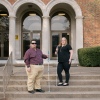
Standing among and touching their life-size figures, hands and faces drops visitors into that consequential historic moment.
“They feel like real people,” Grace Engle, a museum educator at the National Constitution Center (NCC), says to the tour group. “Except they might let you touch them a little more than your average individual might on a first meeting.”
As America recognizes 250 years of existence, this museum in the nation’s founding city has begun offering guided tactile tours aimed at blind and low vision visitors in a gallery called “Signers’ Hall.”

Left: Simon Bonenfant works with the organization Philly Touch Tours and helped train the museum educators leading the tours.
Right: Bonefant engages with George Washington’s face and head.
Rachel Wisniewski for NPR
hide caption
toggle caption
Rachel Wisniewski for NPR
The Americans with Disabilities Act (ADA) of 1990 required most public institutions like museums to make buildings themselves accessible, but access to exhibits inside is often still limited. The NCC joins a growing number of museums nationwide that have, in recent years, incorporated accessibility options like sensory-friendly days into their programming, though “touch tours” are less common.
Visitor Tim Kelly Jr. runs his fingers over Benjamin Franklin’s figure. “Everything feels so distinct on him,” he says. “He’s seated. I could also feel the wrinkles on his face because he was 81 years old at the time of the convention.”
Kelly says it’s refreshing to experience a tour tailored to the way he learns: The museum’s guides provide detailed descriptions of what can be seen and felt, while weaving in a history lesson. Pointing to Eldbridge Gerry in one corner of the room, Grace Engle says, “He is who you have to blame or thank for the beauty of gerrymandering,” explaining that Gerry had once redrawn a district in the shape of a salamander. “And so then a cartoonist deems it gerrymandering.”

The National Constitution Center in Philadelphia is participating in the nation’s 250th anniversary, in part, by expanding access to their exhibits to visitors with disabilities.
Rachel Wisniewski for NPR
hide caption
toggle caption
Rachel Wisniewski for NPR
At other moments, museum staff trace visitors’ hands over the expressive faces, clothing and hands of the statues, all while guiding them safely through the crowded space.
Kristina Marinello, senior director of museum experience, says this gallery has long invited touching. “Ben Franklin’s hands are super shiny because people have kind of always touched him no matter what. Kids like to sit on his lap.” But the center only began offering these tours officially in April, after staff trained with Philly Touch Tours, an organization that works with museums far and wide to make them more accessible.

Left: Replicas of artifacts are available as part of the tactile friendly tours the NCC now offers.
Right: Jeff and Sharon Clark touch the replica of an antique fabric. They have been to the NCC before it offered tactile tours and say the experience now is much improved.
Rachel Wisniewski for NPR
hide caption
toggle caption
Rachel Wisniewski for NPR
Trish Maunder, one of the group’s founders, says “Our mantra is ‘seeing may be believing, but when you touch, you know.’” Maunder, whose daughter is blind, calls touch the “mother sense,” one she thinks people lose connection with as they get older. She hopes tours like this become more prevalent and will help sighted and blind people alike reconnect with that sense. “Your body holds on to that sort of muscle memory, so now you carry that with you.”
Over the last two decades, museums around the country have incorporated accessibility into their programming, says Heather Pressman, who teaches courses on museums and accessibility at Johns Hopkins University. She says meeting ADA accessibility requirements “is the bare minimum.” Ensuring the artifacts in a museum are accessible takes more work, but it doesn’t have to cost much, she says. “Something super simple for people who have low vision is just creating large print labels.” Pressman says exhibits with calming sensory experiences for neurodivergent visitors are another cheap option that’s becoming more widespread. For museums with valuable, ancient artifacts, creating replicas that can be held is also a step toward accessibility.

Left: In addition to touch tours, the museum regularly holds “sensory-friendly” days for neurodivergent visitors with dimly lit rooms and sensory toys. They’re also often intended to be kid-friendly experiences.
Right: The theater in the Constitution Center is often reserved as a quiet room on sensory-friendly days.
Rachel Wisniewski for NPR
hide caption
toggle caption
Rachel Wisniewski for NPR
While accessibility programming is never complete, Pressman says it tends to open their doors to more people than museum staff may realize. “How many of us are now wearing glasses in our 40s? People can also temporarily have a disability, like you break your leg,” for example, she says. In fact, nearly a third of the U.S. population has disabilities.
Kristina Marinello says she has been working on expanding accessibility at the NCC in many ways, including through sensory-friendly days that include features like dimly lit, silent rooms. “Those first three words of the Constitution — ‘we the people’ — we want to stand by that and make sure everybody feels that,” she says.

Left: Akosua “Kosi” Asabere has been on a touch tour at the NCC once before. She says, for once, she doesn’t feel like an afterthought in a museum-going experience.
Right: Asabere feels the cuff of George Washington’s sleeve.
Rachel Wisniewski for NPR
hide caption
toggle caption
Rachel Wisniewski for NPR
As the Constitution Center’s most recent tactile tour comes to a close, second-time visitor Akosua “Kosi” Asabere shares some reflections. “Standing in Signers’ Hall and running my fingers over those bronze statues, I felt this profound sense of reverence, but I also felt deeply conflicted,” she says. Asabere is a software engineer who works on digital accessibility and says she can’t help but think about the nation’s founding document through that lens.
“It was a brilliant document, but it had massive systemic bugs. Women were left out. Black people were left out. Disabled people were left out.”
At the same time, she’s encouraged by places like the National Constitution Center, which she says are taking steps to ensure historically marginalized people, including those with disabilities, are no longer an afterthought.
Edited by: Nirvi Shah
Visual design and development by: LA Johnson


new video loaded: Federal Reserve Holds Interest Rates Steady
transcript
transcript
Federal Reserve Holds Interest Rates Steady
In his first news conference as the Federal Reserve chair, Kevin Warsh announced that interest rates would remain unchanged.
-
The committee decided to maintain the target range for the Fed funds rate at 3.5 to 3.75 percent. We recognize that inflation has been running well ahead of the Fed’s long-stated inflation goal of 2 percent. That’s been going on for more than five years. Persistently high prices are a burden for the American people. But the recent past need not be prologue. Thank you all very much.
By Alisa Shodiyev Kaff
June 17, 2026

WASHINGTON — As President Donald Trump scrambles to wrap up his war with Iran, he’s escalating another one much closer to home, against members of his own party in Congress.
From the sidelines of the Group of Seven summit in France, Trump ordered the Senate on Wednesday to cancel an afternoon hearing for Jay Clayton, his nominee to be director of national intelligence, and threatened not to sign a reauthorization of a critical surveillance law unless the Senate passed a sweeping election bill that has already failed — repeatedly.
The hearing delay not only blindsided and frustrated Senate Republicans, but it also completely derailed Majority Leader John Thune’s carefully laid plans to fast-track the nomination in a bid to unlock Democratic votes for the now-expired spying program.
Asked why Trump would pull the rug out from under them, Thune, R-S.D., said, “Good question.”
The Clayton incident isn’t the first time in recent weeks Trump has made Thune’s life more difficult.
Asked whether Trump and Senate Republicans are on different pages, Sen. Lisa Murkowski, R-Alaska, replied, “It may not be so much a different page, but he’s turning it ahead without telling us about it.”
The already fragile relationship is nearing a breaking point as Trump uses his clout to knock out senators in primaries, issue unachievable demands and repeatedly force the caucus into politically fraught positions. A number of Republican senators have expressed confusion, since his actions make it harder for them to push the White House’s own agenda forward.
“It’s undermining our ability to produce the very results he wants,” said retiring Sen. Thom Tillis, R-N.C. He called the Clayton postponement “a colossal mistake.”
GOP leaders pleaded with Trump to nominate a permanent national intelligence director after his acting pick, Bill Pulte, created a bipartisan firestorm on Capitol Hill over his lack of national security experience. Pulte is a close Trump ally and housing official who has pushed for mortgage fraud investigations into the president’s perceived enemies.
Once it became clear GOP leaders were looking to move Clayton’s nomination quickly — meaning Pulte would never step foot in the full-time role — Trump decided to throw a wrench into the process.
On Wednesday, after Trump instructed the Senate to stall his own nominee, some of his Republican allies said they’ve never seen anything like it before.
“No. I’ve only been in the Senate for 11 years, so no, I haven’t,” said Sen. Mike Rounds, R-S.D., who is running for re-election with Trump’s endorsement.
White House spokeswoman Abigail Jackson said in a statement: “The White House and President Trump have enjoyed working closely with Leader Thune and Senate Republicans to deliver on many important promises to the American people, including the largest tax cut for working Americans in history, and the Secure America Act that fully funds the President’s border security agenda. We look forward to continuing these close relationships and fulfilling President Trump’s priorities that Americans elected him to enact.”
Some rank-and-file Trump allies are trying to steer clear of the clashes.
“You could probably talk to other people around here. I don’t get caught up in, like, the palace intrigue,” Sen. Eric Schmitt, R-Mo., said when he was asked about Trump’s pushing to stall Clayton. “They tend to generally work themselves out.”

Senate Intelligence Committee Chairman Tom Cotton, R-Ark., repeatedly declined to answer questions from reporters Wednesday but, in announcing he would postpone the Clayton hearing, called the delay “regrettable.”
Cotton’s Democratic counterpart on the committee, Sen. Mark Warner, D-Va., said that “this is not a problem between Democrats and Republicans in the Senate,” placing the blame squarely on Trump.
“He threw a live hand grenade into this whole process,” Warner said.
It was just the latest instance in recent weeks of Trump’s timing disrupting his own agenda on Capitol Hill. His requests for $1 billion in ballroom security money delayed the ICE and Border Patrol funding bill. His administration’s announcement of a $1.8 billion “anti-weaponization” fund to compensate allies stalled it even further. And his choice of Pulte came days before the FISA Section 702 program expired, ending any hopes of a deal by last Friday’s deadline.
Adding to Republican frustration was Trump’s move to oust Sen. John Cornyn, R-Texas, with his endorsement of state Attorney General Ken Paxton in the primary. Not only is Cornyn well-liked among his colleagues, but GOP strategists also fear Paxton’s nomination will make it tougher to hold the seat this fall, boosting Democrats’ chances of winning control of the Senate.
“It’s not about sympathy; it’s about basically being able to function,” Cornyn said when he was asked whether he’s sympathetic to Thune’s situation. “I think part of the problem is not President Trump, it’s us making unrealistic promises, and then when they’re not attained, then criticizing one another.”
For Trump’s allies, the small slights are adding up. On Monday, when senators arrived at the Capitol for afternoon votes, they were flying blind in the face of questions about the emerging Iran deal. They weren’t given details, even as many of them have been asking to see the text of the memorandum of understanding. The White House sent them talking points later that evening, after they spent hours walking around the Capitol and addressing reporters.
Asked Wednesday early afternoon about the memorandum of understanding with Iran, Schmitt replied, “The MOU that no one’s seen?”
Even Thune appears to have been left in the dark.
“We haven’t seen anything yet, so there’s nothing really at this point to react to,” he told reporters of the memorandum of understanding Tuesday morning, though Trump had announced the 60-day ceasefire Sunday.
A senior U.S. official provided NBC News with a copy of the memorandum of understanding Wednesday, saying the U.S. originally held back on releasing the text at the request of Iran.
Much of the tension stems from Trump’s inability to secure his top legislative priority of passing the SAVE America Act, a sweeping election law to impose voting limits in every state. Democrats vehemently oppose it, ensuring it can’t get the 60 votes needed to pass the Senate. And most GOP senators are resolute in their opposition to abolishing the filibuster — another persistent Trump demand — seeing it as a long-term protector of conservative priorities.
Trump has also tried — and failed — to get Republicans to fire the parliamentarian, essentially the Senate’s referee, who has determined that the bill is ineligible for a simple-majority vote under Senate rules. And in a clear rebuke to Trump, his allies’ attempts to add it to the ICE and Border Patrol funding bill this month couldn’t even get 50 votes, losing four Republicans and failing 48-50.
“The only way you could get there is to undo or get rid of the legislative filibuster, and there aren’t even close to the votes here in the United States Senate in order to achieve that,” Thune told reporters this month of the SAVE America Act. “It’s not something that we’re going to be able to get done absent having an election, electing some more Republicans.”
Asked Wednesday about the Trump-Thune tensions, Sen. Cynthia Lummis, R-Wyo., said that Thune speaks for the Republican conference and that nobody is vying to replace him. She said Thune is right to candidly tell Trump the votes aren’t there to pass the election bill.
“He should be as frank as he’s being,” Lummis said. “My favorite saying: Tell the truth; it’s easier to remember.”

After the Supreme Court weakened the Voting Rights Act in late April, Republican lawmakers across the South scrambled to redraw their states’ congressional maps.
The court’s decision allowed Republicans, who hold supermajorities in legislatures across the South, to go after more Democratic-held House districts, extending a lengthy tit-for-tat redistricting battle with Democrats that had seemed at an end. While Republicans said they were focused only on partisan advantage, not race, the changes effectively targeted areas where Black voters form the majority.
The effort angered many Black Democrats, who accused conservatives of intentionally undermining their voting power in a region with a painful history of discrimination. Voting remains racially polarized in the South, so Black voters have historically backed Democrats.
Here’s a look at how Louisiana, Alabama and Tennessee broke up majority-Black districts. At least one other Southern state, Georgia, aims to follow suit before the 2028 election.
Louisiana
Louisiana’s former congressional map was at the center of the case before the Supreme Court, which declared the map an illegal racial gerrymander. The new map targeted the Sixth Congressional District, a fairly new majority-Black seat that included the capital, Baton Rouge.
About a third of voters in Louisiana are Black.
Black outlines indicate majority-Black districts.
Distribution of Black voters in …
How Black voters were redistributed in Louisiana
During the debate over redistricting, the president of the State Senate, Cameron Henry, a Republican, told reporters, “If you’re taking the variables in place, such as incumbency, such as party, into some of the factors, you don’t have a lot of options.”
Where more Black or white people live
Where Trump orHarris got more votes
Most of the changes center on Black — and mostly Democratic — voters who live around Baton Rouge. The district lines, however, largely preserve the New Orleans-area majority-Black seat held by Representative Troy Carter, a Black Democrat.
Alabama
After the Supreme Court ruling, Alabama asked the courts to allow the state to use a map that the legislature approved in 2023 but that was later rejected by a federal court. The Birmingham-based federal court had ordered Alabama to draw a map with a second majority-Black district or something “close to it.”
More than one in four Alabama residents are Black.
Black outlines indicate majority-Black districts.
Distribution of Black voters in …
How Alabama dissolved one of its two Black voting strongholds
An independent special master drew a new district that stretched from the capital, Montgomery, through the region known as the Black Belt for its rich, loamy soil, to Mobile, a coastal city.
Outside the South, “there’s not that history of racial animus and racial discrimination towards blocking or minimizing your vote,” said Representative Shomari Figures, a Black Democrat who won the new majority-Black seat in 2024 only to see it redrawn to favor Republicans in 2026.
Where more Black or white people live
Where Trump orHarris got more votes
Republicans said the 2023 map would ensure representation for the Gulf Coast region of the state because it did not split Mobile from the rest of Mobile County. This month, the Supreme Court said Alabama could use it.
That leaves the state with one majority-Black district, which includes the city of Selma. That seat is held by Representative Terri Sewell, a Black Democrat.
Tennessee
After the Supreme Court ruling, Tennessee was the first state to draft and approve a new congressional map that went after its one majority-Black seat, the Ninth Congressional District.
That district included the city of Memphis, where more than half of the state’s Black population lives. The new map split the Memphis area into three districts.
Black outlines indicate majority-Black districts.
Distribution of Black voters in …
How Tennessee broke up its only majority-Black district
The Ninth was one of the few majority-Black districts represented by a white lawmaker, Representative Steve Cohen. Mr. Cohen, a Democrat who had retained significant support among Black voters since his first election in 2006, said he would not seek re-election.
Where more Black or white people live
Where Trump orHarris got more votes
There is no longer a single majority-Black district in Tennessee.
-
 Lifestyle26 minutes ago
What — and who — will be at the Great American State Fair? Here’s a primer
-

 Technology34 minutes ago
Midjourney goes from generating cat images to full-body ultrasound scans
-

 World41 minutes ago
Colombian military neutralizes five terrorists accused in bus bombing that killed 20, injured 45 civilians
-

 Politics44 minutes ago
Hegseth announces 6-month review of American forces in Europe, blasts NATO allies for putting troops ‘at risk’
-

 Health49 minutes ago
Zero sugar, more problems? Study reveals surprising gut health effects
-

 Sports56 minutes ago
Deion Sanders wanted more from his son, Shedeur Sanders, but backs development plan after Myles Garrett trade
-

 Technology59 minutes ago
UK to ban TikTok, YouTube, other social media apps for children under 16, Starmer says
-
 Business1 hour ago
Commentary: A porn firm that a judge called a ‘copyright troll’ now has Meta in its sights — and it could win

