News
Texas School Police Pepper-Sprayed, Tackled and Tasered Students


Since the massacre at Robb Elementary in Uvalde in 2022, school districts across Texas have spent billions of dollars to station police officers on every campus in the state. The effort, the most ambitious in the nation, was intended to protect students from similar tragedies.
But the constant presence of officers has transformed the way many public schools manage discipline, subjecting students to heavy-handed police tactics for behavior that once would have landed them only in the principal’s office, The New York Times and The San Antonio Express-News found.
Officers in Texas displayed startling belligerence at times, grabbing or tackling students a fraction of their size over misconduct that often appeared to be minor. Children in elementary school, including one as young as 6, were handcuffed. Teenagers were arrested, charged with crimes and even jailed. In the most extreme cases, they wound up in hospitals, bruised or concussed, after being body-slammed or shocked by Tasers, which are prohibited in the state’s juvenile detention facilities but allowed in its public schools.
There is no comprehensive record of use-of-force incidents across the more than 1,000 public school districts in Texas. Many districts and police agencies declined to disclose their data to our journalists; others did not respond to public records requests. More than 200 provided some information, but in most cases, it was limited.
Still, by examining even that small share of records, our reporters identified more than 2,600 use-of-force incidents that occurred from January 2022 through December 2025. About 450 of those interactions were described in detailed reports, which we reviewed. We also watched video footage from over two dozen encounters.
The records provide a first-of-its-kind look at how Texas’ initiative around school policing has played out in districts large and small, urban and rural.
Many incidents began over misbehavior such as dress-code violations, vaping or schoolyard scraps. Officers, often summoned by principals or teachers, escalated some situations by shouting obscenities or insults. They used physical takedown tactics in about 60 situations when students ignored their commands, talked back or pulled away.
In the Judson school district, which includes parts of San Antonio, an officer slammed a 15-year-old boy onto a table after he threw a cheese stick at another student, according to witnesses cited in public records. In a statement, the school district said that the student had tried to walk away from the officer, who used “necessary force to gain control of the situation.”
In the Cypress-Fairbanks district, near Houston, an officer hogtied a 10-year-old boy with a behavioral disorder who had kicked the principal, using a cord to bind his hands and feet behind his back, an internal investigation found. The officer had twice before used the same restraint technique, when the boy left campus during school, the records show. The district later banned the practice.
Tayshawn Chadwick, 17, was suspended from his school in the Aldine district for threatening to fight another student in December 2023. When he tried to retrieve his house keys from a classroom before leaving campus, a school officer pinned him against a window, according to records. Another officer pressed a Taser against his skin and shocked him repeatedly.
“It felt like a lightning bolt,” Tayshawn recalled in an interview.
Tayshawn was charged with resisting arrest and held in the county jail. The charge was dismissed after he completed an anger-management program. The school district declined to comment on the incident; records show that the officers’ supervisors deemed their actions in compliance with department policy.
In interviews, dozens of parents, teachers, principals and students said that they believed police officers were needed to keep schools safe. Many praised officers for stopping violent fights. Almost everyone cited fear of school shootings. As recently as March, a student at a high school in the San Antonio area shot a teacher and then killed himself. School officers have confiscated dozens of guns in that region alone, and some have thwarted potential attacks.
“Just look at the TV,” said LaTres Essien, who teaches third-grade math in Dallas. “There’s no school in America that should not have some kind of officer.”
Police chiefs said physical force was necessary in police work, even at schools. “We can’t be lackadaisical and say, ‘Well, we’re in a school, and maybe we shouldn’t go hands on with this student,’ and then it rises to a level that he or she does hurt someone,” said Charles Carnes, who in December retired as chief of the Northside school district’s department in San Antonio.
Some departments disciplined officers for going too far, including in the hogtie incident and the pepper-spray and vape cases shown in the videos above. (Neither the officer involved in the lunchroom brawl case nor his department provided comment.)
But in Texas, no state agency has the power to routinely review school officers’ actions and weigh in on possible overreach.
Lawmakers here have embraced school policing without establishing safeguards required for meaningful accountability, policing experts said. A 2019 law meant to keep officers out of “routine student discipline” does not define the term or detail repercussions for violations. Police departments in Texas are not required to report incidents of force in schools unless they shoot someone.
School boards and police agencies are responsible for oversight, state officials said. But in interviews, two dozen board members from across Texas said they did not consider that part of their job. “We just approve what they need to buy,” said Michael Valdez, a board member in the Edgewood school district in San Antonio.
Several said they were unaware that their officers used force on students at all.
A review of use-of-force policies from more than 200 school district police departments found that many were largely copied from those used by municipal police agencies. Some addressed how to handle livestock and animal control calls. Most provided no specific guidance on handling students.
‘Eyes Wide Open’
Police officers have been assigned to some schools in Texas for nearly a century. In the 1930s, newspaper articles show, the Houston Police Department employed part-time “school policemen” to help direct traffic.
But it was not until the 1980s and ’90s, amid concerns about drugs and violence, that the ranks of school officers began to swell. The 1999 shooting at Columbine High School in Colorado led to a larger rise.
Elsewhere in the country, school districts typically tapped the local sheriff’s office or police department for officers. Texas was unusual in that many districts formed their own departments instead.
As police presence in schools grew, some educators became wary of harsh punishment and practices that could push students into the criminal justice system. Even in law-and-order Texas, concerns seemed to break through. In 2019, the Legislature passed a law saying that school boards should not task officers with routine student discipline.
Then came Uvalde, the deadliest school shooting in Texas history, which claimed the lives of 19 students and two teachers.
A year later, in 2023, lawmakers passed legislation to require at least one licensed police officer at each of the state’s public schools. While other states had taken steps to increase school security, few relied as heavily on the police.
Before the Texas law was adopted, some parents, teachers and advocates warned that it would lead to more arrests and incidents involving force. Alycia Castillo, the associate director of policy and advocacy for the Texas Civil Rights Project, a nonprofit based in Austin, said that several groups had already raised concerns about heavy-handed police tactics in schools. Lawmakers, she said in an interview, had their “eyes wide open.”
In the two years that followed, statewide annual spending on school security rose to more than $1.3 billion from about $900 million.
Today, Texas is home to nearly 400 school district police departments, more than all other states combined. Most of the remaining districts have contracts with outside police agencies. The number of officers trained to work in schools — about 11,000 — exceeds the total number of police officers in at least two dozen states.
Most of what school officers do is mundane. They secure external doors, usher students through metal detectors and monitor hallways for fights. Some mentor students and offer advice.
But routine interactions have been punctuated at times by physical encounters. Officers grabbed or tackled students hundreds of times, data and records show. They used pepper spray in dozens of cases and shocked students with Tasers in at least nine incidents. On four occasions, reporters found, officers held teenagers at gunpoint.
Some large school districts reported using force more than 100 times in a school year. In an interview, Kirby Warnke, the chief of the Corpus Christi school district police department, said that his officers got physical with students “almost every day,” often to restrain or redirect them.
Students were left with bruises, scrapes or other injuries in nearly a quarter of the 450 cases reviewed by reporters. Two teenagers suffered concussions, according to medical records and an interview with one family’s lawyer.
About two dozen of the overall cases involved children in elementary school. In the Northside school district, an officer handcuffed a 6-year-old boy who kicked a school employee during a tantrum.
State law prohibits using restraints on children in fifth grade or below in all but the most dangerous situations. In a statement, the district said that the officer had perceived an “immediate risk of harm.”
The boy was still in cuffs when his father arrived a few minutes later and began filming on his cellphone.
“The police wants me to die!” the child cried.
‘The Heavy Hand’
In May 2024, Anabelle Jaramillo rang a plastic doorbell outside a classroom at Texas City High School. The $13 bell came off and Anabelle walked away with it, according to a description of surveillance footage included in a police report.
The next day, administrators accused the 17-year-old honor student of theft and assigned her three days of in-school suspension.
Certain there had been a misunderstanding, Anabelle showed up at the office of Sonia Davis, an assistant principal. She told Ms. Davis that she had accidentally dislodged the doorbell and tucked it into a nearby planter so that she would not get in trouble, she recalled in an interview.
Still, Ms. Davis summoned the Galveston County sheriff’s deputies at the school and, body camera footage shows, asked them to speak with Anabelle about theft.
Anabelle continued to plead her case. She texted her mother, and Ms. Davis extended her suspension by two days for using a cellphone in the office. Ms. Davis told Anabelle to leave. But the teenager would not budge from her seat.
Anabelle gasped for air for about three minutes before going still, body camera footage shows. Ms. Davis called for the school nurse. Deputy Ruiz took her pulse. Anabelle later told reporters that she had passed out.
Other cases reviewed by reporters similarly escalated.
A staff member called for an officer when a 17-year-old in a special education class threatened a classmate and threw a “sanitizer can” at the student, the police report said; the officer dragged the boy to the ground and, after a scuffle, punched him in the face twice, video footage shows.
A teacher alerted an officer to a 15-year-old who was swearing in a hallway; the officer took the student down, records show, and dragged him into a room by his leg.
In interviews, educators said that they sometimes needed help managing unruly students. Many feel pressure to be tough on misbehavior, said Anita Wadhwa, a former teacher who now runs a nonprofit in Houston focused on alternative approaches to school discipline.
“No adult wants to look like a kid is talking back to them,” she said.
Some school district leaders said that they had sent a clear message: Officers should get involved only if a student is accused of a serious crime or if someone is at risk of physical harm.
“Our officers are not disciplinarians, period,” said Sean Maika, who was the superintendent of the North East Independent School District in San Antonio until January.
But in many places, that message seems to have gotten lost. Michelle Parsons, who teaches a training course required for school officers in Texas, said that officers frequently described being pulled into minor disciplinary matters. At a recent training attended by a reporter, officers were told to stay out of incidents that would not otherwise prompt a 911 call. Several scoffed and said their principals would be unhappy.
Mrs. Parsons said that principals and teachers often see officers as “the heavy hand.” Texas does not require them to be trained on when to call school police.
Shortly after Anabelle’s arrest, her mother, Martha Jaramillo, arrived at the school to find her on the ground, footage shows. “She was very rude to us,” Ms. Davis, the assistant principal, told Mrs. Jaramillo.
Mrs. Jaramillo told the nurse about her daughter’s health conditions, including asthma. One of the deputies called for paramedics, who took the teenager to an emergency room.
Two weeks later, Anabelle turned herself in at the county jail for the theft charge. There, she said, she had another panic attack.
Neither Ms. Davis nor Texas City school district officials agreed to be interviewed for this article. In a statement, the district said Ms. Davis had not violated its policies. The Galveston County Sheriff’s Office declined to comment. The deputies involved in the case did not respond to multiple efforts to reach them.
Kim Simon, a national expert on school policing and a former officer from Virginia who reviewed the case for The Times and The Express-News, said that Ms. Davis and the officers had escalated a minor offense unnecessarily.
“Nobody was acting in the best interest of a child,” Ms. Simon said.
Command and Control
Across the state, officers directed obscenities, insults and threats at students just before or after using physical force, records and video footage show.
“Stop crying like a little girl,” a school police officer in San Antonio ordered a seventh-grade boy who had gotten in trouble for being disruptive.
“Boy, I will hurt you,” an officer in Houston told a high school student who talked back to him.
“Get your fucking hands up before I shoot you!” an officer in Galveston shouted while pointing her gun at a 17-year-old she had cornered in a yard. The teen had run off campus after he was caught with a vape.
Most officers employed by a Texas school district previously worked for municipal police agencies, an analysis of police certification data found. More than 1,000 worked as jailers.
In those roles, officers are encouraged to have a commanding presence in order to take control of dangerous situations.
“The notion of policing requires force,” said Aaron Kupchik, a professor of sociology and criminal justice at the University of Delaware, who writes about school policing. “It requires that you compel people to obey your authority.”
But dealing with young people, he and other law enforcement experts said, calls for a different approach. Research shows that adolescents, whose brains have not yet fully developed, often have difficulty with impulse control. Yelling at or physically dominating them, the experts added, can backfire.
In Texas, the state-mandated training for school police officers includes instruction in child psychology, conflict resolution and managing students with behavioral issues. But at only 20 hours, the program is half the minimum recommended by the National Association of School Resource Officers. Kentucky, which also mandates officers at all public schools, requires 120 hours.
When officers used force on students, department leaders almost always had the final say on whether they acted within bounds or overstepped.
Supervisors often reviewed forms describing the incidents, and they noted on some whether they approved of the officers’ actions. Reporters examined more than 100 such documents, finding that supervisors almost always determined that the force had been appropriate.
In some other cases reviewed by reporters, officers were disciplined, but received little more than verbal warnings or orders to get additional training.
In 2024, Officer Linda Holland used pepper spray to stop a group of girls from fighting and then kneed one of the girls in the face, video footage shows. She was required to complete four training courses, including one on ethics, according to an internal report. A supervisor wrote that her actions were “not a good look.”
Officer Holland hung up when a reporter called for comment. In a statement, the district described the scene as “chaotic,” adding that the officer did not intend to hurt the girl.
Some parents, records show, took concerns about officers to the Texas Commission on Law Enforcement, which licenses all of the state’s police officers. But the commission says it cannot investigate excessive force complaints unless the officer was criminally charged.
In at least two cases, when parents have filed federal lawsuits against officers over use of force, the appellate court that covers Texas ruled against their claims. In 2023, the court ruled in favor of an officer who used a Taser on a 17-year-old boy with an intellectual disability when he tried to leave school. The court said that the officer’s actions were akin to corporal punishment, which is legal in Texas.
Alienated and withdrawn
Some students who were subject to physical force from police officers said that they had suffered lingering consequences.
Tayshawn Chadwick, who was stunned with a Taser, said he stopped leaving the house. Julian Montes, who was slammed into a lunch cart, is now afraid of police officers.
Anabelle Jaramillo said the doorbell incident led her to become withdrawn from even close friends.
Prosecutors dismissed the theft charge after she completed an online course about stealing. But she was mortified when a crime website posted her mug shot. She finished her classes from home and skipped her graduation ceremony.
Two years later, Anabelle has finally begun to put the trauma behind her. She gave birth to a son and completed community college. She plans to attend a nearby university in the fall in hopes of becoming a veterinarian. But the police episode has made her less trusting. The adults at her high school, she said, had failed her.
“I thought they’re there to hear you out, to build you up and get you into the future,” she said. Instead, “They broke me down.”
Justin Mayo, Melissa Manno, Liz Teitz, Maggie Allwein and Teresa Mondría Terol contributed reporting. Susan C. Beachy, Kitty Bennett, Alain Delaquérière, Georgia Gee, Sheelagh McNeill and Kirsten Noyes contributed research. Produced by Nico Chilla, Jerry Vienna and Rumsey Taylor. This article was reported in partnership with Big Local News at Stanford University.

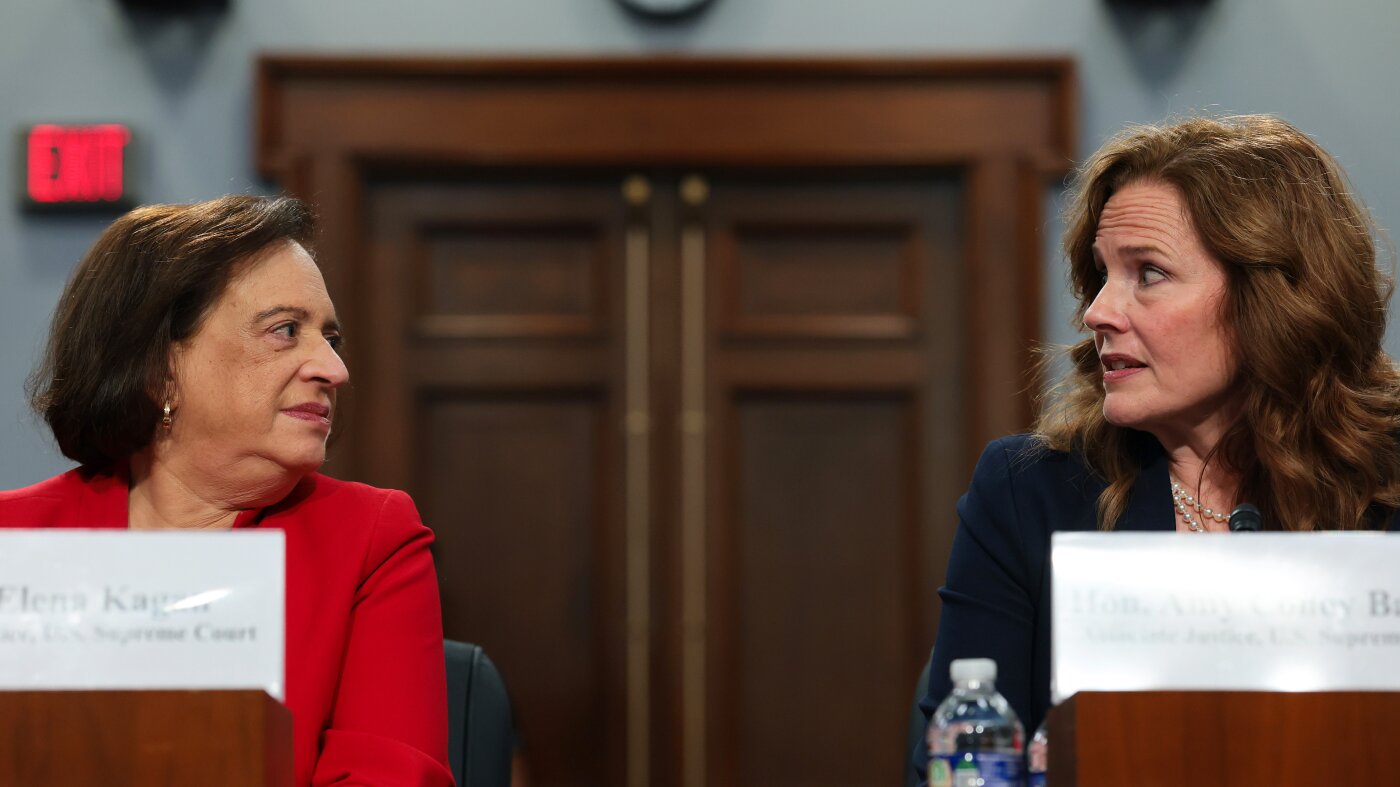
Supreme Court Justices Elena Kagan and Amy Coney Barrett testify before the House Appropriations Committee on Capitol Hill on July 14, 2026 in Washington, D.C.
Anna Moneymaker/Getty Images
hide caption
toggle caption
Anna Moneymaker/Getty Images
The Supreme Court did something Tuesday that it has not done in seven years. It sent two of the justices to Capitol Hill to testify about the court’s budget request for the coming year. The budget has grown dramatically in recent years because of the equally dramatic rise in the number and intensity of threats to the justices’ safety.
Designated as the court’s representatives were Justice Elena Kagan, appointed by President Obama, and Justice Amy Coney Barrett, appointed by President Trump.
As Kagan pointed out in her testimony, it was Republican Darrell Issa and Democrat Elijah Cummings who insisted that the court beef up its security ten years ago after Justice Antonin Scalia died in his sleep on a hunting trip, with no security anywhere nearby to respond quickly.

“They said, kind of like, we think you’re crazy, you know, that that you have less security than director of the Office of Personnel Management does,” she recounted the Congressmen as telling the Court, “and we think that you have to do better.”
Before that, the justices basically had little to no security. They drove their own cars to work; went to the movies and shopped at supermarkets unaccompanied, and did their private travel on their own. And frankly, they liked it that way, because having security is personally invasive.
In recent years, however, the court has undertaken major changes, including continually expanding the court police force to protect the justices and their homes at all times, and funding additional cybersecurity measures.
And yet, as Justice Kagan pointed out, the Court’s $207 million budget request is less than one tenth of one percent of the entire federal budget.
The justices spoke at length Tuesday about how rising threats impacted their lives. Justice Barrett came prepared with two harrowing stories. First was the day she brought home a bullet-proof vest.
“My 12-year-old son was standing in the doorway of my bedroom and he wanted to know what it was,” she testified, “and I didn’t know how to respond. I didn’t expect that performing this service was going to put me in the position of explaining to my children what a bulletproof vest was and why I had to wear one.”
She also described how just six weeks ago, her house was swatted, with local police responding to a fake emergency call. Local police could have stormed her home, but for the fact that her own security detail was there to prevent it.
Indeed, threats have deeply affected judges across America. After U.S. District Court Judge Esther Salas’s 20-year old son was murdered by a gunman seeking to kill her, many federal judges have reported receiving packages bearing the name of her slain son. Those threats, Justice Barrett testified, “are meant to intimidate and they’re meant to harass.”
Sen. Jack Reed (D-R.I.), asked questions about President Trump’s furious response to adverse rulings in the tariff and birthright citizenship cases, and whether Trump’s heaping insults on the court could play a role in jeopardizing the safety of some justices. Kagan had a two-part reply.
“Criticism is fair game. I mean, go for it. You know, life in the big city is that you’re subject to all kinds of criticism. But intimidation is a different thing entirely. And when political figures of any stripe are trying to intimidate judges,” she said, “that’s where we really have crossed the line.”
The hearings were not confined to issues of safety. Congresswoman Rosa De Lauro (D-Conn.) asked about the Supreme Court’s ethics requirements, noting that members of Congress and the executive branch are limited to gifts under $50, while the Supreme Court has no such limit.
She is supporting a bill that would impose upon the Supreme Court the same restrictions on receiving gifts that apply to Congress. And she called for an enforcement mechanism for the ethics rules adopted by the Supreme Court itself.
But Justice Kagan, who said she favors an enforcement mechanism, added that creating such a system is “hard.” After all, as she noted, “you wouldn’t want either the President or Congress” imposing a system on the court because that could well lead to compromising the independence of the judiciary.
One idea that Kagan seemed to like would be to create a panel of distinguished retired judges to enforce the court’s ethics code. But Justice Barrett seemed unpersuaded.
“Who selects the judges? How is the panel composed? There’s just a lot of complexity,” that hasn’t been worked out, she said. The disagreement between the two was, if anything, illustrative of just how hard it was to get the court to finally agree on even the relatively porous ethics code it voluntarily adopted in 2023.
The Justices were also questioned about the court’s emergency docket, dubbed by critics “the shadow docket.” These cases were extremely rare until the Trump administrations.
The critical difference between the emergency docket and the so-called merits docket is that emergency docket appeals often leapfrog over the lower courts, allowing the high court to decide cases without full briefing and argument, and inevitably without much, if any, explanation.
Critics, including Justice Kagan, have often criticized these unsigned and unexplained emergency docket orders for making it difficult for lower courts to know what the law is. Some have in fact accused the court of inviting the Trump administration to treat the docket like a fast-pass to getting policy rubber-stamped.
Questioned by Senator Chris Van Hollen (D-Md.), Kagan observed that part of the reason for the Court’s increasing use of the emergency docket comes from the fact that “we’ve granted a number of these…And when people know that relief is available, there are a lot of smart lawyers out there in the world who are going to say, ‘Why don’t we take our shot at that?’” In other words, the court’s own behavior may have invited the existing problem to metastasize.

Mexico has begun filing criminal complaints with state prosecutors in the United States over the deaths of its citizens in U.S. immigration custody and during enforcement operations, the foreign mini

Maine ICE shooting caught on security camera
Surveillance footage from two local businesses shows a white car driving in circles at a street intersection.
MEXICO CITY, July 13 (Reuters) – Mexico has begun filing criminal complaints with state prosecutors in the United States over the deaths of its citizens in U.S. immigration custody and during enforcement operations, the foreign ministry said on Tuesday.
Mexico’s government has also sent cease-and-desist letters to U.S. detention centers where Mexican nationals have died, the ministry added in a statement.
The filings follow the deaths of at least 14 Mexican nationals in ICE custody and several others during arrest operations, including the recent fatal shooting of a Mexican citizen by an ICE agent in Houston.
President Claudia Sheinbaum announced Mexico’s intention to escalate its response to the deaths last Friday, as she claimed that the government “cannot turn a blind eye to the Mexicans who have died.”
In addition to the measures in the U.S., Mexico’s foreign minister also contacted the United Nations High Commissioner for Human Rights regarding the deaths of Mexican nationals in ICE custody.
Mexico expects the U.N. office to gather information from U.S. authorities, analyze the events and “refer the case to the relevant special procedures of the Human Rights Council,” the statement added.

Michelle Mildenberg Lara for The Marshall Project
This much is undisputed: On Nov. 2, 2023, a guard and a prisoner at a federal penitentiary in California got into it over a straw sunhat that the officer had confiscated. The man — identified in court records by his initials, J.M. — walked out of the office, as Officer Sandra Munagay followed him. When he stopped and turned around, Munagay “cocked back … and punched me in my face,” he said in an interview. That is on camera. Munagay admitted to the assault and pleaded guilty this January to falsifying records about it.
But the more severe harm came after, J.M. said, in a hallway without security cameras. As Munagay kicked and hit him, she shouted to other officers that J.M. had attacked her. According to a lawsuit, at least three other guards then rushed in, forced him into a blind spot, and pinned him face-first to a wall. With J.M.’s hands cuffed, he says an officer then sexually assaulted him with an unknown object.
That night, J.M. was transferred to another prison, where a nurse noted bleeding and tenderness in his rectum, medical records show. That gave J.M. more proof than most people behind bars in his situation.

But guards still had near-total control over whether he could file a complaint, or someday sue over what happened to him. J.M. knew they could destroy his paperwork, claim it got lost, or simply deny him the forms he needed. And like he had experienced in other federal prisons, he says, they might punish him for even trying to speak out.
It’s the same dilemma presented to anyone who faces violence in federal prison: Try to file an administrative grievance and risk opening yourself up to retaliation — or stay quiet, endure the abuse, and forgo your chance to someday bring your case to court.
Under federal law, people in prison must go through the facility’s own grievance process before they can attempt to sue. That gives prison staff a “chokehold over access to the courts,” said Colin Prince, a civil rights attorney and former federal defender who is representing J.M. in his lawsuit.
“The guards functionally have power over whether a prisoner can sue them for their own misconduct,” he said. “The entire system is layer upon layer of bureaucratic insulation against accountability. It simply prevents prisoners from getting access to the courts.”
An attorney for Munagay said he and his client declined to comment. A spokesperson for the Bureau of Prisons, Randilee Giamusso, said she could not discuss individual cases or ongoing litigation.
An investigation by The Marshall Project and NPR found that less than 2% of grievances filed in federal prison in 2023 were granted. A majority were rejected for procedural errors or “administratively closed” for other reasons. The findings were based on a federal database, published by the Data Liberation Project, containing nearly 1 million federal prison grievance cases dating back to 2000.
But that data only includes instances where incarcerated people were able to file a complaint at all. An unknown number of cases, especially those involving physical and sexual violence, go unreported, as the same officers accused of abuse can silence those trying to seek help, according to court records, lawsuits, and interviews with attorneys, incarcerated people, advocates and former bureau officials. A recent report by the Government Accountability Office found that fear of retaliation was a major impediment to reducing and reporting sexual abuse in federal prisons.
Prison officials said bureau policy prohibits retaliation of any kind, and that they review and investigate allegations of abuse. In an email, Giamusso wrote that the remedy system is “a safeguard intended to foster resolution within the system, not a barrier to court access.” She noted that remedies related to sexual abuse can be submitted in other ways, such as “third-party reporting and [Prison Rape Elimination Act]-specific channels.”
But many prisoners disagree. “The grievance system is a joke,” said Jimmy Hodge, who was released from federal prison in early 2025. Hodge says he was abused in multiple federal penitentiaries, but was frequently blocked from filing complaints about it. “If you’re grieving over abuse, they’re going to harass you, they’re going to assault you, but you’re never going to get relief.”
Since the passage of the Prison Litigation Reform Act 30 years ago, which required incarcerated people to file grievances before attempting to sue, the rate of civil rights cases filed from prison has dropped significantly.
Lawmakers at the time were concerned about “frivolous” lawsuits from prisons overwhelming federal courts. Politicians pointed to one case where a person had allegedly sued over whether he received chunky or creamy peanut butter. (The case was actually about not getting a $2.50 refund for peanut butter returned to the commissary, which is the equivalent of hours of prison labor.)
“People talk a lot about prisoners filing frivolous lawsuits,” said professor Margo Schlanger of the University of Michigan Law School, who has studied prison litigation across the U.S. “But a huge number of prisoner cases are about really, really serious matters. They’re about abysmal medical care and awful conditions and failures to protect them from harm by staff or by other prisoners. They’re about sexual violations.”
Attempts to significantly reform the law have gone nowhere, Schlanger said. “Having a system that stands in the way and says, ‘You know what, because you filed that grievance after three days instead of after two, you are out of luck and out of court’ — that is a shocking betrayal of justice.”
People who are blocked from filing grievances can sometimes convince a court that the remedy system was unavailable and their lawsuit should proceed. But that is a high bar that may require documentation and the help of an attorney, which many people filing from prison don’t have.
As is, the law fails to account for all the ways prison staff can thwart someone’s attempts to follow the remedy process, attorneys say.
To submit a complaint, someone must obtain a form from their counselor or another prison employee and then return the completed form to staff. According to bureau rules, an incarcerated person must file on their own behalf, unless it is regarding sexual abuse — whether they are in the infirmary or solitary confinement or have a disability. They can receive assistance with their filing from “trained inmate aides,” someone on the outside or a staff member, Giamusso wrote.
For people in isolation, filing a complaint is even harder. “You can’t just walk over to a box on the wall that says grievances and put it in the slot,” said attorney John Boston, co-author of the “Prisoners’ Self-Help Litigation Manual.” “You’ve got to hand it to the correctional officer. And that right there is a prescription for mischief.”
Multiple people in federal prison said officers refused to provide the forms they needed. “I have had difficulty in obtaining the initial grievance form because the unit counselor who issues the forms was friends with the officer whom the complaint was about,” wrote Erick Hobbs, now incarcerated in federal prison in North Carolina. According to Giamusso, if someone can’t get a form, they can ask for help from any staffer, “proceed to the next step in the remedy process, or report concerns through alternative channels.”
Even if you can get a form, there’s no guarantee the paperwork will be filed. “I have had officers doing a ‘random shakedown’ of a cell, and remedy papers go missing,” wrote William Batton, from a federal prison in Massachusetts. Many said prisoners were often transferred to a new facility and lost their paperwork in the process. That halts a case, as any appeal requires copies of every previous response and filing.
People in federal prison have just 20 days after an incident to file a complaint. Those regarding sexual abuse are supposed to be exempt from deadlines, under the federal Prison Rape Elimination Act. There is no such exemption for physical violence.
“People who are the most hurt are often the least equipped to describe it and file a grievance promptly,” Schlanger said. “Requiring them to very speedily figure out exactly what they’re complaining about can be a very, very high hurdle.”
By the time J.M. was assaulted in California, he had served time in some of the country’s most notorious federal prisons. In 2020, he was held at Big Sandy penitentiary in Kentucky, where officers had an unofficial policy: If someone requested protective custody because they feared other prisoners, guards would beat the person asking for help. Then the guards worked together to cover up the attacks, according to court records. Six staff members at Big Sandy were convicted for their role in the abuse.
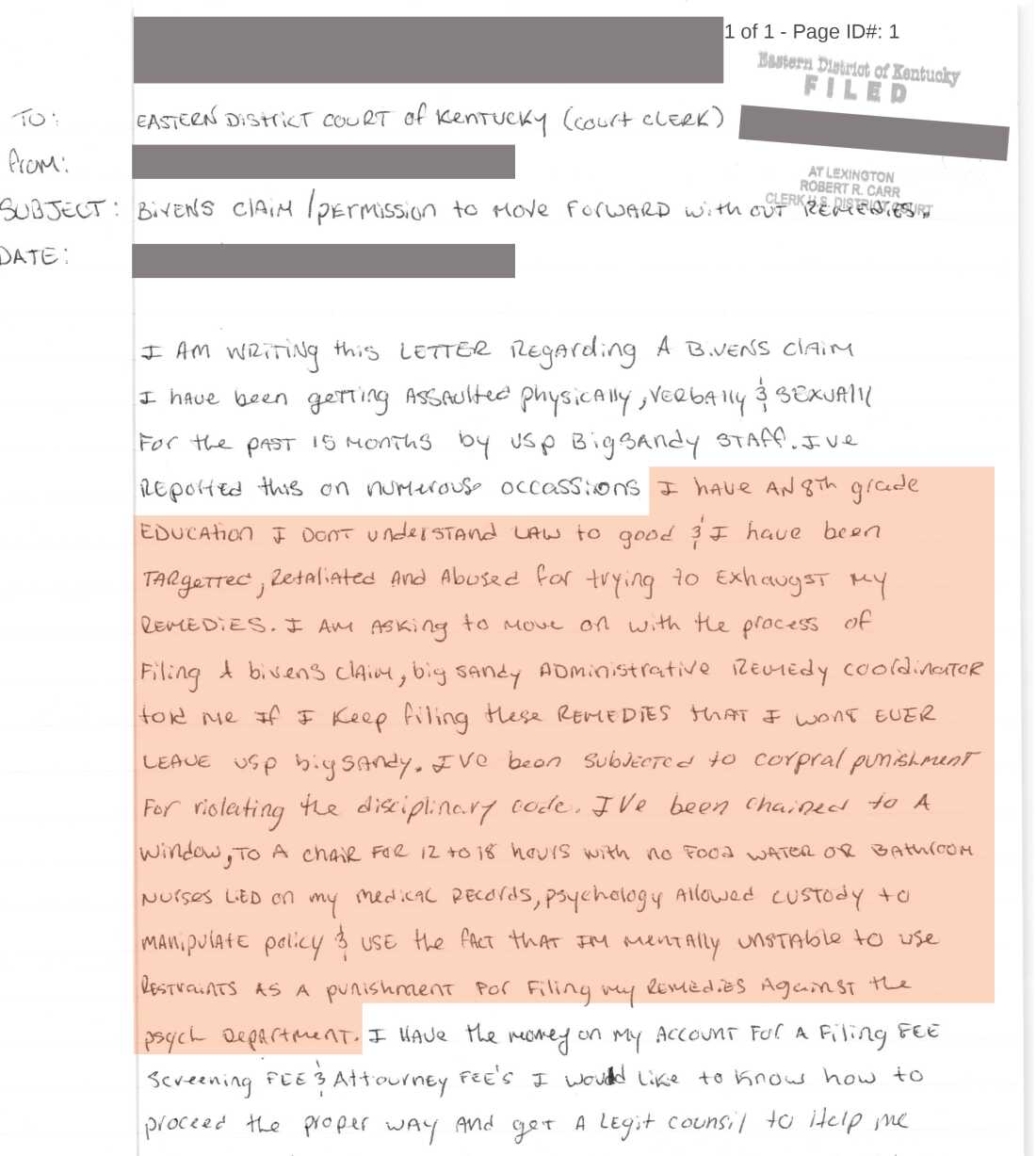
J.M. tried to report the abuse he received at Big Sandy penitentiary in 2020 to the Eastern District Court of Kentucky. The highlighting and redactions were done by The Marshall Project.
PACER
hide caption
toggle caption
PACER
When J.M. tried to report the abuse he said he suffered at the hands of Big Sandy staff, it only brought more mistreatment. “I have an 8th-grade education, I don’t understand law,” he wrote to a federal court in 2020. “I have been targeted, retaliated and abused for trying to exhaust my remedies. Big Sandy [staff] told me if I keep filing these remedies that I won’t ever leave.” In his letter, J.M. described being chained to a chair for 12 to 18 hours at a time with no “food water or bathroom.”
“Nobody should get chained to no bed for … hours for filing a piece of paper, no matter what,” J.M. said in a recent interview.
His plea to the court, like several others filed from Big Sandy at that time, went nowhere.
In one case reviewed by The Marshall Project, an incarcerated man reported being pepper-sprayed, choked, beaten with a baton and repeatedly called racial slurs by Kentucky officers who were later convicted. He tried multiple times to file grievances about the attacks but received no response before he was transferred to another prison, according to a legal complaint. When he sued in court, his case was thrown out: He hadn’t completed the final two levels of the bureau’s remedy process.
By 2021, J.M. was transferred from Big Sandy to Thomson penitentiary in Illinois, then one of the most violent federal prisons in the country. Bureau officials closed the high-security Special Management Unit there in 2023, after an investigation by The Marshall Project and NPR exposed a culture of abuse and multiple homicides.
In his legal complaint, J.M. said officers at Thomson also refused to provide him with grievance forms. In a survey of over 120 people who had been held at Thomson, conducted by legal advocacy group The Washington Lawyers’ Committee, many reported the same interference. “I’m gonna break your fucking hands since you like to write us up,” one man said he was told, after an officer confiscated his stamps and legal documents.
There are supposed to be other avenues for incarcerated people to report their abuse. But in a setting where no communication is truly anonymous, and the fear of retaliation is prevalent, even reaching out to the Inspector General felt risky, J.M. said. And it was hard to trust another government agency. “It’s like being in a house, and your mother or father is abusing you,” he explained. “And then you go and try and tell your mother or father, ‘Y’all abusing me.’ It didn’t make sense.”
In the U.S. Government Accountability Office report, published in May, investigators found that most surveyed prisoners said they could experience retaliation from staff if they reported sexual abuse. Less than half said they would feel comfortable reporting to the warden or a corrections officer. And many of the surveyed people didn’t know they had other options to report a sexual assault, like calling a rape crisis center or asking a family member to report on their behalf. The bureau agreed with the recommendations laid out in the report.
Fear of being targeted can hide systemic problems. At FCI Dublin in California, which closed in 2024 over widespread sexual abuse, officers frequently punished people for trying to file complaints, said Aron Laureano, who spent two years at the facility.
“They made it literally impossible for anybody to say anything,” she said. The first time Laureano filed a grievance, an officer came to her cell and quoted from her written complaint in front of everyone. “And that’s why they got away with it for so long.”
According to a federal lawsuit, officers retaliated against Laureano by placing her in solitary confinement, taking away her visits and phone calls, and confiscating her property. In one bizarre form of punishment, Laureano said, an officer made her walk around the prison yard, gather the eggs and baby hatchlings of geese who were roosting on the grounds, and stuff them in a trash bag.
Laureano came home from prison in 2024. “You went from one monster to another,” she said of navigating her time at Dublin. “You didn’t have anywhere to go. And I think that’s the worst feeling in the world. I told myself I would never put myself in a predicament like that again, ever.”
After the 2023 assault at Atwater penitentiary in California, J.M. was transferred to a different federal facility and locked in solitary confinement for making threats, insolence, and refusing to obey an order. In her official retelling of the incident, Officer Munagay had claimed that J.M. “walked toward me in an aggressive way” and that she “feared for [her] life.”
What happened with Munagay and the other officers followed J.M. to the new facility. “Everybody knew about the situation, it was funny to them,” he said of the guards there. “I had officers come and tell me, ‘Hey, drop the case, she’s got three kids.’” Staff also began threatening him, according to J.M.’s complaint. They told other prisoners he was a snitch, he said, and locked him in four-point restraints for hours, where each limb was chained to a concrete slab.
It wasn’t just the guards he was worried about. J.M. had seen employees turn prisoners against each other, he said, as payback for writing someone up. “If I file a remedy … my unit team is going to come … take everybody’s stuff, trash everybody’s cells, and say, ‘We’re doing this because [J.M.] complained,’” he said. “Now the other inmates are mad, ‘Oh, it’s your fault.’ Your life is in danger.”
Federal prison policy required J.M. to file his complaint at the institution level first, unless it was regarding a “sensitive” issue. Then he could mail a claim directly to the regional director. J.M. didn’t have enough postage, so he fashioned a fishing line out of plastic wrappers, and used it to trade food for stamps with other men on the tier.
His grievance was rejected. The bureau did not consider his issue “sensitive,” according to a federal database, and required him to file again at the prison level. When J.M. went to file an appeal, prison staff seized and destroyed his paperwork, his lawsuit says.
“He had been assaulted, isolated, trapped, and could not tell anyone who would listen,” his complaint states. “By mid-January 2024 … JM was expressing ‘suicidality’ to the mental-health department because he could not ‘participate’ in the ‘Administrative Remedy Process.’”
Nearly six months after his attack, prison staff dropped the disciplinary charges against J.M., as video footage showed Munagay had punched him. Federal prosecutors filed criminal charges against Munagay six months later. In June, she was sentenced to four months in prison. J.M.’s lawsuit is ongoing.
No charges have been filed regarding the sexual assault J.M. says he experienced. In 2024, there were 32 allegations of sexual abuse by staff reported at Atwater penitentiary.
J.M. has since been moved to another federal penitentiary out of state. His struggles with the grievance system continue. He’s trying to appeal a grievance he filed about not receiving his allotment of postage stamps, but he doesn’t have enough stamps to mail the paperwork.
“I’m resilient. I’m not going to give up just because other people failed,” he said about his commitment to keep trying to use the system. “I’m going to keep filing no matter how small or big the situation is, and hopefully something will change. These are the rules I gotta follow. This is the only way I got to fight.”
-
 Colorado6 minutes ago
10 Colorado sporting events that speak to Colorado’s outdoors culture
-

 Connecticut12 minutes ago
Early morning forecast for July 15
-

 Delaware18 minutes ago
How a Delaware Chinese restaurant became a musical sensation
-

 Florida23 minutes ago
Florida Cracker Trail predates America, honors history by annual ride
-

 Georgia30 minutes ago
Mayor Kelly Girtz Inducted Into Georgia Municipal Hall of Fame
-

 Hawaii36 minutes ago
Hearings set for men charged in attempted murder case – Hawaii Tribune-Herald
-

 Idaho42 minutes ago
Bond revoked for indicted Idaho mother
-

 Illinois48 minutes ago
Residents, lawmakers oppose proposed Illinois American Water rate increase at Bolingbrook hearing

