Entertainment
Kevin Hart addresses Tony Hinchcliffe’s joke: ‘What do you want me to do? Drag him off?’


After his Netflix roast inspired tit-for-tat feuding among comedians and backlash from viewers over a joke about George Floyd, Kevin Hart’s stance is clear: All is fair in love, war and comedy.
During a Tuesday appearance on “The Breakfast Club,” Hart addressed the controversy stemming from Netflix’s “Roast of Kevin Hart,” which aired earlier this month and included material that shocked viewers. Tony Hinchcliffe, who helms the No. 1 live podcast in the world, “Kill Tony,” applied his politically incorrect approach to comedy that similarly outraged audiences at a 2024 campaign rally for then-presidential candidate Donald Trump.
“The Black community is so proud of you right now,” he quipped at Hart. “George Floyd is looking up at us all, laughing so hard that he can’t breathe.”
In 2020, Floyd was murdered by police Officer Derek Chauvin, who pressed his knee into Floyd’s neck for more than nine minutes, until he died. His last words were “I can’t breathe,” which he said more than 20 times. The killing sparked global unrest and the largest civil rights protest since the 1960s. Hart attended Floyd’s memorial and private service in Minneapolis.
“The George Floyd joke, it wasn’t a tasteful joke to our culture,” Hart told the podcast. “But our audience that’s watching the roast … you get why they’re doing it, you get why the racial humor is on the table.”
Hart continued that the approach to comedy is nothing new and said, “Tony Hinchcliffe arguably had the best set, or one of the best sets.”
“Would I tell those jokes? No, but do I get why they’re being told? Yes,” Hart said.
Floyd’s brother, Terrence Floyd, spoke with “Breakfast Club” host Loren LoRosa after the roast aired and said that he expected Hart to step in and tell Hinchcliffe he’d gone too far.
“What do you want me to do? Drag him off?” Hart asked during his appearance on the podcast. “That’s not what I agreed to do. That’s not the job at hand. The job at hand was to produce a successful roast, which I did.”
Not only has the Netflix roast caused a stir among viewers, but the comedians who participated also have been trading slights in recent weeks. Chelsea Handler didn’t mince words when she offered her take on Hinchcliffe, as well as Shane Gillis, who also performed a set during the roast. According to Handler, ex-girlfriends of the controversial comedians slid into her DMs and told her what she said she already knew about them.
“They’re racist,” she said during an appearance on Deon Cole’s “Funny Knowing You” podcast. “That they’re bigots, that they’re sexist, that they think they’re like invincible.”
Handler said that one of Gillis’ jokes about lynching Hart was “worse than rape.” In response, Gillis told the Hollywood Reporter in a statement that Handler was capitalizing on the moment.
On Monday’s episode of “Kill Tony,” Hinchcliffe responded to Handler’s remarks by calling her “a bit of a c—. “



- THE ODYSSEY
- Starring: Matt Damon, Tom Holland and Anne Hathaway
- Directed by: Christopher Nolan
- Rated: R
- Running time: 2 hrs 45 mins
- Universal
Our score: 4.5 out of 5
EPIC. If I was asked to describe Christopher Nolan’s latest film, that is the word I would use. He has mounted a film that rivals the greatest achievements of filmmakers like Cecil B. DeMille or David Lean. And, like the films of those mentioned, it’s runs a tad too long.
I was shocked, but pleased, to see that my 12-year-old granddaughter recently did a school paper on King Agamemnon. Thank goodness they’re still teaching History in our schools. Based on Homer’s “The Odyssey,” the film tells the story of King Odysseus (Damon) and his adventures which, if you’ve read “The Odyssey,” include the Trojan Horse, the Cyclops and assorted angry Greek gods. The film covers each of these adventures in great detail, sparing nothing in the production design department. While Odysseus is away – and he’s gone for a l-o-n-g time, his wife Penelope (Hathaway) has to endure a never ending string of “suitors,” men lining up in the hopes of replacing the King should he not return. The men are nothing more then scavengers, taking advantage of the law of Zeus, which decrees no one should be turned away. This angers the Queen’s son, Telemachus (Holland), who must control his temper when the men try to bait him into a fight, the idea being if Telemachus is killed, the new husband would become the King. It’s all very interesting and complicated. And long.
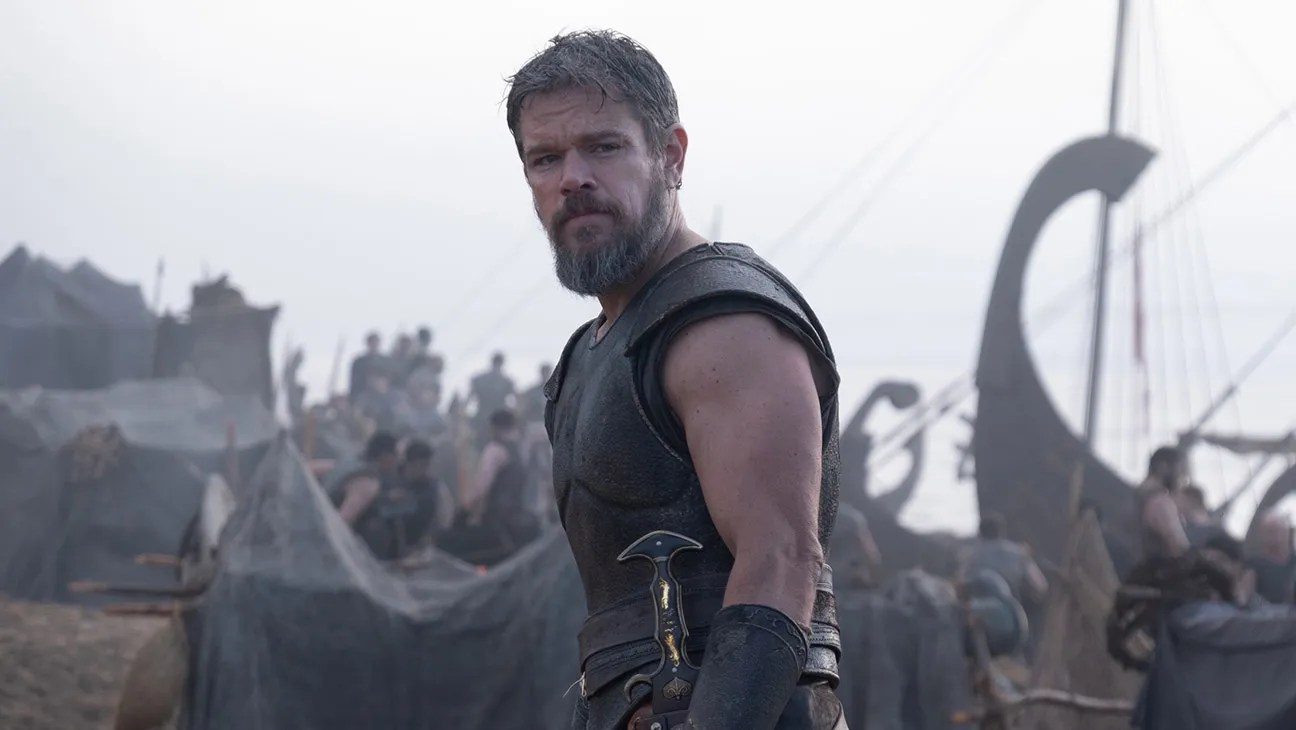
Director Nolan is one of the rare filmmakers who, in my opinion, has never made a bad film. From “Memento” to the “Dark Knight” trilogy to the Oscar-winning “Oppenheimer,” he has proven himself a true master of cinema. “The Odyssey” only adds to that distinguished resume’
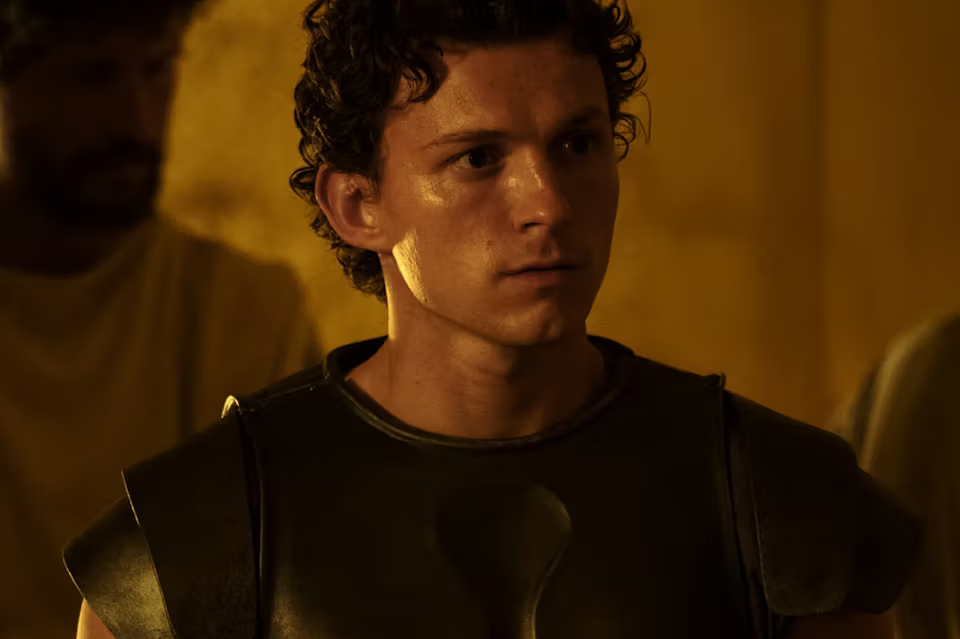
The cast is a tribute to Nolan himself who, like Woody Allen, can pretty much get anyone he wants for his films because, as an actor, why wouldn’t you want a credit in one of his films. Besides the three stars named above, the cast includes Robert Pattinson, John Leguizamo, Zendaya, James Remar, Jon Bernthal, Oscar nominees Samantha Morton and Elliot Page as well as Oscar winners Charlize Theron and Lupita Nyongo. As MGM used to advertise, “more stars than there are in heaven.”
The script and story are pretty faithful to the source material, though for some reason it bothered me whenever Telemacus referred to Odysseus as “dad.” Never father. The weird things you notice. Visual.y the film is stunning and the Trojan Horse and battle of Troy are worth the price of admission alone. I will add that I did see the film in 70 mm and, if that format is playing in your town, I urge you to see it in that format.
On a scale of zero to five, “The Odyssey” receives ★★★★ ½
Entertainment
Review: Christopher Nolan’s ‘The Odyssey’ is a mighty Trojan horse of his thematic obsessions

Tell me, Christopher Nolan, when did it first rosy-fingered dawn on you that your favorite type of protagonist — a tormented sinner-hero — was a specialty of the ancient Greeks? Millennia before Matthew McConaughey’s astronaut sobbed over abandoning his family and Cillian Murphy’s Robert Oppenheimer gasped that he had become the destroyer of worlds, the Greeks spun cautionary legends about Odysseus, the Trojan War tactician who outsmarted his own plan to sail smoothly home.
Nolan refuses to tremble before the canon. Grabbing mighty scissors, he cuts and rejiggers Homer and a bit of Virgil to transform these classical texts into his type of tale: one fixated on memory, self-identity, destructive genius and the slippage of time. As ever, it’s light on sex, heavy on wine-dark angst.
Once you endure its opening stretch — an expositional barrage with the pace of an obnoxious cop show — “The Odyssey” ascends as a monument to movie craft with shuddering ships, rough-hewn landscapes and practical monsters who snatch and grab men at random from above like giant skill cranes. Unlike in most mythological tales, the white Corinthian columns have been swapped out for brutal stone architecture. The Parthenon won’t be built for another 800 years; likewise, Athenian democracy is centuries away.
Nolan has anchored his “Odyssey” at the fall of the Bronze Age, a once-great era toppled by wealth-hoarding, diminished trade and climate catastrophes. Fearful of invading marauders, humankind has turned distrustful and stingy, ignoring Zeus’ command to show generosity toward the poor and foreign-born, a cornerstone of faith that would later be repurposed in the New Testament.
-
Share via
This Odysseus (Matt Damon) is both witness to and wrecking ball of the collapse. Not only does he steal, slaughter and pillage while expecting to be treated with kindness, but he’s also brainstormed the atomic bomb of his day: the Trojan horse, a deceitful invention planted into the sandy beaches of Troy that marks the decline of civilization like the Statue of Liberty in “Planet of the Apes.” Inside this claustrophobic wooden beast, Odysseus and his wild and bloodthirsty Greeks are crammed cheek-to-sandal so tightly that you can’t imagine how they’ll spring into action without first getting a massage. Outside and looking up at it, the pony seems to sneer.
“The Odyssey” is a saga with half a dozen detours and one destination, Ithaca, Odysseus’ kingdom. While he’s been fighting in Troy, his palace has been overrun by men who want to marry his faithful wife, Penelope (Anne Hathaway), and murder his helpless son, Telemachus (Tom Holland). Robert Pattinson’s oily suitor woos Penelope like a “Bachelorette” contestant: “It’s time to live again,” he urges her, certain that Penelope’s vengeful husband won’t come back. Forget that rose, dude, and run away.

Anne Hathaway and Tom Holland in the movie “The Odyssey.”
(Melinda Sue Gordon / Universal Pictures)
After 20 years away — 10 at war, 10 adrift — Odysseus is anxious to reclaim his kingdom. Or is he? Nolan floats a convincing psychological reason why this Odysseus subconsciously believes his duplicitous actions during the war deserve permanent exile from civilization. Although, as is the case with too much of Nolan’s storytelling, he wrongly thinks it’s more interesting to withhold Odysseus’ traumatic hang-up until the ending. The Greeks never tried to confuse the audience in the pursuit of suspense. They delivered their plots arrow-straight to make the dread sting.
Saddled with a silly black beard that eventually goes gray, Damon’s Odysseus is stubborn, overconfident and sacrilegious, but doesn’t bear that much resemblance to the conniving, hypocritical egotist of lore who fretted over his wife’s fidelity while seducing not one, but two, enchantresses, Calypso and Circe. Today’s viewers might demonize Odysseus’ erotic exploits; instead, they’ve been Damon-ized into something innately goodhearted.
The chasteness of Nolan’s version bugs me as it’s insulting he doesn’t trust audiences to grapple with this hero’s moral complexity — and I’m gut-sick that he’s probably right. Plus, it leaves Charlize Theron’s Calypso nothing to do but limply listen to (and medicate) Odysseus like a bored therapist reaching for the lithium. I was hoping for more zest from a blond wearing actual fishnets that could catch sardines.
At least Samantha Morton’s body-horror spin on the witch Circe is terrific. To punish his men for barging into her hut, she digs her fingers inside their skin like clay, remolding them into the swine she claims they are. Her outrage is one of the best ideas in the movie. Likewise, Lupita Nyong’o’s Helen is regal and formidable, but it’s a mistake to double-cast her as Helen’s twin sister, Clytemnestra. The whole reason thousands of men fought a war over the most beautiful woman alive is that there’s only one of them — unless undermining that excuse is the point. (In an aside, we’re told that Benny Safdie’s aloof Agamemnon, hiding under a try-hard scary helmet decorated with a golden spine, really waged it to break up Troy’s trade routes.)
Unlike in Homer or even “Clash of the Titans,” which showed the gods as toga-clad twits toying with mortal lives like action figures, they have little, if anything, to do in this plot. In Homer’s original verse, Athena is as fussy as a stage mother, showing up every few pages disguised as someone mortal to bless both Odysseus and Telemachus with live-action Photoshop filters that make them extra handsome. Here, Holland’s Telemachus gambles Athena is hiding inside half the people he meets until his father chides, “Don’t look for gods in men, you’ll just be disappointed.”
Instead, Nolan balances religion on the spear tip of doubt. The angry sea god Poseidon is reduced to rumors; mighty Zeus withheld to a few well-timed thunderclaps. Even Athena, if that genuinely is whom Zendaya is playing, isn’t that helpful, mostly staring at Odysseus in mute dismay. It’s possible to get to the end of “The Odyssey” and conclude that Nolan doesn’t believe in gods at all. To him, men must be proactive in their own demise. (I’m half-convinced, the way I don’t really swear by the zodiac but nevertheless stopped dating Libras.)
Composer Ludwig Göransson scores the breath-holding assault on Troy to drums that pound faster and faster on our nerves, as does our alarm that Odysseus’ troops aren’t the good guys. Occasionally, Göransson adds a lovely monotone layer of woodwinds or a keening chorus that sounds like the oldest song on Earth.
Conversely, during the talky Ithaca sequences, when the movie is rightly paranoid of losing our attention, the more modern heist-thriller music is flat-out obnoxious, especially in a scene where Odysseus lays out his ruse to infiltrate his house to John Leguizamo’s trusty goatherd, the most lovable man ever introduced throwing a puppy off a cliff. (No, really — it’s the movie’s only outright joke.)
Hoyte van Hoytema’s Imax-framed cinematography is assertive and present, rocking with the stormy waves and peering into the torch-lit darkness where the color palate is as starkly orange and black as an ancient Greek urn. Working with the special effects team, Van Hoytema cloaks the non-digital wizardry of the Cyclops and six-headed Scylla behind naturalistic camera movements and shadows so that, rather than drawing too much attention to themselves, the creatures just feel real. As gray and wrinkled as the bottom of a mummy’s foot, the Cyclops’ face is wonderfully askew, like he was stepped on by someone even bigger than him.
Nolan’s “Odyssey” engraves marvelous images onto the ancient oral poem. One of the most haunting shots is Odysseus sprinting out of Hades chased by an army of the dead who regret following him into battle. In turn, Nolan has sacrificed Odysseus himself to serve his own needs, scrapping the character’s prickly personality to Trojan-horse a message about how empires collapse.
Aghast at the ways of men, he’s dug his own Circe-like fingers into Homer to manipulate the tale into a moralistic “Oppenheimer” prequel. Even Odysseus seems to suspect as much. “Our mistakes will again be forgotten,” Odysseus predicts as the land he loves sails into the Dark Ages while he steers the helm. He’s done unforgivable wrongs. But in that moment, he’s right.
‘The Odyssey’
Rated: R, for violence and some language
Running time: 2 hours, 52 minutes
Playing: Opens Friday, July 17 in wide release
Movie Reviews
Saari Review: Memory, Betrayal and Identity Converge at River Valley Film Festival – Hollywood Times


Premiering at the 2026 River Valley Film Festival, Saari uses fragmented memories, Finnish landscapes and restrained performances to explore betrayal, identity and reconciliation.
By Valerie Milano
Palm Springs, CA (The Hollywood Times) 7/14/26 – In the visually striking short film Saari—Finnish for “island”, a peaceful family retreat becomes the setting for the slow collapse of a relationship.
Co-written by Justin Seegmueller, Corey L’Esperance and Suvi Härkönen, the film follows Daniel, played by Seegmueller, as he reflects on the choices that damaged his relationship with Liina, portrayed by Ilona Karppanen. Told through fragments of the past, present and future, Saari gradually reveals how secrecy and betrayal can transform a place of safety into one of emotional confinement.
The nonlinear structure was not simply a stylistic choice. The project was developed and filmed over more than a decade, with footage captured in Finland, Boston and the desert. L’Esperance explained that the filmmakers divided the story into “past, present and future,” allowing audiences to experience the relationship from both characters’ perspectives.
Click below for our exclusive interview:
He described Daniel and Liina as two people who are “stuck in these moments in time,” making the fragmented narrative especially appropriate.
Seegmueller said Daniel’s internal struggle is rooted in the questions, “Am I that person? Am I still that person?” His restrained performance captures a man attempting to reconcile his current identity with the damage caused by earlier decisions.
For Seegmueller, the film is fundamentally about choice.
“It’s all about decision-making,” he said. “Are you an accumulation of all your decisions?”
Finland’s lush island scenery contrasts sharply with Daniel’s later isolation in the barren desert. Seegmueller described the progression as “lush and then dead,” a simple but effective visual representation of a relationship moving from intimacy and possibility to emotional aftermath.
For Liina, the island represents family history, comfort and security. By inviting Daniel there, she welcomes him into her sanctuary. His secrets, however, begin to contaminate that protected space.
“You let me into your life,” Seegmueller explained, “and now I’m here almost ruining your sense of security.”

 Because the couple reaches the island by rowboat, the setting also creates a sense of entrapment as suspicion and resentment begin to surface. L’Esperance noted that once they are there, “there’s not really anywhere you can go.”
The film’s cross-cultural perspective was strengthened by the collaboration between American co-director L’Esperance and Finnish co-director Härkönen. Their responsibilities shifted according to which character dominated a scene. L’Esperance generally led sequences centered on Daniel, while Härkönen took a stronger role when Liina’s experience was at the emotional forefront.
That approach helps prevent Liina from existing only as a reaction to Daniel’s behavior. Her journey eventually becomes more compelling than his guilt.
Karppanen traveled to the United States for the first time to film the Boston scenes, which were completed approximately three years after the original Finland footage. Seegmueller said the friendship they developed during production can be seen in the warmth between their characters during the relationship’s happier moments.
The filmmakers deliberately avoid explaining every detail of Daniel’s betrayal. Earlier edits revealed even less, but test audiences needed additional narrative guidance.
“We do need to have some breadcrumbs,” L’Esperance said, explaining that without them, the story became “a little too lost on the audience.”

 The challenge was to provide enough information while maintaining the film’s quiet, interpretive tone. L’Esperance said they wanted to leave room for viewers to “fill in some of the blanks.”
The lengthy production process also changed how the filmmakers viewed Daniel. L’Esperance acknowledged that they initially saw him as “this hero,” but over time recognized that “he is kind of a bad guy in some of these aspects.”
That evolving perspective gives the film greater moral complexity. Daniel is not granted an easy redemption, and his introspection does not erase the harm he caused.
Karppanen brings strength and emotional restraint to Liina, who emerges from the experience as what L’Esperance called “a completely different person.” A final city scene suggests that she is beginning to reclaim her identity and imagine a future beyond Daniel and the relationship that betrayed her.
Subtle, atmospheric and open to interpretation, Saari asks whether people are defined by their worst decisions, and what reconciliation means when the damage cannot simply be undone.
After more than 10 years of work, the film’s world premiere at the River Valley Film Festival is especially meaningful. Both L’Esperance and Seegmueller attended film school in Philadelphia, making the Pennsylvania premiere a return to the state where their filmmaking journeys began.

 Seegmueller hopes the film encourages audiences to examine their own choices and personal histories.
“What does that say about you?” he asked. “What does that say about your story and your own narrative?”
Saari will have its world premiere at the 2026 River Valley Film Festival. Seegmueller will attend the premiere in person, while members of L’Esperance’s family are expected to represent him at the festival.
-

 Fitness4 minutes ago
More Muscle, Less Fat—Is This High-Tech Workout A New Fitness Answer?
-

 Movie Reviews16 minutes ago
Film Review: “The Odyssey” – MediaMikes
-
World28 minutes ago
Movie Review: In Christopher Nolan’s ‘The Odyssey,’ an ancient epic is reborn
-

 Health58 minutes ago
The Epicenter of Drug Deaths in America Is Shifting West
-
 Lifestyle1 hour ago
Homelessness is more common than you think. : It’s Been a Minute
-

 Technology1 hour ago
Lucid’s bankruptcy rumor is a bad sign for the EV future
-

 World2 hours ago
Slain American mother Jamey Carney remembered as ‘ray of sunshine’ at Ireland funeral
-

 Politics2 hours ago
Canadian woman accused of slapping Trump-supporting teen turned over to ICE

