Entertainment
Tenor saxophonist Sonny Rollins has died


Sonny Rollins, a sublime tenor saxophonist and one of the last iconic figures of the golden age of post-World War II jazz, died Monday at his home in Woodstock, N.Y. Diagnosed years ago with pulmonary fibrosis, he was 95. His death was announced on his website.
Rollins survived virtually all of his contemporaries from the 1950s and ’60s, the period in which the fundamental elements of the contemporary jazz that followed for the next half-century were established. Among his peers were musicians such as Charlie Parker, Miles Davis, Thelonious Monk, Dizzy Gillespie, Bud Powell, John Coltrane, Cannonball Adderley and J.J. Johnson.
His long, productive career encompassed more than six decades, in each of which his live performances and recordings continually attested to his preeminence as one of jazz history’s most vital, innovative and influential artists.
“Rollins has an original jazz voice,” critic Zan Stewart wrote in The Times in 1990, “rooted in the bebop mode, but a voice that has evolved over time, incorporating other styles and other forms as they fit that voice.”
His magisterial presence was a constant in his performances, from the time he was in his 20s into his later years. A commanding figure at 6 feet 2, he played with a sound and an articulation to match his visual image. His affection for standard tunes brought startlingly new vitality to such unlikely songs as “The Surrey With the Fringe on Top.” And, on any given night, he didn’t hesitate to expand an improvisation to startling lengths, finding new ideas well beyond the imaginative limits of most jazz players.
“Rollins hates clichés and signature phrases — ‘licks’ — and refuses to play them,” critic Stanley Crouch wrote in the New Yorker in 2005. “Consequently, for him there are no highly polished professional performances. When he’s on, which is seven or eight times out of 10, Rollins — known as ‘the saxophone colossus’ — seems immense, summoning the entire history of jazz, capable of blowing a hole through a wall.”
He was also a master of structure, even during his more extended improvisations. Playing a standard tune, he would frequently develop paraphrases of the melody, taking it through unlikely re-imagining of the harmonies of a song. At times, the piano players in his groups would simply back off during part of Rollins’ solos, loath to risk following the twisting pathways of his improvising.
“The story begins with the melody,” he told Crouch. “You keep the story going by using the melody the way you hear it as something to improvise on. In reality, it should all be connected — the melody, the chords, the rhythm. It should all turn out to be one complete thing.”
Rollins clearly kept to that concept throughout his career, from his earliest recordings in the late ’40s, while he was still in his teens, to his work in his 70s and 80s. His playing style displayed evolving aspects over the years, and he chose a variety of different settings in which to display his improvisational wares. Yet the idea of an improvised solo as a story to tell, and of the melody as the vehicle for that story, was a constant in his music.
‘’I have the hope that a melody, any piece of music, can perform miracles,” Rollins told Lloyd Sachs in 2001 in the Chicago Sun-Times. “Years ago, Coltrane and myself used to feel that, boy, we were going to be able to turn the world around. We believed we could change the way people thought through music. That didn’t happen, but I still have faith in the power of music, in old songs, strong melodies, strong playing.’’
Theodore Walter Rollins was born Sept. 7, 1930, in New York City. His mother, Valborg, who had emigrated from St. Thomas in the Virgin Islands, worked as a domestic; his father, Walter, who had emigrated from St. Croix, was a petty officer in the U.S. Navy. Rollins and his two older siblings were all introduced to music early by their father, who was a clarinetist. His sister, Gloria, played piano; his brother, Valdemar, played the violin.
Rollins’ first instrument, at age 13, was the alto saxophone, followed by the tenor when he was in his mid-teens. By the time he graduated from Benjamin Franklin High School he was already working as a professional musician. He made his initial recordings in 1949 — first with singer Babs Gonzalez, then with pianist Bud Powell and trombonist Johnson. By 1961, he was beginning to perform and record with Davis, Parker and Monk.
Like many other young jazz artists of the period, however, he was deeply affected, not only by the playing, but by the lifestyles of the older beboppers who were his significant influences, many of whom had become addicted to drugs. Although Parker, his primary idol and mentor, urged him to stay clean, Rollins developed a heroin habit that eventually led to his arrest and 10-month imprisonment.
After his release, he was detained for violating the terms of his parole and sent to Federal Medical Center in Lexington, Ky. Emerging after four months, he was diagnosed, according to his record, as clinically “cured.”
Rollins returned to active playing, rapidly establishing himself as one of the important young saxophonists of his generation. After playing with the high-visibility Clifford Brown/Max Roach Quintet, Rollins recorded “Saxophone Colossus” in 1956 — a classic jazz album, and the highlight of a series of breakout recordings he made in the ’50s for the Prestige label. One of the tracks, a brightly melodic calypso theme titled “St. Thomas,” is Rollins’ best known composition, and a standard in the lexicon of jazz tunes.
In the late ’50s his musically exploratory efforts continued via “Tenor Madness,” a recording in which he is paired with Coltrane, showcasing the two principal tenor saxophone stylists of the era. He also recorded three albums — “Way Out West,” “A Night at the Village Vanguard” and “The Freedom Suite” — using the innovative lineup of tenor saxophone, bass and drums, omitting any chord-producing instrument.
Despite his rapid rise to the top of the jazz world, Rollins felt burned out in 1959 and decided to take time off to work on what he felt were the limitations in his music.
Seeking a location where he could practice without bothering the neighbors in his Manhattan apartment, he found a perch on the Williamsburg Bridge. When he returned to public view in 1962, he titled his comeback album “The Bridge,” quickly reestablishing his role as a primary jazz voice. For the balance of the ’60s he continued to explore new areas, with albums touching on the then-prevalent jazz avant-garde, Latin rhythms and one of his most persistent interests: the reexamination of unlikely standards from the Great American Songbook.
Rollins took another sabbatical at the end of the ’60s, when he went to India to study meditation, yoga and Eastern spirituality and philosophy.
On his return, he began to incorporate elements of pop, funk and rock in his music, primarily via his rhythm sections.
His recordings and performances from the ’80s on moved across the gamut of the various personal stylistic expressions he had developed in the ’50s, ’60s and ’70s. But, characteristically, he also frequently continued to stretch the limits of his music. One of the most unusual examples was his fascination with solo saxophone improvisations, notably on the appropriately titled “The Solo Album.”
In 2001, Rollins received a Grammy Award for jazz instrumental album for “This Is What I Do.” In 2006, at 75, he scored a triple win in DownBeat magazine’s readers poll with awards for No. 1 Tenor Saxophonist, Jazzman of the Year and Recording of the Year (for “Without A Song: The 9/11 Concert”). His performance on “Why Was I Born,” one of the tracks on the recording, was also awarded a Grammy for jazz instrumental solo.
Rollins was still searching and discovering while on tour into his 80s.
“I’m still trying to get a little further along the road to perfection, or salvation,” Rollins said in a 2011 Times profile. “I’m not there yet. I’m far enough away from that that I’m still engaged. Playing live is the only way. …
“On the concert stage, everything crystallizes. Performance is where it happens.”
In 2017, Rollins donated his archives to the Schomburg Center for Research in Black Culture in Harlem, where it is available to the public. Rollins’ last public performance was in 2012.
Rollins leaves no immediate survivors. Lucille, his wife of nearly 40 years, died in 2004.

Entertainment
‘You’re scaring my people.’ Shia LaBeouf’s alleged stalker arrested after posting viral video
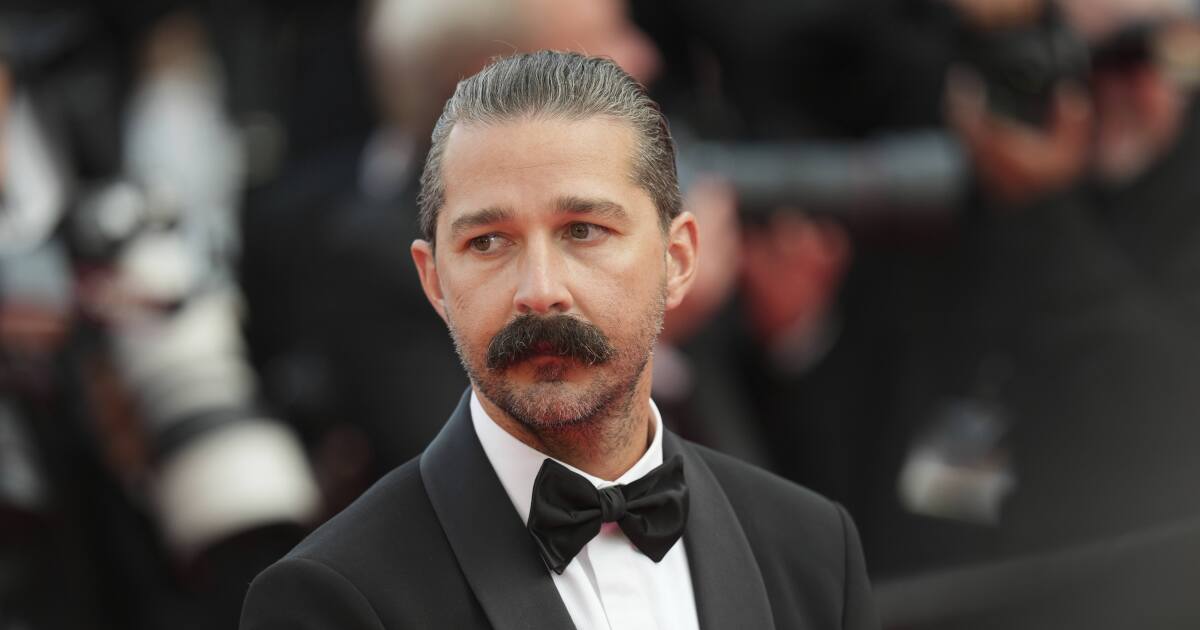
Shia LaBeouf’s alleged stalker has been arrested after posting a video of the actor asking to be left alone.
According to Orleans Parish Sheriff’s Office booking records, Alyssa Lee Couture, 40, was arrested Monday night and booked on a misdemeanor charge of stalking. Hours earlier, Couture had posted a video of a confrontation with LaBeouf in what appeared to be a grocery store parking lot. The “Honey Boy” actor is shown speaking to Couture through the window of a car.
“Leave me alone. God bless you. Leave me alone,” LaBeouf says calmly in the video. “You’re scaring my dad. You’re scaring my people. Leave me alone.”
Couture has posted more than 5,000 videos on her Instagram, most of which feature the woman addressing the embattled actor, whom she appears to believe is her husband. In a GoFundMe launched in May, Couture wrote that she was hoping to raise $70,000 to find permanent housing and that she had been living in her car and staying with family members. She also wrote that she had schizophrenia, among other disabilities.
Although the New Orleans Police Department does not identify Couture’s stalking victim as LaBeouf due to privacy policies, the timeline of her booking appears to line up with the confrontation with LaBeouf.
According to People, LaBeouf left Los Angeles after his split from actor Mia Goth last year and relocated to Louisiana to be closer to family.
In June, he pleaded guilty to three counts of simple battery, months after he went viral for his involvement in a Mardi Gras altercation in New Orleans. The actor, 39, was arrested in New Orleans on Feb. 17. At the time, New Orleans police confirmed LaBeouf was charged with two counts of simple battery for allegedly assaulting two men near a bar in the French Quarter. TMZ published bystander video of the incident and footage of LaBeouf walking through the French Quarter hours before the brawl.
The actor was released from jail shortly after his arrest and posted $100,000 in bond. More than a week after LaBeouf’s initial arrest, the New Orleans Police Department issued a second warrant for the actor’s arrest in connection with the same incident, and he racked up an additional simple battery charge. Prior to the second arrest, a New Orleans judge ordered LaBeouf to begin substance abuse treatment and undergo weekly drug testing.
Times staff reporter Alexandra Del Rosario contributed to this report.

- THE ODYSSEY
- Starring: Matt Damon, Tom Holland and Anne Hathaway
- Directed by: Christopher Nolan
- Rated: R
- Running time: 2 hrs 45 mins
- Universal
Our score: 4.5 out of 5
EPIC. If I was asked to describe Christopher Nolan’s latest film, that is the word I would use. He has mounted a film that rivals the greatest achievements of filmmakers like Cecil B. DeMille or David Lean. And, like the films of those mentioned, it’s runs a tad too long.
I was shocked, but pleased, to see that my 12-year-old granddaughter recently did a school paper on King Agamemnon. Thank goodness they’re still teaching History in our schools. Based on Homer’s “The Odyssey,” the film tells the story of King Odysseus (Damon) and his adventures which, if you’ve read “The Odyssey,” include the Trojan Horse, the Cyclops and assorted angry Greek gods. The film covers each of these adventures in great detail, sparing nothing in the production design department. While Odysseus is away – and he’s gone for a l-o-n-g time, his wife Penelope (Hathaway) has to endure a never ending string of “suitors,” men lining up in the hopes of replacing the King should he not return. The men are nothing more then scavengers, taking advantage of the law of Zeus, which decrees no one should be turned away. This angers the Queen’s son, Telemachus (Holland), who must control his temper when the men try to bait him into a fight, the idea being if Telemachus is killed, the new husband would become the King. It’s all very interesting and complicated. And long.
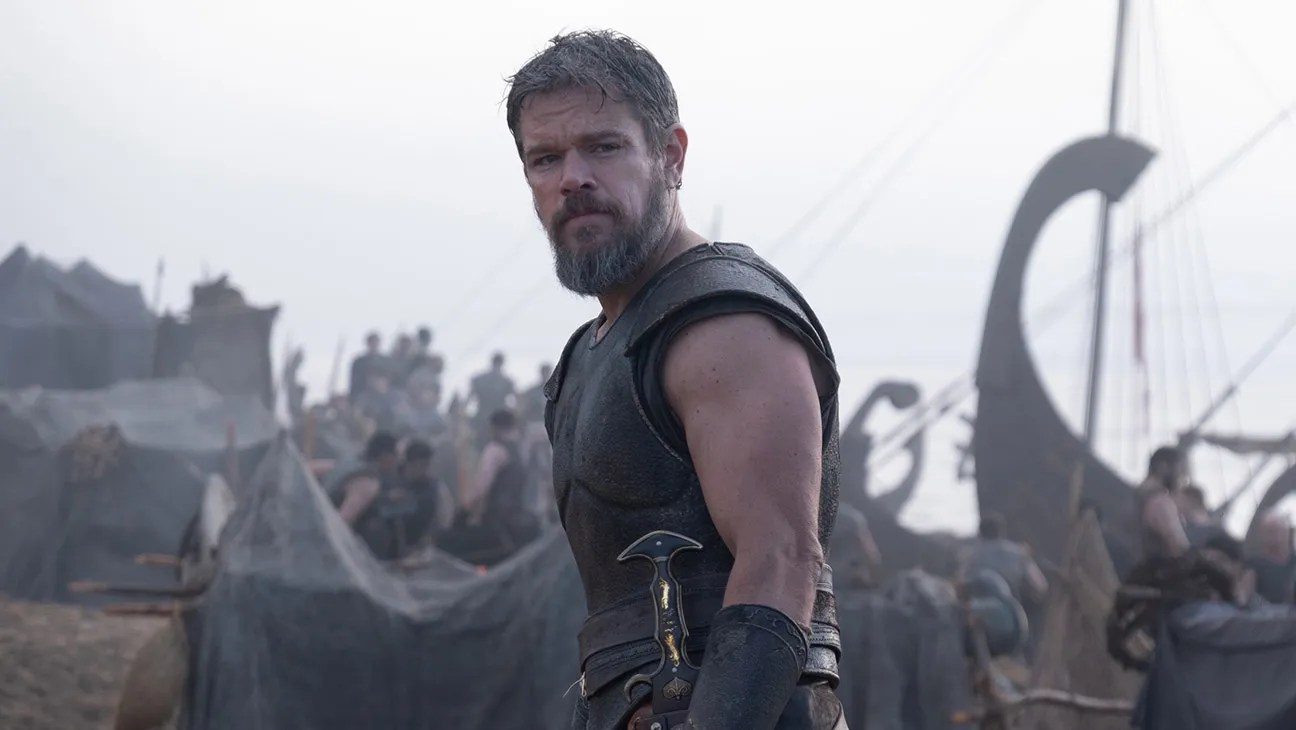
Director Nolan is one of the rare filmmakers who, in my opinion, has never made a bad film. From “Memento” to the “Dark Knight” trilogy to the Oscar-winning “Oppenheimer,” he has proven himself a true master of cinema. “The Odyssey” only adds to that distinguished resume’
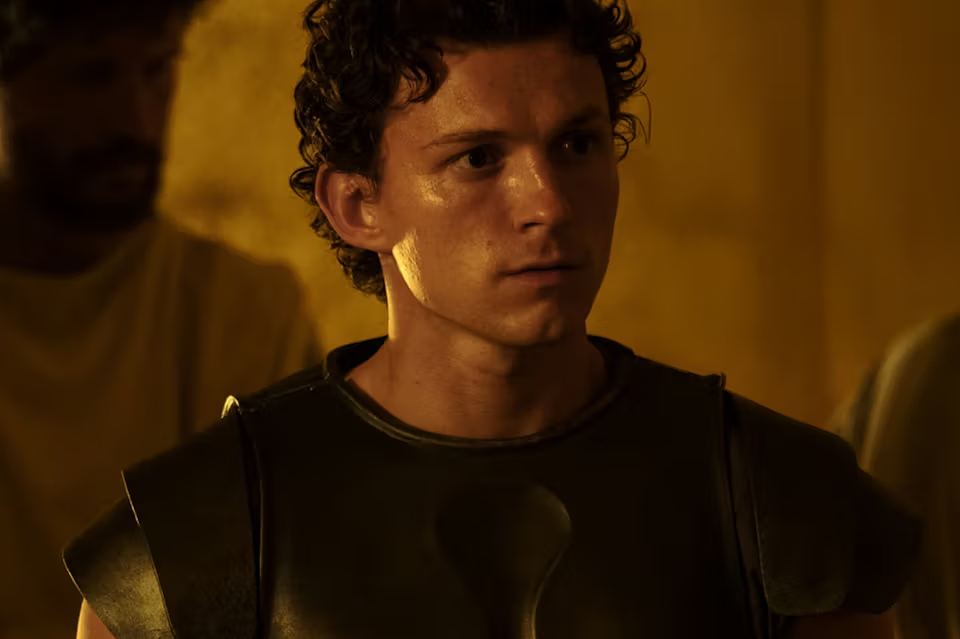
The cast is a tribute to Nolan himself who, like Woody Allen, can pretty much get anyone he wants for his films because, as an actor, why wouldn’t you want a credit in one of his films. Besides the three stars named above, the cast includes Robert Pattinson, John Leguizamo, Zendaya, James Remar, Jon Bernthal, Oscar nominees Samantha Morton and Elliot Page as well as Oscar winners Charlize Theron and Lupita Nyongo. As MGM used to advertise, “more stars than there are in heaven.”
The script and story are pretty faithful to the source material, though for some reason it bothered me whenever Telemacus referred to Odysseus as “dad.” Never father. The weird things you notice. Visual.y the film is stunning and the Trojan Horse and battle of Troy are worth the price of admission alone. I will add that I did see the film in 70 mm and, if that format is playing in your town, I urge you to see it in that format.
On a scale of zero to five, “The Odyssey” receives ★★★★ ½
Entertainment
Review: Christopher Nolan’s ‘The Odyssey’ is a mighty Trojan horse of his thematic obsessions

Tell me, Christopher Nolan, when did it first rosy-fingered dawn on you that your favorite type of protagonist — a tormented sinner-hero — was a specialty of the ancient Greeks? Millennia before Matthew McConaughey’s astronaut sobbed over abandoning his family and Cillian Murphy’s Robert Oppenheimer gasped that he had become the destroyer of worlds, the Greeks spun cautionary legends about Odysseus, the Trojan War tactician who outsmarted his own plan to sail smoothly home.
Nolan refuses to tremble before the canon. Grabbing mighty scissors, he cuts and rejiggers Homer and a bit of Virgil to transform these classical texts into his type of tale: one fixated on memory, self-identity, destructive genius and the slippage of time. As ever, it’s light on sex, heavy on wine-dark angst.
Once you endure its opening stretch — an expositional barrage with the pace of an obnoxious cop show — “The Odyssey” ascends as a monument to movie craft with shuddering ships, rough-hewn landscapes and practical monsters who snatch and grab men at random from above like giant skill cranes. Unlike in most mythological tales, the white Corinthian columns have been swapped out for brutal stone architecture. The Parthenon won’t be built for another 800 years; likewise, Athenian democracy is centuries away.
Nolan has anchored his “Odyssey” at the fall of the Bronze Age, a once-great era toppled by wealth-hoarding, diminished trade and climate catastrophes. Fearful of invading marauders, humankind has turned distrustful and stingy, ignoring Zeus’ command to show generosity toward the poor and foreign-born, a cornerstone of faith that would later be repurposed in the New Testament.
-
Share via
This Odysseus (Matt Damon) is both witness to and wrecking ball of the collapse. Not only does he steal, slaughter and pillage while expecting to be treated with kindness, but he’s also brainstormed the atomic bomb of his day: the Trojan horse, a deceitful invention planted into the sandy beaches of Troy that marks the decline of civilization like the Statue of Liberty in “Planet of the Apes.” Inside this claustrophobic wooden beast, Odysseus and his wild and bloodthirsty Greeks are crammed cheek-to-sandal so tightly that you can’t imagine how they’ll spring into action without first getting a massage. Outside and looking up at it, the pony seems to sneer.
“The Odyssey” is a saga with half a dozen detours and one destination, Ithaca, Odysseus’ kingdom. While he’s been fighting in Troy, his palace has been overrun by men who want to marry his faithful wife, Penelope (Anne Hathaway), and murder his helpless son, Telemachus (Tom Holland). Robert Pattinson’s oily suitor woos Penelope like a “Bachelorette” contestant: “It’s time to live again,” he urges her, certain that Penelope’s vengeful husband won’t come back. Forget that rose, dude, and run away.

Anne Hathaway and Tom Holland in the movie “The Odyssey.”
(Melinda Sue Gordon / Universal Pictures)
After 20 years away — 10 at war, 10 adrift — Odysseus is anxious to reclaim his kingdom. Or is he? Nolan floats a convincing psychological reason why this Odysseus subconsciously believes his duplicitous actions during the war deserve permanent exile from civilization. Although, as is the case with too much of Nolan’s storytelling, he wrongly thinks it’s more interesting to withhold Odysseus’ traumatic hang-up until the ending. The Greeks never tried to confuse the audience in the pursuit of suspense. They delivered their plots arrow-straight to make the dread sting.
Saddled with a silly black beard that eventually goes gray, Damon’s Odysseus is stubborn, overconfident and sacrilegious, but doesn’t bear that much resemblance to the conniving, hypocritical egotist of lore who fretted over his wife’s fidelity while seducing not one, but two, enchantresses, Calypso and Circe. Today’s viewers might demonize Odysseus’ erotic exploits; instead, they’ve been Damon-ized into something innately goodhearted.
The chasteness of Nolan’s version bugs me as it’s insulting he doesn’t trust audiences to grapple with this hero’s moral complexity — and I’m gut-sick that he’s probably right. Plus, it leaves Charlize Theron’s Calypso nothing to do but limply listen to (and medicate) Odysseus like a bored therapist reaching for the lithium. I was hoping for more zest from a blond wearing actual fishnets that could catch sardines.
At least Samantha Morton’s body-horror spin on the witch Circe is terrific. To punish his men for barging into her hut, she digs her fingers inside their skin like clay, remolding them into the swine she claims they are. Her outrage is one of the best ideas in the movie. Likewise, Lupita Nyong’o’s Helen is regal and formidable, but it’s a mistake to double-cast her as Helen’s twin sister, Clytemnestra. The whole reason thousands of men fought a war over the most beautiful woman alive is that there’s only one of them — unless undermining that excuse is the point. (In an aside, we’re told that Benny Safdie’s aloof Agamemnon, hiding under a try-hard scary helmet decorated with a golden spine, really waged it to break up Troy’s trade routes.)
Unlike in Homer or even “Clash of the Titans,” which showed the gods as toga-clad twits toying with mortal lives like action figures, they have little, if anything, to do in this plot. In Homer’s original verse, Athena is as fussy as a stage mother, showing up every few pages disguised as someone mortal to bless both Odysseus and Telemachus with live-action Photoshop filters that make them extra handsome. Here, Holland’s Telemachus gambles Athena is hiding inside half the people he meets until his father chides, “Don’t look for gods in men, you’ll just be disappointed.”
Instead, Nolan balances religion on the spear tip of doubt. The angry sea god Poseidon is reduced to rumors; mighty Zeus withheld to a few well-timed thunderclaps. Even Athena, if that genuinely is whom Zendaya is playing, isn’t that helpful, mostly staring at Odysseus in mute dismay. It’s possible to get to the end of “The Odyssey” and conclude that Nolan doesn’t believe in gods at all. To him, men must be proactive in their own demise. (I’m half-convinced, the way I don’t really swear by the zodiac but nevertheless stopped dating Libras.)
Composer Ludwig Göransson scores the breath-holding assault on Troy to drums that pound faster and faster on our nerves, as does our alarm that Odysseus’ troops aren’t the good guys. Occasionally, Göransson adds a lovely monotone layer of woodwinds or a keening chorus that sounds like the oldest song on Earth.
Conversely, during the talky Ithaca sequences, when the movie is rightly paranoid of losing our attention, the more modern heist-thriller music is flat-out obnoxious, especially in a scene where Odysseus lays out his ruse to infiltrate his house to John Leguizamo’s trusty goatherd, the most lovable man ever introduced throwing a puppy off a cliff. (No, really — it’s the movie’s only outright joke.)
Hoyte van Hoytema’s Imax-framed cinematography is assertive and present, rocking with the stormy waves and peering into the torch-lit darkness where the color palate is as starkly orange and black as an ancient Greek urn. Working with the special effects team, Van Hoytema cloaks the non-digital wizardry of the Cyclops and six-headed Scylla behind naturalistic camera movements and shadows so that, rather than drawing too much attention to themselves, the creatures just feel real. As gray and wrinkled as the bottom of a mummy’s foot, the Cyclops’ face is wonderfully askew, like he was stepped on by someone even bigger than him.
Nolan’s “Odyssey” engraves marvelous images onto the ancient oral poem. One of the most haunting shots is Odysseus sprinting out of Hades chased by an army of the dead who regret following him into battle. In turn, Nolan has sacrificed Odysseus himself to serve his own needs, scrapping the character’s prickly personality to Trojan-horse a message about how empires collapse.
Aghast at the ways of men, he’s dug his own Circe-like fingers into Homer to manipulate the tale into a moralistic “Oppenheimer” prequel. Even Odysseus seems to suspect as much. “Our mistakes will again be forgotten,” Odysseus predicts as the land he loves sails into the Dark Ages while he steers the helm. He’s done unforgivable wrongs. But in that moment, he’s right.
‘The Odyssey’
Rated: R, for violence and some language
Running time: 2 hours, 52 minutes
Playing: Opens Friday, July 17 in wide release
-
 Lifestyle5 minutes ago
Trump relished in being compared to dictators like Hitler and Stalin, journalist says
-

 Technology17 minutes ago
Skullcandy’s bass-boosting Crusher headphones now come with Bose’s ANC
-

 World23 minutes ago
WATCH: Russian soldier thrown through air as Soviet-era helicopter gun spins out of control
-

 Politics29 minutes ago
Lindsey Graham’s final act reverberates in Senate as sister is urged to “keep pedaling”
-

 Health35 minutes ago
Is lettuce still safe to eat amid Taco Bell illness probe? Doctors answer
-

 Sports41 minutes ago
Marcello Hernández roasts Jake Paul, Tiger Woods and Bill Belichick in ESPYS monologue
-

 Technology47 minutes ago
You paid for it. So why is your device showing ads?
-
 Business53 minutes ago
Paramount shareholder lawsuit accuses Ellisons of corruption

