Movie Reviews
Film Review: “Slanted”


Hello, dear reader! Do you like what you read here at Omnivorous? Do you like reading fun but insightful takes on all things pop culture? Do you like supporting indie writers? If so, then please consider becoming a subscriber and get the newsletter delivered straight to your inbox. There are a number of paid options, but you can also sign up for free! Every little bit helps. Thanks for reading and now, on with the show!
Warning: Full spoilers for the film follow.
I went into Slanted with rather limited expectations. The reviews have been middling, but I was willing to take a chance on it, both because I love body horror and because I love a film that grapples with complex social issues. To some extent, Slanted does do that–its story about a young Chinese-American woman who decides to undergo an experimental surgery that will transform her into a White person forever is one that has a great deal of contemporary relevance–but it ultimately isn’t willing to commit to its own bit. It stumbles in a host of ways, not least because it feels pulled in two different directions: on the one hand, its commentary is about as blunt as a sledgehammer, while on the other it never really goes whole-hog on its body horror conceit. The result is a film that’s both muddled and deeply frustrating.
Written and directed by Amy Wang, the film focuses on Joan Huang (Shirley Hunt), the daughter of Chinese immigrants Sofia and Roger Huang (Vivian Wu and Fang Du). Though she loves her father in particular, Joan carries around a deep shame and loathing of her Chinese identity, one that is exacerbated by her desperate desire to be prom queen. Her shame runs so deep, in fact, that when she’s offered the chance to undergo an experimental surgery to turn White, she jumps at the chance, transforming into Jo Hunt (Mckenna Grace). However, the transformation proves to be a double-edged sword, as it not only alienates her from her parents and her best friend but also has unforeseen physical side effects.
In order for a film like this one to really work–or, to put it slightly differently, for it to have real teeth as a piece of social and cultural commentary–it has to be willing to lean into whatever elements it’s playing with. This is particularly true when you decide to play in the genre of the body horror, which is known for its extremes and for its ability to make an audience squirm. For a while, I had hopes Slanted was going to go this route–there’s a quasi-gnarly moment during her hair transplant where we get a few close-ups of the machine pulling out her hair by the roots–but then the film just sort of limply indulges in some subpar body horror imagery, most of which involves Jo/Joan’s face starting to sag. It all leads to the fateful moment when she’s crowned prom queen, only for her once-beautiful visage to appear sagging and wrinkled, leading to her classmates’ revulsion.
In a braver film, this whole sequence could easily have been as horrifying and tragic as in Carrie, where the title character’s final humiliation leads to her self-immolation and that of most of her high school classmates. Slanted, however, chooses to play it safe. To be quite honest, I was very underwhelmed by the physicality of it all, which just felt sad rather than horrifying. I kept thinking…is this it? This is what all of this has been building to? It’s not that I wanted Joan to suffer, obviously, but when you’ve been told you’re watching a body horror film, you expect more…body horror? As it is, it was almost comedic, which just isn’t the vibe I think you were supposed to get from the film as a whole.
It’s especially frustrating that the most horror-inducing moment ends up being the very last frame, in which Jo, filled with remorse, has torn off parts of her White face, revealing glimmers of the girl she was before. One can easily imagine a film where this would’ve been the climax toward which it was all leading, and I’d go so far as to say this approach would have been genuinely horrifying. In my view, the best and most affecting horror films are those with an element of tragedy to them, and it’s hard to think of something more tragic than a young Asian American woman only recognizing the true consequences of what she’s done once it’s too late. As it is, it feels like more of an afterthought, and rather than engendering the emotions associated with horror it just left me frustrated for what the film might have been.
That said, I do think there’s something compelling, and more than a little terrifying about the film’s central premise, which suggests a distressing number of people of color would take the chance to be White if they could. One of the most genuinely disturbing films in the entire film is when we see an entire crowd of BIPOC folks clamoring to get in to see the doctor and get their own surgery. For his part, R. Keith Harris gives a chilling performance as Dr. Willie Singer, who was an Indian-American doctor who perfected the surgery, espousing the philosophy of “if you can’t beat them, be them.” However, as frightening as all this is, it just doesn’t quite gel with the rest of the film, in particular Joan’s desperate desire to be homecoming queen and the just general awfulness of her White peers, which sometimes become more caricatures than real people.
If there’s one thing that saves this film, it’s the performances of Vivian Wu and Fang Du as Joan’s parents. The scenes between Joan and her mother are particularly wrenching, especially since Sofia genuinely loves her daughter and wants to share important pieces of family lore and tradition with her. The fact that Joan can’t see this until too late is far more horrifying than anything that happens to her body after her transformation.
Is Slanted a bad movie? I wouldn’t go so far as to say that. However, it is undeniably a frustrating one, and I kept finding myself wishing it could’ve gone just a bit further, could’ve gone for the throat. Failing that, it could’ve been a bit subtler in its delivery, especially since its central message is an important one. The way that Whiteness–White identity, White skin, White culture–is constantly framed by our society as something toward which everyone should aspire is a problem, and it causes untold damage to BIPOC everywhere. However, while Slanted clearly aspires to Get Out levels of cultural commentary, it ultimately falls flat, leaving us wondering what might have been.


By and large, the zombie subgenre has bitten off more than it can chew in modern times. Between George Romero survival films and camp comedies, the well has become pretty infected. But once in a while, along comes a movie like This Is Not A Test.
Let’s sink our teeth into this new release and see how it stacks up against the classics.
The tone and tenor of this film represent the classic survival movies like Night Of The Living Dead. But the thing that grabs the audience about This Is Not A Test is the trauma of the characters. Holt shines as a withdrawn survivor of an abusive home, trying to cut through the wreckage to reunite with her sister. Each of the main characters have standout traits, and they bathe in strongly acted moments as the stress of the situation changes who they are.
The gore in This Is Not A Test is pretty strong. The attacks spring quickly and when they do, the special effects team does a good job showcasing the battle scars. The camera work is also frenetic in a good way, because the chaos of the chase scenes puts the viewers in a first-person perspective. This film lets you feel like a part of the survivors, so their journeys are interactive.

Longtime fans may say that there’s nothing new in This Is Not A Test, and maybe they’re right. There’s no fresh take on the monsters here, no crazy origin, nothing that we haven’t seen in the past fifty-eight years. But the pacing nails a great balance between getting to know the characters and getting the zombie splatter fest. The mental meltdowns of the characters feel well earned, and the arc of Sloane and her sister brings a lot of heart and investment to the story. Even the most jaded zombie horror fans will find something to appreciate here, even as a background movie.
Adam MacDonald has made another intense hit here, and This Is Not A Test is currently available to stream on Shudder.

- THE ODYSSEY
- Starring: Matt Damon, Tom Holland and Anne Hathaway
- Directed by: Christopher Nolan
- Rated: R
- Running time: 2 hrs 45 mins
- Universal
Our score: 4.5 out of 5
EPIC. If I was asked to describe Christopher Nolan’s latest film, that is the word I would use. He has mounted a film that rivals the greatest achievements of filmmakers like Cecil B. DeMille or David Lean. And, like the films of those mentioned, it’s runs a tad too long.
I was shocked, but pleased, to see that my 12-year-old granddaughter recently did a school paper on King Agamemnon. Thank goodness they’re still teaching History in our schools. Based on Homer’s “The Odyssey,” the film tells the story of King Odysseus (Damon) and his adventures which, if you’ve read “The Odyssey,” include the Trojan Horse, the Cyclops and assorted angry Greek gods. The film covers each of these adventures in great detail, sparing nothing in the production design department. While Odysseus is away – and he’s gone for a l-o-n-g time, his wife Penelope (Hathaway) has to endure a never ending string of “suitors,” men lining up in the hopes of replacing the King should he not return. The men are nothing more then scavengers, taking advantage of the law of Zeus, which decrees no one should be turned away. This angers the Queen’s son, Telemachus (Holland), who must control his temper when the men try to bait him into a fight, the idea being if Telemachus is killed, the new husband would become the King. It’s all very interesting and complicated. And long.
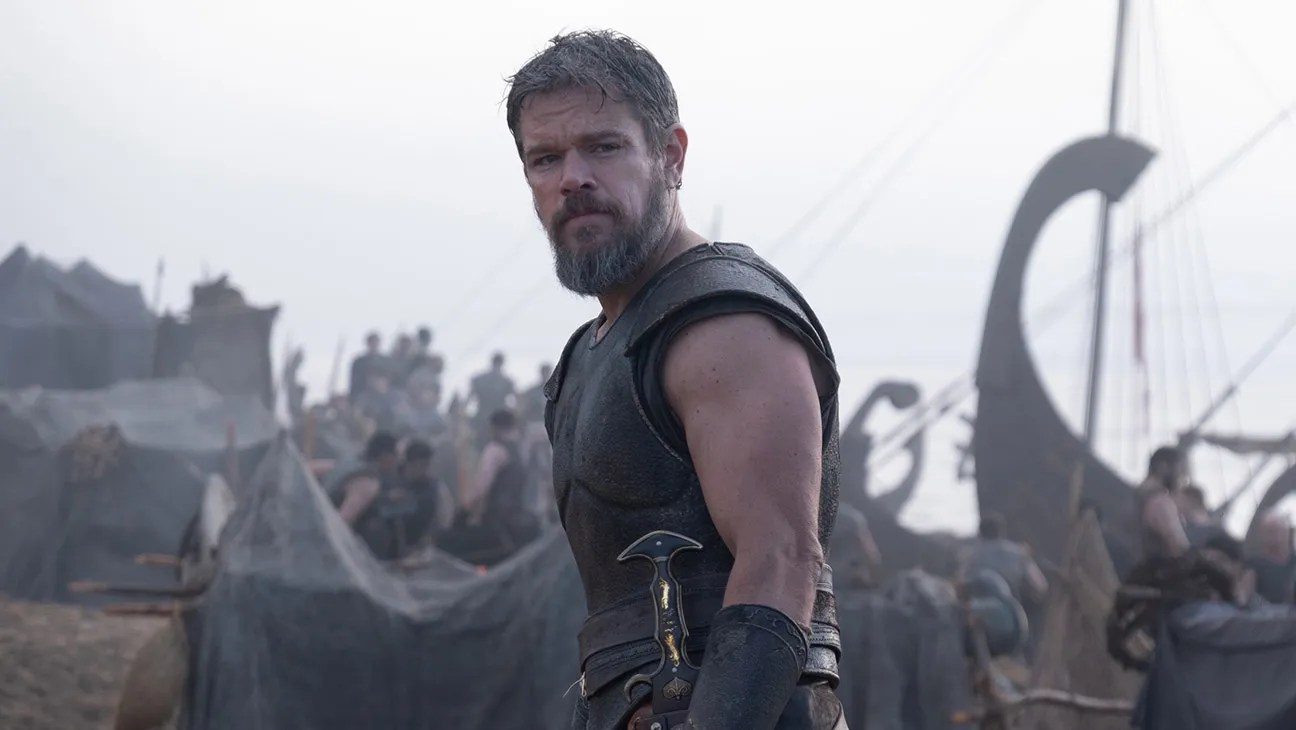
Director Nolan is one of the rare filmmakers who, in my opinion, has never made a bad film. From “Memento” to the “Dark Knight” trilogy to the Oscar-winning “Oppenheimer,” he has proven himself a true master of cinema. “The Odyssey” only adds to that distinguished resume’
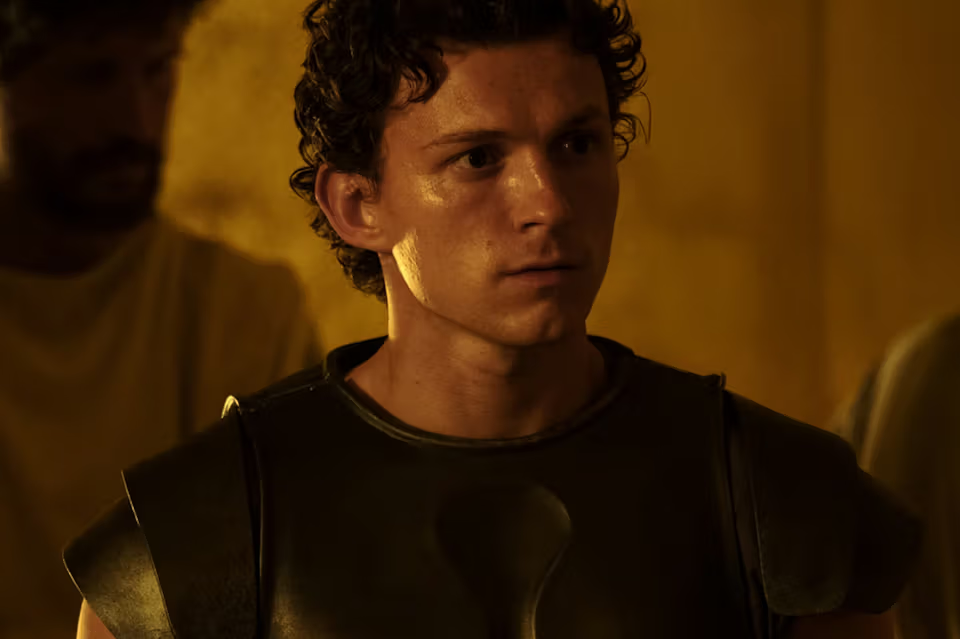
The cast is a tribute to Nolan himself who, like Woody Allen, can pretty much get anyone he wants for his films because, as an actor, why wouldn’t you want a credit in one of his films. Besides the three stars named above, the cast includes Robert Pattinson, John Leguizamo, Zendaya, James Remar, Jon Bernthal, Oscar nominees Samantha Morton and Elliot Page as well as Oscar winners Charlize Theron and Lupita Nyongo. As MGM used to advertise, “more stars than there are in heaven.”
The script and story are pretty faithful to the source material, though for some reason it bothered me whenever Telemacus referred to Odysseus as “dad.” Never father. The weird things you notice. Visual.y the film is stunning and the Trojan Horse and battle of Troy are worth the price of admission alone. I will add that I did see the film in 70 mm and, if that format is playing in your town, I urge you to see it in that format.
On a scale of zero to five, “The Odyssey” receives ★★★★ ½
Movie Reviews
Saari Review: Memory, Betrayal and Identity Converge at River Valley Film Festival – Hollywood Times


Premiering at the 2026 River Valley Film Festival, Saari uses fragmented memories, Finnish landscapes and restrained performances to explore betrayal, identity and reconciliation.
By Valerie Milano
Palm Springs, CA (The Hollywood Times) 7/14/26 – In the visually striking short film Saari—Finnish for “island”, a peaceful family retreat becomes the setting for the slow collapse of a relationship.
Co-written by Justin Seegmueller, Corey L’Esperance and Suvi Härkönen, the film follows Daniel, played by Seegmueller, as he reflects on the choices that damaged his relationship with Liina, portrayed by Ilona Karppanen. Told through fragments of the past, present and future, Saari gradually reveals how secrecy and betrayal can transform a place of safety into one of emotional confinement.
The nonlinear structure was not simply a stylistic choice. The project was developed and filmed over more than a decade, with footage captured in Finland, Boston and the desert. L’Esperance explained that the filmmakers divided the story into “past, present and future,” allowing audiences to experience the relationship from both characters’ perspectives.
Click below for our exclusive interview:
He described Daniel and Liina as two people who are “stuck in these moments in time,” making the fragmented narrative especially appropriate.
Seegmueller said Daniel’s internal struggle is rooted in the questions, “Am I that person? Am I still that person?” His restrained performance captures a man attempting to reconcile his current identity with the damage caused by earlier decisions.
For Seegmueller, the film is fundamentally about choice.
“It’s all about decision-making,” he said. “Are you an accumulation of all your decisions?”
Finland’s lush island scenery contrasts sharply with Daniel’s later isolation in the barren desert. Seegmueller described the progression as “lush and then dead,” a simple but effective visual representation of a relationship moving from intimacy and possibility to emotional aftermath.
For Liina, the island represents family history, comfort and security. By inviting Daniel there, she welcomes him into her sanctuary. His secrets, however, begin to contaminate that protected space.
“You let me into your life,” Seegmueller explained, “and now I’m here almost ruining your sense of security.”

 Because the couple reaches the island by rowboat, the setting also creates a sense of entrapment as suspicion and resentment begin to surface. L’Esperance noted that once they are there, “there’s not really anywhere you can go.”
The film’s cross-cultural perspective was strengthened by the collaboration between American co-director L’Esperance and Finnish co-director Härkönen. Their responsibilities shifted according to which character dominated a scene. L’Esperance generally led sequences centered on Daniel, while Härkönen took a stronger role when Liina’s experience was at the emotional forefront.
That approach helps prevent Liina from existing only as a reaction to Daniel’s behavior. Her journey eventually becomes more compelling than his guilt.
Karppanen traveled to the United States for the first time to film the Boston scenes, which were completed approximately three years after the original Finland footage. Seegmueller said the friendship they developed during production can be seen in the warmth between their characters during the relationship’s happier moments.
The filmmakers deliberately avoid explaining every detail of Daniel’s betrayal. Earlier edits revealed even less, but test audiences needed additional narrative guidance.
“We do need to have some breadcrumbs,” L’Esperance said, explaining that without them, the story became “a little too lost on the audience.”

 The challenge was to provide enough information while maintaining the film’s quiet, interpretive tone. L’Esperance said they wanted to leave room for viewers to “fill in some of the blanks.”
The lengthy production process also changed how the filmmakers viewed Daniel. L’Esperance acknowledged that they initially saw him as “this hero,” but over time recognized that “he is kind of a bad guy in some of these aspects.”
That evolving perspective gives the film greater moral complexity. Daniel is not granted an easy redemption, and his introspection does not erase the harm he caused.
Karppanen brings strength and emotional restraint to Liina, who emerges from the experience as what L’Esperance called “a completely different person.” A final city scene suggests that she is beginning to reclaim her identity and imagine a future beyond Daniel and the relationship that betrayed her.
Subtle, atmospheric and open to interpretation, Saari asks whether people are defined by their worst decisions, and what reconciliation means when the damage cannot simply be undone.
After more than 10 years of work, the film’s world premiere at the River Valley Film Festival is especially meaningful. Both L’Esperance and Seegmueller attended film school in Philadelphia, making the Pennsylvania premiere a return to the state where their filmmaking journeys began.

 Seegmueller hopes the film encourages audiences to examine their own choices and personal histories.
“What does that say about you?” he asked. “What does that say about your story and your own narrative?”
Saari will have its world premiere at the 2026 River Valley Film Festival. Seegmueller will attend the premiere in person, while members of L’Esperance’s family are expected to represent him at the festival.
-

 Illinois5 minutes ago
Data center fears mount after Illinois village residents prepare for the worst
-

 Indiana11 minutes ago
Statewide Silver Alert issued for two missing Indiana children
-

 Iowa17 minutes ago
Weight loss drug needles creating safety risk for eastern Iowa law enforcement
-
Kansas23 minutes ago
Kansas Lottery Powerball, Pick 3 winning numbers for July 15, 2026
-

 Kentucky29 minutes ago
Cyclosporiasis spreads across Kentucky
-

 Louisiana35 minutes ago
Louisiana pastor ordered to stay away from home of man he attacked
-

 Maine41 minutes ago
In Maine, Bobby Charles vs. Hannah Pingree is the race that matters | Opinion
-

 Maryland47 minutes ago
Maryland confirms 5 new measles cases, bringing year’s total to 9 – WTOP News

