Colorado
Denver elementary school gets new upgrades through Target Bullseye Builds program


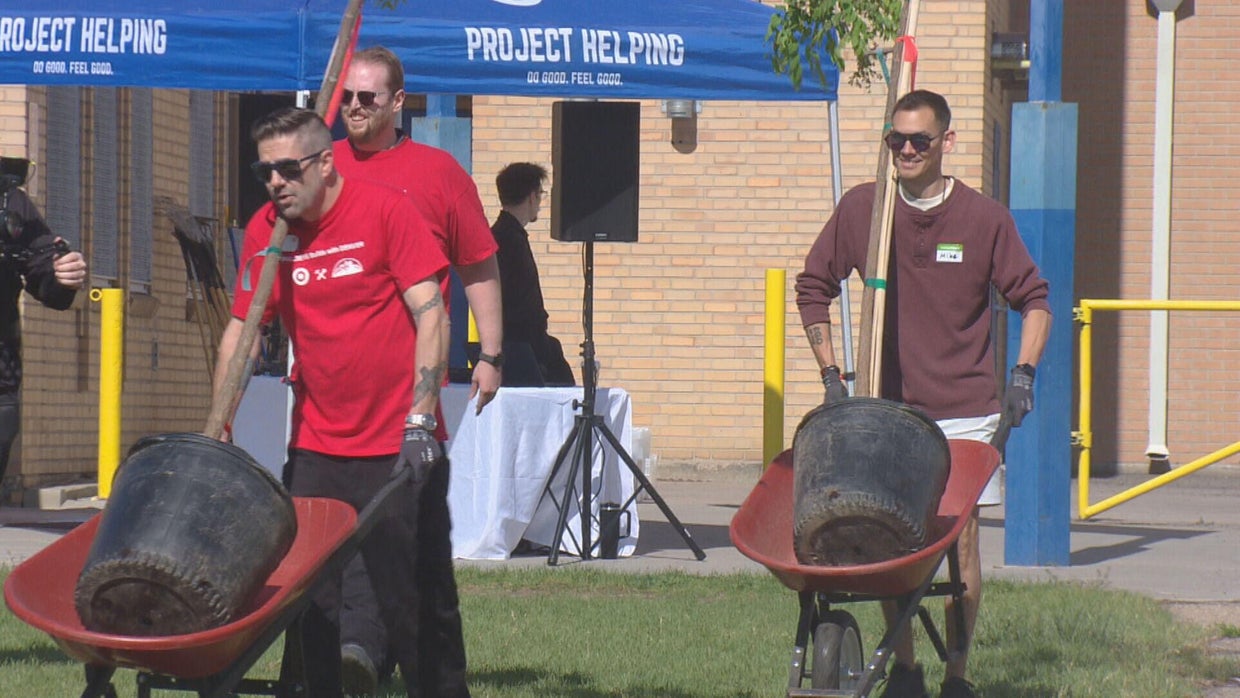
Target team members traded shopping carts for paint brushes on Friday as they helped transform spaces inside a Denver elementary school through the company’s Bullseye Builds program.
The volunteer effort at the Trevista at Horace Mann Elementary School included upgrades to the teacher’s lounge, outdoor beautification projects, and the creation of a new sensory room for students with disabilities. Employees spent the day painting, decorating and building spaces designed to better support both students and staff.
“It’s really exciting for the team because we get to roll up our sleeves and volunteer, and also make an impact to the students and teachers here at the school,” said Alisa Dalton, Target’s vice president of community engagement and belonging.
The project is part of Target’s nationwide Bullseye Builds initiative, which combines volunteer efforts with the company’s design expertise to support community needs identified at the local level.
“We’re going to be doing 13 Bullseye Build programs across the country this year, and how we approach these projects is really listening to the community and where they need us most,” Dalton said.
Trevista Principal Jessica Mullins said the opportunity came after Target reached out while the school was applying for a grant through Apple.
Students quickly noticed the changes taking shape around campus.

“Kids are really excited [about] the vibe today, running around, they’re with Target,” Mullins said.
Mullins said the improvements will benefit more than just students.
“You have to take care of your staff,” she said. “When you have happy teachers, that impact takes care of your students.”



Where is the proposed passenger rail station for Fort Collins?
Front Range Passenger Rail proposes a station just north of Drake Road. Take a tour of the area.
What it might be like to use a future Colorado Connector train to get from Fort Collins to Denver’s Union Station and beyond — along with the cities in between — is coming into clearer focus.
The Front Range Passenger Rail District’s website now shows the locations of all of its proposed passenger train stations.
And now the district has also unveiled how its trains will be branded to reflect the personality of Colorado Connector, nicknamed CoCo.
If all goes according to plan, the Colorado Connector will run on the existing BNSF railroad lines from Fort Collins to Pueblo, and eventually on to Trinidad.
Full buildout will require passage of a sales tax and years of work.
However, Phase 1, also known as joint service or starter service, could begin by 2029 and can be done without sales tax approval, according to the district.
This phase would run between Fort Collins and Denver’s Union Station, with stops in Loveland, Longmont, Boulder, Louisville, Broomfield and Westminster.
At least eight city councils have passed resolutions of support for the district’s proposed station locations in their communities.
It’s not a done deal because for the starter service to begin, almost half of its funding still needs to be approved by RTD, the Regional Transportation District serving the Denver metro area.
To fund anything beyond starter service will require voters who live within the Front Range Passenger Rail District boundaries to pass a sales tax.
Where Front Range Passenger Rail stations are to be located
- Fort Collins: The proposed station location is right in the geographic center of Fort Collins. North of Drake Road, running parallel and directly adjacent to the Mason Trail and MAX bus rapid transit line. The heart of Colorado State University is three MAX stops to the north. Old Town with its restaurants, shops and Old Town Square is about 2 miles north, and passengers can use the trail or the MAX bus to get there. The district’s station description notes that CSU’s Canvas Stadium, Moby Arena and key live music venues can be reached in 15 to 20 minutes.
- Loveland: The station would be located along Railroad Avenue between Seventh and Eighth streets, two blocks from the downtown historic district. There is a bus stop about a block away, the COLT South Transfer Point on Eighth Street, the district’s website says, adding that trails like the Loveland Loop and Long View Trail offer bicycle connectivity, while U.S. Highway 34, about six blocks to the north, gets visitors to Estes Park and Rocky Mountain National Park.
- Longmont: This station would be in Longmont’s lower downtown, along First Street near Main Street, off Coffman Road. Front Range Community College is planning a new campus in the area, Coffman Street is Longmont’s first dedicated multimodal corridor, and a future bus rapid transit line is planned for 2028, according to the district. The station would connect to the St. Vrain Greenway, an 8-mile trail that connects to other city and regional trails.
- Boulder: The proposed station is centrally located, north of Pearl Parkway and west of Foothills Parkway. It’s located within walking distance of Boulder Junction, a bus hub, and connects to the city’s network of bike paths, greenways, research and educational campuses, and downtown destinations, according to the district. The University of Colorado Boulder, about 3 miles away, and a cluster of federal research institutions could be accessed using high-frequency bus routes and are within biking distance, according to the location description. The Pearl Street Mall is less than 2 miles west.
- Louisville: The station is proposed on Front Street, a block away from the town’s walkable Main Street corridor with its restaurants and shops, between South and Short streets. The nearby Steinbaugh Pavilion hosts outdoor events like markets, and there’s existing pedestrian connectivity to the RTD line and city parking, according to the district’s location description.
- Broomfield: This station would be east of the Denver-Boulder Turnpike (U.S. Highway 36), at West 116th Avenue and Wadsworth Boulevard. This is “a gateway area where the character of the land is actively changing,” according to the location description, with new residential investment and connections “in every direction.” A pedestrian bridge over U.S. 36 to the west leads to a bus rapid transit station that links to Denver, Boulder, Denver International Airport and the Anschutz Medical Campus. The nearby U.S. 36 Bikeway connects to downtown Denver and downtown Boulder.
- Westminster: The station would be located at West 88th Avenue and Harlen Street, in a redeveloped spot that was once the site of the old Westminster Mall. This “new downtown” includes hospitality, shopping, restaurants, public parks and a new performance pavilion. The passenger rail district, in its description of the location, says the station’s connectivity “is among the strongest on the corridor,” adding that the Flatiron Flyer’s U.S. 36 and Sheridan Station is within walking distance of the future station and the U.S. 36 Bikeway is accessible. Westminster’s 180-mile trail system also passes through the station area, connecting riders from Standley Lake Regional Park on the west to the city of Thornton on the east.
- Union Station in Denver: Located in the heart of the city, seven RTD rail lines converge at Denver’s Union Station, including to and from Denver International Airport, along with more than a hundred regional bus routes, Amtrak’s California Zephyr, Canyon Spirit and CDOT’s future Mountain Rail. Free transit serves the 16th Street Mall and the state Capitol, and the station and surrounding area is a destination itself. Nearby trails connect to Denver’s broader trail network, according to the district. Union Station is where the Colorado Connector starter service, also known as joint service, ends. The rest of the Colorado Connector route below depends on taxpayer funding.
- Littleton: Here, the Colorado Connector rail platform would be integrated directly into the existing RTD light rail station at Mineral Station. There is a shopping and lifestyle district to the north. The South Platte River corridor, including to the Highline Canal Trail and C‐470 Trail, feeds to the station area, according to the district.
- Sterling Ranch: This location would bridge the gap between Douglas County and the Denver metro area. It would be located in the vicinity of U.S. Highway 85 (Santa Fe Drive) and Titan Road. The precise location has yet to be determined, but it would serve the Sterling Ranch community, Lockheed Martin, Roxborough, Highlands Ranch, Castle Rock and broader Douglas County.
- Colorado Springs: This station would be located adjacent to the US Olympic and Paralympic Museum and near America the Beautiful Park, Weidner Field and the Pikes Peak Center for the Performing Arts, near Interstate 25 and Cimarron Street. Connections are available via Sierra Madre Street, Pikes Peak Greenway Trail, the free ZEB shuttle and local bus routes, but “full community connectivity will require continued coordination in the future,” the district’s description says.
- Pueblo: This station would be the southern terminus of the Colorado Connector, located at the historic Pueblo Union Depot near Interstate 25 and Union Avenue. A future pedestrian bridge could connect to the Union Avenue Historic Business District, “a lively, walkable core of 1890s-era masonry buildings featuring boutique retail, residential lofts, and restaurants,” according to the rail district’s description. The Historic Arkansas Riverwalk is within a half mile of the proposed station. The Pueblo Transit Center is located within 1 mile of the station, and the plan envisions a regional bus port for rail and bus services.
- Trinidad: Front Range Passenger Rail District’s current plan calls for a Trinidad station as part of a future “border-to-border” service to come even further into the future. Trinidad is the only community in the FRPR District outside of Denver with intercity rail service already. The Amtrak Southwest Chief platform serves daily intercity passengers near I-25 and Commercial Street on the edge of Trinidad’s historic downtown. There’s a free seasonal trolley that could extend to the station, the district’s description says: “The station location provides immediate access to downtown, brand new lodging nearby, refuge for interstate travelers, and an eclectic mix of tourism offerings, including art, history, architecture, and adventure.”
Colorado Connector adopts fox mascot
The Front Range Passenger Rail District recently released its new branding for the Colorado Connector.
A rendering of the train features the new logo, with the words “CoCo” in orange and “Colorado Connector” in blue.
“Trustworthy and purposeful, yet fun, lighthearted and full of personality, CoCo is designed to reflect the culture, character and communities of Colorado’s Front Range,” a news release announcing the branding says.
The branding also features a fox mascot, “a native Colorado animal known for agility, intelligence, and the ability to navigate diverse landscapes with ease,” the news release says. “Curious, resourceful, and always on the move, the fox embodies the adventurous spirit of the Front Range and the joy of discovering what’s just beyond the next stop.”

MONTE VISTA, Colo. (KKTV) – Citing high water temperatures and low flow, Colorado Parks and Wildlife imposed voluntary afternoon fishing closures on two stretches of the Rio Grande starting Wednesday.
The impacted areas include the section of the river from the Rio Grande Reservoir Dam to the Rio Grande Canal and the stretch from Big Meadows Reservoir Dam to the confluence of the main stem of the river.
“We feel it is important to protect the fish populations in the Rio Grande from low flows and warm temperatures,” said CPW aquatic biologist Estevan Vigil. “The Rio Grande has a long stretch that meets Gold Medal standards for the number of larger fish, and these fish need relief from the high temperatures they are experiencing.”
Closures are in place from noon to midnight each day until further notice. Find a full list of fishing closures here.
Copyright 2026 KKTV. All rights reserved.

Editor’s note: Welcome to the 13th installment of our 15-week series Colorado 150, marking 150 years of statehood with our favorite Colorado things.
The best part about going up the mountain — and, to be honest, that part is pretty great, too — is that you then get to go back down. Sometimes at whooshing speed.
We in Colorado have found a seemingly infinite number of ways to turn our rugged state into a limitless playground. On rock and snow and ice and dirt and asphalt and grass and water, the Rocky Mountain rollercoaster brings joy in forms both familiar and completely weird. To wit: there’s a hugely popular coffin race at a festival in Estes Park dedicated to a frozen Norwegian grandpa and it’s not even the oldest coffin race in the state — that one, the world’s first, takes place every year in Manitou Springs.
The list below offers a snapshot of some of the sporting events that make Colorado so unique, but it is by no means exhaustive. There’s also the Pike Peak International Hill Climb, where cars race up America’s Mountain while drifting perilously close to the abyss; the Deer Trail Rodeo, which bills itself as the world’s first rodeo; and the Meeker Classic sheepdog trials, the herding version of the Super Bowl.
You can watch world-class skiing at the Birds of Prey course in Beaver Creek or head to Pueblo and take in the Bell Game, the oldest high school football rivalry west of the Mississippi River, or grab a hot dog and sit in the stands at Coors Field to watch a baseball move (or not move) in a way it does at no other Major League park.
Or maybe do something no one has thought up yet. If in 150 years we came up with all this, imagine what we’ll dream up in the next 150. Let us know your favorite Colorado sporting event or activity — past, present or future tense — and we’ll add it to the list of reader submissions.
Burro racing

Pack burro racing was named Colorado’s official summer heritage sport in 2012, but dates back to 1949, when the first official race was organized between Leadville and Fairplay. Per race rules, each burro must carry a pickax, a shovel and a gold pan. Since the burros were carrying a full load, the miners had to walk, which is why there’s no riding in pack burro races.
There are about a dozen races around Colorado every summer, uniting mountain towns and attracting crowds eager to watch the unique celebration of the state’s mining boom. Anyone can race, and no prior donkey experience is required.
MORE INFO
Skijoring

The Wild West spectacle called skijoring challenges even the most experienced skiers as they swerve past gates, jam their arms through dangling orange rings and soar over gaps nearly 13 feet long. Oh, and all while being pulled by a horse and hitting speeds of 40 mph down a snow-covered straightaway in a mere few gallops.
Across Colorado, folks line the main streets of mountain towns to watch the mashup of rodeo and ski racing, with adrenaline-seeking cowboys and skiers flying down the straight track set up along streets once lined with saloons and gambling halls.
MORE INFO
GoPro Mountain Games

Born in 2002 as a local whitewater paddling contest, the GoPro Mountain Games are a cultural celebration of mountain sports and music. The four-day festival still revolves around kayaking — with the world’s top paddlers racing and flipping through the swollen Gore Creek — and includes climbing, slacklining, trail running and mountain biking. The early-June weekend is the official launch of summer for Vail, with a rare blend of spectating and participation that typically injects more than $11 million into the local economy with nearly 100,000 attendees and more than 5,000 athletes competing in all kinds of contests.
MORE INFO
Leadville Series

Mountain bikers from around the world vie every summer for what has become a coveted spot to claim the sport’s biggest badge, er belt buckle, of honor. The 100-mile race starts in the early-morning hours at 10,152 feet and goes 50 miles across some of the toughest terrain, only to hit Columbine Mine to turn around and do it all again.
And for those who cross the finish line in less than 12 hours, a shiny belt buckle awaits. (And the following week, a smaller group of runners takes to a similar 100-mile track to race across the sky.)
MORE INFO
Hardrock 100

For more than 30 years, the world’s top trail runners have rallied in Silverton for the ultimate test. The Hardrock 100 race climbs some 33,000 vertical feet across 102.5 miles with lithe runners galloping above 12,000 feet a total of 13 times on a course that includes the summit of 14er Handies Peak. The average finish time for this race is around 40 hours, but the uber-elite runners finish in 25 hours or less.
About 3,000 runners apply for the Hard Rock 100 every year and only 146 are chosen in a golden-ticket lottery that balances gender and reserves spots for aspiring runners who have never started or crossed the finish line.
MORE INFO
Ouray Ice Festival

Every winter an army of ice-farming volunteers and climbers carefully sculpts more than 200 ice climbs, trickling 200,000 gallons of water a night down craggy limestone into the mineral-tinted Uncompahgre River. The precipitous frozen fangs lure nearly 25,000 climbers a year who fuel a vibrant winter economy in the city that calls itself the Switzerland of America.
The ice park is just a short stroll from hot springs, hotels and coffee shops. The peak of the park’s season comes with the Ouray Ice Festival and Competition every January.
MORE INFO
Bolder Boulder

Colorado summer doesn’t start until the race gun goes off for the Bolder Boulder. The marquee 10K is an annual showcase of the quirky and the inspiring. The day mixes an upward of 40,000 competitors, a Memorial Day celebration inside Folsom Field, and a crowd of adoring spectators.
Tens of thousands of runners fill the streets every year, from people running in costumes or pajamas to professional athletes drawn by the race’s hefty prize purses. Along the route, some fans have cookouts. Others cheer and spray competitors with a water hose while live music blares at points along the route.
MORE INFO
Colfax Marathon

The 26.2-mile run is centered around the longest continuous commercial street in the country, and after more than two decades the weekend has evolved to showcase runners of all abilities. There’s a 5k, 10k, half-marathon and even relay teams. So, you don’t have to be one of those 26-milers to join the masses.
The marathon also tours some of Denver’s most iconic spots: starting and finishing in City Park, but in between hitting the Broncos stadium, a fire station and plenty of views along the creeks and rivers as it heads toward the foothills before turnaround.
MORE INFO
Olympic Center

Located in downtown Colorado Springs, the Olympic & Paralympic Training Center draws more than 130,000 visitors a year to see where some of the world’s best athletes prepare for the Games. Sports fans can tour the campus, which includes among other facilities an aquatic center, gymnasiums, velodrome and shooting center.
And a few miles away, the U.S. Olympic & Paralympic Museum features a dozen galleries. There’s plenty to see and do as visitors can learn at exhibits on athlete training, the science and technology in athlete performance, the history of the Summer and Winter Games, and the USOPC Hall of Fame.
MORE INFO
Iron Horse Bicycle Classic

A brotherly bet birthed the Iron Horse Bicycle Classic in 1971 when Tom Mayer pedaled his Schwinn from Durango to Silverton faster than his brakeman brother in a coal-fired train. More than a half-century later, the Memorial Day weekend bike party draws thousands of pedalers in a celebration that pumps nearly $5 million into the Four Corners economy and anchors one of the most vibrant bike cultures in the West.
In an era where the graveyard of road bike races is stacked dozens deep, the Iron Horse has endured thanks largely to the unwavering embrace of the Durango community. It’s safe to say the Iron Horse’s vibrancy helped land the first-ever world championship of mountain biking, which returns in 2030.
MORE INFO
-

 Los Angeles, Ca1 hour ago
Water main break floods West Hollywood streets, traps cars
-

 Detroit, MI2 hours ago
Detroit’s air quality early Thursday ranked as hazardous, worst in the world
-

 San Francisco, CA2 hours ago
‘It was a scene from the Titanic’: Fishermen recall rescuing passengers from sinking boat in SF Bay
-

 Dallas, TX2 hours ago
Big picture takeaways from the Dallas Mavericks first week at Summer League
-

 Miami, FL2 hours ago
“We’re going to be champions”. Argentina fans in Miami Beach celebrate team’s win against England
-

 Boston, MA2 hours ago
4 Red Sox Trade Targets to Solidify Boston’s Push for a Playoff Spot
-

 Denver, CO2 hours ago
RTD considers ending Denver’s 16th Street FreeRide shuttle due to budget issues
-

 Seattle, WA2 hours ago
Trump immediately fires the new court-appointed top prosecutor in Seattle | CNN Politics

