Science
Scientists Press Congress on Dismissal of National Science Foundation Board and Research Funding


More than 2,500 scientists said in a letter to Congress on Monday that President Trump’s dismissal of the National Science Foundation’s oversight board was an “alarming attack” on research funding that could put the United States at a disadvantage with rivals, especially China.
“We stand with the National Science Board, and call on Congress, as an equal branch of government, to rapidly and firmly support science by calling for the reinstatement of terminated National Science Board members,” the signatories wrote.
In a separate letter last month, more than a dozen former leaders of the foundation urged the White House and Congress to quickly fill the leadership vacuum President Trump created at the agency. Established in 1950, the agency has been responsible for annually distributing about $9 billion in research grants in recent years. That money funds much of the public science research in the United States, from artificial intelligence to astronomy.
The former board members have been trying to call attention to what they say is a growing research funding gap with China. Last week, the N.S.F. published the board’s 2026 report on the state of U.S. science and engineering, which the board had finalized before its dismissal. In the report, the board warned China had overtaken the United States in research and development expenditures.
That gap is likely to grow as science funding under the Trump administration is at a low point.
As of May 1, the agency has committed 10 percent of its congressionally appropriated funds, roughly half of what the foundation had awarded by this point in previous fiscal years, according to Grant Witness, which tracks scientific grants.
A White House spokesman justified the decision to fire the board by pointing to a 2021 Supreme Court decision about the governance structure at another government agency. The spokesman added that the N.S.F. was delivering on Mr. Trump’s pledge to cement America’s technological and innovative dominance.
Former agency board members, however, voiced concerns about the foundation’s ability to fulfill its mission. The dismissal of the board and the yearlong vacancy of the role of foundation director has left the agency “in a very precarious position,” said Yolanda Gil, a computer science professor at the University of Southern California and former board member.
Four people formerly on the board date the deterioration of its relationship with the administration to April 2025, when the N.S.F. canceled hundreds of active research grants without consulting any board members. Shortly thereafter, the foundation’s director, Sethuraman Panchanathan, announced his resignation; another board member, Alondra Nelson, resigned a few weeks later.
Ms. Nelson, a social science professor at the Institute for Advanced Study, said that she had seen the writing on the wall. “It was so clear that our work was going to be compromised,” she said.
Another former board member said the administration had left scientists in the dark on its plans. “It almost didn’t matter what question we asked, the answer would almost come back exactly the same, and it would always be along the lines of, ‘that’s an active conversation with the administration,’” said Keivan Stassun, a physics and astronomy professor at Vanderbilt University. “A lot of euphemism, but no actual answers.”
With limits on its ability to conduct oversight, the board turned to its responsibility of advising Congress on science policy.
Last May, the White House released a budget request for the 2026 fiscal year that proposed slashing N.S.F.’s funding by more than half, but board members advised Congress to maintain similar funding levels as in previous years.
Divided into small groups, board members told lawmakers of both parties about the importance of funding science research, raised the specter of China’s growing scientific output and discussed how new technology could help modernize the N.S.F.
In the end, Congress appropriated $8.75 billion to the research funding agency, a modest cut from the $9.1 billion in fiscal year 2025.
Last month, Mr. Trump released his budget plan for the 2027 fiscal year, again calling for significant N.S.F. cuts. This time, the White House requested about $4.9 billion for the agency, a more than 40 percent cut.
In the proposal, the administration also said it wanted the N.S.F. to fund a $900 million project to build an ice-breaking vessel. Arctic cutters are a priority for this administration, and last October Mr. Trump signed a memorandum directing the Coast Guard to build four Arctic Security Cutters in Finland. As of February, the Coast Guard awarded contracts for 11 ships. It is unclear if there is any connection between the Coast Guard’s vessels and the one Mr. Trump has proposed that the N.S.F. fund.
For the former board members, who were nominally responsible for approving major N.S.F. programs like the Arctic vessel venture, the proposal came as a surprise.
“It just sort of appeared in the president’s budget request,” said Mr. Stassun, who led the board’s subcommittee on funding larger facilities and projects. “It had not gone through any of the normal processes,” he added.
But before board members could discuss the shipbuilding proposal or begin advising Congress on funding levels for the N.S.F., they were dismissed.



Scientists hoped for years to make a machine that could emulate the movements of diving birds, such as puffins, and offer an affordable, unobtrusive way to monitor fragile marine ecosystems. A team of researchers at M.I.T. has been able to create such a waterproof winged robot, according to a study published July 9 in the journal Science.
Nearly one month after a fire destroyed a massive cold-storage facility in Boyle Heights, the neighborhood has been overcome by the stomach-churning stench of rotting food.
As facility operator Lineage works to remove more than 85 million tons of weeks-old food from its 500,000-square-feet warehouse, the rancid odors have attracted throngs of rats and swarms of flies, as a foul-smelling brownish liquid pours from the seams of the building.
Now, with a heat wave descending over much of Southern California, residents worry the odor could get even worse and scores of residents have called air quality regulators to complain. At the same time, environmental groups are accusing Lineage representatives and emergency responders of downplaying the risks pose by chemicals released during the fire.
Boyle Heights, a neighborhood that has been subjected to decades of toxic pollution from rail yards and other industries, has again become the center of attention in another environmental disaster. Already, the official response to the Lineage fire has eroded trust in government agencies, residents say.
Remediation work continues at a Lineage facility in Boyle Heights, where residents and nearby businesses have complained of a rotting food odor for weeks.
(Allen J. Schaben / Los Angeles Times)
On Tuesday, Sen. Alex Padilla (D-Calif.) visited the gutted warehouse alongside L.A. Fire Chief Jaime Moore and representatives of the South Coast Air Quality Management District and a contingent of environmental organizations. Padilla, along with Sen. Adam Schiff (D-Calif.) and Rep. Jimmy Gomez (D-Los Angeles), wrote a letter to the U.S. Environmental Protection Agency, calling on the agency to return to the cleanup zone to monitor air and water quality.
“Given the materials present in the warehouse, we are concerned about the long-term health and environmental impacts from contaminated smoke and water runoff on communities surrounding the warehouse,” the letter read.
Joe Lyou, president of nonprofit Coalition for Clean Air, told Padilla that he has heard of people becoming sick in the weeks after the event.
“I think that pointed to a problem with the messaging while the event first happened,” Lyou said. “It wasn’t consistent [with] if you smell smoke, see ash to get out and protect yourself — make sure you’re not exposed to it. There were different messages coming from different people, and we need to fix that.”
“The whole community was completely overwhelmed … and concerned about the ammonia, concerned about burning plastic, concerned about all sorts of other [emissions] that are really hard, difficult, expensive to measure. But … we’ll just never know some of those things,” Lyou said.

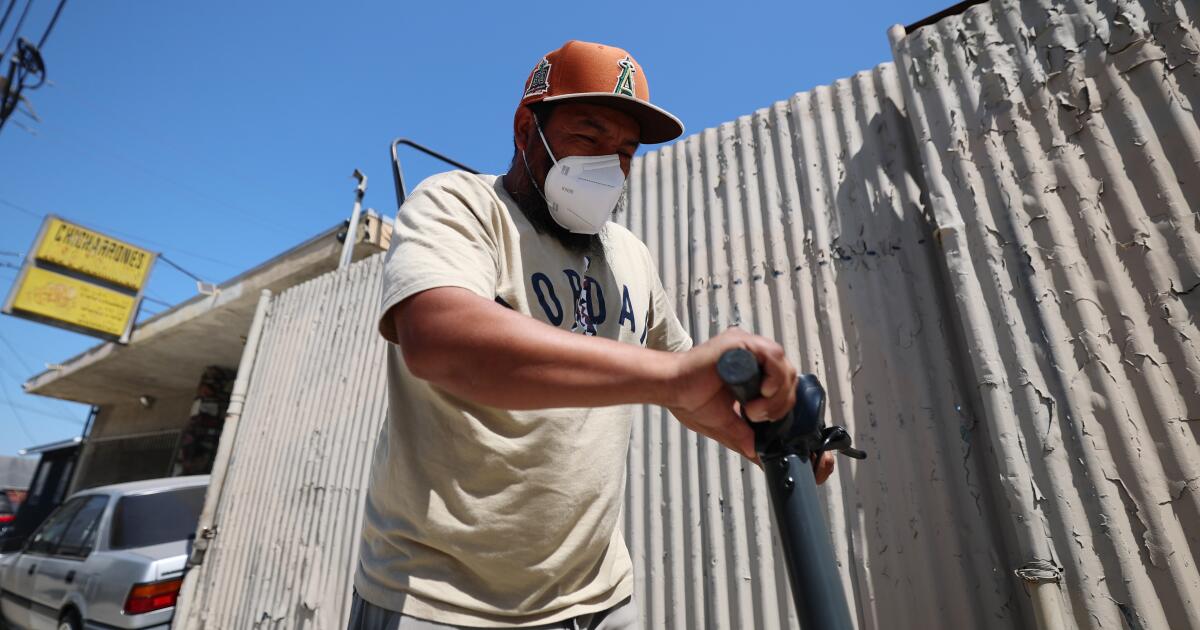
Street vendor Lupe Gonzalez pushes her cart away from a gutted warehouse in Boyle Heights.
(Allen J. Schaben / Los Angeles Times)
Chief Moore has faced criticism for his decision to advise residents to shelter indoors rather than to evacuate during the blaze. That stood in sharp contrast with Orange County fire officials, who evacuated tens of thousands of residents near an overheating chemical tank in Garden Grove in May.
On Tuesday, Moore told Padilla that the two incidents were very different. Moore said he had discussed the dilemma with TJ McGovern, the interim fire chief for the Orange County Fire Authority.
“He says everybody got mad at him because he evacuated everybody and nothing blew up,” Moore told Padilla. “But everybody’s mad at you because of the shelter-in-place [order] and it smells.”
Moore said that “there was nothing in the air that was hazardous” and that firefighters “never had a threat of an explosion.”
However, environmental experts said 14,000 pounds of flammable anhydrous ammonia were stored in tanks and used as refrigerant at the Lineage warehouse and posed a significant risk of explosion until it was removed days into the fire.
Environmental and community groups said L.A. fire officials also repeatedly emphasized the risks from ammonia in their radio communications. On the first day of the fire, a group of firefighters was hit by a plume of ammonia gas, and fire command quickly organized medical help.
“The majority of my division got exposed to ammonia gas. We’ll need to get them assessed.”
On Tuesday, Moore said no amount of ammonia was detected.
“When [firefighters] opened those doors, there was what looked like a big vapor cloud that came out,” Moore said. “That was the cold air mixing with the hot air that caused a vapor. It wasn’t ammonia.”
But residents remain skeptical.
Padilla’s visit follows a notice of violation that the South Coast Air Quality Management District issued to Lineage. The notice of violation was issued on July 12, after the agency received more than 40 public complaints of rotten, sour, garbage-type odors in the area. Inspectors confirmed the odors with community members and traced them back to cleanup operations at the facility, according to the air quality agency.
Boyle Heights residents are calling on Gov. Gavin Newsom to declare a mandatory evacuation of their community, saying the fire and the toxic aftermath are continuing to pose health risks. Without an evacuation order, they said, insurance companies won’t help residents who want to relocate with rent or mortgage relief.
“For nearly a month, a cold-storage warehouse fire has poisoned the air over the Eastside and Los Angeles County and City officials have refused to issue a mandatory evacuation,” read a statement from the community group Protect LA Now. “That refusal forces victims to pay their own way out, and leaves those who can’t afford to leave trapped in gases and toxins that no agency will name.”

Joe Lyou, president of the Coalition for Clean Air, explains how smell is affecting his health while talking to the media near a fire-gutted Lineage facility Tuesday.
(Allen J. Schaben / Los Angeles Times)
Tensions have been building in the community since the fire broke out on June 17 and burned for days.
At a contentious town meeting last week, Los Angeles Mayor Karen Bass struggled to open the meeting over the loud boos and yelling of community members, actions that were repeated as other elected officials took the microphone. The crowd grew even louder when Lineage Chief Operating Officer Jeff Rivera took to the stage and was met with shouts of “Liar!”
Air quality has been a constant concern for the community since the incident began. Beyond the health hazards of breathing in smoke from a building fire, there was a brief, temporary scare when an ammonia line that helped keep the building refrigerated was compromised, though Lineage has said the chemical was not detected in the air. Additionally, 85 million pounds of food thawed, burned and spoiled inside, creating a terrible smell that emanated from the property.
Nora Saenz, a resident of Bell, said she believed local leaders when they said there was no threat. During the fire, she took her niece and nephew to a community event in La Mirada, which was downwind of the fire.
Now Saenz fears what they might’ve breathed in.
“The day of the fire, we were told that the air was safe to breathe,” she recalled. “To this day, I don’t know what I exposed my niece and my nephew to.”
Times staff writers Salvador Hernandez, Clara Harter and Seamus Bozeman contributed to this report.
Video released by Chinese state media shows a state-owned aerospace company launching a rocket and recovering part of it on Friday. The successful launch of a reusable rocket was a major step for China toward challenging SpaceX’s satellite internet dominance.
-

 Los Angeles, Ca48 minutes ago
Southern California hits hottest day of its extreme heat warning
-

 Detroit, MI1 hour ago
Steve Yzerman out as Detroit Red Wings GM, moves to senior advisor role
-
 San Francisco, CA1 hour ago
Supervisors urge California to expand S.F. speed-camera program
-

 Dallas, TX1 hour ago
Five teens injured after crashing carjacked vehicle during Dallas police chase
-

 Miami, FL2 hours ago
Tokyo-style Neapolitan pizza is coming to Miami, led by legendary pizzaiolo chef Bun
-

 Boston, MA2 hours ago
SEE THE GOOD: Roxbury center reminds young adults ‘You got this’ – Boston News, Weather, Sports | WHDH 7News
-
Denver, CO2 hours ago
Five Points affordable housing building honors Dr. Justina Ford | Rocky Mountain PBS
-

 Seattle, WA2 hours ago
Seattle weather: Hot and sunny day Wednesday, highs in the 80s


