Connect with us

Minneapolis, MN

G42’s Core42 leases 20MW in converted Minneapolis office building as UAE expands US AI data centre footprint

Published

on

G42’s Core42 leases 20MW in converted Minneapolis office building as UAE expands US AI data centre footprint


TL;DR

Core42, the cloud subsidiary of Abu Dhabi’s G42 Group, has leased 20 megawatts in a converted office building in downtown Minneapolis. The company building the Stargate UAE campus is now filling American offices-turned-data-centres, part of a broader pattern in which the same AI systems emptying offices are generating the demand to fill them with servers.

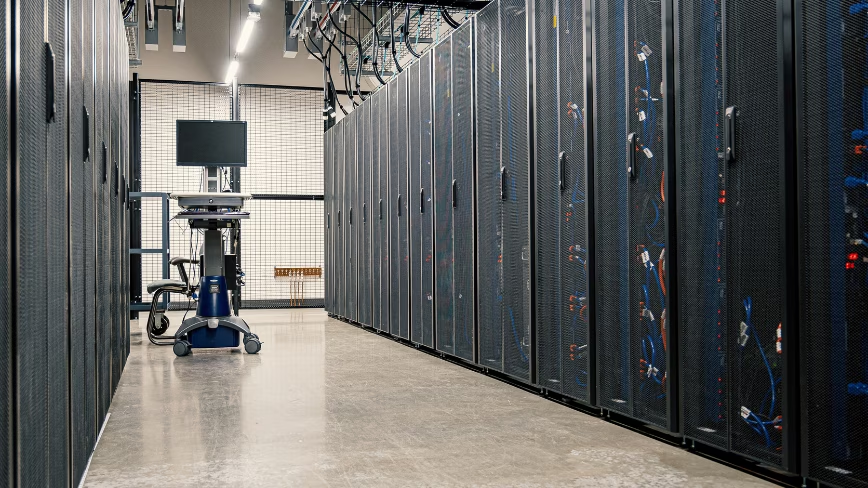
The building at 1001 Third Avenue South in downtown Minneapolis used to be an office. Now it is a data centre, and its anchor tenant is not a Silicon Valley hyperscaler but Core42, the cloud and AI infrastructure subsidiary of Abu Dhabi’s G42 Group. The lease, reported by Bloomberg on Wednesday, covers 20 megawatts of capacity in a facility converted from commercial office space by Legacy Investing, a Virginia-based developer that has spent more than 70 million dollars transforming the property. The deal is a small piece of a much larger pattern: the UAE’s most ambitious AI company is building a network of American data centres while simultaneously constructing the largest AI compute facility outside the United States, and the buildings it is filling were, until recently, home to the kind of white-collar workers whose jobs AI is designed to replace.

Advertisement

The tenant

G42, led by CEO Peng Xiao and backed by Abu Dhabi’s national security adviser Sheikh Tahnoon bin Zayed Al Nahyan, has become the UAE’s principal vehicle for AI infrastructure investment. The company is building the Stargate UAE campus, the international flagship of the 500 billion dollar Stargate joint venture between OpenAI, SoftBank, Oracle, and Abu Dhabi sovereign investment vehicle MGX, across approximately 19 square kilometres of desert south of Abu Dhabi. The first phase, a 200 megawatt compute cluster powered by Nvidia Grace Blackwell GB300 systems, is scheduled to come online by the end of 2026, with full build-out designed to reach one gigawatt of capacity at a projected cost exceeding 30 billion dollars. The project has already attracted geopolitical threats, with Iran warning of retaliatory strikes against Gulf infrastructure including commercial data centres.

Core42’s US expansion extends well beyond Minneapolis. The company signed a ten-year lease with TeraWulf for more than 70 megawatts of data centre infrastructure at the Lake Mariner facility in upstate New York, with an option for an additional 135 megawatts. G42 has also announced a one billion dollar data centre investment in Vietnam and established Core42’s European headquarters in Dublin. The Minneapolis lease adds a relatively modest 20 megawatts to a portfolio that is scaling globally, but its significance lies less in the capacity than in the location: a converted office building in the centre of an American city whose downtown vacancy rate, like those of most mid-sized US cities, has climbed steadily since the pandemic.

The conversion

The 💜 of EU tech

The latest rumblings from the EU tech scene, a story from our wise ol’ founder Boris, and some questionable AI art. It’s free, every week, in your inbox. Sign up now!

Legacy Investing acquired 1001 Third Avenue South in 2019 and has since invested heavily in converting the six-storey property from office to data centre use. The company spent more than 70 million dollars on improvements in 2025 alone, expanding the building’s capacity from approximately two megawatts to 21 megawatts. In January 2026, Cloud Capital and Bahrain-based asset manager Arcapita acquired the property for 235 million dollars through a joint venture, reflecting the premium that data centre conversions now command over traditional office valuations.

Advertisement

The economics of office-to-data-centre conversion have become compelling enough to reshape urban real estate markets. US utilities plan to spend 1.4 trillion dollars by 2030 to power the AI boom, and the demand for data centre capacity has outstripped the supply of purpose-built facilities. Converting existing office buildings offers developers a faster path to market than ground-up construction, provided the building’s structural load capacity, power infrastructure, and cooling systems can be upgraded to support the density of modern compute hardware. Not every office qualifies. The buildings that do, typically those with reinforced concrete construction, proximity to fibre networks, and access to sufficient electrical capacity, have become some of the most sought-after properties in commercial real estate.

The pattern

G42’s American data centre strategy reflects a broader shift in how sovereign AI ambitions are materialising in the United States. The company is not simply building compute capacity abroad. It is establishing a physical presence inside the American power grid, the American fibre network, and American commercial real estate markets. The Minneapolis lease, the TeraWulf deal in New York, and facilities in California and Texas create a distributed infrastructure footprint that positions Core42 as a provider of what the company calls sovereign cloud and AI infrastructure: compute capacity that can serve both G42’s own AI workloads and those of its customers, including the US-based companies that require data residency within American borders.

The race to secure data centre capacity has drawn startups, sovereign wealth funds, and hyperscalers into direct competition for the same constrained resources: power, land, cooling, and fibre connectivity. In Minneapolis, Legacy Investing’s conversion of an office building into a 21 megawatt facility illustrates how developers are working around those constraints by repurposing existing urban infrastructure rather than competing for greenfield sites in the exurban corridors where most large-scale data centres are built. The approach has limits. Twenty megawatts is a fraction of the capacity that a purpose-built hyperscale facility delivers, and the structural constraints of an existing building make future expansion difficult. But for a tenant like Core42, which needs distributed US presence rather than concentrated scale, the urban conversion model offers something that a greenfield campus in rural Virginia does not: proximity to enterprise customers and the network interconnection density of a major metropolitan area.

The context

The geopolitics of UAE-linked AI infrastructure in the United States remain sensitive. G42 severed its ties with Chinese technology companies in 2024 under pressure from the US government, a prerequisite for receiving access to advanced American AI chips. Microsoft invested 1.5 billion dollars in G42 as part of that realignment, and the company has since positioned itself as a bridge between American AI technology and Gulf capital. OpenAI’s decision to pause its Stargate UK project over energy costs and regulatory concerns has made the UAE’s willingness to build at scale and speed more strategically valuable, and G42’s ability to secure chip imports for the Stargate UAE campus has been treated by the US government as a test case for whether AI infrastructure can be deployed in allied nations without compromising national security.

The financial dynamics of AI infrastructure investment have produced valuations and capital commitments that would have been inconceivable five years ago. Oracle’s stock fell 50 per cent despite a Wall Street buy consensus as concentration risk from its OpenAI dependency spooked investors. Alphabet raised its full-year 2026 capex estimate to between 180 and 190 billion dollars. The International Energy Agency predicts that energy use from data centres will double by the end of 2026. Into this environment, a 20 megawatt lease in a converted Minneapolis office building registers as a footnote. But the tenant signing the lease is the company building the largest AI compute facility outside the United States, and the building it is moving into is one of hundreds of American offices being repurposed to house the infrastructure that is making the offices themselves obsolete. The conversion is not just architectural. It is economic. The same AI systems that emptied the office are now filling it with servers.

Advertisement


Source link

Minneapolis, MN

MN weather: Dangerously hot week ahead

Published

on

MN weather: Dangerously hot week ahead


A sunny and dangerously hot Monday begins a prolonged stretch of 90-degree weather across Minnesota. An extreme heat warning remains in effect for central and northern Minnesota through Thursday.  FOX 9 meteorologist Cody Matz has the forecast.


Source link

Continue Reading

Minneapolis, MN

Minneapolis City Council halts new data center developments until November

Published

on

Minneapolis City Council halts new data center developments until November


A halt on the construction of data centers in Minneapolis took effect in July after the Minneapolis City Council discussed the need for more time to understand the facilities’ potential environmental impacts.

The Council approved the halt through November by an 8-5 vote in May. Members said the halt allows time to study the environmental impacts of data centers and plan their development more conscientiously. 

However, Council members not in favor of the halt said it will result in reduced tax revenue and may drive away businesses willing to invest in downtown Minneapolis.

Data centers are not new to the Minneapolis area, but community concerns have grown in recent months, President of Minnesota Building and Construction Trades Council Dan McConnell said.

Advertisement

“Data centers have been around for decades,” McConnell said. “They’re not new. There just seems to all of a sudden be this hysteria around data centers.”

Celeste Robinson, policy aide to Minneapolis Council member Robin Wonsley, said the city should not rush the process because of the potential environmental trade-offs compared with the promised economic benefits. She said the halt could be extended to allow a full 12 months of analysis. 

Robinson said the Council’s halt on data centers allows for a more thorough evaluation of their impacts.

“I think that there’s a misconception that the City Council being deliberative and taking the time to do it right. I think that there’s been a portrayal that that’s somehow a bad thing,” Robinson said.

Robinson said, although data centers are often seen as an investment, there is no evidence the developments generate the economic benefits for communities that supporters claim they do. She said the Council wants to determine what resources they would potentially take from the city. 

Advertisement

“It is corporations who see land, fresh clean water, and electric grids that they can use for their profit, and that those profits get moved out of state to shareholders,” Robinson said. “They are not reinvested in our community, and so a lot of the rhetoric around data centers has really been about unverified claims around them being a source of investment.”

The American Federation of Labor and Congress of Industrial Organizations’ website claims that data centers are a staple for the modern job market and help to create more jobs, but labor protections for workers and regulations to protect surrounding communities are needed.

Resolution 7, a plan created by the AFL and CIO, outlines labor protections for data center employees and regulations aimed to protect surrounding communities. The plan calls for legislation that would require data centers to conserve water and energy. It seeks transparency from data center operators, union labor agreements and policies requiring data center operators to pay their share of energy and water costs. 

In recent years, a lack of development in Minneapolis has seen a decline in commercial property value, leaving a shortfall of about $50 million in expected commercial property tax to fall onto the shoulders of residents, according to the Minneapolis Times. To help offset that shortfall and alleviate the burden that was placed on residents, Minneapolis must find new sources of revenue, Council member Elizabeth Shaffer said. 

Some believe data centers, often being large-scale commercial developments, can relieve these financial pressures. Shaffer said the data center located in the Sleep Number headquarters in downtown Minneapolis has had a positive financial impact on the city.

Advertisement

“The Sleep Number building increased its valuation to eight times what it was a year ago because of a data center,” Shaffer said. “That helps relieve the property tax burden that residents and apartment owners have been feeling.”

When property values increase, property tax revenue also increases, helping Minneapolis generate revenue and address its estimated $50 million deficit, Shaffer said. 

Robinson said data centers are not the only way for Minneapolis to generate revenue within the city. 

“Council member Wonsley has been looking at how do we tax the rich, how do we put fees on real estate transfers for extremely high-value real estate,” Robinson said. “There are so many things that the city council can be doing to bring in new revenue to shift the property tax burden off of working-class people, that is not related to letting big tech corporations build data centers.” 



Source link

Advertisement
Continue Reading

Minneapolis, MN

MN weather: Extreme heat warning in the Twin Cities

Published

on

MN weather: Extreme heat warning in the Twin Cities


Extreme Heat Warning

from SUN 8:00 AM CDT until TUE 1:00 AM CDT, Norman County, Kittson County, Wadena County, Roseau County, North Beltrami County, Mahnomen County, Wilkin County, North Clearwater County, Clay County, Red Lake County, West Otter Tail County, West Marshall County, East Marshall County, Pennington County, West Becker County, South Beltrami County, Lake Of The Woods County, West Polk County, Grant County, South Clearwater County, Hubbard County, East Polk County, East Otter Tail County, East Becker County


Source link

Continue Reading
Advertisement

Trending