Entertainment
Review: Trigger warning? ‘For Want of a Horse’ gives new meaning to the term ‘animal lover’


“For Want of a Horse,” a play by Olivia Dufault receiving its world premiere in an Echo Theater Company production at Atwater Village Theatre, wants to have a rational conversation about a taboo topic that can provoke instant outrage.
The subject is zoophilia, not to be confused with bestiality, though for many of us it will be a distinction without much of a difference.
Calvin (Joey Stromberg), a good-looking, mild-mannered married accountant, has harbored a secret for much of his life. He has a thing for horses. His erotic interest began at an early age, and all his efforts to lead a normal life have left him depressed and contemplating suicide.
His wife, Bonnie (Jenny Soo), is a permissive kindergarten teacher who’s having difficulty restraining a girl in her class who has discovered the joys of masturbation. Worried about her husband, she discovers through his browsing history that he’s once again visiting strange animal sites.
She suggests he keep a horse, explaining that she doesn’t want to end up a widow or divorcée. Calvin is taken aback by her generosity but has come to recognize that his preference is more than a kink. It’s part of his identity — and maybe the only part that makes his life seem worth living.
Joey Stromberg and Jenny Soo in “For Want of a Horse” at the Echo Theater Company.
(Cooper Bates)
A horse named Q-Tip (Griffin Kelly) enters the couple’s lives. A stable is secured, and the mare, who senses that something strange is going on, is indulged with apples and caresses.
Kelly, a statuesque presence in a dress, harness and boots, brings the horse to life with wild, unpredictable movements. The sheer size of the animal poses a threat to humans. One kick, as Q-Tip herself explains in one of her thought-bubble monologues, is capable of penetrating a steel wall. But controlling an animal’s food supply is an effective way of winning over its trust.
Calvin has found support in the online zoophilia community. PJ (Steven Culp), a man whose current inamorata is a bichon frise, is considering moving to a country where zoophilia isn’t illegal. He’s tired of the shame and the secrecy. He’s proud of his attachment to pooch, even if his thing for dogs has cost him contact with his daughter and ex-wife.
Dufault doesn’t shy away from sexual details. For PJ, intimacy depends on peanut butter. Calvin describes the physical signals that reveal Q-Tip’s erotic satisfaction. The play occasionally descends into sitcom humor. (PJ says he’s considering creating a human-dog dating app called Rin Tin Tinder.) But mostly the subdued tone steers clear of sensationalism.
The production, directed by Elana Luo, is scrupulously well-acted by the four-person cast. Stromberg makes Calvin seem not only reasonable but surprisingly sensitive. Soo’s Bonnie sweetly embodies the excesses of a kind of progressive piety. As PJ, Culp gruffly embraces his role as the play’s polemical fire-starter. And Kelly’s Q-Tip, in the production’s most physically demanding performance, straddles the human-animal divide with theatrical aplomb.
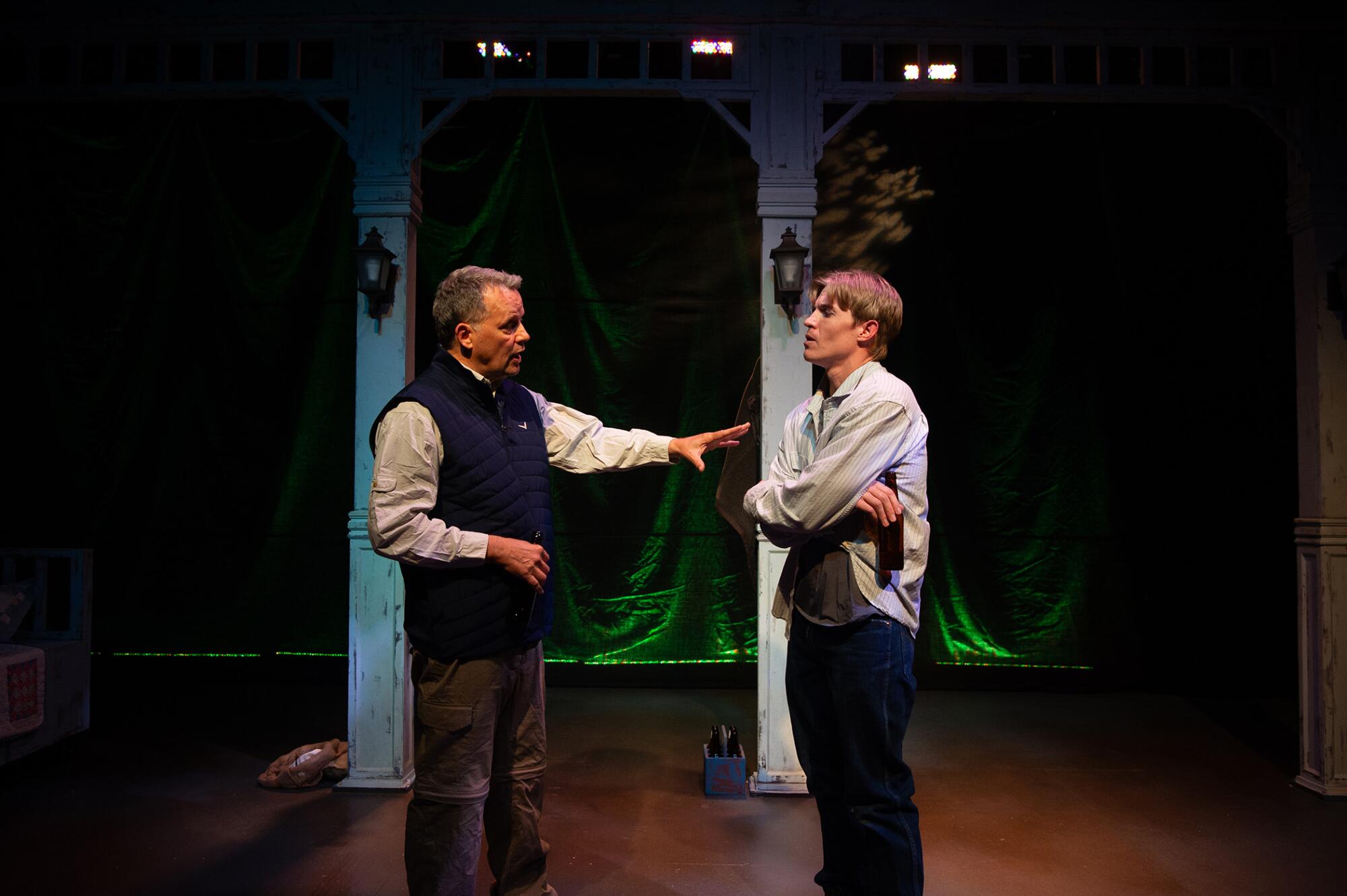
Steven Culp, left, and Joey Stromberg in “For Want of a Horse” at the Echo Theater Company.
(Cooper Bates)
The open-mindedness that Dufault, a trans playwright, brings to the play creates some dramatic slack. Possibly the same fear of making value judgments that has inhibited Bonnie from imposing common-sense discipline in her classroom has robbed “For Want of a Horse” of a propulsive point of view.
The play moves monotonously between Calvin and Bonnie’s bedroom and the stable. Scenic designer Alex Mollo has worked out an efficient way of shifting between these realms by employing the same set of wooden trunks. But the argument of the play doesn’t so much build as elapse.
Time takes its toll, and Calvin eventually has to make a decision. But the character who interested me most was Bonnie, whose reality is only glimpsed. The play tacitly uses her husband’s threat of suicide as a trump card. Zoophilia isn’t merely a fetish for Calvin but a nonnegotiable part of his identity.
This questionable assumption can be psychologically scrutinized not only from Calvin’s point of view but also from his wife’s. The play wants to have an intelligent debate, but it doesn’t want to interrogate certain political positions too skeptically.
At one point, Bonnie objects when Calvin compares his situation to that of homosexuality, but the conversation ends there. The reality is that the right wing has been making a similar claim, arguing that same-sex marriage opens the door to bestiality, polygamy and incest. “For Want of a Horse” inadvertently lends legitimacy to this line of reasoning.

Griffin Kelly in “For Want of a Horse” at the Echo Theater Company.
(Cooper Bates)
Not that extremist positions should be off limits, but they ought to be more rigorously addressed. Similarly, Bonnie’s concern about the issue of consent — how can a horse say yes to intercourse with a human — is introduced only to be dismissed in a shrug of mild-mannered bothsidesism.
While watching “For Want of a Horse,” I recalled a program on PBS called “My Wild Affair” that wasn’t about zoophilia but about the problematic nature of human bonds with untamed animals. Relationships with a seal, an elephant and a rhino, for example — obsessive, protective, loving friendships — all seemed to end if not in outright tragedy, then in shattering heartbreak.
Q-Tip is rightfully given the play’s last word, and Kelly, an actor (HBO’s “The Book of Queer”), writer and comedian, is the production’s driving force. We can never know what’s inside this mare’s mind because Q-Tip’s brain has evolved so differently from our own. Kelly plays the anthropomorphic game while retaining some of the inscrutability of a four-legged creature.
It is through language that we, as humans, traverse the chasm separating us from one another. That’s not possible with animals, even with our closest domestic companions. (Try explaining a necessary medical procedure to a cat.)
“For Want of a Horse” sets out to speak about the unspeakable, but its construction may be too tame for such a wild subject.
‘For Want of a Horse’
Where: Echo Theater Company, Atwater Village Theatre, 3269 Casitas Ave., L.A.
When: 8 p.m. Fridays, Saturdays, Mondays; 4 p.m. Sundays. Ends May 25
Tickets: $15-$42.75
Running time: 1 hour, 30 minutes (no intermission)
Info: echotheatercompany.com

Entertainment
From YouTube to the multiplex: How low-budget horror films are beating big-budget studio bets

Two of the biggest box-office standouts of 2026 so far were not made by established studio directors or built on franchise IP.
“Obsession” and “Backrooms” — horror films from internet-native directors in their 20s — have outperformed far more expensive studio releases.
The breakout success of these films has ignited debate across Hollywood about what made these movies so popular, especially among Gen Z moviegoers who haven’t been flocking to cinemas in recent years. Here’s what to know:
The numbers
”Obsession” was directed by 26-year-old Curry Barker, who got his start on YouTube with sketch comedy and horror shorts. Released May 15 by Focus Features, the film was made for just $750,000 but opened to a staggering $17 million and has improved on its debut every weekend since.
“Obsession” set an all-time horror record for the biggest fourth weekend for a film at the domestic box office, raking in $25.4 million. It now ranks as the year’s fifth most popular film, nearing $200 million domestically and roughly $295 million worldwide — ahead of Pixar’s “Hoppers” ($166 million) and Paramount’s “Scream 7” ($121 million), per Box Office Mojo.
“Backrooms,” from 21-year-old Kane Parsons — known on YouTube as Kane Pixels — drew on an online fascination with liminal spaces, leading audiences through an endless run of nearly indistinguishable rooms.
Released May 29 by A24 (known for such acclaimed films as “Moonlight” and Everything Everywhere All at Once”) on a reported $10-million budget, it opened to $81 million and crossed $100 million in under a week.
Within two and a half weeks, it had outgrossed the entire theatrical runs of horror films “Five Nights at Freddy’s 2,” “Smile” and “Scream 7.” It sits as 2026’s eighth-highest-grossing film.
Who is watching?
The audiences are young. In recent weeks, nearly 90% of “Backrooms’” viewers were under 35, with more than half under 25. Over “Obsession’s” first few weekends, 75% of the audience was 17 to 34, which is significant at a time when major studios have struggled to consistently get younger viewers to trek to the multiplex.
Why it’s working
Audiences have clearly latched onto the stories, said Jason Blum of Blumhouse–Atomic Monster, who worked on both films.
“There’s been an audience kind of waiting to get back to the movie theaters, and we in Hollywood really have not landed on what would get them back,” he told The Times in an interview this week.
Blum, who upended horror genre with the “Paranormal Activity” franchise, ties the success of “Backrooms” and “Obsession” to a connection to the directors’ origins.
Because the films were made by creators who speak to younger viewers daily on YouTube, he said, that generation “feels like they’re being spoken to.”
David Gross, an analyst at FranchiseRe, framed it as a new pipeline of talent and material. Creators can build large followings very inexpensively, he said, and their stories arrive further developed — which expedites the development and discovery process. He called internet-based storytelling “another additive source for material for movies.” Blum added that the films’ success could make studios more willing to bet on undiscovered directors who “might not have been considered” before.
Rosie Ramirez, chief marketing officer at Galaxy Theatres, said a young first-wave audience tends to generate buzz. More than a month after “Obsession” was released, she said, the Nevada chain’s four California locations are only now seeing a second wave of moviegoers curious about the hype.
Notably, the rise of these two films has unfolded in the shadow of major releases like Disney’s “Star Wars: The Mandalorian and Grogu,” and Mattel’s “Masters of the Universe,” both of which returned underwhelming numbers in their respective opening weekends.
Is it a trend or an anomaly?
Whether this marks a lasting shift or a fluke is unclear. May crossed $1 billion in box office — with “Backrooms” and “Obsession” doing much of the heavy lifting. Despite the improvement, the box office has yet to full return to pre-pandemic levels, with the summer tracking roughly 3.5% behind summer 2019, said Comscore’s Paul Dergarabedian.
And Dergarabedian questioned how the industry could replicate a success that, in his words, was “authentically and organically created” rather than manufactured: “It just happened,” he said.
Ramirez argued the broader summer slate — franchise tentpoles like “Toy Story 5” alongside some original surprises — points to a healthy box office regardless, a reminder that “it doesn’t always have to be the big summer blockbuster.”
Movie Reviews
‘Finnegan’s Foursome’ Review: Edward Burns’ Spiky-Quaint Sports Dramedy Is a Tale of Family Therapy Through Golf

Thirty years after “The Brothers McMullen,” the writer, director, and actor Edward Burns looks preserved in amber — his hair and beard have some silver, but at 58 he’s still lean and handsome in that prince-of-the-working-class Irish-American way. And it’s not just Burns who’s more or less unchanged; so is his filmmaking style. “Finnegan’s Foursome” is his 16th feature, and he’s still doing that shaggy-likable, spiky-quaint, semi-low-budget Edward Burns dramedy thing — the script that’s talky and kind of funny, though in a way that often sounds like a script; the camerawork that never strays too far from the functional; the acting that hovers between lively and broad. The style Burns works in is now closer to television than movies, and given that “Finnegan’s Foursome” is getting a streaming release (starting today), you could say it’s a minor indie movie that has found its rightful home.
It’s a sports comedy, about golf and Ireland and family conundrums (it would be overstating it to call them demons), and a key thing that might put you in the audience demo for it is if you happen to be a serious golfer. It’s a movie spun out of the love of the game. Burns, who first shows up in a samurai man-bun, plays Freddy Finnegan, a wealthy clothing entrepreneur who seems to have a happy and settled life, except that he’s got anger-management issues, all stemming from his rivalrous relationship with his irascible Irish father, Jack (Ian McElhinney).
At first, we think the movie is going to be about these two facing off. Jack, at his home in South Carolina (he came over from the old country in 1959), is hosting the latest edition of the Finnegan’s Cup — an annual golfing competition in which four members of the family face off against one another, mostly as an excuse for Jack, a retired golf instructor, to tell his old jokes and stories and reminisce about the days when he was good enough to rub shoulders with the Big 3 (Arnold Palmer, Jack Nicklaus, and Gary Player).
He’s a blustery egomaniac, though he strikes us as a warm-hearted one. And Freddy, of course, resents the hell out of him. But what we think are going to be the fireworks between these two come to a halt when one of the players hits a hole in one and Jack keels over in shock, dead of a heart attack.
The family now has to scatter Jack’s ashes in the four locations he has chosen in Ireland (two of them are golf courses). And that’s an excuse for Freddy, who resents his da even in death; his more benign older brother, Teddy (Brian d’Arcy James), a novelist who has been suffering from writer’s block; Freddy’s musician son, Frankie (Brian Muller), whom he treats nearly as cavalierly as his father treated him; and Teddy’s adult daughter, Marie (Erica Hernandez), to take a week’s vacation in Ireland, where they’ll play out the Finnegan’s Cup at a handful of fabled golf courses, smacking around some home truths along with the ball.
There’s plenty of on-the-nose dialogue (“His dying wish was to get us all back here to Ireland”), as well as cornball boasting (“It’s not about the clubs, little brother, it’s about the man who’s swingin’ ’em”) and generic braggadocio (“I believe that is what you call an eagle!”). Freddy and Teddy never stop making side bets and busting each other’s chops, mostly about who has the better golf game, this being the locker-room form of brotherly love. If the family tension simmers, it’s mostly because Freddy and Teddy have opposite feelings about their father. Listening to their back-and-forth taunts, Marie says, “I’m sorry, so this entire trip is nothing but constant ball-busting?” Swap in “movie” for “trip,” and you’ve got an idea of “Finnegan’s Foursome,” though you should also toss in Frankie doing his cringe mock-sports-announcer banter.
“Finnegan’s Foursome” is structured as a sports movie, and Burns, working with the cinematographer Jeff Muhlstock, connects you to the geometric majesty of the links. But when you watch a film like “Tin Cup,” part of the thrill is that you want to see the Kevin Costner hero win; that’s the dramatic Zen of a sports film. Watching “Finnegan’s Foursome,” we’re not overly invested in whether Edward Burns’ entitled a-hole gets a winning golf score over his novelist brother.
There’s a touching scene where three of the characters sing “The Parting Glass” at a pub. But here’s how “Finnegan’s Foursome” is a bit soft. The movie is about Freddy coming around to see that his da really did love him, and that he wasn’t such a bad guy (he gave him the love of golf, after all). But the reason we readily buy this is that it’s so apparent from the outset. Jack’s big crime? Being away “at the office” (i.e., the golf course) too much. As ultimate sins of parents go, it’s kind of a dated sin. You want to say to Freddy, “Stop whining.” Especially because the Jack we see, in his competitive Irish way, had a lot of spirit; he was no ogre. Of course, he also tried to “get into Freddy’s head” on the golf course, but that’s kind of a privileged problem. It’s Freddy who needs to dismantle the ogre of resentment in himself, and that’s not quite a movie — that’s therapy.
The blithe and likable “The Brothers McMullen” won the Grand Jury Prize at the 1995 Sundance Film Festival and went on to have a healthy theatrical life, launching Burns’ career as a homespun auteur — at the time, he almost seemed like the shoestring Irish-American answer to Woody Allen. I was a fan of the early Burns films (especially “She’s the One,” his 1996 crossover movie, costarring Jennifer Aniston and Cameron Diaz), but his moment in the spotlight didn’t last long. After crossing over, he kind of crossed back, retreating into the not-fully-on-the-radar indie wilderness. That’s where he has remained, and watching “Finnegan’s Foursome” you see why: He’s trying to stay true to his world (all the Irish chop-busting and piss-taking), but he hasn’t grown as a filmmaker. Then again, maybe that’s not so important. He doesn’t hit long drives, but by the end of “Finnegan’s Foursome” the ball is in the cup.

As the noise-rap-electro act Jane Remover shrieked and pleaded through a 90-minute marathon set at the Fonda on Thursday night, one very young couple dressed right out of a conservative‘s nightmare — gender-ambiguous, purple hair, facial piercings — tapped me on the shoulder. They politely asked if I could mind their newly bought vinyl for a bit as they thrashed in the heaving crowd. Of course, this unc obliged them.
Anyone who laments that L.A. crowds don’t dance should go to one of the last sets of Jane Remover’s three-night stand at the Fonda this weekend. It had the most genuinely raucous pit I’ve seen in 2026, made all the more feral for how sweet and earnest it was. After a hotly tipped Coachella set, this Live Exhibit tour affirmed that the subculture Jane Remover built may or may not have wider pop potential, but it’s getting big enough to count for stardom in the fractured music world of today.
Jane Remover is a trans polymath producer and singer-songwriter with influences across rave, shoegaze, trap and beyond. They’ve built up a ferocious elaboration on the hyperpop of predecessors like Sophie, who similarly packed so many good ideas into songs they became talismanic to fans, a tonic to reinvent yourself (new Charli XCX opener Underscores is another fellow traveler).
The music itself sounds like reverse-engineering the moment in the 2000s when metalcore kids discovered EDM. Only now it’s Discord-disaffected youth ramping up hardstyle techno, autotuned girlypop ballads and rage-rap to an explosive fusion point. “Census Designated,” Jane’s brash and dramatic 2023 coming-out LP, tipped them as a force beyond the underground. But they soon eclipsed it with 2025’s “Revengeseekerz,” a deliriously overheated mix of romantic yearning, internet score-settling and virtuosic production prowess.
Backed by just a DJ (Dazedgxd, who opened the set) and a retina-scorching light rig up front, Jane acknowledged on Thursday that the stakes were getting much higher. They joked that they’d played the El Rey like three times before this tour, and to judge by the wild-eyed passions out in the audience, the Fonda will probably be the smallest venue they’ll play for some time. “It gets so cold this high up,” Jane sang on “Turn Up or Die.” “Can’t go to hell but I can drop you off.”
The sentiments driving the music are ultramodern: self-aware, vicious and desperately vulnerable. The hilariously zesty “Angels in Camo” (home to the all-time banger of a line: “Jesus never had it with a freak b—”) wrapped up with a bloodletting plea that “I can’t let you b— win.” Jane wields that word like the flaming sword on the “Revengeseekerz” album cover, with all the casual lustiness of Future but also the wrath of a reclaimed slur.
On “Professional Vengeance,” they grappled with the weird lures of celebrity and intimacy, where no one really knows anyone but desire still courses; “Experimental Skin” found them craving and fighting off God and nihilism and technology and addiction all at once.
The tension in these tracks are the binding agent for Jane’s fan base — the music is full of contradictions and incompatibilities smashing together that just feel like being young right now. Other than a quick affirmation that fans of all identities and backgrounds will always be welcome at their shows, they let the contorting, violent music speak for itself about the way queer fans are feeling about life under siege in the United States.
If the set was a bit too long for the limited setup onstage, it was because Jane simply had that much music to let out — that caliber of emotion to unburden, that much want to acknowledge. It seemed like the set was closing with “In the Dark,” an aching ballad from their Venturing side project, plainly declaring “I still dream of us” through a fog of effects. But instead they ramped it back up for one last cathartic blast to close, sending their faithful out onto Hollywood Boulevard, sweaty and filthy and fundamentally known.
-
Entertainment5 minutes ago
From YouTube to the multiplex: How low-budget horror films are beating big-budget studio bets
-
 Politics13 minutes ago
Commentary: Behested payments aren’t illegal, but they are a problem. Especially for Newsom
-
 Sports23 minutes ago
Dodgers’ walk-off stuns Orioles as Dalton Rushing helps cap wild comeback
-

 World35 minutes ago
Trump doubles down on Meloni photo comments
-

 News58 minutes ago
The Real Love Company made her feel whole. Then ‘Daddy’ said to strip naked.
-

 Los Angeles, Ca2 hours ago
Woman, man found shot to death in Pomona, suspect leads officers on erratic chase
-

 Detroit, MI3 hours ago
Today in History: June 20, race-related rioting erupts in Detroit
-

 San Francisco, CA3 hours ago
San Francisco hotels see steady World Cup business, but fall short of Super Bowl surge

