News
Communities launch cleanup after severe weather and tornadoes churn across Midwest

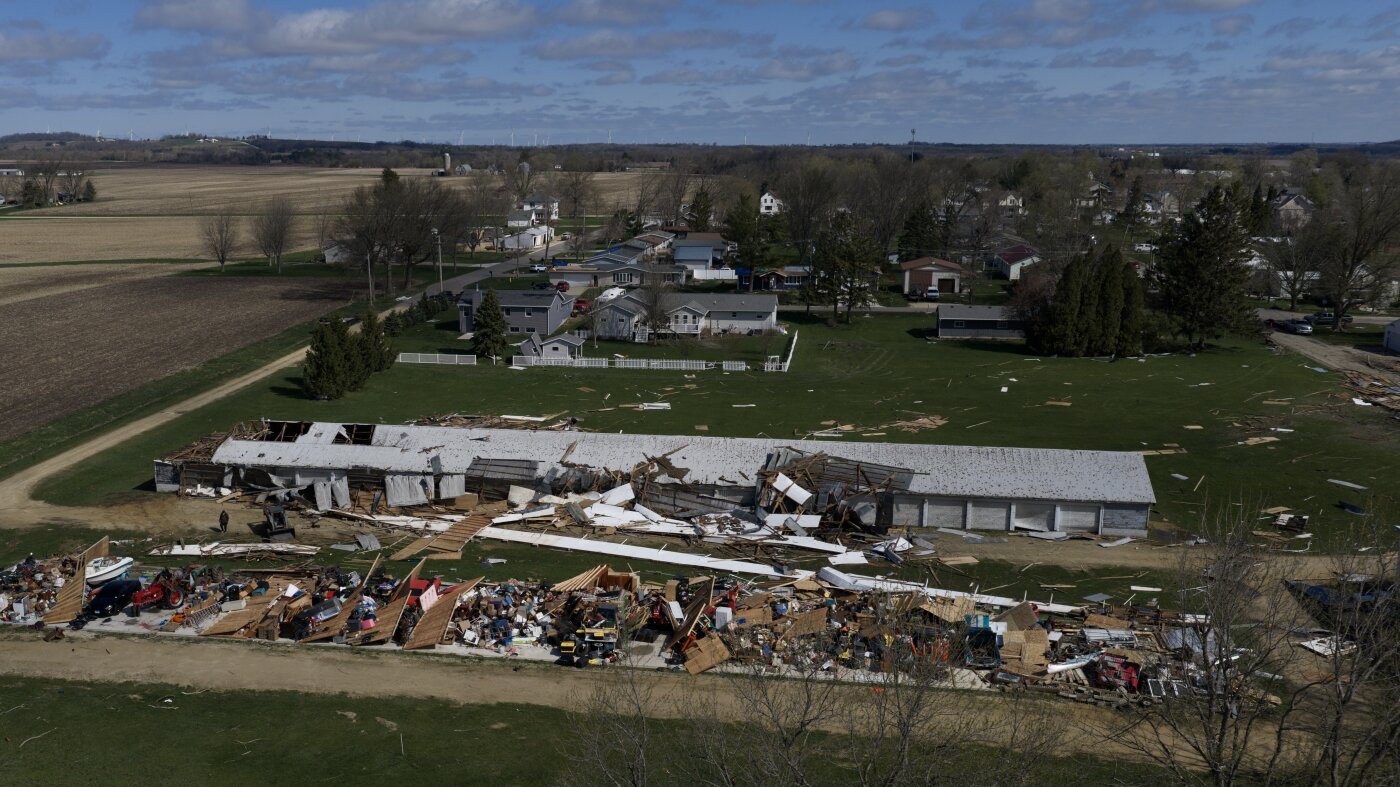
An aerial view shows damage from a tornado, on Saturday in Lena, Ill.
Scott Olson/Getty Images
hide caption
toggle caption
Scott Olson/Getty Images
Communities across the Upper Midwest are cleaning up after tornadoes and severe weather impacted the region over the weekend, damaging and destroying dozens of homes and knocking out power for tens of thousands.
“Numerous” severe storms were tracked across parts of Iowa, Illinois and Missouri on Friday, according to the National Weather Service. At least 66 tornado reports were submitted in multiple states including Oklahoma, Illinois, Missouri, Wisconsin and Iowa, the NWS Quad Cities IA/IL office said Sunday.
No deaths have been reported from the severe weather and tornado outbreak.

In Marion Township in Minnesota, about 30 homes were damaged and a dozen have significant damage because of a tornado, according to the Olmsted County Sheriff’s Office. The tornado also damaged at least 20 homes in Stewartville and there is a temporary shelter in Rochester for people displaced by the storms, according to MPR News.
“Tornado disaster recovery continues to occur at full speed,” the Olmsted County Sheriff’s Office said on Saturday.
In Illinois, McClean County officials declared a disaster emergency because of severe storms in Bloomington. “At this time, no injuries have been reported, and emergency response agencies remain actively engaged to ensure public safety and continuity of essential services,” officials said in a statement.
But further north in the village of Lena, an EF-2 tornado caused the “most significant damage” where “many homes and outbuildings were damaged, trees uprooted, and power lines downed,” the NWS said. Numerous roads have also been blocked by debris, the Stephenson County Sheriff’s Office also said.

People continue to clean up following a tornado, on Saturday in Lena, Ill.
Scott Olson/Getty Images
hide caption
toggle caption
Scott Olson/Getty Images
There have been no fatalities and no reports of serious injuries associated with the storm, Chief Deputy Andy Schroeder from the Stephenson County Sheriff’s Office told NPR on Sunday.
More than 43,000 customers lost power in Illinois but power was restored to almost all of them by Saturday night, according to electric utility ComEd.
Several tornadoes also occurred across Wisconsin, according to the NWS office in La Crosse. Twenty-six tornado warnings were issued by the office on Friday, the most in one day since the weather service office was built in 1995.

In one Marathon County town, 75 homes were destroyed by a tornado, according to Ringle Fire Chief Chris Kielman.
“It took out a whole residential area,” Kielman said, according to Wisconsin Public Radio.
The American Red Cross of Wisconsin said volunteers are helping those impacted by the storm with meals, shelter and support.
Parts of the state are still dealing with multiple rounds of severe weather and tornadoes from earlier in the week that brought flooding to some communities.


The exterior of the Robert F. Kennedy Department of Justice building is pictured on May 4, 2021, in Washington, D.C.
Patrick Semansky/AP
hide caption
toggle caption
Patrick Semansky/AP
The Justice Department released a memo this week that quietly calls into question decades of civil rights protections for Americans with disabilities and stirred fear and anger among advocates and families.
The memo, an opinion from the Office of Legal Counsel, argues that states do not have to provide in-home or community-based care to people with disabilities who need support. These services allow many disabled Americans to continue to live, learn and work at home or in their own communities, among family and friends.
“It is now the position of the United States government that people with disabilities don’t have a right to be part of their communities,” says Alison Barkoff, a health law and policy professor at George Washington University who led disability law and policy efforts during both the Obama and Biden administrations. “I can’t overstate how significant this change in position is.“
Without the federal government requiring that states provide these services – to help disabled people integrate into their communities – advocates and legal experts warn that cash-strapped states could cut them and return to what was once common practice: de facto segregation of Americans with disabilities in nursing homes and large institutions.
Pushback from the disability community was swift.
“As America prepares to celebrate 250 years of independence, [this memo] threatens to drag our nation back to a dark and shameful era of ignorance and cruelty,” said the American Association of People with Disabilities. “This interpretation will open the doors for states to revert to warehousing people with disabilities out of sight and out of mind in institutions.”
“This opinion is a direct threat to decades of progress toward community living for people with disabilities,” said Shira Wakschlag of The Arc of the United States, a nonprofit disability advocacy group. “People with disabilities shouldn’t be forced into institutions because a state refuses to provide services in the community.”
The Justice Department did not respond to an NPR request that it explain its position as well as why it is changing course after decades of legal and bipartisan support for community services.
What the law says
This new memo calls into question what legal experts say has been settled law for decades.
Both Section 504 of the Rehabilitation Act and Title II of the Americans with Disabilities Act have long been interpreted to require that states provide services to Americans with disabilities in the most integrated setting appropriate. In short: Institutionalization should be a last resort.
In 1999, a case testing these protections made it to the U.S. Supreme Court. In Olmstead v. L.C., two women with mental disabilities sued Georgia, arguing that the state had failed its obligation to provide services that would allow them to return to their communities and that it had continued to institutionalize the women instead, thus violating their civil rights.
The court agreed that states have a legal responsibility to provide support that integrates disabled Americans into their communities, and for nearly three decades, courts across the country have embraced that interpretation.
By 2023, 8.4 million Americans were receiving home- and community-based services through Medicaid.
The new memo, written by Lanora Pettit, principal deputy assistant attorney general in the Office of Legal Counsel, argues that, while federal law prohibits discrimination on the basis of disability, it does not impose an “integration mandate” on states to provide these community services.
What’s more, the memo argues, the Supreme Court’s Olmstead decision “held only that a state cannot institutionalize such patients without justification.”
But, the memo adds: “What counts as adequate justification remains an open question.”
At one point, Pettit acknowledges the novelty of this reading: “We recognize that this view of Olmstead‘s import is out of step with the common understanding of that decision within the federal courts.”
Why it matters
“The United States government since 1977 has taken the position that [federal law] includes an integration mandate that requires services to be provided in the most integrated setting appropriate,” says professor Barkoff, who worked in the Obama Justice Department leading its Olmstead enforcement efforts.
For decades, Barkoff adds, both Republican and Democratic administrations, including the first Trump administration, proactively enforced federal disability law and repeatedly brought actions against states that relied too heavily on care in large, segregated settings that the law says should be a last resort.
The courts and Congress decided institutionalization should be a last resort because people’s personal liberty is at stake, says Jennifer Mathis of the Bazelon Center for Mental Health Law: “Who you can see, when you can go out, when you eat, what you eat. Who your roommate is, who you talk to, what your environment is. And for so many people who are institutionalized, their life is literally a hallway. I have been on those hallways with people. It is deadening.“
This memo signifies a dramatic change in the U.S. government’s official position.
“We are incredibly concerned that the message coming from the federal government in this memo is, ‘It’s fine to go back to the days that people were placed in institutions,’ even though they can be served in the community, even though they want to be and even though it’s more cost-effective,” Barkoff says.
The timing matters too. The memo arrives as a new case, Texas v. Kennedy, is making its way through the courts. The case, brought by Texas and several other states, is essentially a fresh challenge to the integration mandate on states.
With this memo, the federal government is aligning itself with the plaintiffs in the case. Though Mathis cautions: “It’s important to understand that [this memo] is not the law, that the Justice Department can’t change the law. Congress makes laws, not agencies.“
For now, it’s not clear what the immediate impact of the memo will be, though it seems the Justice Department will stop its enforcement efforts around Olmstead.
Why now?
The Justice Department memo appears to be the latest salvo in a broader effort that began on July 24, 2025, when President Trump issued an executive order intended to make it easier for state and local governments to police homelessness.
“Endemic vagrancy, disorderly behavior, sudden confrontations, and violent attacks have made our cities unsafe,” the order argues, going on to claim that “the overwhelming majority of these individuals are addicted to drugs, have a mental health condition, or both.”
The administration’s solution: Involuntary institutionalization. “Shifting homeless individuals into long-term institutional settings for humane treatment through the appropriate use of civil commitment will restore public order,” the order reads.
In a 2023 campaign video, President Trump himself pledged: “For those who are severely mentally ill and deeply disturbed, we will bring them back to mental institutions, where they belong.”
A conservative Texas think tank, the Cicero Institute, has been a driving force behind recent efforts to forcefully combat homelessness, including through institutionalization.
One serious obstacle to large-scale institutionalization of the unhoused is federal disability law that has long required home- or community-based services instead, when appropriate. A footnote in the Justice Department’s new memo appears to suggest these laws have contributed to the rise in chronic homelessness.
To the contrary, Barkoff says, the Olmstead decision “has been one of the most effective tools in providing services and stable housing to people who are homeless.”
NPR has previously reported that the Trump administration’s push for institutionalization faces another big obstacle: An acute shortage of beds at these specialized facilities.
The memo arrives as Republicans have also passed deep cuts to Medicaid, which is the primary source of funding for community-based services many disabled Americans rely on.
Multiple legal experts tell NPR that, in response to last year’s One Big Beautiful Bill Act, states must now make deep cuts to a whole range of services previously funded by Medicaid. The Trump administration’s memo, they add, essentially gives states permission to cut these localized supports and, instead, rely on institutionalization – even though research shows the latter is considerably more expensive for states to provide.
This comes as disability advocates were already pushing back against the Trump administration’s announcement on Tuesday that it would move federal administration of special education programs out of the Department of Education and into the Department of Health and Human Services – a change that, as with the new Justice Department memo, raised fears of a rollback of the enforcement of longstanding civil rights protections.

new video loaded: The Sacred Catholic Site Where Trump Wants a Border Wall

By Reis Thebault, Christina Shaman, Jon Miller, June Kim and Melanie Bencosme
June 20, 2026

Kim was, in her words, “starving for that fatherly love.”
She became an intern for Baer and always looked forward to being held in his arms for extended periods of time. She eventually asked him if there was anything she could do to help ease the fear that she believed was still holding her back.
There was, Baer told her. At his direction, she took off her top and bra, Kim said, and he held her but didn’t touch her breasts or privates.
“It felt very parental, and it felt very special,” she said.
In hindsight, Kim said, she cherished the experience for another reason.
“I was getting this special attention from him,” she said. “I was pretty desperate for that in my life.”
She now sees it as classic grooming behavior.
It happened one other time, Kim said, and she eventually asked him if there was anything else she could do to experience a “bigger shift.”
Baer brought her to the pool house and instructed her to remove her clothes piece by piece, Kim said. He lay in bed with her, rubbed her back and held her breasts, according to Kim.
“There was no talking me into it — I just did it,” Kim said. “In hindsight, I realized I didn’t feel free to say no to any of it. I had the belief that if I did say no, he would write me off.”
When Kim got the call from her daughter Penelope, she said it jolted her out of what she now describes as a cult mindset.
She spoke to other women in the community and said she heard more stories involving naked holding.
One of those women was Inge Jechart. A mother of two with a doctorate in physics, Inge had been an active Real Love member since a friend recommended Baer around 2005.
“At that time, I was lost and lonely,” she said, describing struggling under the weight of a faltering marriage and a strained relationship with her sons. “I learned how to become a better person and more loving and understanding.”
The first time Baer held her in his lap, Inge was overcome with emotion.
“I just cried,” Inge recalled. “It was such a relief to feel safe and loved. What else do we want in life?”
Following that experience, Inge said, she booked every retreat at his house that she could. And it was there, in 2017, that she said she twice got naked with Baer at his direction.
“We hold our own children when they’re naked to make them feel safe,” Inge said. “For me, that’s what we were doing.”
“And here’s the thing,” she added. “It made a huge difference for me.”
But Inge said Baer fondled her breasts the second time, and that didn’t feel right at all.
“I said, ‘Hey, as a 4-year-old, I wouldn’t have breasts,’” she recalled. “And he stopped.”
Inge said Baer told her he had done it with only one other woman before, and he added in a stern voice: “I don’t talk about this with anyone else.”
“I got the message,” Inge said. “Our community was important to me, and I didn’t want it to blow up, so I kept silent.”
But she said she never considered that he might be engaging in naked holding with younger, more impressionable women like Veena and Penelope.
Kim, Penelope’s mother, said the same.
“It had never crossed my mind that he would ever do this with my daughter,” Kim said. “I was completely blind to that possibility.”
The backlash
In February 2019, Kim sat down at her computer and began to type an email to Baer.
“Greg what you have done with my daughter…is wrong, hurtful, traumatic and goes against so many gospel principles,” read the email, which was reviewed by NBC News.
“Holding people without clothes on needs to stop, what you are doing is wrong,” it added. “Touching my daughter between her legs when she was naked was wrong — there is no justification for it.”
“I know of 4 women personally who have undressed completely with you, and I don’t know hardly anyone that you spend time with so I conjecture that there are many more,” Kim wrote near the end. “I beg of you…put a stop to this horribly damaging behavior.”
Baer was defiant in his response.
Kim’s daughter was “claiming events that never happened,” he wrote. “And she is supplying lots of details that never happened. And now she is sharing these details with as many people as she can find.”
Kim’s email wasn’t the only scathing message Baer received during this period.
“I am writing to perhaps appeal to your consciences and any integrity you may still have left,” wrote a woman from the U.K. in an email viewed by NBC News. “Shut Real Love down now before it’s too late.”
“Greg you have had sexual dealings with way more women than we initially thought,” the woman added. “That’s not including the naked holding.”
Baer replied with another strong denial.
“Nothing, absolutely nothing, like this is occurring, and people are healing all over the place,” he wrote to the British woman.
After receiving an email from NBC News, the woman declined to be interviewed, citing the lasting emotional toll.
“It’s honestly an incredibly traumatic part of my life, and one I don’t want to revisit,” she wrote. “It’s been 8 years and I haven’t moved on.”
The aftermath
Veena, Penelope and her mother said they all reached out to the police in Baer’s hometown of Rome but were told there was not enough evidence to pursue a sexual abuse case.
The Rome Police Department confirmed to NBC News that it conducted an investigation but said no charges were brought due to “insufficient probable cause.”
The women said they had also reported Baer to their local Mormon churches.
A spokesman for the Church of Jesus Christ of Latter-day Saints, widely known as the Mormon church, said it “initiated ecclesiastical proceedings involving this individual beginning in February 2020.”
The process could lead to a member’s excommunication, but the spokesman said he was not authorized to comment on the outcome of the proceedings.
Veena and Penelope filed lawsuits against Baer in Georgia’s Floyd County Superior Court in April 2019. They were settled five months later for $12,000 each. (The attorney who represented Baer, Robert Smalley, declined to comment.)
By then, Veena was adapting to life outside of Real Love. She had already separated from her husband and left the church. While raising her three children, she went back to college. A career in physics no longer interested her. She earned a degree in psychology from Columbia University.
“To help me understand what on earth just happened,” Veena said.
A few years ago, she decided to write what became a very different book than the one originally conceived about her experience in Real Love. She used pseudonyms for the group and for Baer himself, but the account, she said, was drawn from her recollections, emails and journal entries.
“The True Happiness Company” was published last year with the subtitle, “How a Girl Like Me Falls for a Cult Like That.”
Veena hoped that it would help her process what happened and serve as a cautionary tale for others.
“The physical violation is not what unravels me,” she says in the book. “It’s the loss of life experience, the mental and emotional violation of having my young adulthood orchestrated by someone with undue influence over me. It’s the friendships that disintegrated. The career paths unexplored. The opinions he replaced with his own.”
“The changes feel almost imperceptible as they happen,” she added later in the book, “and then suddenly appear extreme in retrospect.”
If you or someone you know is in crisis, call or text 988 or go to 988lifeline.org to reach the 988 Suicide & Crisis Lifeline, or visit SpeakingOfSuicide.com/resources.
-

 Kansas4 minutes ago
Salvador Perez attended the Ecaudor-Curaçao match at Arrowhead. So did other royals — from the Netherlands
-

 Kentucky11 minutes ago
Kentucky Colonels executive to speak at Florence Rotary Club on Monday, public welcome to register
-
Louisiana14 minutes ago
Louisiana Lottery Powerball, Pick 3 results for June 20, 2026
-
 Maine19 minutes ago
You drew a Maine moose permit. Here’s what to do right now.
-

 Maryland26 minutes ago
Maryland Gov. Moore champions the spirit of Juneteenth and togetherness at AFRAM 50
-

 Michigan29 minutes ago
Insider: Shaky polls cause uproar in Michigan Senate, governor races
-

 Massachusetts34 minutes ago
Swimmer pulled from Houghton’s Pond after search
-

 Minnesota41 minutes ago
Aurora clinches division championship with 4-1 win over River Light

