Entertainment
Karol G at Coachella was a global hit. Yet other foreign acts fear touring the U.S.

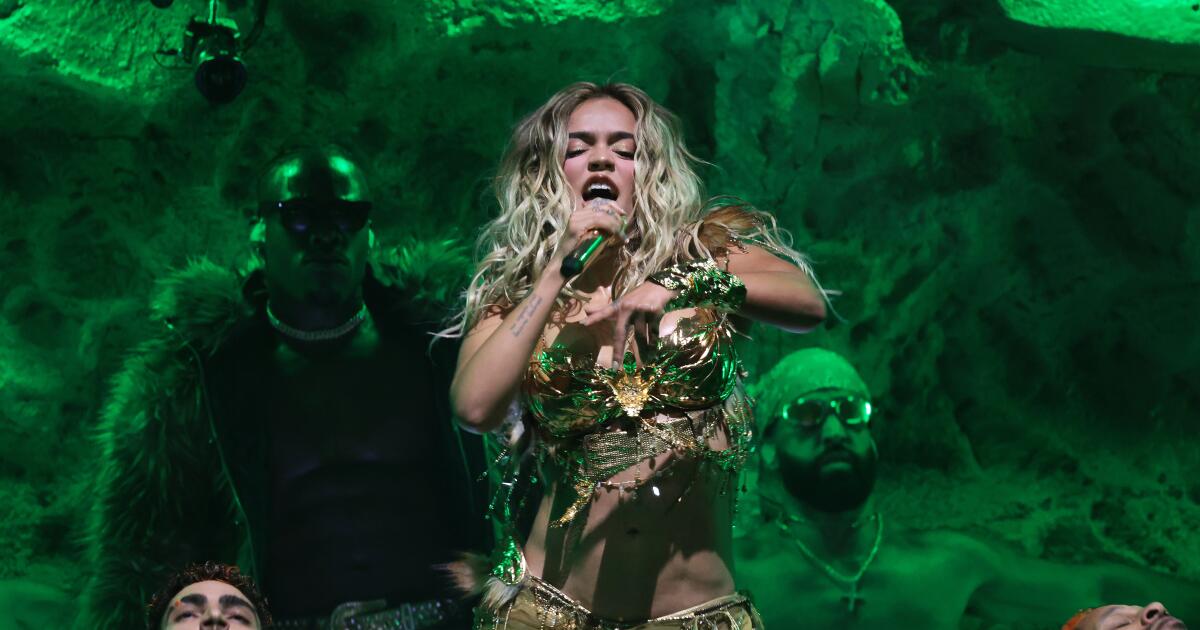
On the first Sunday night of Coachella, headliner Karol G told her American fans, and her global audience, to keep fighting.
“This is for my Latinos that have been struggling in this country lately,” the Colombian superstar told the tens of thousands watching her in person, and many more on the fest’s livestream. She’d recently criticized ICE in a Playboy interview, but this set was about her fans’ resolve. “We want everyone to feel welcome to our culture, so I want everyone to feel proud of where you come from. Don’t feel fear — feel pride!” she said.
Any artist would be proud to play that caliber of headline slot. But right now, many foreign acts also feel fear — or at least wariness — about booking substantial tours in the United States. A year of brutal ICE raids, tensions at border crossings and policed political speech, coupled with sky-high prices for expedited visas, fuel and other touring logistics, could push international acts away from the U.S.
“The fears that ICE would raid shows didn’t really materialize, but there is a chilling effect,” said Andy Gensler, editor of the touring-biz trade bible Pollstar. “Trump’s only been back in office a year, so we haven’t fully seen the effects, but it does send a message that if you’re a political artist you won’t get a visa. With the economic shock of gas prices and tourism way down, the signifiers are out there.”
The music economy is still thriving in SoCal. Coachella sold out with record spending from fans, and fears that ICE might show up for a prominent Latin headliner proved unfounded. (The agency did not respond to a request for comment on Coachella, and Lt. Deirdre Vickers of the Riverside County Sheriff’s office said that their office “does not participate in immigration enforcement operations.”)
But in smaller venues featuring emerging and mid-tier global acts, some see trouble ahead.
Pollstar’s Gensler estimates that the total number of concerts in the U.S. they tracked for the first quarter of 2026 was down about 17% from last year. That could be due to many economic factors — but slower international touring could be contributing.
“The U.S. is still incredibly lucrative market, the arena and stadium level buildings are vast and you can make more money here than any market in the world,” Gensler said. “But I’ve heard anecdotally that fewer people are going to South by Southwest, and tourism from Canada is way down, and that includes music tourism to California. As barriers go up, and the economic shock of gas prices impacts touring, it’s hard to know how that will all shake out.”
Talent firms who specialize in bringing young acts to the U.S. began noticing pullback before this year’s festival season. Adam Lewis is the head of Planetary Group, a marketing agency that produces and promoting musician showcases in the U.S., with a significant roster of artists from abroad. He said that performers who ordinarily would leap at the chance to play U.S. festivals are taking hard looks at the payoffs and risks.
“Artists are thinking twice, based on what the government is doing right now,” Lewis said. “You can look at the economics — the fees are cost prohibitive to get a visa. People are scared, at the bottom line. Artists and industry people are afraid to come to the U.S. for any music event. The money is going elsewhere.”
South by Southwest, the March Texas confab for music, film and tech, was among the first festivals to feel a pinch this year. Several sources said they saw fewer foreign showcases and acts amid a broader culling of music. In 2025, Canada canceled its popular annual showcase, after deciding that hostile policies made the risks not worth the rewards. Many still pulled off successful events, but acknowledged the mood has shifted.
“The perception of how hard it’s gotten has taken root, and that has meant that not as many acts will take the chance on the threat of being turned away or risking future entry,” said Angela Dorgan, the director of Music From Ireland, the Irish Music Export office (which is funded by Culture Ireland). That organization has helped break acts like CMAT (a hit at Coachella this year) and Fontaines DC in the U.S.
“Artists want to continue to come here in spite of the trouble and not stay away because of it. There’s a unique pull to America for all Irish people, so we don’t want to see you hurting,” Dorgan said. ”Irish artists feel that their U.S. fans need music more than ever now and want to continue to connect with and support their fans.”
Takafumi Sugahara, the organizer of “Tokyo Calling X Inspired By Tokyo,” a Japanese showcase at South by Southwest, agreed: “Bringing artists to the United States has always been challenging when it comes to obtaining visas, but it feels like the process has become even more difficult than before — perhaps due to the current political climate under the current administration.”
Fans watch Karol G perform at the Coachella stage last weekend. “We want everyone to feel welcome to our culture, so I want everyone to feel proud of where you come from. Don’t feel fear — feel pride!” the Colombian superstar said.
(Christina House / Los Angeles Times)
After high-profile incidents of tourist detainments and fear of reprisals for political speech, those worries and long-dreaded expenses may shift their priorities. “From my point of view, the impact of global conflicts or wars does not seem to be affecting artists’ decisions very strongly for now,” they said. “However, if the current situation were to worsen, it’s possible that we could begin to see that change.”
Coachella usually hits a few visa snafus every year (this year, the English electronic artist Tourist had to cancel. Last year, it was FKA Twigs). Yet the Grammy-winning Malian Algerian group Tinariwen had to cancel a major tour this year, after the Trump administration placed severe new travel restrictions on 19 countries, including Mali. Folk legend Cat Stevens scotched a book tour after visa problems. Outspoken acts like the U.K.’s Bob Vylan have been denied U.S. visas for criticizing Israel, and the Irish rap group Kneecap faced hurdles after their visa sponsor, Independent Artist Group, dropped them for similar reasons last year.
The Times spoke to one European band (who asked not to be named, for fear of reprisals from the U.S. government) who had a substantial tour of U.S. theaters booked last year, before their visas were denied just days before the tour was due to begin. They were forced to cancel those dates and reschedule for spring 2026, losing tens of thousands of dollars in up-front costs and non-refundable fees. (A performance visa routinely costs $6,000 with now-necessary expedited processing.)
“Our manager said, ‘This has never happened before, but even though you paid lot of money and the check cleared, you won’t have visas,’” the band said. They wondered if their pro-Palestinian advocacy might have played a role, but now believe it was due to changes in their application forms.
That small discrepancy “meant we lost tens of thousands of [dollars], which for a mid-tier band with a loyal cult following, was quite ruinous,” they said. “We had to put on fundraising shows to get to zero, then re-apply for visas, and paid four grand extra to expedite them. We took out a loan to pay it. We felt relentlessly fleeced,” they said. “We love the U.S., but now there is a reality in which we have to cut our losses and stop coming. A lot of bands are giving up on the U.S., for sure.”
“It’s a different feeling now where the U.S. government can do anything to us, and we just have to take it,” they added. “They’re moving the goalposts the whole time. It’s scary.”
That fate can befall even major acts, particularly those from Latin America.
Last year, superstar Mexican singer Julión Álvarez canceled his concert for a planned 50,000 fans in Arlington, Texas, when his touring visa was revoked. Grupo Firme faced a similar fate at the La Onda festival in Napa Valley. Los Alegres del Barranco saw their visas canceled after they projected an image of drug kingpin “El Mencho” during a concert.
“That was a moment where people realize how serious or scary it can get for promoters with this administration when comes to the visa situation, how quickly things can change and you can lose millions,” said Oscar Aréliz, a Latin music expert at Pollstar.
An act the caliber of Karol G might not face quite the same risks, though she told Playboy that “If you say the thing, maybe the next day you’ll get a call: ‘Hey, we are taking your visa away.’ You become bait, because some people want to show their power.”
If it can happen to a stadium-filler like Álvarez, it can happen to anyone. That might make some Latin acts prioritize other regions.
Bad Bunny demurred on touring the continental U.S. for fear of ICE raids at his shows, opting for a lengthy residence in his home territory of Puerto Rico instead.
Local Latin music hubs like Santa Fe Springs and Pico Rivera have suffered greatly under recent ICE raids and have seen fans retreat in fear. Las Vegas is a major touring destination for acts during Mexican independence celebrations in September, but now “it feels different,” Aréliz said. He expects the city — typically boisterous with Latin acts then — to lose a big chunk of music tourism from the north and south.
“Vegas’ top tourist countries are Canada and Mexico, so we’re going to see other countries benefit from this. If acts struggle to tour here because of the visa situation, they’re going to tour Mexico and Latin America instead,” he added.
Tours typically book a year in advance, so the full effects of the visa issues and ICE fears may not be felt until later in 2026 or 2027. The results of the midterm elections may change global perception of America’s safety. The country is still an incredibly valuable touring market for acts that can make it work.
But the world’s music community now looks at the U.S. like an old friend going through a rough patch: They’ll be happy to see us once we pull it together.
“Certainly over the last number of years in the U.S., we have been thinking of where we could find these new audiences for Irish music,” Dorgan said. “The unofficial theme of our at home showcase Ireland Music Week was, ‘America. We are not breaking up with you, but we are seeing other people.’”


In the modern entertainment age, franchising for the sake of it has become entirely commonplace. So long as intellectual properties are financially successful and capable of regularly turning a profit, no franchise is ever truly finished. Strangely enough, over the past decade, this has become especially true even in the medium of animation. Where sequels to animated films used to be predominantly relegated to straight-to-DVD releases and bargain bins at discount stores, they are now the bread and butter of the industry.
I say all of this to say that it’s easy to get jaded and uber-cynical when you see a title like “Toy Story 5” preparing for release. However, what’s so wonderful about Andrew Stanton and Kenna Harris’ long-gestating sequel is that it’s about as far from an easy cash grab as humanly possible. Instead, this fourth sequel to Pixar’s seminal original launching pad of a film overtly embraces several of the themes and subtextual threads that have emerged organically throughout the series, recontextualizing the three-decade-long-running franchise of cinematic bangers in a way I had never really thought about before: modern mythology.
TOP FIVE THINGS ABOUT “TOY STORY 5”
5. The Dynamic Duo of Andrew Stanton and Kenna Harris
Toy Story 5 is written and directed by the duo of Andrew Stanton and Kenna Harris. Stanton is a longtime Pixar veteran, a creative who has a writing credit on the first Toy Story and who also directed films like Finding Nemo and the masterpiece that is WALL-E. Harris, meanwhile, is a newer voice within Pixar, having made their directorial debut on the Luca-adjacent short film Ciao Alberto. In this combination of old and new, Toy Story 5 is able to strike a balance that is both traditional and innovative.
The film is both ruthlessly focused and astoundingly audacious. The first act spends time juggling multiple story threads, all of which inevitably collide in the latter half of the film. However, the fact that Stanton and Harris have crafted a structure that allows for these big, ambitious narrative swings while still remaining firmly rooted in the distinct perspective of Jessie as a character is nothing short of mesmerizing. Toy Story 5 is very much a film that could have simply played the hits and raked in the cash, but Stanton and Harris’ combined work, alongside their collaborators at Pixar, results in something far more nuanced, articulate, and affecting.
4. The Music
Randy Newman has long been the stalwart of the Toy Story franchise, writing original songs for all of the films and orchestrating the entire musical scores for them as well. That remains predominantly the case in this fifth entry, though he does receive a musical assist from Taylor Swift as well, with her bespoke end credits song, “I Knew It, I Knew You.”
The song is killer (and that is coming from someone who was kind of dreading new Swift music after the debacle that was The Life of a Showgirl), and Newman’s score is fantastic. The venerated musician finds inspiration anew in key elements of the plot, such as the legion of marooned high-tech Buzz Lightyear toys, who get their own operatic vocal arrangements to underscore their scenes. Elsewhere, Newman digs even deeper into the roots of his earlier inspirations, most notably with Jessie as a character, who receives a stronger twang in her theme music, along with numerous symphonic renditions of the iconic “When She Loved Me” from Toy Story 2. All in all, it’s phenomenal music across the board, worth hearing on the best sound system you can get.
3. The Playtime Setpieces
The masterpiece that is Lee Unkrich’s Toy Story 3 opens with one of my favorite sequences from any Toy Story film: a playtime sequence that sees the animators bringing young Andy’s imagination to cinematic life in thrilling fashion. It’s exciting, hysterical, and altogether enthralling. In Toy Story 5, with the toys and the films as a whole having shifted over to Bonnie, she gets numerous instances of her own playtime set pieces, and they are all just as fantastic.
Incorporating an entirely new animation style and aesthetic, these sequences bring the imaginations of these young girls (newcomer Blaze gets a playtime set piece as well) to life in the same way that the third film brought Andy’s to life. These sequences are full of innovation and bursting with creativity, while also gaining an immense amount of traction from contrasting themselves with the playtime sequences from earlier in the franchise. They are thrilling, insightful, and enlightening all at once, more than worth the price of admission.
2. The Performances
There are so many fantastic vocal performances throughout Toy Story 5. Tim Allen is as reliably broad as ever as Buzz, but it’s the other two-thirds of the main trio here that really get to shine in unexpected ways. First up is Joan Cusack as Jessie, who gets to be this film’s full-on protagonist and absolutely rises to the occasion. Jessie has long been a rich character, but seeing her get more room to breathe is a bona fide treat, and Cusack delivers her greatest vocal performance of the series as a result.
Then there is Tom Hanks as Woody, who absolutely soars as a result of the exact opposite approach: he’s unencumbered by the narrative and instead freed up to go kind of bonkers. In installments past, Woody has often been relegated to the role of the comedic straight man in one way or another. But here, Woody is unleashed, and Hanks subsequently goes completely off the rails. This is the most scenery he has ever chewed in one of these movies, hamming it up with several line deliveries in absolutely gut-busting ways.
Also, the scene-stealer of the movie is Conan O’Brien as Smarty Pants, a tech-based toilet aid. Conan goes full-blown gonzo in the ways that only Conan can, while also delving into some unanticipated nuance and pathos. All around, miraculous stuff.
1. What They Grow Beyond
The central narrative hook of Toy Story 5 is “tech versus toys.” There are about a million different ways this could have gone horribly wrong, and yet Stanton, Harris, and the team manage to pull it off with aplomb. The film is ultimately about the ways childhood has changed over the course of the franchise’s run: how technology has infiltrated this once-idyllic daydream of playtime and the implications of outsourcing childhood imagination to a series of devices.
On top of this, the franchise’s treatment of its characters remains consistent and earnestly authentic as ever. The way the Toy Story films continue to function as “yes, and” storytelling, building off each installment in ways that feel organic and deeply satisfying, is astounding. I don’t want to spoil some of this film’s greatest moments, but suffice it to say it engages meaningfully with its past while also charting a new course forward.
Where the previous two installments each brought things toward a sense of closure for the series as a whole, Toy Story 5 distinctly does not. Instead, it recontextualizes the franchise and redefines what a Toy Story film can be in the process.
GRADE
(A-)
Andrew Stanton and Kenna Harris’ Toy Story 5 is a Pixar film that more than lives up to the studio and franchise’s reputation. In an entertainment ecosystem full of seemingly unyielding franchises that keep proliferating for the sole sake of producing more monetizable content, Toy Story 5 stands in stark contrast as a passion-filled artistic statement. It is almost certainly not the sequel many Toy Story fans want, but it is instead the one they need: a film about the intrinsic beauty of growing, to infinity and beyond.

Discover more from RGM
Subscribe to get the latest posts sent to your email.
Entertainment
The hottest new rock star is the Vampire Lestat — with help from Bowie, Iggy and Freddie

In early June, hundreds of fans dressed to the nines were in attendance at a rock star’s sold-out show at New York’s Beacon Theatre. There was lace everywhere and leather too. Chains dangled from belt loops and wrists. Some attendees arrived with dyed crimson hair, others with orange or pink.
Sheer black outfits that looked pulled from the pages of a gothic romance novel were draped on bodies. If “The Rocky Horror Picture Show” had collided with a modern concert, it might have looked something like this.
Then a man took the stage. Was it Lestat de Lioncourt, the immortal vampire-cum-rock star, or was it actor Sam Reid?
Moments earlier, attendees had watched the first episode of AMC’s “The Vampire Lestat,” the rebranded third season of “Interview With the Vampire” that premiered earlier this month. This season adapts Anne Rice’s novel of the same name, which is told from the perspective of Lestat, played by Reid, and transforms him into a touring musician.
Now Reid, dressed in black with his chest partially exposed beneath an open jacket revealing a scar, stepped on stage and into the role of Lestat in front of the audience. As he moved across the stage, phones shot into the air. Fans screamed. People sang along to a slew of songs, and for a moment, the line between actor and character seemed to disappear.
At first glance, the assignment to turn Lestat into a rock star seemed straightforward. The vampire at the center of Rice’s beloved novels has flirted with music before. In 2002’s “Queen of the Damned,” he emerged as a leather-clad nu-metal frontman capable of commanding massive crowds. But bringing Lestat into the present introduced a different challenge. Rock music no longer occupies the same place in popular culture. Fame is fragmented. Audiences are skeptical of celebrity. Social media can build a star overnight and tear them down just as quickly.
Yet “The Vampire Lestat” asks viewers to believe something as audacious as a centuries-old vampire still being able to captivate people, launch a music career and inspire a movement. Reid thinks part of what drives the character is something surprisingly modern.
“Nobody cares that I exist, nobody cares that I’m not relevant,” Reid said of Lestat’s mindset entering the season. “It’s really fun to see him struggle with that and see him try to find his place in the world and not immediately get world domination.”
Making that fantasy feel believable required far more than putting Lestat in leather and handing him a microphone. To pull it off, the show’s creative team had to build a rock star from the ground up, crafting a visual identity, creating music that could stand on its own outside the series, and transforming Reid into a performer capable of owning a crowd rather than simply acting in front of one.
Sam Reid’s Lestat de Lioncourt crowd-surfs in “The Vampire Lestat.”
(Sophie Giraud / AMC)
“Dropping Lestat down into 2025 and making the decision for him to play rock ‘n’ roll was a really great dramatic switch because while there are many great rock bands that are alive and kicking right now, their hold of the cultural landscape is quite small,” showrunner Rolin Jones said. “You couldn’t think of a worse way to get your message out than going to be a rock star right now.”
That challenge became the foundation of the season.
Step 1: Making the music
A polished aesthetic, marketing and, in Lestat’s case, book buzz can only take a musician so far. It’s the music that had to make diehard fans believe he’s an artistic genius, or at least a star in the making.
That challenge landed with composer Daniel Hart long before a single script was finished. In an unusual twist, many of the songs that would eventually appear throughout the season were written before the writers’ room fully mapped out the story.
“There were so many unknowns when we started,” Hart said. To find a way in, Hart and Jones started with their familiar reference point: David Bowie.
“We settled, I think sort of obviously, on David Bowie as the launch pad for our Lestat,” Hart said. “The way that Bowie was so mercurial, and he was a chameleon. He reinvented himself throughout his career.”
Hart also looked to artists as varied as Kurt Cobain and Chappell Roan, while drawing inspiration from classical music, blues and the old-world sound Lestat would have absorbed over his long life. One early writers’ room exercise even involved breaking down the influences embedded within “Long Face,” the Bowie-coded first single released from Lestat’s fictional album.
“‘Long Face’ feels like a Bowie rip-off to Daniel Molloy [played by Eric Bogosian], and so then Lestat breaks the song down for him and goes into all the other influences that are in there,” Hart said. “ ‘Long Face,’ you could say, was in some way influenced by Bach, and then [he] talked about Willie Dixon, and how the blues had influenced Lestat when he was around the … 1920s and ‘30s.”
“He’s been alive for 250 years,” Hart continued. “He’s seen and heard a lot of music.”
The creative team never set out to replicate the hard-rock sound that defined “Queen of the Damned.” If anything, Jones felt trying to outdo that soundtrack would have been a losing battle.

In “The Vampire Lestat,” Sam Reid sings every song himself, including “Long Face,” “Butterscotch Bitch,” “Your Biggest Fan,” “All Fall Down” and “Black Licorice.”
(Sophie Giraud / AMC)
“I mean, that soundtrack is deservedly very famous,” Jones said. “And I think if we decided to out-Korn Korn, we were going to be in trouble.”
Instead, their Lestat was a musician still searching for his voice. Jones says the season begins in a more performative glam-rock space before gradually evolving into something more personal.
“We thought ‘70s Bowie is where we would start, and that we would musically make a journey with him as we went deeper and deeper,” he said. “He would put his band on one tour, what a normal band would do, over four albums. The music just keeps changing. And as he gets more and more vulnerable, the songs begin to change. They get more raw. They get more exposure, and the music style evolves.”
Reid sang every song himself, including “Long Face,” “Butterscotch Bitch,” “Your Biggest Fan,” “All Fall Down” and “Black Licorice.”
“The more bombastic, the more over-the-top songs — he doesn’t seem to like them by the end of this season,” Hart said. “The more introspective songs that come later on are more in his new wheelhouse.”
That journey also shaped how Reid approached the material. While audiences will ultimately see the songs unfold within the context of the show, Reid encountered many of them before he fully understood where Lestat’s story was heading.
“I think in the beginning, he’s coming from an artificial kind of construct,” Reid says. “As the show goes on, the music becomes more personal, and he becomes less interested in actually finding love through his audience and more about finding who he is as an individual and as an artist.”
When Jones first began adapting “The Vampire Lestat,” he briefly considered making the character the sort of arena-filling superstar audiences might expect, like a Beyoncé or Taylor Swift. But the more the writers discussed it, the less interesting that version felt.
“If we were gonna start chipping away at all the armor that Lestat had, one of the great repetitive ways of a tour is you just can’t seem to break a ceiling,” Jones said. “He’s a niche star. And I think that is part of the gas that fuels this little journey.”
Hart also had the impression that Lestat would be a massive star.
“But it became more apparent that [he might] not exactly have the kind of success that he wanted and desperately felt like he needed — that was a more interesting story to tell,” he said.
Step 2: Getting the rock star look
While the audience has to believe Lestat is a rock star, they also have to believe he’s someone with the look — and worth staring at.
Lex Wood, the show’s costume designer, said that the challenge began long before cameras rolled on Season 3. Jones first floated the idea of rock star Lestat while the team filmed Season 2 in Prague in 2023, giving Wood time to begin imagining what a nearly 300-year-old vampire might wear while reinventing himself as a singer. During a production trip to Paris, she started sourcing pieces and collecting references that would eventually make their way into this season years later.

“The main aim of building costumes for Lestat was to maintain an element of the unachievable,” says show costumer designer Lex Wood. “To emphasize that Lestat is untouchable.”
(Sophie Giraud / AMC)
Being fashionable wasn’t the only goal.
“The main aim of building costumes for Lestat was to maintain an element of the unachievable,” Wood said. “To emphasize that Lestat is untouchable. Hence, building specific costume build shapes and patterns that we adapted throughout the season.”
That idea guided nearly every aspect of the wardrobe. While the first two seasons often presented Lestat through structured tailoring and muted palettes, Season 3 arrives in a much louder world.
“A big thing really was that we wanted to push more color into the season in general,” Wood said.
Wood said the choice reflected where Lestat finds himself emotionally. No longer confined to drawing rooms and period silhouettes, he’s navigating celebrity, performance and self-reinvention. Leather remains. Black remains. But so do bursts of color, softer fabrics and strange patterns.
“We wanted to break Lestat free of the suiting,” Wood said. “Though we wanted to remain true to his roots in the 18th century, we also wanted Lestat’s pieces to feel slightly otherworldly at times.”
That meant weaving in elements of garments from the 18th century and making them feel contemporary. This could look like a very specific cut of a sleeve of a shirt that nods to that time.
Wood also studied the backstage photography of Mick Rock, pulling references of Bowie, Iggy Pop and Freddie Mercury. She blended that with punk-inspired designs from Vivienne Westwood and Jean Paul Gaultier. Goth icon Siouxsie Sioux also became an influence, particularly in the use of layering, texture and attitude.
Wood said the scattered references reflect a character actively trying to figure out who he wants to be.
“He’s investigating social media himself,” she said. “As he’s discovering his presence as a rock star. He’s investigating what it means to be a rock star.”
“He’s finding his persona,” she continued. “And trying on different personas.”
That idea extends all the way down to accessories, with Lestat’s jewelry blending old and new — a custom necklace created by a U.K. silversmith recalls one worn by Mercury during Queen’s early years, while rings featuring sculpted teeth serve as subtle reminders of his vampiric nature.
“We purposefully wanted some of his wardrobe to not be recognizable to any particular brand — at other times, we wanted to celebrate high-end fashion, to explore his playfulness and unpredictable character through his clothing,” Wood said.
Even the shoes became part of the transformation. One of Wood’s earliest conversations with Reid centered on abandoning the heeled footwear that helped define earlier versions of the character. This Lestat needed something heavier for a performer who could pace a stage.
“He wanted something that felt more grounded,” Wood said. “Something he could bounce around more in.”
Wood said the redesigned footwear altered Reid’s posture and movement, helping create a version of Lestat that she noted feels more volatile and more comfortable captivating a crowd than charming one.
Step 3: Becoming the rock star
For all the work that went into the costumes, music and scripts, none of it mattered unless the watchers believed the actor tying it all together.
Reid had already spent two seasons playing Lestat through other characters’ memories and perspectives. This time around required him to carry the character’s story through his own reflections. More importantly, he had to answer a deceptively difficult question: Why would anyone follow Lestat in the first place?

“It’s not fame that he’s after,” says Reid of his character in “The Vampire Lestat.” “Fame is totally temporary for a creature that lives forever.”
(Sophie Giraud / AMC)
The surface answer might be fame. The character launches a music career, records songs and steps into the spotlight. But Reid doesn’t think that’s what drives him.
“It’s not fame that he’s after,” Reid said. “Fame is totally temporary for a creature that lives forever.”
Reid sees Lestat as someone searching for validation.
“Not for the vampire that he is, but for the human being that he was,” he said. “He’s been pretty heavily rejected. From Louis through the book, and then his mother knows exactly how to string him along, when to give him love and when to take it away. So he’s really looking for validation and going into an audience space is where he first experienced that.”
While developing the season, Reid says he became increasingly interested in the gap between the public version of Lestat and the person underneath it.
“His whole life has been performance,” Reid said. “His whole life has been a lot of adversity, and the way that he kind of climbs out of that is to build a construct that he can perform and operate in. It makes a lot of sense for him to do this rock star persona. Through this season you start to see him realize that the music and the art can allow him to access himself as opposed to it just being a performance.”
“He’s trying to discover his sound as a musician,” Reid continued. “But he’s also trying to discover who he is.”
Throughout the season, viewers see a musician struggling to connect.
“Why can’t I sell out 5,000 seats?” Jones says, describing the character’s mindset. “I used to be able to walk into a room and everyone would love me.”
For Jones, that’s ultimately what makes Lestat feel like a contemporary artist. Sure, he may be an immortal vampire, but he’s navigating the same questions that confront plenty of artists: How much of yourself to reveal? How much should one perform? Can admiration ever substitute for genuine connection?
By the time the season reaches its conclusion, Lestat is still larger than life. But he’s also a more complicated performer forced to reckon with the distance between being seen and understood. Jones said none of this would be possible without Reid in the role.
“I think his performance in Season 3 is one of the 10 greatest American TV performances of all time,” Jones says. “I’d put him right next to Carroll O’Connor, Walter White [played by Bryan Cranston] and James Gandolfini.”
“And I’d look at all of them and say, ‘You guys didn’t sing.’ ”

Welcome to an exciting year-long project here at The Nerdy. 1986 was an exciting year for films giving us a lot of films that would go on to be beloved favorites and cult classics. It was also the start to a major shift in cultural and societal norms, and some of those still reverberate to this day.
We’re going to pick and choose which movies we hit, but right now the list stands at nearly four dozen.
Yes, we’re insane, but 1986 was that great of a year for film.
The articles will come out – in most cases – on the same day the films hit theaters in 1986 so that it is their true 40th anniversary. All films are also watched again for the purposes of these reviews and are not being done from memory. In some cases, it truly will be the first time we’ve seen them.
This time around, it’s June 13, 1986, and we’re off to see Karate Kid Part II and Legal Eagles.
Karate Kid Part II
Who knew this film would do so much work to make Cobra Kai the series it would become?
Six months following the events of the first film, Daniel finds himself at a crossroads as Ali has broken up with him and his mom is moving for work again and he doesn’t want to go. Mr. Miyagi (Pat Morita) Offers to take Daniel in, but as they work on what will become his room, he receives a letter asking him to come him to Okinawa as his father is dying. The two pack their bags and head to Japan where Mr. Miyagi’s past comes back to haunt him as Daniel looks forward to a potential new romance.
The film is fine, but it is definitely not the same quality as the first. Where the characters go story wise makes sense, but it still doesn’t feel that much like we needed to follow them any further in their lives.
As we all know in 2026, howver, their stories were far from over.
Where to watch: Available to stream.

Legal Eagles
There are some films where you wonder if anyone ever looked at a script and thought, “Could we maybe have one less plot?”
Tom Logan (Robert Redford) is an Assistant District Attorney who is possibly going to run for DA when his boss leaves the position. Laura Kelly (Debra Winger) is representing a performance artist, Chelsea Deardon (Daryl Hannah) who just can’t seem to get out of her own way. Everyone collides and starts making everything just that much more complicated for everyone involved.
I like every who stars in this movie, but the story is just so pointless. It has a weak foundation and instead of trying to build it up, they just keep piling one more thing on top of another and pretending that is how storytelling works.
Great cast. Horrible script.
Where to watch: Available to stream.
1986 Movie Reviews will continue on June 27, 2026, with American Anthem, Labyrinthm Running Scared, and Ruthless People.
-

 News17 minutes ago
Newsom declares State of Emergency for Boyle Heights warehouse fire
-

 Los Angeles, Ca2 hours ago
Kids, teens can enjoy free lunch at over 90 parks across Los Angeles
-

 Detroit, MI2 hours ago
Metro Detroit church hosts community event to support youth: “We’re here for you”
-

 San Francisco, CA2 hours ago
San Francisco celebrates Black freedom at weekend Juneteenth parade: ‘We’re all people’
-

 Dallas, TX2 hours ago
Redesign debate intensifies as Dallas convention center faces costly delays
-

 Miami, FL2 hours ago
‘An insane memory’: New World Cup super hero plays in Miami but not with Messi
-

 Boston, MA2 hours ago
FAA investigates close call between two aircraft at intersecting runways at Boston Logan International Airport | CNN
-

 Denver, CO2 hours ago
Proposed September 2026 Service Changes

