Lifestyle
They lost their homes to fire. Now they’re rebuilding with all-electric.

No one is forcing fire survivors in Altadena and Pacific Palisades to rebuild their new homes all-electric. But many of them want to, for health reasons, cost savings, or because they’re worried about climate change.
Burning gas and propane for cooking, water heating and space heating in California homes and businesses creates 10% of the state’s greenhouse gas emissions. It also releases pollutants indoors.
That’s why, in recent years, state policy has pushed toward electrification, and about 39% of new homes in California in 2024 went in without gas lines. Only 8% of all homes were all-electric in 2020.
Yet after last year’s fires, Gov. Gavin Newsom waived a 2025 building code that strongly encouraged electric heat pumps in new construction, allowing residents in the burn zones to build back to older, less efficient standards.
The city of L.A. also waived a requirement that new homes be all-electric.
Climate experts called these rollbacks a missed opportunity. Early figures show 1,300 residents have already have applied for reconnections through SoCalGas, which serves most of Los Angeles.
Yet some determined groups of neighbors are building all-electric anyway, even without the requirements. Here are some of their reasons:
Neighbors building passive homes in Altadena
Leo Cheng is part of a group of about 10 Eaton fire survivors working together to build passive homes in Altadena.

Felipe Jimenez, a construction foreman, reads plans for a new home on East Mariposa Street in Altadena on Friday.
(Gary Coronado / For The Times)
A passive house is airtight and highly insulated, designed to reduce the need for air conditioning and heating to the highest extent possible.
Cheng, who previously lived in a home with a gas stove, furnace and water heater, became interested in the concept when he learned that it could keep out more smoke and toxic ash during a fire.
He sees passive homes as going hand in hand with all-electric appliances, because “with airtight construction, having a gas stove in the house especially doesn’t make sense” for indoor air quality.
Cheng was one of the western Altadena residents who received evacuation orders late on Jan. 7, 2025. He remembers rushing out of his house in the middle of the night without time to turn off the gas, so he also likes the idea of reducing fire risk by eliminating it all together.
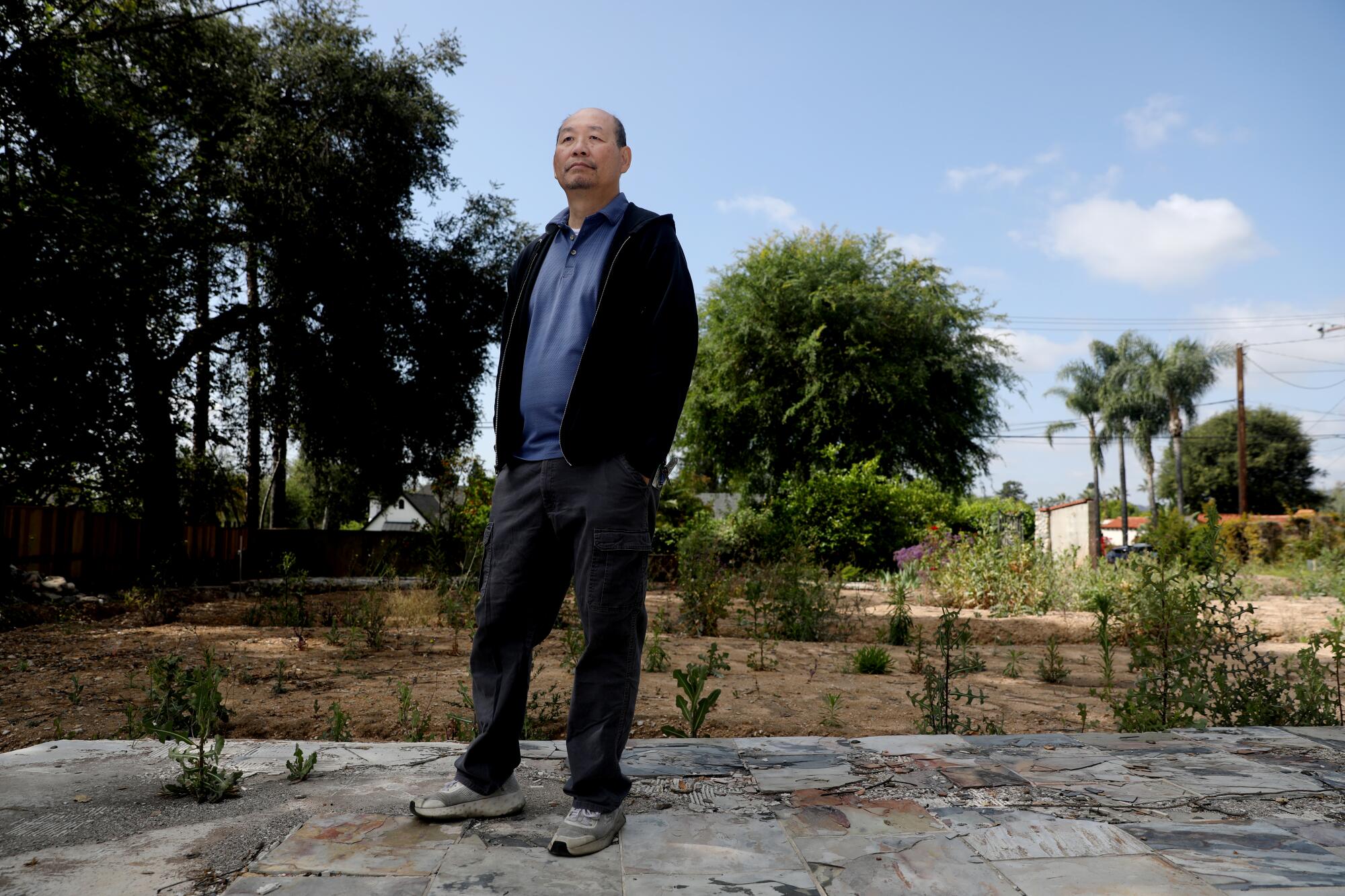
Leo Cheng, 60, on the site where he lived with his wife in a 1960s California ranch home on East Calaveras Street in Altadena.
(Gary Coronado / For The Times)
After going on a passive house tour led by his neighbor Jaime Rodriguez, whom he credits with sparking the passive house movement in Altadena, Cheng became part of a small but growing group that meets once a week to support one another with rebuilding energy-efficient, all-electric homes. A former NASA Jet Propulsion Laboratory engineer, he has decided to become a passive house consultant.
Besides indoor air quality, climate change is a big concern.
“I’m a firm believer that climate change played a big role in how intense and how widespread these fires were,” Cheng said. “Using fossil fuel in this day and age is not a good idea.”
Companies building all-electric catalog homes
Building a custom-designed home can bring an array of hurdles. For those looking for a simpler and more affordable approach, the Foothill Catalog Foundation offers pre-approved, all-electric home designs in styles that honor the architectural legacy of Altadena.
Local architects Cynthia Sigler and Alex Athenson took inspiration from early 20th century Sears catalogs that sold homes as kits when they founded the nonprofit last year.
They’re already working with 11 families with homes under construction, and have 50 more signed on to build their catalog homes.
Athenson said they didn’t set out to design their models all-electric but decided to go that route for health and safety reasons. Another factor was the money and time they could save clients by cutting out the need for two utility hookups.
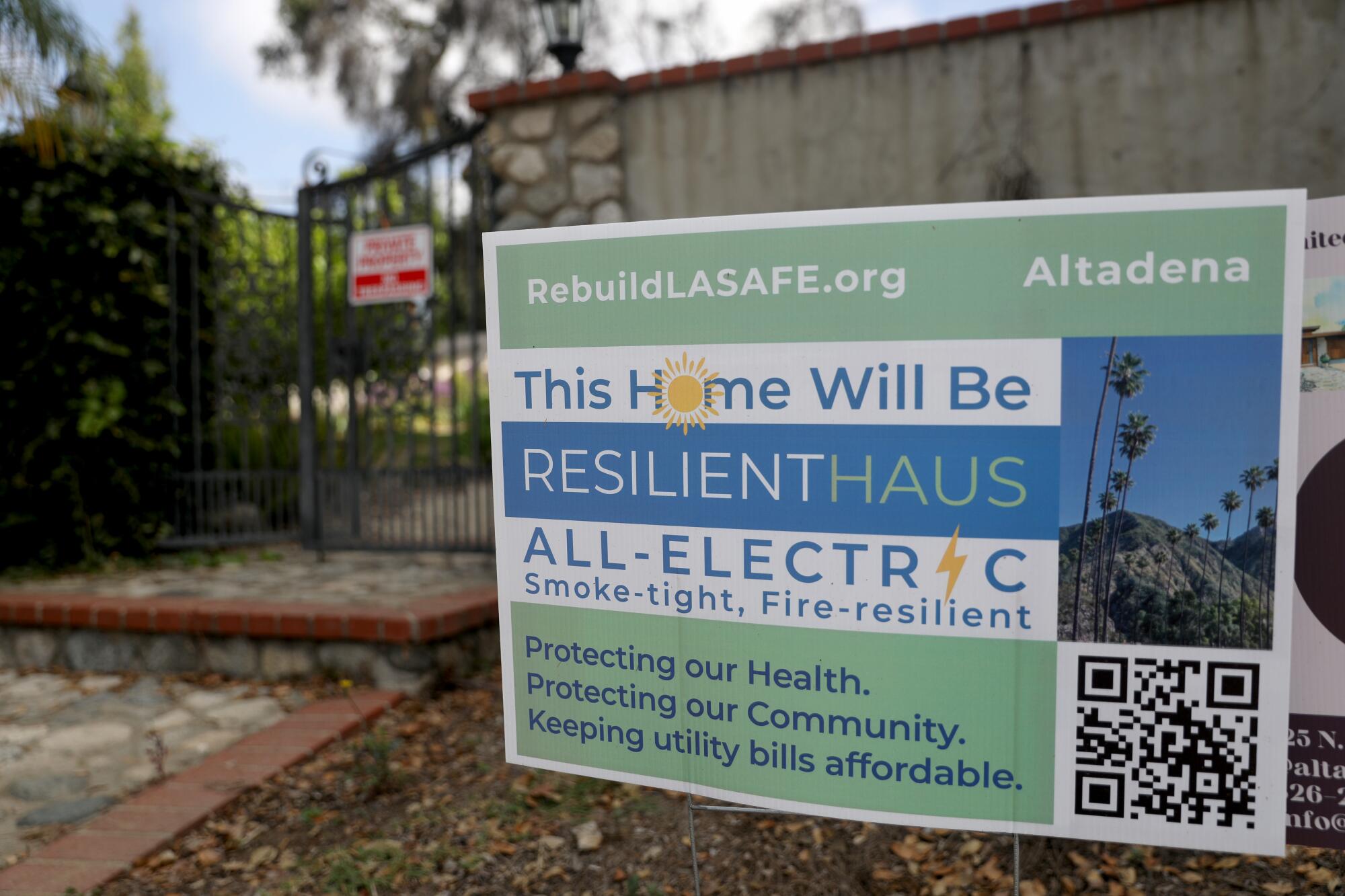
A sign in front of the home of Leo Cheng announcing that an all-electric home will be built where his home burned down during the Eaton fire.
(Gary Coronado / For The Times)
According to the Building Decarbonization Coalition, an electrification advocacy group, all-electric homes cost $3,000 to $10,000 less to build than mixed fuel homes in Los Angeles. That savings helps when it comes to buying appliances like heat pumps, which are the most efficient but tend to be more expensive up front.
The heat pump will yield lower utility bills for summer cooling because they use far less electricity than traditional air conditioners. They create winter heat bill savings in L.A. too.
The biggest question Athenson gets from clients is about electric cooking, especially when they’re used to cooking with gas. But he said concerns usually fall away when they learn more about induction stoves. “If you ask most chefs, that’s the most dialed-in, precise way to cook,” he said.
Genesis Builders LA is also offering fixed-price, pre-approved catalog homes in Altadena, with models that can be all-electric or use gas. Builder Devang Shah said he’s working with about 30 fire survivors, half of whom opted for all-electric.
“Some people have preferences for gas cooking and the look of a gas-lit fireplace,” said Shah. But all his clients will use electric heat pumps for space and water heating. Although the state waived a requirement that all new homes have solar for the burn areas, they still must be solar-ready. Shah’s models all come with solar and that, he said, helps heat pumps pencil out every time.
An incentive program for all-electric rebuilds
After a long delay, a $22-million incentive program launched on April 6 to support residents rebuilding all-electric in California disaster areas served by investor-owned utilities like Southern California Edison. Customers can qualify for $7,000 to $10,000 in subsidies, with more available for low-income fire survivors and bonuses for batteries and passive homes.
In just the first 10 days, 116 people from Altadena applied.
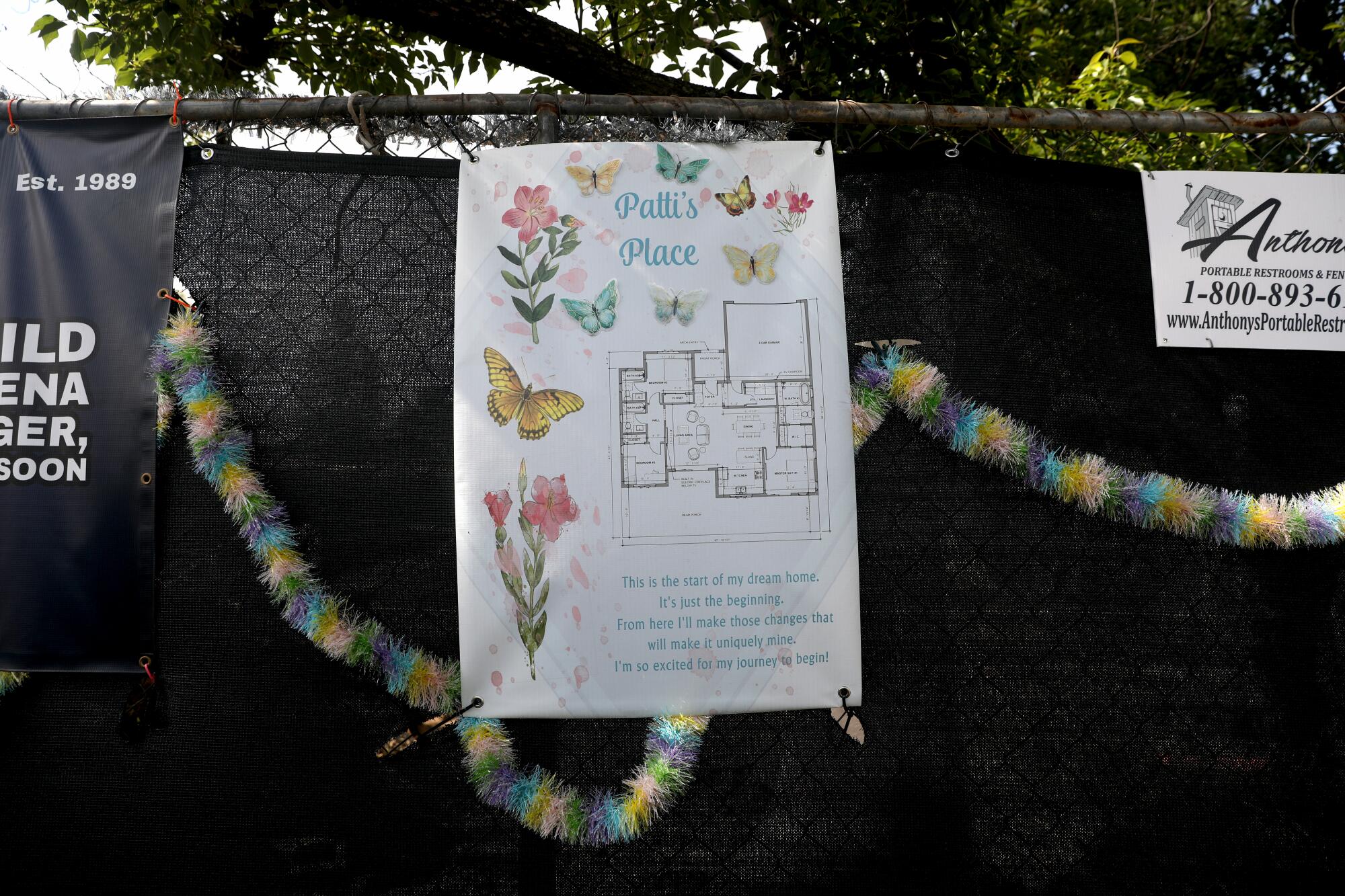
A plan for a new home along East Altadena Drive.
(Gary Coronado / For The Times)
Los Angeles Department of Water and Power, which serves most of the Palisades, also has a rebate program for electric wildfire rebuilds, with subsidies for all-electric homes or individual appliances.
Reza Akef, a builder in the Palisades and chair of the Pacific Palisades Community Council’s Infrastructure Committee, said people do consider these incentives in deciding what appliances to buy. On the other hand, SoCalGas offers wildfire rebates for more energy-efficient gas appliances. More than 1,100 households have enrolled.
About 90% of Akef’s 45 Palisades clients will keep gas. He said the fuel is faster for pool and spa heating, where electric heat pumps are more energy-efficient than gas but heat the water more slowly. Some of his clients feel a gas line will boost the resale value of their home, he said, and others have concerns about relying on one electric utility if the power goes out.
A spokesperson for Newsom said California is “aggressively pursuing widespread electrification” but would not burden survivors with “additional mandates and red tape.” Mayor Karen Bass’ office said she was giving Palisadians “options of how they want to rebuild,” with fire resiliency at the forefront.
Kari Weaver is an interior designer who lost her home in the Palisades fire and a member of Resilient Palisades, a group that’s advocating all-electric rebuilds. She plans to build an all-electric home with a solar and battery system in case of blackouts. But she’ll keep a gas line on the property and is still deciding if she’ll connect it to her pool. She’s looking into options like a cover that insulates the water, hybrid heaters and new electric heating models.
“These types of appliances are getting better all the time,” she said.


Alzo Slade and Peter Sagal on stage at the Studebaker Theater in Chicago
Jenn Udoni/NPR
hide caption
toggle caption
Jenn Udoni/NPR
This week’s show was recorded in Chicago with host Peter Sagal, judge and scorekeeper Alzo Slade, Not My Job guest Caro Claire Burke and panelists Karen Chee, Peter Grosz, and Shane O’Neill. Click the audio link above to hear the whole show.
Who’s Alzo This Time
Tourists Embrace The USA; The Wedding of the Century; Advances in Parenting
Panel Questions
Stolen Flavor
Bluff The Listener
Our panelists tell three stories about 80’s band A-ha making the news this week, only one of which is true
Not My Job: Caro Claire Burke, the author of Yesteryear, joins us to answer questions about yearbooks
This week, Caro Claire Burke, author of the book of the summer, Yesteryear, joins us to play a game called, “Yesteryear, meet Yearbook.” Three questions about yearbooks.
Panel Questions
Bookmarks and Beaches; One Man’s Trash
Limericks
Alzo Slade reads three news-related limericks: Jurassic Purse; Viper Visions; Humanity’s Tilt
Lightning Fill In The Blank
All the news we couldn’t fit anywhere else
Predictions
Our panelists predict, what would be the big surprise at Taylor Swift’s wedding
Lifestyle
Day 1,578 of WW3: The UN Security Council will meet on Monday to address Russia's latest strikes on cultural and religious sites, including the attack on Kyiv-Pechersk Lavra. ANGH, of course. This is your Saturday Ukraine discussion
Day 1,578 of WW3: The UN Security Council will meet on Monday to address Russia's latest strikes on cultural and religious sites, including the attack on Kyiv-Pechersk Lavra. ANGH, of course. This is your Saturday Ukraine discussion

NEW YORK, NEW YORK – APRIL 21: Laverne Cox attends the “Animal Farm” New York Premiere at Regal Theater on April 21, 2026 in New York City.
Jamie McCarthy/Getty Images
hide caption
toggle caption
Jamie McCarthy/Getty Images
In 2013, when the Netflix series Orange Is the New Black came out, the world met the character Sophia Burset — a Black trans woman serving as the resident hairstylist in prison.
For much of the audience, it was also the first time they met actress Laverne Cox — who landed the role of Sophia at the age 40, just when she was thinking of quitting acting altogether.
In her new memoir Transcendent, Cox talks about the challenges she faced long before Netflix came knocking: a mother who withheld love, a father who was never around and the brutal denigration she encountered growing up Black and trans in the deep South.
To unlock this and other bonus content — and listen to every episode sponsor-free — sign up for NPR+ at plus.npr.org. Regular episodes haven’t changed and remain available every weekday.
Email us at considerthis@npr.org.
-
Mississippi1 second ago
Iconic Mississippi foods and top US foodie states
-

 Missouri5 minutes ago
Man shot, killed after argument spills out of south Kansas City home
-

 Montana12 minutes ago
Photos: Montana East-West Shrine Game
-

 Nebraska15 minutes ago
Deadline looms for filing Nebraska Homestead Exemption applications
-

 Nevada20 minutes ago
The nation’s data center debate has reached Southern Nevada
-

 New Hampshire27 minutes ago
'New Hampshire Outright' creates open, safe spaces for LGBTQ+ families
-

 New Jersey30 minutes ago
Gun shots fired in Greenwich Township NJ, police investigating
-

 New Mexico35 minutes ago
Fiesta Subaru helps hundreds of New Mexico dogs find homes with big donation

