Entertainment
Coachella posts set times and surprise! Jack White is on the bill

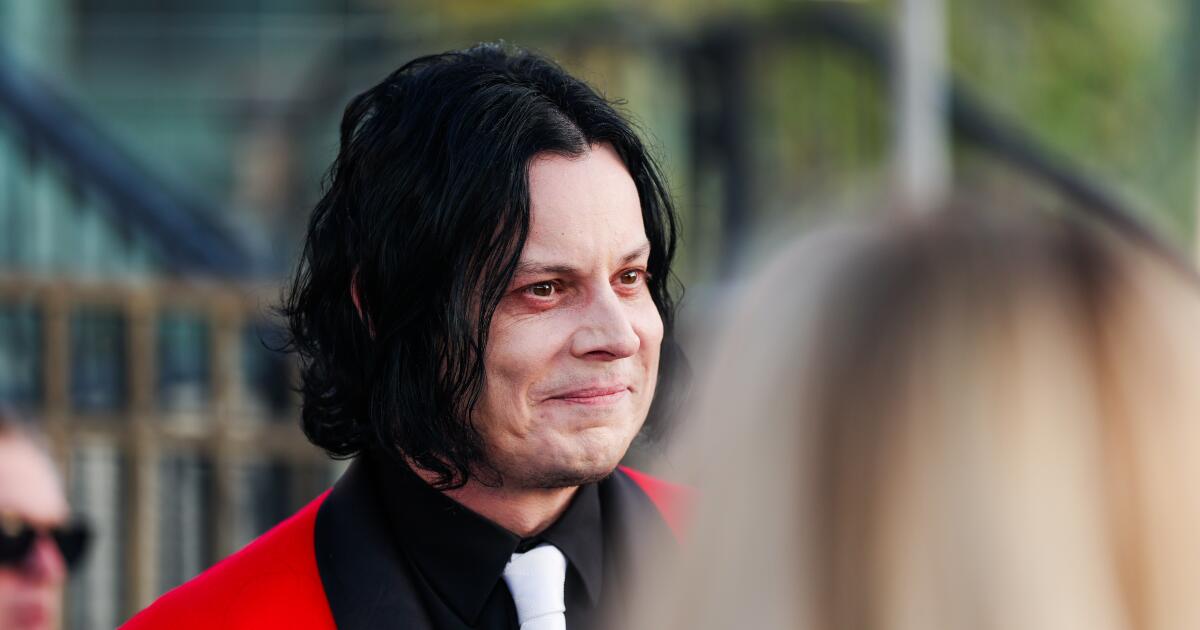
The Coachella Valley Music and Arts Festival posted set times for Weekend 1 of the 2026 edition and a former headliner has been added to the lineup.
Jack White, who was the musical guest on “Saturday Night Live” with host Jack Black over the weekend, will be the opening performer in the Mojave Tent on Saturday playing from 3 to 3:45 p.m.
White is the latest festival alum added to the bill for a surprise slot in recent years, joining the likes of Weezer and Ed Sheeran in 2025, Blink-182 in 2023 and Arcade Fire in 2022.
White last headlined the festival as a solo act in 2015. He was inducted into the Rock & Roll Hall of Fame last year as a member of the White Stripes, which played Coachella in 2003.
The sold-out festival is topped by Sabrina Carpenter on Friday, Justin Bieber on Saturday and Karol G on Sunday. Carpenter has the earliest headlining spot of the three, with a set scheduled for 9:05 to 10:35 p.m. Following Carpenter on opening night is electronic artist Anyma, who is debuting a production called “Æden” at midnight on the Coachella stage.
Nine Inch Noize, the collaboration between Nine Inch Nails’ Trent Reznor and German producer Boys Noize, will be in the Sahara Tent on Saturday night from 8 to 8:45 p.m.
Coachella hasn’t announced Weekend 2 set times yet.
Earlier on Monday, Coachella posted more information about the mysterious Radiohead activation on the poster dubbed “the Bunker.”
A post on Coachella’s Instagram called it the debut of “Radiohead Motion Picture House Kid A Mnesia,” with a 75-minute-long large format film from band frontman Thom Yorke and band artist Stanley Donwood of “sketches, paintings, collages, audio recordings and handwritten notes” captured during the recording of “Kid A” and “Amnesiac.”
It’s free to see, but there’s a reservation system for a time slot. People who can’t make a reservation will be admitted on a first-come, first-served basis.
On the Coachella website, it describes the Bunker as being located near the Sahara Tent.


As the noise-rap-electro act Jane Remover shrieked and pleaded through a 90-minute marathon set at the Fonda on Thursday night, one very young couple dressed right out of a conservative‘s nightmare — gender-ambiguous, purple hair, facial piercings — tapped me on the shoulder. They politely asked if I could mind their newly bought vinyl for a bit as they thrashed in the heaving crowd. Of course, this unc obliged them.
Anyone who laments that L.A. crowds don’t dance should go to one of the last sets of Jane Remover’s three-night stand at the Fonda this weekend. It had the most genuinely raucous pit I’ve seen in 2026, made all the more feral for how sweet and earnest it was. After a hotly tipped Coachella set, this Live Exhibit tour affirmed that the subculture Jane Remover built may or may not have wider pop potential, but it’s getting big enough to count for stardom in the fractured music world of today.
Jane Remover is a trans polymath producer and singer-songwriter with influences across rave, shoegaze, trap and beyond. They’ve built up a ferocious elaboration on the hyperpop of predecessors like Sophie, who similarly packed so many good ideas into songs they became talismanic to fans, a tonic to reinvent yourself (new Charli XCX opener Underscores is another fellow traveler).
The music itself sounds like reverse-engineering the moment in the 2000s when metalcore kids discovered EDM. Only now it’s Discord-disaffected youth ramping up hardstyle techno, autotuned girlypop ballads and rage-rap to an explosive fusion point. “Census Designated,” Jane’s brash and dramatic 2023 coming-out LP, tipped them as a force beyond the underground. But they soon eclipsed it with 2025’s “Revengeseekerz,” a deliriously overheated mix of romantic yearning, internet score-settling and virtuosic production prowess.
Backed by just a DJ (Dazedgxd, who opened the set) and a retina-scorching light rig up front, Jane acknowledged on Thursday that the stakes were getting much higher. They joked that they’d played the El Rey like three times before this tour, and to judge by the wild-eyed passions out in the audience, the Fonda will probably be the smallest venue they’ll play for some time. “It gets so cold this high up,” Jane sang on “Turn Up or Die.” “Can’t go to hell but I can drop you off.”
The sentiments driving the music are ultramodern: self-aware, vicious and desperately vulnerable. The hilariously zesty “Angels in Camo” (home to the all-time banger of a line: “Jesus never had it with a freak b—”) wrapped up with a bloodletting plea that “I can’t let you b— win.” Jane wields that word like the flaming sword on the “Revengeseekerz” album cover, with all the casual lustiness of Future but also the wrath of a reclaimed slur.
On “Professional Vengeance,” they grappled with the weird lures of celebrity and intimacy, where no one really knows anyone but desire still courses; “Experimental Skin” found them craving and fighting off God and nihilism and technology and addiction all at once.
The tension in these tracks are the binding agent for Jane’s fan base — the music is full of contradictions and incompatibilities smashing together that just feel like being young right now. Other than a quick affirmation that fans of all identities and backgrounds will always be welcome at their shows, they let the contorting, violent music speak for itself about the way queer fans are feeling about life under siege in the United States.
If the set was a bit too long for the limited setup onstage, it was because Jane simply had that much music to let out — that caliber of emotion to unburden, that much want to acknowledge. It seemed like the set was closing with “In the Dark,” an aching ballad from their Venturing side project, plainly declaring “I still dream of us” through a fog of effects. But instead they ramped it back up for one last cathartic blast to close, sending their faithful out onto Hollywood Boulevard, sweaty and filthy and fundamentally known.

Photo: 1-2 Special/Everett Collection
The English director Mark Jenkin works a bit like a local artisan from another era. Filming in and around his native Cornwall, he shoots his pictures himself on a 16mm Bolex, the kind of camera that might have been used by film students decades ago and that produces tactile, slightly grainy images. He also edits the movies himself, and records his sound later, layering in dialogue and effects and music (sometimes composed by himself) with an austere, handcrafted precision. This gives Jenkin’s work a certain timelessness, as if it belongs to the past but not to any specific period of the past. True, such an old-fashioned approach could feel performative, like an unusually well executed Instagram filter. But Jenkin’s style ties directly to his subjects and his expressive philosophy. His latest, Rose of Nevada — which stars two name actors, Callum Turner and George MacKay, and opens in New York today after doing the festival rounds — has the beguiling simplicity of a fable and the captivating textures of a dream. It stays with you like an unexpected and unanswerable question.
Jenkin privileges atmosphere through the collection of minute, sometimes abstract details. Set in a sparsely populated and depressed fishing village, Rose of Nevada opens with the unexpected return of the empty boat of the title, thought lost decades ago. Its arrival is announced by close-ups of barnacles, of rusty edges on ancient metal, of curious plant growth and moldy, tangled coils of black rope, as if its return was just part of a broader natural order. The Rose of Nevada clearly has a tragic history, which perhaps explains the psychological paralysis of the few remaining townsfolk. But it’s here, and so it must set off on a new fishing voyage.
Joining the journey, almost as if they were pulled towards it, are Nick (MacKay), a downcast man who needs money and seems incapable of meeting his young family’s most basic needs, and a drifter, Liam (Turner), whom we first see running down a road as if he were fleeing something. Both men are alienated from their environs, though for different reasons: MacKay conveys Nick’s quiet awkwardness well, and Turner has a charming, freewheeling energy that suggests he’s up for anything. When they return from the fishing expedition, however, the two men find that they’ve transported back several decades in time, and they’re mistaken for — or rather, they appear to be inhabiting the bodies of — two young deckhands who died long ago. Now that it’s the 1990s again, the fishing village is thriving, its local pub crowded with people and blaring pop. Nick and Liam see the younger, happy versions of the broken townspeople they’d left behind. Liam (now known as Alan) suddenly has a family, and Nick (now known as Luke) suddenly has parents. It’s almost as if the young men have been offered to the harvest gods as a sacrifice. And it’s worked.
So, it’s a ghost story, and a time travel story, and a folk tale, and something of a kitchen sink drama, but it’s also none of these things, really, and that’s where Jenkin’s formal gambits come in. His filmmaking has a lovely, homespun directness. We can feel scenes and moments being constructed, which fixes our attention on seemingly simple exchanges. An example: Early on, we see Nick hand his daughter a candy. Other filmmakers might shoot such a scene in a quick, offhand manner to mask its emotional weight, but Jenkin goes in the opposite direction, shooting everything in relative close-up and cutting the action to both extend and clarify it: We see Nick pull the candy out of its box, we cut to the girl receiving the candy, we see his wife see the girl, we cut to the wife taking the candy, we cut to a close-up of her unwrapping it, we cut to the girl getting the candy back, and we see Nick’s response. On some level, this could be an introductory filmmaking exercise: a whole series of extremely deliberate shots and edits designed to show this man’s feeling of inadequacy. But within the general precision of Jenkin’s style, the moment doesn’t stand out. Instead, it’s one in a long line of specific, human moments through which he builds his narrative and conjures a mood.
Such straightforwardness give Rose of Nevada a fable-like quality: There’s no narration, but we feel the deliberate rhythms of the storytelling, the telling emphasis on certain details over others. But weirdly, it also has something of the opposite effect: The film’s intimacy and Jenkin’s attention to the elements (along with his fondness for elliptical, well-timed flash frames) lends everything an otherworldly aura. Despite the time travel premise, nobody’s running around looking for a time machine to take them back, nor are they wasting much time trying to figure out how the dynamics of time travel work. The writer-director lets the unexplainable remain unexplained, because he’s interested more in our emotional response to it. We watch how people interact with these transformed versions of Nick and Liam, and we watch Nick and Liam’s own disparate responses to this new world, to the competing philosophies of life that emerge from this bewitching film. Rose of Nevada’s power lies in its peculiarities.
See All

SANTA BARBARA — Sixty-one years and a day after he laid down the epochal “Like a Rolling Stone” in a recording studio on Seventh Avenue in New York City, Bob Dylan shuffled onstage on the other side of the country dressed so fine in a dark jacket with the hood pulled over his head.
The hood, which Dylan has been wearing even for shows without the cool coastal breeze that blew through the Santa Barbara Bowl on Wednesday night, has lately become an object of online fascination; one guy on X last year wrote that he was obsessed with the rock legend’s “new dripped out look,” and I have to agree: Though there are great hooded-Dylan photos going back decades, his current wardrobe — as seen nightly against a velvety curtain lighted from below — is a vibe through and through. (His Bobness forbade photographers from shooting Wednesday’s show, which means you’ll have to consult social media for a glimpse.)
Dylan’s drip isn’t the only thing putting him into the viral bloodstream of the internet. In March, he launched a Patreon, where he’s posting short stories and apparently AI-assisted installments in an audio series called “Lectures From the Grave”; this week, he contributed his thoughts on aging to a widely shared New York Times op-ed pegged to President Trump’s 80th birthday. In my social feeds, at least, quotes from Dylan’s piece — “You’re an old king from some vanished country,” he wrote — kept turning up next to clips of Timothée Chalamet celebrating the New York Knicks’ NBA Finals win — an oddly poetic interleaving given their history.
All this stuff is cool; I admire veteran culture-shapers who figure out how to adapt to a new information environment. Yet one of the reasons it’s fun to encounter Dylan on Instagram is because you can still encounter him in the flesh. And at 85, he’s absolutely cooking on the road right now.
Wednesday’s show was the first in a handful he’s playing around Southern California this week, including a gig scheduled for Saturday night at Palm Desert’s Acrisure Arena. For years after the release of 2020’s pulpy “Rough and Rowdy Ways,” Dylan said he was on the Rough and Rowdy Ways tour; this month, though, he started selling T-shirts that describe his latest run of dates as the Long Hot Summer tour — precisely the sort of taxonomical quirk to get Bobheads going in the comments.
The concert, which ran about 80 minutes, mixed four cuts from “Rough and Rowdy Ways” with older Dylan songs like “All Along the Watchtower” and “To Be Alone With You” and covers such as Bo Diddley’s “I Can Tell” and Eddie Cochran’s “Nervous Breakdown.” But the whole thing felt like one continuous dream state, as Dylan — accompanied by a four-piece band dressed in dark colors to match the boss — croaked, gasped and crooned from behind an electric piano he played like somebody knocking the keys with his arm as he reaches for a drink.
“False Prophet” was a raunchy blues while “When I Paint My Masterpiece” rode a luscious rumba groove; “Crossing the Rubicon” and “I’ve Made Up My Mind to Give Myself to You,” both from “Rough and Rowdy Ways,” got arrangements completely different from those on the album.
To the astonishment of many a Bobhead, Dylan’s guitarist Doug Lancio was replaced in Santa Barbara by Julian Lage, the youngish jazz star known for his work with Gary Burton and John Zorn. (Dylan said nothing about the change, nor about anything else, from the stage; a spokesman for the singer said he had no word on whether Lage was a permanent addition to the band.) Lage’s playing was tender and spooky, not least in “Tryin’ to Get to Heaven,” where every 30 seconds or so the chords would go in some direction I could never have predicted.
The result was a spectacle of emotion — you’d have to have tried not to get swept away by “I Shall Be Released,” which closed the show — but also of belief in one’s craft. Onstage as on your phone, Dylan was searching for new limits Wednesday — a lifer grinding toward the sublime.
-

 Health16 seconds ago
Measles-infected traveler may have exposed passengers at LAX and nearby hotel, health officials warn
-

 Sports7 minutes ago
World Cup Red Cards: 2026 Has More Red Cards Than Each Of Last 2 World Cups
-

 Technology10 minutes ago
China’s brain chip breakthrough raises big questions
-
 Business15 minutes ago
Ranch lovers can soon travel with a TSA-friendly kit of the popular American dressing
-
Entertainment22 minutes ago
At the Fonda, Jane Remover’s violent yearning heralds a new kind of stardom
-
 Lifestyle25 minutes ago
Beer, with a twist? SoCal dads find solidarity through an unexpected activity
-
 Politics30 minutes ago
Billionaire tax proposal faces hurdles as it moves closer to November ballot
-
 Science37 minutes ago
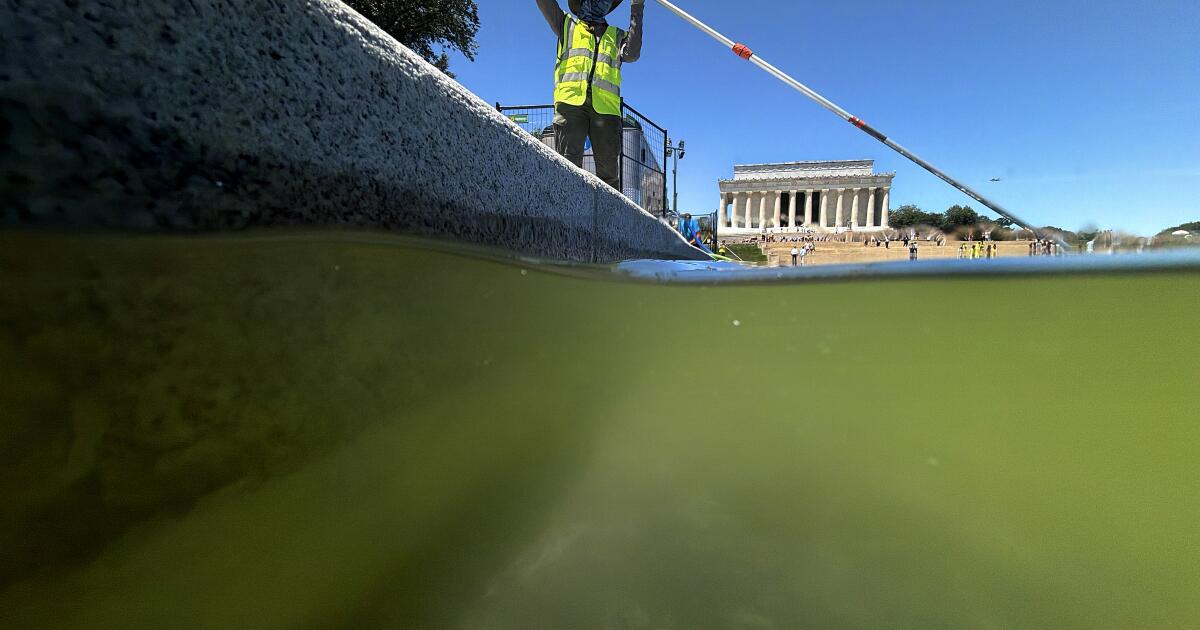
Here’s why the Lincoln Memorial Reflecting Pool went green so fast

