California
Commentary: Culling the field for California governor? Don’t look at me, says Betty Yee
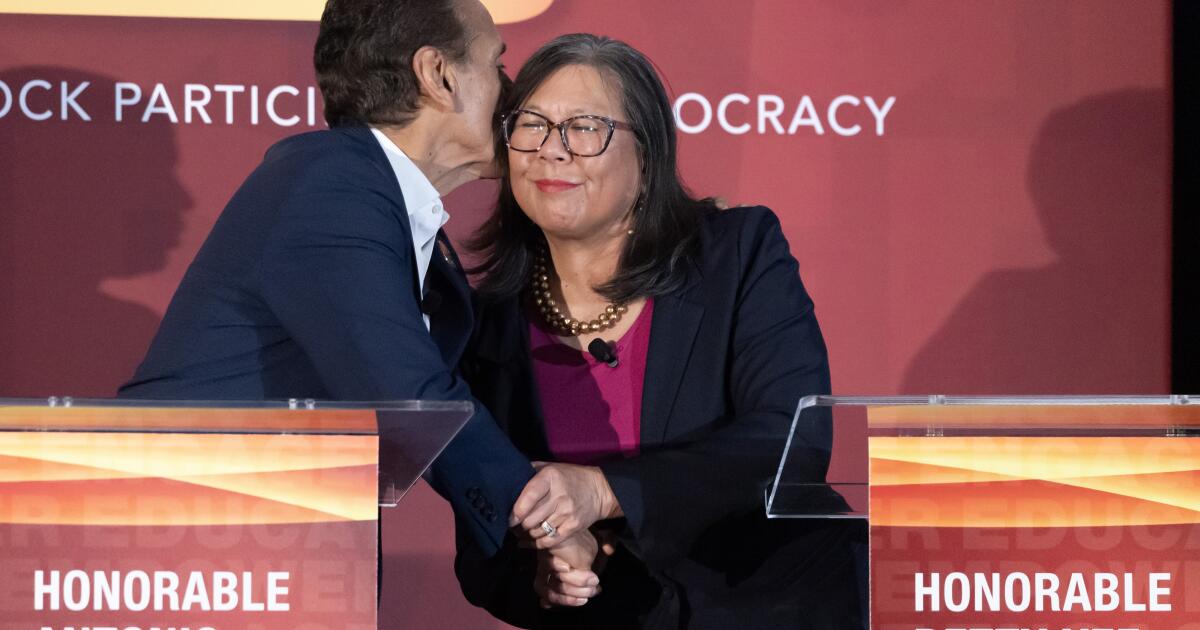
OAKLAND — Betty Yee knows what people are thinking. She’s heard what they’ve said and read the many emails she’s gotten.
The former state controller has been running for California governor longer than just about anybody in the cheek-by-jowl field. And yet the Democrat is bumping along near the bottom, a blip in polls and a laggard in the money chase.
But no, Yee said, she has no intention of quitting the race, as she’s been urged, and no fear that, by staying in, she’ll help two Republicans advance to November’s runoff, locking Democrats out of the governor’s office for the first time since George W. Bush was president.
“I just don’t see it,” Yee said, given the way Chad Bianco and Steve Hilton, the top GOP contenders, are smacking each other around, hoping to emerge as the undisputed Republican standard-bearer.
Beyond that, she said, it’s not as if anyone’s running away with the contest; most polls have shown the leading candidate — which depends on the survey — standing atop the pile with around 20% support.
That isn’t exactly landslide territory.
“The public is still shopping,” Yee said. “In the next month or so, we’re going to try to get [a TV ad] on the air, basically make our case and hope that can spread as voters are getting more focused on the race.”
Which is not to say Yee is delusional.
“As a candidate, I make that assessment every day about whether we’re going to be viable or not,” she said last week, just before stopping by the Alameda County voter registrar‘s office to file paperwork for the June 2 primary.
“Right now, it’s less than a 50-50 chance,” Yee said, suggesting it’s her job to boost those odds by getting voters to appreciate what she offers, which amounts to unvarnished talk about the challenges facing the next governor and the ways Sacramento — which has been run for years by fellow Democrats — isn’t working.
“ ‘Accountability’ has kind of become a dirty word … where it’s about who we’re going to throw under the bus, rather than stepping back and saying, ‘What have we gotten for the dollars that we spend and, if we’re not getting those outcomes, how do we do better?’ ”
Yee served two terms as controller, in effect the state’s chief financial officer, and 10 years before that on the Board of Equalization, which oversees property tax assessments. She’s isn’t trying to buy the governorship, like billionaire Tom Steyer, or leverage her political celebrity, like cable-TV fixtures Katie Porter and Eric Swalwell. Instead, Yee is running a grassroots campaign, visiting nearly all 58 California counties and holding as many face-to-face meetings as humanly possible.
“I’m in the trenches,” she said. “I knock on doors every election cycle because to me, that’s the reality check of where people really are in terms of their lives.”
Which is certainly an admirable approach, albeit a rather idealistic strategy in a state of nearly 23 million voters, spread over roughly 800 miles from north to south. It would take more than two years of round-the-clock campaigning just to give each and every one a quick handshake.
The most notable feature of Yee’s candidacy is her message. She’s not selling barn-burning populism or viral take-downs of President Trump — “I don’t have any gimmicks, I don’t swear, I don’t have a reality-TV show personality” — but rather practical know-how and a deep understanding of state government.
It’s almost quaint in today’s theatrical political environment.
Seated at a sidewalk table outside a coffee stand in downtown Oakland, Yee focused on California’s stretched-thin budget, which happens to be her area of expertise.
“People ask what would you do in your first days as governor, if you have the privilege of serving,” Yee said, as her butterscotch latte sat cooling. “I’d come clean with the voters about where we are fiscally.”
After years of surpluses, she said, the state is spending more than it can afford. Facing a structural deficit, the next governor will have to cut programs and raise taxes, not just one or the other, with corporations and California’s richest residents being forced to cough up more. (She’s dubious, however, of a proposed November ballot measure imposing a one-time 5% tax on billionaires, questioning whether it would stand up in court.)
Sacramento’s credibility, Yee suggested, is on the line.
Before any expansive new programs can be implemented — and she has some notions for how to make life more affordable, increase access to healthcare and create jobs — Californians have to be convinced their tax dollars are being well spent and delivering proven results. “I would really insist on and invite stricter accountability of what we do with our money,” Yee said.
She’s not beyond criticizing the current administration.
“I mean, I’ve been termed out as controller since January 2023. I still get calls from companies in the [European Union], Canada, even Mexico about how we want to do business with California. Who do we talk to?” Yee said. “So I’ll send them over to the governor’s Office of Business Development and they tell me, ‘Well, we try to call people, but nobody’s answering our call.’ ”
(In response, a spokesman for the Office of Business and Economic Development touted California as “a premier hub for international business” and described foreign trade and investment as major drivers of the state economy.)
As for Gov. Gavin Newsom, while she supports his teenaged trolling of Trump, she said it shouldn’t be done through official channels, , or on the taxpayers’ dime.
“We have to focus on making the state work,” Yee said, “and that’s where I’m more focused on because people … want service delivery. They want government to be responsive to their needs. Somebody just pick up the damn phone on the other line to help them.”
Tough medicine, as she described it, and “stabilization” — which is “kind of my theme” — won’t make a great many hearts go pit-a-pat. But Yee hopes that straight talk and her distinct lack of ornamentation will count for something with California voters.
“The climate now is that people are very drawn by the performative approaches,” she said. “However, I think that will change. I want to give [voters] credit, because I do think they are very discerning when they’re ready to mark their ballot.”
The coming weeks will test that premise. And Yee is staying put.

California
California’s Voter ID Initiative is Way More Chill Than Trump’s SAVE Act
Sources: California Voter ID Initiative text (proposed); H.R. 7296, Safeguard American Voter Eligibility Act, 119th Congress, 2d Session (introduced January 30, 2026); Congressional Research Service Bill Summary; California Secretary of State; National Conference of State Legislatures (NCSL).
Background: How California Currently Handles Voter Identification
Under current California law, U.S. citizenship is required to vote, but the state relies on voters to simply attest to their citizenship when registering. California does not generally require voters to show identification at the polls. The limited exceptions apply only to first-time federal election voters who registered by mail or online without providing a California ID or Social Security number, and even then, the state allows a broad range of documents, including utility bills, bank statements, paychecks, or official government mail.
In 2024, Governor Gavin Newsom signed legislation explicitly banning local jurisdictions from requiring voter ID, following Huntington Beach voters’ approval of a local measure to do so. California currently has among the most permissive voter identification rules in the nation.
The California Initiative: A Targeted, Inclusive Reform
A proposed California ballot initiative would amend the state constitution to add a new Section 3.1 to Article II. The initiative states three purposes: to “promote public confidence and trust in the electoral process,” to “deter and detect voter fraud by maintaining accurate voter registration records and confirming eligibility to vote,” and to “minimize the risk of voter impersonation by requiring proof of identity to vote.”
The measure is notable for what it does and, just as importantly, for what it does not do.
For in-person voting, the initiative requires that “each time a voter casts a ballot in person in any election in the State, the voter shall present government-issued identification.” The initiative defines government-issued identification as “documentation that allows conclusive verification of the voter’s identity.”
For mail voting, the requirement is far more limited. The voter needs only to provide “the last four digits of a unique identifying number from government-issued identification that matches the one designated solely by the voter for their voter registration.” Importantly, the type of ID designated by each voter “must be indicated in their voter registration record, noted on the mail ballot envelope provided to them, and available to them on request by phone or electronically,” so voters are never caught off guard.
On the question of cost, the initiative is explicit: “Upon request by an eligible voter, the state shall provide, at no charge, a voter ID card for use in casting a ballot.” This is perhaps the most important provision in the measure. One of the most common and legitimate criticisms of voter ID laws is that they can function as a de facto poll tax. This initiative addresses that concern directly by guaranteeing that the means of compliance are freely available to every eligible voter.
On citizenship verification, the initiative directs the Secretary of State and county elections officials to “use best efforts to verify citizenship attestations using government data” and to “annually report what percentage of each county’s voter rolls have been citizenship-verified.” This is a transparency measure, not a documentation barrier.
On accountability, the initiative requires that “during every odd-numbered year, the State Auditor shall audit the State’s and each county’s compliance with this section and report its findings and recommendations for improving the integrity of elections to the public.” Citizens may also “seek judicial review and remedy of the State’s or any county’s compliance with this section.”
What the initiative does not do is equally important. It does not require documentary proof of citizenship to register to vote. It does not require voters to submit citizenship documents with mail ballots beyond the last four digits of an ID number. It does not impose criminal penalties on election officials. It does not create unfunded mandates. It does not establish a private right of action against election workers.
In short, the California initiative is a narrowly drawn measure. It asks voters to confirm who they are while ensuring that the tools to do so are freely available to all.
The Federal SAVE Act (H.R. 7296): A Sweeping and Problematic Mandate
Introduced in the House on January 30, 2026, by Rep. Chip Roy and referred to the Committee on House Administration, the Safeguard American Voter Eligibility Act amends the National Voter Registration Act of 1993. Unlike the California initiative, which works within existing systems, the SAVE Act would fundamentally restructure how Americans register to vote and cast ballots in federal elections, with requirements that, in many cases, are practically impossible for millions of eligible citizens to meet.
Here is what the bill actually requires, provision by provision, and why each raises serious concerns.
1. Documentary Proof of Citizenship Required to Register
The bill is unambiguous on this point. It states that “a State may not register an individual to vote in elections for Federal office held in the State unless, at the time the individual applies to register to vote, the individual provides documentary proof of United States citizenship.”
The bill defines acceptable proof narrowly. It includes a REAL ID-compliant document “that indicates the applicant is a citizen of the United States,” a valid U.S. passport, or a military ID combined with “a United States military record of service showing that the applicant’s place of birth was in the United States.” For voters who cannot provide those documents, the bill allows a government photo ID paired with a certified birth certificate, but that birth certificate must meet an exacting list of requirements: it must include “the full name, date of birth, and place of birth of the applicant,” must list “the full names of one or both of the parents of the applicant,” must carry “the signature of an individual who is authorized to sign birth certificates,” must include “the date that the certificate was filed with the office responsible for keeping vital records in the State,” and must bear “the seal of the State, unit of local government, or Tribal government that issued the birth certificate.”
This is an extraordinarily demanding standard. Birth certificates are lost, damaged, or were never properly recorded, particularly for older Americans, rural residents, and low-income citizens.
The bill does include a fallback process for applicants who cannot produce these documents. They may “sign an attestation under penalty of perjury that the applicant is a citizen of the United States” and “submit such other evidence to the appropriate State or local official demonstrating that the applicant is a citizen.” The official then makes a personal judgment and must sign a sworn affidavit “swearing or affirming the applicant sufficiently established United States citizenship.” This places an unusual and significant legal burden on individual election workers who are simply trying to help voters register.
2. A Photo ID Requirement That Specifies Citizenship on the Face of the Document
The bill requires that every voter in a federal election present an “eligible photo identification document.” The bill defines that document as one containing “a photograph of the individual identified on the document,” “an indication on the front of the document that the individual identified on the document is a United States citizen,” and either an ID number or “the last four digits of the social security number of the individual identified on the document.”
The citizenship indicator requirement is the critical problem. Currently, only a handful of states denote citizenship status directly on driver’s licenses. Even REAL ID-compliant cards display the same gold star insignia for citizens and lawfully present non-citizens alike. The bill does include a limited workaround: a voter may present a non-compliant ID “together with another identification document that indicates the individual is a United States citizen.” But requiring two documents at the polls is itself a significant additional burden, and it would disqualify the standard ID held by the vast majority of Americans unless paired with a second document.
The bill also specifies that for in-person voting, the eligible photo identification document “shall be a tangible (not digital) document,” closing off the possibility of using a digital ID on a smartphone, a technology that several states have begun adopting.
3. Double Documentation Required for Absentee Voting
For voters casting absentee ballots, the bill requires that a copy of the eligible photo identification document be submitted both “with the request for an absentee ballot” and again “with the submission of the absentee ballot.” This double documentation requirement, which most states do not currently impose at any stage, would add substantial friction to the process that millions of Americans, including elderly, disabled, and overseas military voters, rely upon as their primary means of voting.
4. Immediate Effective Date, No Funding, No Phase-In
The bill states plainly that its provisions “shall take effect on the date of the enactment of this section.” There is no phase-in period. There is no federal funding provided to help states implement new documentation systems, train election workers, update voter registration forms and databases, or communicate requirements to the public. The Election Assistance Commission is given just 10 days after enactment to “adopt and transmit to the chief State election official of each State guidance with respect to the implementation of the requirements.” States are given 30 days to “establish a program” for identifying non-citizens on voter rolls. These are the conditions under which states would be expected to overhaul their entire voter registration and election administration infrastructure.
5. The Risk of Bifurcated Elections
States that cannot comply with the law’s requirements could be forced to maintain two separate voter rolls: one for voters who have provided documentary proof of citizenship and are eligible to vote in federal elections, and one for voters who have not. Arizona has operated under just such a bifurcated system since 2004, resulting in nearly two decades of continuous litigation. The SAVE Act would risk spreading that legal and administrative chaos to all 50 states simultaneously, with no funding and no preparation time.
6. Mandatory Federal Database Cross-Checks and Data Sharing
The bill requires states to establish programs to identify non-citizens on voter rolls using information from the Department of Homeland Security’s SAVE system, the Social Security Administration, and state driver’s license agencies. Federal agencies must respond to state requests within 24 hours and are directed to “share information with each other with respect to an individual who is the subject of a request.”
The bill goes further: it directs the Secretary of Homeland Security to “conduct an investigation to determine whether to initiate removal proceedings” against any non-citizen found to be registered to vote. This means voter registration data would become a direct input into federal immigration enforcement. The scope of personal voter information flowing between state election systems and federal agencies raises significant privacy concerns that the bill does not address.
7. Criminal Penalties for Election Officials
The bill amends the existing criminal penalties section of the National Voter Registration Act to make it a federal crime for an election official to register “an applicant to vote in an election for Federal office who fails to present documentary proof of United States citizenship.” The bill also criminalizes “providing material assistance to a noncitizen in attempting to register to vote or vote in an election for Federal office” for executive branch officers and employees.
Critically, the bill does not limit criminal liability to knowing or willful violations. An election official who makes an honest administrative mistake could face federal criminal prosecution. This provision could have a severe chilling effect on election administration, discouraging qualified people from serving as election officials and causing those who do serve to deny registration to borderline applicants out of fear of personal legal consequences.
8. A Private Right of Action Against Election Officials
The bill expands private right of action provisions under the National Voter Registration Act to include “the act of an election official who registers an applicant to vote in an election for Federal office who fails to present documentary proof of United States citizenship.” This means private individuals may sue election officials directly for compliance failures, compounding the chilling effect of the criminal penalties and creating a hostile legal environment around the routine work of election administration.
Side-by-Side Comparison
The Bottom Line
Both proposals share a stated goal: ensuring that only eligible U.S. citizens cast ballots in American elections. But they represent fundamentally different visions of how to pursue that goal, and the differences matter enormously for millions of American voters.
The California initiative works within existing systems. It asks voters to confirm who they are, provides free IDs to those who need them, and builds in transparency and accountability through annual audits and public reporting. Its requirements are clearly defined, its burdens are modest, and its protections for voters are explicit.
The SAVE Act, as written in H.R. 7296, would impose requirements that tens of millions of eligible American citizens cannot currently meet, without providing a dollar in funding, a meaningful period of preparation, or protection for the election officials expected to carry it out. It takes effect the day it is signed. It gives states 30 days to overhaul their voter rolls. It exposes election workers to both criminal prosecution and private lawsuits for honest mistakes. It routes voter registration data into federal immigration enforcement. And it threatens to force all 50 states into the kind of bifurcated election chaos that Arizona has lived with for two decades.
Reasonable people can disagree about whether voter ID requirements are necessary or wise as a matter of policy. But the contrast between these two proposals is instructive. One is a carefully drawn, incremental reform that takes eligible voters’ concerns seriously. The other is a sweeping federal mandate that, as written, would make voting harder for millions of lawful American citizens while creating new legal and administrative burdens that states are given neither the time nor the resources to meet.
California
Man who was severely stabbed bled to death after someone stole his ambulance, family says
Recent retiree Reinaldo Jesus Lefonts was charging his EV in a Downey library parking lot when he was attacked in a stabbing that severed both carotid arteries and both jugular veins. He was alive when an ambulance arrived at the parking lot — but that emergency vehicle was then stolen.
The driver of the ambulance, according to police, led officers on a pursuit that ended in a crash miles away.
“In that moment, every second mattered,” Lefonts’ family says in a legal claim against the city. “The City’s paramedics and rescue vehicle were Reinaldo’s only realistic chance of survival.
Lefonts died at the scene of the stabbing, authorities say.
Now his family is seeking $40 million from the city. Their attorneys cite failures in public safety and the emergency response. They say a “surveillance” sign at the lot led Lefonts to believe he was safe, and that the ambulance was missing a required locking device.
The 68-year-old had only recently retired from his job as a lab technician at UCI Medical Center when he was attacked on the morning of Sept. 13, 2025, in the Downey Civic Center parking lot adjacent to the public library at 11121 Brookshire Ave., according to the claim, filed Friday with the Downey city clerk. Suspect Giovanni Navarro, 23, had been arrested for trespassing at the same location less than 24 hours earlier.
Navarro had 28 prior criminal convictions, including brandishing a weapon, attempted burglary and criminal threats, attorneys said.
The Los Angeles County medical examiner determined that Lefonts suffered at least four sharp force injuries to his head, neck and right forearm. The fatal wound was a stab to the neck, and the manner of death was ruled a homicide, according to the autopsy report.
The Downey Fire Department rescue vehicle that responded was not equipped with a Tremco anti-theft locking device required under state law and applicable Fire Department standards, the family’s attorneys argue. While paramedics treated Lefonts, 52-year-old Nicholas DeMarco allegedly got into the ambulance and drove away. The police pursuit followed.
In the parking lot, Lefonts was pronounced dead at 9:55 a.m., the autopsy report states.
The city logged about 675 calls for service to the Civic Center and library between January 2022 and December 2025, covering assaults, robberies, sex crimes, arson and narcotics violations, according to the claim.
“While both the violent attack and theft were criminal acts, it was entirely foreseeable in light of the known conditions around the Civic Center and the repeated criminal and transient activity in the area,” the claim states. “The City’s failure to equip its own rescue vehicle and secure it properly directly interfered with the provision of emergency care to Reinaldo. As a result, Reinaldo did not receive the timely medical treatment he desperately needed.”
Just weeks before Lefonts was killed, the Downey City Council received a report at its Aug. 26, 2025, meeting on homelessness-related public safety concerns, attorneys said.
The family’s attorneys also argue that the lot’s posted signage, reading “Area Under 24 Hour Surveillance,” led Lefonts to reasonably believe he was in a protected space when he paid the city to use its EV charger, the claim states.
“The City of Downey knew this parking lot was dangerous,” lead attorney Alexis Galindo said in a statement. “They knew the man who killed Reinaldo had just been arrested there the day before. They knew their rescue vehicle wasn’t properly equipped. And still, they did nothing. Reinaldo died within reach of help that should have been there. His family deserves answers, accountability and justice.”
The claim seeks $35 million in general damages and $5 million in special economic damages. Under California law, the city has up to one year to respond by accepting, rejecting or settling. A rejection would allow the family to file the case in court as a formal lawsuit.
California
Candidates scramble, one quits, after redistricting shakes up California’s congressional races
Two years after Huntington Beach residents voted to effectively ban Pride flags from being displayed on city property, the conservative coastal city could be represented by a gay member of Congress and outspoken critic of President Trump — Rep. Robert Garcia.
That twist of fate came after last year’s unprecedented mid-decade rejiggering of California’s congressional districts.
Voters in November overwhelmingly approved Proposition 50 — Gov. Gavin Newsom’s plan to neutralize Republican gerrymandering in Texas — to help Democrats win control of the House this November and put a meaningful check on the Trump administration.
The political tremors triggered by the ballot measure already have reshaped California’s political landscape.
Veteran Republican Rep. Darrell Issa of northern San Diego County, an incessant thorn in the backside of President Obama, has called it quits. Northern California Rep. Kevin Kiley has shed his GOP label to run as a political independent. And two Republican congressional incumbents find themselves in a political death match in a newly crafted district straddling Orange, Riverside and San Bernardino counties.
The new 42nd District remains anchored in Garcia’s home base of Long Beach. But under the new lines, it has swapped out Southeast L.A. communities such as Downey and Bell Gardens for the more MAGA-friendly cities of Huntington Beach and Newport Beach.
“I say that every time a district crosses the L.A.-Orange County border, a Democrat gets its wings,” said Paul Mitchell, the redistricting expert who drew the new lines for Democrats. “Drawing the Long Beach district to go down to Huntington Beach meant that you’re giving Robert Garcia a community that, in its elected City Council, has been real anathema to who he is as a person, being an out gay member of Congress.”
The change means Garcia’s district shifts rightward with a lot more Republican voters, but still has a Democratic majority. Former Vice President Kamala Harris would have still won the new district in the 2024 presidential race by 13 points, making Democrats confident that it’s still one where Garcia could win.
As the top Democrat on the House Oversight Committee, Garcia is poised to win more power in pushing back against the Trump administration if historical precedent holds and Democrats win back the House majority in November.
Garcia was unavailable for an interview, but many of the new voters he will have to court are represented by Rep. Dave Min (D-Irvine), who won the closely divided Orange County seat in 2024 and now faces a slightly bluer voting base in his newly configured district.
“I have a lot of voters to introduce myself to,” said Min, who described himself as “progressive for Orange County” because he cares about protecting civil rights but often aligns with law enforcement and small-business interests.
“The message [to new voters] is that you may not always agree with me, but that I will try my best to do what I say. I will fight to deliver on the promises I make, I will fight for the values that I represent myself as caring about. And I listen to my constituents,” he said, noting that he recently held his seventh town hall since he was elected.
In a neighboring Orange County district, Republican Reps. Young Kim and Ken Calvert are going to battle for control of the region’s only safe Republican seat post-Proposition 50. That district also crosses county lines — into Corona, Chino Hills and other parts of western Riverside and San Bernardino counties.
Republicans may be dismayed to see the two popular party leaders battling it out in what promises to be a brutal and expensive election.
Republican “primary voters are looking for how to distinguish between two of the same flavor,” said Rob Stutzman, a Republican political strategist. “Republican voters are going to like both of them, so how do you make that judgment?
“Often, it comes down to who their friends are,” he said, noting that endorsements from interest groups and other elected officials are usually more valuable in primaries than general elections.
A handful of Democratic candidates have also declared for the seat, which campaign strategists said could split the liberal vote and allow both Calvert and Kim to advance to the general election ballot.
Issa bids farewell, Kiley drops GOP label
Chairman Darrell Issa (R-Bonsall) listens to testimony from witnesses during a House Oversight Committee hearing entitled “Reviews of the Benghazi Attack and Unanswered Questions,” in the Rayburn House Office Building on Capitol Hill in 2013 in Washington.
(Drew Angerer / Getty Images)
Issa’s decision to forgo a run for reelection came as a surprise Friday, even though speculation has swirled about his future after the newly drawn congressional districts put him in a seat where Democratic voters outnumber Republicans. That was a major downgrade from his current district, which swallows up right-leaning eastern San Diego County and the conservative pockets of Temecula and Murrieta.
“This decision has been on my mind for a while and I didn’t make it lightly,” Issa said in a statement. “But after a quarter-century in Congress — and before that, a quarter-century in business — it’s the right time for a new chapter and new challenges.”
Democrats celebrated the departure of Issa, who helped fund the successful 2003 recall of California Democratic Gov. Gray Davis, and led the congressional investigation of the 2012 attack on the U.S. diplomatic mission in Benghazi during the Obama administration.
“After over two decades of disastrous representation, Darrell Issa is once again running for the exits — and good riddance,” said Anna Elsasser, spokesperson for the Democratic Congressional Campaign Committee.
Several Democrats had already announced plans to challenge Issa, including San Diego City Councilmember Marni Lynn von Wilpert.
Proposition 50 also split the sprawling district held by Kiley, a Republican from Rocklin, into six pieces, leaving the Northern California congressman and frequent Newsom critic with few good options.
Over the following months Kiley posted on social media to announce — like the dating show “The Bachelor” — where he would not run until it came down to two districts: a safe Republican seat that would force Kiley into a primary with longtime Rep. Tom McClintock (R-Elk Grove) or a district with a 9-point Democratic registration advantage.
Kiley chose to avoid challenging McClintock and delivered his final rose to the new 6th District along with a twist: On Friday the congressman announced he would run as an independent candidate rather than a Republican.
Rep. Kevin Kiley (R-Rocklin) in his office in Washington in 2025.
(Richard Pierrin / For The Times)
In a lengthy social media post and accompanying video, Kiley said he has become “frustrated, sometimes disgusted, by the hyper-partisanship in Congress” and that he answers to constituents, “not party leaders.”
But without a political party behind him, Kiley’s campaign is “entirely his burden,” said Republican strategist Matt Rexroad. “He’s not going to get the party endorsement. He’s really on his own.”
Without a letter denoting a political party next to their name on the ballot, independent candidates have historically gotten lost in the mix.
One other candidate, a Christian author named Michael Stansfield, confirmed Friday that he filed to run for the seat as a Republican, giving Kiley automatic competition for conservative votes.
Several Democrats have already announced campaigns for the seat — which lumps conservative suburbs of Sacramento with liberal-leaning ones closer to the capital city — including former state Sen. Richard Pan, Sacramento Dist. Atty. Thien Ho, West Sacramento Mayor Martha Guerrero and Lauren Babb, a public affairs leader for Planned Parenthood clinics in California and Nevada.
The race could revive a pandemic-era rivalry between Kiley and Pan, who tussled over vaccine and public health rules while serving in the state Legislature.
New districts, new challengers
For some longtime Democrats such as Rep. Brad Sherman, the addition of new GOP voters could help them fend off challenges from younger progressive candidates.
Half a dozen Democrats, mostly younger progressives, have filed paperwork to challenge Sherman (D-Sherman Oaks), 71, who has represented parts of the San Fernando Valley for nearly 30 years.
The 32nd District remains solidly blue post-Proposition 50, but a nearly seven-point swing to the right “makes it less likely that two Democrats go to the general, which makes it less likely that [Sherman] would get beaten,” said Mitchell.
It’s a similar story for Reps. Doris Matsui (D-Sacramento), Mike Thompson (D-St. Helena) and John Garamendi (D-Walnut Grove), who are all in their 70s and 80s and facing younger, more progressive challengers.
While gaining more conservative voters may help some incumbents avoid facing another Democrat in November, the threat of such a faceoff is pushing them to be more active on the campaign trail, Rexroad said.
“You’re seeing more activity by Doris Matsui and Mike Thompson and John Garamendi as a result of them being challenged, because they like their seats and they’d like to hold on to them,” Rexroad said.
Times staff writer Seema Mehta contributed to this report.
-
Wisconsin1 week agoSetting sail on iceboats across a frozen lake in Wisconsin
-
Massachusetts1 week agoMassachusetts man awaits word from family in Iran after attacks
-
Maryland1 week agoAM showers Sunday in Maryland
-
Pennsylvania5 days agoPa. man found guilty of raping teen girl who he took to Mexico
-
Florida1 week agoFlorida man rescued after being stuck in shoulder-deep mud for days
-
Sports6 days agoKeith Olbermann under fire for calling Lou Holtz a ‘scumbag’ after legendary coach’s death
-
Virginia6 days agoGiants will hold 2026 training camp in West Virginia
-
Politics1 week agoMamdani’s response to Trump’s Iran strike sparks conservative backlash: ‘Rooting for the ayatollah’