Washington, D.C
Trump’s ‘hammer’: Stephen Miller’s power extends far beyond immigration


WASHINGTON — Most people know Stephen Miller as the steely face of Donald Trump’s deportation push.
But Miller has other jobs inside the West Wing; lots of other jobs.
A given day might find Miller pressing to fix the dry, malfunctioning fountains in Washington, D.C., or to replace broken security cameras on the city’s streets, a senior administration official said.
He is helping drive the president’s effort to force changes on college campuses meant to uproot what Trump believes is an embedded liberal culture. “He [Miller] wants to focus on it,” said Sen. Lindsey Graham, R-S.C., who said he has spoken directly to Miller about Trump’s education agenda. “We need to do something about these universities, they’re just out of hand here.”
At 10:00 a.m., Miller runs a daily meeting with senior federal officials where the topic might be sinking a boat in the Caribbean that the administration deems suspicious or breaking up a drug cartel.
Marco Rubio may have the most titles in Trump’s second term (four at one point), but Miller appears to carry the biggest jumble of assignments. He is both the White House’s homeland security adviser and policy chief — a long leash that allows him to burrow into almost any foreign or domestic priority that Trump puts forward.
Interviews with 13 present and past Trump administration officials and lawmakers — many of whom were granted anonymity to speak candidly — suggest that the sheer sweep of Miller’s portfolio may partly account for his staying power in Trump-world. He looks to have survived a national uproar over federal agents’ killing of two Americans in Minnesota who were protesting the immigration crackdown he championed, and which the administration has recently loosened.
Another reason for Miller’s longevity may be just that — his longevity. Many of the people who were part of Trump’s first campaign in 2016 are long gone: they’ve become peripheral figures in Trump-world or been exiled altogether. Vice President Mike Pence had a falling out with Trump over the 2020 election certification. Steve Bannon lasted less than a year as Trump’s chief strategist in the first term.
Miller is an original and one of the few left standing — “the hammer” tasked with propelling Trump’s promises to fruition, as Bannon described it in an interview.
After years in Trump’s company, Miller has made himself pretty much indispensable.
“All the executive orders signed on Day One, Week One, Month One are things that Stephen selected as executive orders that would be written, reviewed, edited and followed up on,” said a former White House official.
‘He understands the MAGA DNA’
A week after federal agents killed Renee Good in Minneapolis, Miller addressed Immigration and Customs Enforcement agents on Fox News directly, saying they had “federal immunity” to perform their duties. Soon after federal agents shot and killed another protester, Alex Pretti, on Jan. 24, the Department of Homeland Security issued a statement saying, “This looks like a situation where an individual wanted to do maximum damage and massacre law enforcement.” In the next hour, Miller posted three times on X, referring to Pretti as “a domestic terrorist,” a “would-be assassin,” and “an assassin.”
Though the evidence did not back up those assertions, all the posts are still up. A preliminary DHS review sent to Congress on Jan. 27 made no mention of Pretti attacking officers or brandishing a gun. The same day, Miller issued a statement saying that the initial DHS remarks had come from federal agents on the ground.
Democratic lawmakers began calling for Miller’s resignation in Trump’s first term. In this go-round, retiring Republican Sen. Thom Tillis of North Carolina has joined the attack, likening Miller to “Wormtongue,” the sycophantic adviser to the king in J.R.R. Tolkien’s “The Lord of the Rings.”
All to no avail.
Miller is the muscle behind implementation of policies that are dear to Trump and the MAGA base. As ever, Trump seems to want him around.
Asked about Tillis’ condemnation, the White House pointed to a string of social media posts from other GOP lawmakers praising Miller. “Stephen Miller is a great American,” wrote Sen. Ted Cruz, R-Texas, in a post on X last month. “The haters are the same ones who facilitated the deadly invasion of our nation.”
The White House did not make Miller available for an interview.
Karoline Leavitt, the White House press secretary, said in a statement, “Stephen Miller has faithfully served President Trump for eleven years because he’s intelligent, hardworking, and loyal. As both Deputy Chief of Staff for Policy and Homeland Security Adviser, Stephen brings together all corners of the government to ensure every single policy, both foreign and domestic, is implemented at record speed. The results over the course of the past year speak for themselves.”

Miller has worked in the White House every day of Trump’s presidential tenure – a feat that prominent first-term officials, including the president’s daughter Ivanka Trump, son-in-law Jared Kushner and a cascade of chiefs of staff and national security advisers, didn’t match.
Up close, he can be a “sweet” colleague — as one person put it — who will inquire about someone’s family, but also preternaturally focused on the task at hand.
“He doesn’t have the best bedside manner sometimes, but he’s very effective,” Bannon said.
Back in the 2016 campaign, Miller would sit on Trump’s plane and type. And type some more. A person close to Trump who flew on the plane recalled sitting next to Miller and not getting so much as a hello.
“He never even really looked up,” the person said. On a few occasions, the person said he asked that his seat be moved next to someone more convivial.
Yet this person conceded Miller’s value to the operation.
When Miller would write speeches, the text would go up on the Teleprompter for Trump to read, unchanged, the person said.
“He understands the MAGA DNA better than anyone,” the person said. “Susie [Wiles] is such an institutional Republican. Stephen is, well, I don’t really know what Stephen is.”
What he is, Graham said, is “one of those figures who was there from the beginning. He [Trump] just admires his determination. He thinks Stephen is one of the most determined, well-informed people you’ve ever met. He’s like a dog with a bone and Trump likes that.”
Moving with urgency
Trump came back into office bent on making Washington more visually appealing and Miller has taken up the cause, helming meetings at the White House with federal and city officials who all have sway over the capital’s appearance and livability.
Channeling Trump, Miller reinforces the notion that Washington, the nation’s capital, can’t be “crime-ridden and dangerous,” the senior administration official, who takes part in the meetings, said in an interview.
Discussions can get pretty detailed. A city official will go over crime statistics and the rate at which murder cases are solved, the senior official said. Miller and his cohorts will discuss fixing the dry fountains and ridding the streets of graffiti.
“It’s not only about making D.C. safe; it’s about making it beautiful. He [Miller] is the driver, the conductor if you will,” the official said.
A spokesperson for Muriel Bowser, mayor of Washington, declined comment.
Alongside the Cabinet officials who are pressuring Harvard and other elite universities to stamp out what Trump considers a “woke” influence is Miller. One of the schools the Trump administration has targeted is Duke University, whose alums include the 40-year-old Miller.
“He’s made it one of his missions in life to make sure that Jewish students can go to college without fear and that a lot of this ‘woke’ BS with federal dollars stops,” said Graham.
Both Trump and Miller are in a hurry. Trump has less than three years to implement his policies, if that. A Democratic takeover of Congress in the midterm elections in November could paralyze Trump’s agenda.
Conscious of the clock, Miller is moving with an urgency that at times takes colleagues aback.
“I don’t know that he has a real power base other than his policy shop and those who work for him,” said the person close to Trump, who flew on the president’s campaign plane in 2016. “I think it’s kind of Stephen versus the entirety of the federal government.”
Another senior administration official said in an interview that “maybe people aren’t used to getting phone calls from the Homeland Security adviser” — (meaning Miller) — “at all hours of the day.”
“Stephen presses, to the best he can, the people to achieve this agenda so that we can finish the wall, we can keep America safe and we can deport the individuals in this country who don’t belong,” the official said. “And that may be a lot for some people, particularly people who aren’t used to such an aggressive agenda, but that’s the way Donald Trump focuses and that’s the way Donald Trump operates every day.”
On a recent episode of her podcast, Miller’s wife, Katie, asked Defense Secretary Pete Hegseth who was most likely to call him with an after-hours emergency.
“Ah, Stephen Miller,” Hegseth said with barely a pause. He laughed, adding, “It’s 100%.” Hegseth’s wife said she agreed with that answer.
Feigning a late-night call, Hegseth continued: “‘Babe, look who it is.’ Stephen — you know it’s true.” He added, “There’s others on the list, but he’s on top of the mountain top.”
Slowing down Miller
A brake on Miller is Susie Wiles, the White House chief of staff whom Trump has dubbed “the Ice Maiden.” Miller comes to her morning meetings with more policy detail at his command, more executive orders in the offing, than the system can bear in some instances, according to a former White House official who worked in Trump’s second term.
“Stephen can want to do an executive order in under 24 hours,” the former official said.
“There are often times she pauses things that are moving too fast to allow for other voices to get in before the president makes a decision,” the official added. “If Stephen gets over his skis and the president is ready to make a decision without all the points, she finds a way to slow things so everyone can be properly informed.”
Miller tends to be deferential to Wiles, the former White House official said. Like Miller, Wiles was there at the start. She ran Trump’s Florida campaign in the 2016 presidential race, helping him win the voter-rich state.
The journalist Chris Whipple talked extensively to Wiles for a Vanity Fair profile published in December, eliciting unsparing critiques of people in Trump’s orbit. And yet in all those candid conversations, Whipple told NBC News in an interview, “I didn’t see any daylight between Susie Wiles and Stephen Miller.”
“If there was any friction there, I didn’t see it,” he said. “In my experience, Wiles spoke fondly of Miller and his closeness to his family.”
A senior White House official, in response to a question about Wiles and Miller, said that Wiles “works alongside the president at lightning speed, and of course, she always wants to ensure that the president is best served by hearing from as many voices as possible. The chief of staff and Stephen are close.”
Miller has been getting some unwanted attention of late. Amid a drop in Trump’s approval ratings, Tillis suggested that the “conductor” might be driving Trump’s legacy off a cliff. And speculation has churned in the news media that Miller might be on the outs.
Don’t bet on it, said Graham. Jettisoning Miller would amount to a repudiation of Trumpism to some degree — an admission that something in the decade-long Trump presidential odyssey has gone awry.
“If you knew anything about Trump and Stephen Miller, you would understand very quickly that when they cut the lights out on the last day of President Trump’s term, Stephen Miller will be there,” he said.

Washington, D.C
DC reaches settlement with man detained while protesting troops with Darth Vader song

The District of Columbia has reached a settlement agreement for an undisclosed amount of money with a resident who claims police illegally detained him for following an Ohio National Guard patrol while playing Darth Vader’s theme song from “Star Wars” on his phone — an act of protest against the Trump administration’s federal law-enforcement surge in the nation’s capital.
A court filing late Thursday says the plaintiff, Sam O’Hara, will drop his lawsuit’s claims against the District and four Metropolitan Police Department officers within three business days of receiving the settlement payment. The filing doesn’t specify a dollar amount for the deal between the district and O’Hara, who is represented by the American Civil Liberties Union of the District of Columbia.
In an email on Friday, an ACLU spokesperson referred to the settlement’s financial terms as “a significant amount” that O’Hara “is pleased with” but said they aren’t disclosing the dollar figure to protect his privacy. A spokesperson for D.C. Attorney General Brian Schwalb’s office declined to comment on the settlement.
O’Hara’s agreement with the district doesn’t resolve his related claims against an Ohio National Guard member. Attorneys for the Guard member, Sgt. Devon Beck, have asked a judge to dismiss O’Hara’s claims against him.
“He was there because that was his assigned duty,” Beck’s lawyers wrote. “This was not an accidental encounter or a one-time disagreement on a public sidewalk.”
An earlier court filing, in February, said O’Hara had reached a settlement agreement “in principle” with the district. In response, a judge agreed to suspend the case while they negotiated terms.
O’Hara sued the district last October, claiming police officers violated his First Amendment rights to free speech and his Fourth Amendment rights against unreasonable seizures and excessive force.
The ominous orchestral music of “The Imperial March” from Star Wars movies was the soundtrack for O’Hara’s peaceful protests against President Donald Trump’s ongoing deployment of Guard members in Washington. Millions of TikTok users have viewed O’Hara’s videos of his interactions with troops, according to his lawsuit.
A series of major events tied to the nation’s 250th anniversary celebrations promise to bring big crowds and heightened security. On the News4 Rundown: That security is likely to include more National Guard troops as a new report says there’s a limit to their impact on safety in D.C.
O’Hara, an artist who works in the hospitality industry, says he didn’t interfere with the Guard troops during their Sept. 11, 2025, encounter on a public street. One of the troops summoned Metropolitan Police Department officers, who stopped O’Hara and kept him handcuffed for 15 to 20 minutes before releasing him without charges, according to the lawsuit.
“The law might have tolerated government conduct of this sort a long time ago in a galaxy far, far away. But in the here and now, the First Amendment bars government officials from shutting down peaceful protests,” the suit says.
Trump, a Republican, issued an executive order declaring a crime emergency in Washington last August. Within weeks, hundreds of Guard troops and federal agents were helping police patrol the city. The surge inflamed tensions with residents of the heavily Democratic district. Hundreds of Guard members remain deployed in the district nearly a year later, with no clear end in sight.
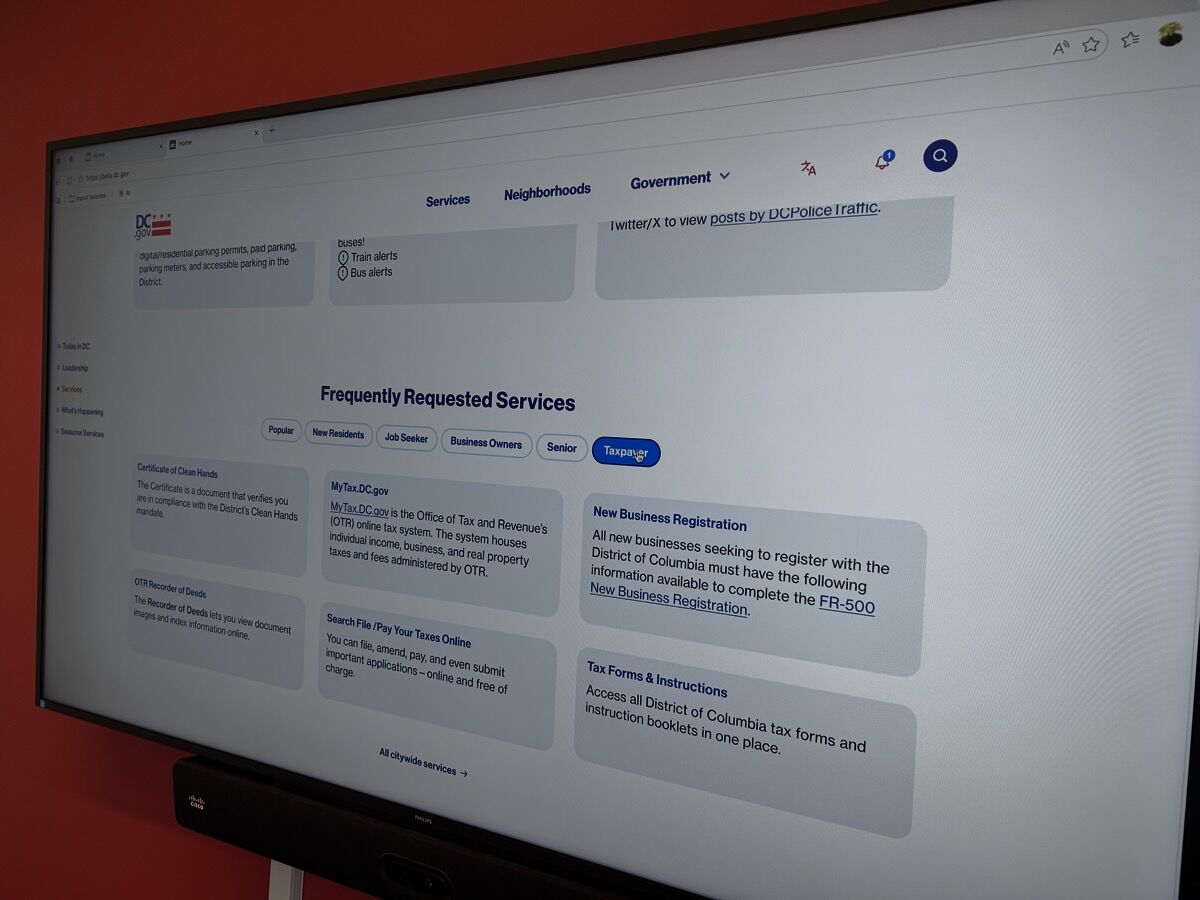
The overhaul is the first in more than a decade and comes in response to feedback that it’s hard to find information on the current site without being efficient at using Google or other search tools.
The D.C. government’s website is getting a complete revamp, a step city leaders hope will make it easier for residents, visitors and business owners to access the help they need.
The District unveiled a beta version of the new DC.gov — beta.dc.gov — and plans to have the redesigned site ready to launch before the end of the year.
The website’s overhaul is the first in more than a decade. It comes in response to feedback that it’s hard to find information on the current site without being efficient at using Google or other search tools.
“This website, it’s really going to eliminate the alphabet soup that you have to remember every day,” said Stephen Miller, the District’s chief technology officer. “So, do you need to know that it’s DPW that’s picking up your trash, or you just need to know that it’s dc.gov?”
The site is built on Drupal 11, which the city said has stronger built-in security features. It includes an integrated calendar and sections for seasonal government services.
Popular searches, based on site traffic data, will also be featured prominently on the main page.
“It’s going to show you, here’s popular services today, based on being a resident, based on being a new resident, based on being a job seeker, based on being a business owner, or based on just being a general resident of the city,” Miller said.
The project cost about $500,000 in dedicated funds.
“We’re setting this up so that you can just go in, say, ‘My trash was missed,’ and it’s going to tell you exactly how to fix that problem,” Miller said.
D.C.’s Office of the Chief Technology Officer is collecting feedback. Residents can leave comments on the beta site and at events at Haynes Senior Wellness Center and Eastern Market, among others, in the coming weeks.
An artificial intelligence-powered search tool, built using Google’s AI technology, will be included on the new DC.gov site after its official launch.
The District, Miller said, is “trying to clean up our content, because what we want to make sure is when we put AI into this site, it’s giving you the right information.”
“We see a lot of future use with AI,” Miller said. “I’d love to get to a point where it’s, ‘Hey Siri, renew my driver’s license,’ and we’ve laid out the foundation for something like that to happen in the future.”
Get breaking news and daily headlines delivered to your email inbox by signing up here.
© 2026 WTOP. All Rights Reserved. This website is not intended for users located within the European Economic Area.

A 16-day state fair is among the biggest attractions of the country’s 250th celebration in Washington DC. The Great American State Fair, which features attractions from each of the 50 states, runs from 25 June to 10 July across the National Mall from the US Capitol to the Washington Monument.
The BBC asked visitors why it was important for them to attend the fair.
Video by Meiying Wu
Produced by Madeline Gerber
-

 Pennsylvania22 seconds ago
Federal government sues Pennsylvania, others over SNAP data
-

 Rhode Island3 minutes ago
Target 12: State of RI’s fire hoses
-

 South-Carolina8 minutes ago
Mississippi State baseball lands Will Craddock, South Carolina transfer infielder
-

 South Dakota15 minutes ago
South Dakota Republicans reject censuring John Thune over stalled SAVE America Act
-

 Tennessee18 minutes ago
Flood watch in effect for Middle Tennessee: 2-3″ of rain expected Saturday
-

 Texas23 minutes ago
Texas state school board approves mandated reading list including Bible passages
-

 Utah30 minutes ago
Utah, Salt Lake County awarded grants for community cleanup
-

 Vermont33 minutes ago
West Rutland man dies in hit-and-run, police seek vehicle

