Florida
Razor-clawed carnivorous invasive reptiles spreading in South Florida pose bigger threat than iguanas, officials say


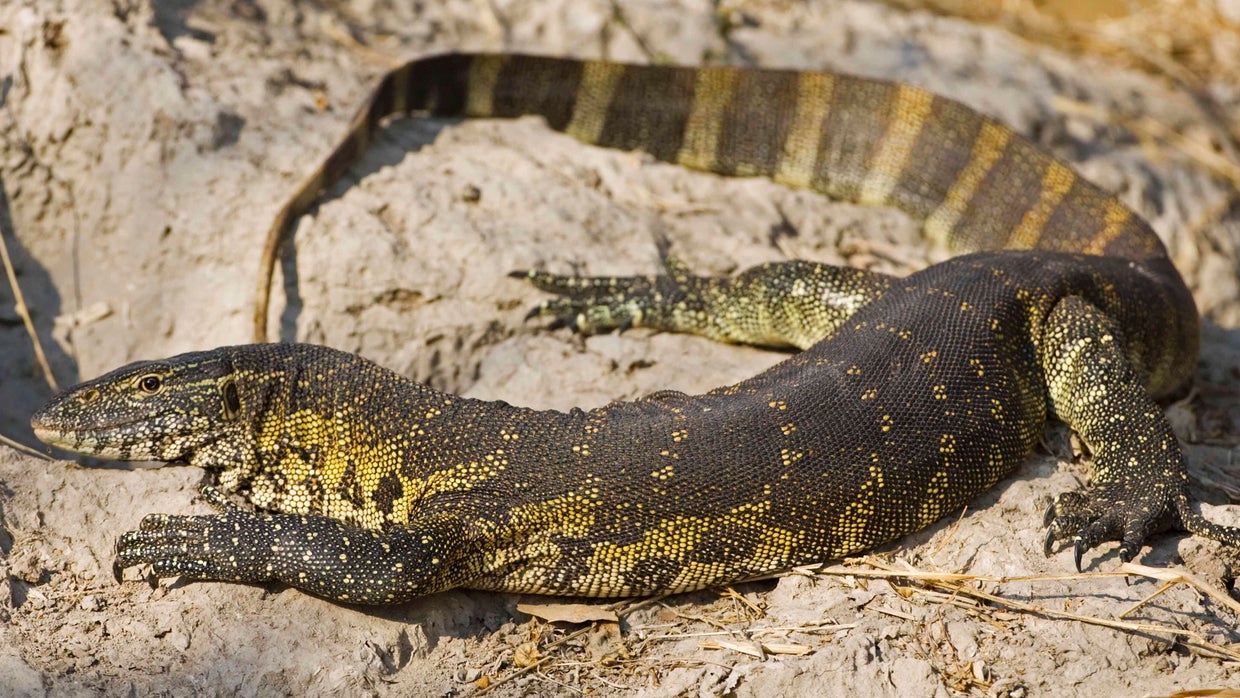
They swim with paddle-like tails, climb trees using hooked claws and hunt on land. Nile monitor lizards, powerful carnivores that can grow longer than six feet, are spreading through South Florida, earning a reputation from wildlife officials as one of the most dangerous invasive reptiles in the state.
Data show sightings have grown significantly in recent years, particularly in the Florida Peninsula, where entire neighborhoods in Cape Coral are now considered their established habitat.
According to EDDMapS data, Lee County, in the Tampa Bay area, leads the state with 1,616 reported sightings, followed by Palm Beach County with 299, Miami-Dade with 76, and Broward with 68.
The Florida Fish and Wildlife Conservation Commission classified the Nile monitor as an invasive species and added it to Florida’s Prohibited species list in April 2021.
Where do Nile monitors come from? And how did they get to Florida?
The Nile monitor is a semi-aquatic lizard native to sub-Saharan Africa. It is the largest lizard species in Africa, and according to the U.S. Geological Survey, the largest and most dangerous non-native lizard established in the United States.
Adults can stretch more than 7.5 feet long and weigh over 20 pounds, according to USGS. FWC said a typical adult in Florida averages about 5 feet and roughly 15 pounds.
They’re olive green to black with yellow striping on the head and jaw. Their tails are long and flattened like a paddle, which experts say helps them swim. They can stay underwater for 12 to 15 minutes and are just as comfortable climbing trees as they are moving through canals.
USGS said they’re also smart, adaptable and highly mobile, traits that make invasive species especially difficult to control.
In Africa, Nile monitors are found throughout much of the continent, especially near rivers, wetlands and lakes.
In Florida, wildlife officials believe most populations stem from the pet trade.
According to FWC and USGS, monitors likely arrived through escaped or intentionally released pets. They can break out of cages using their claws or push open enclosures. Some may have escaped during hurricanes that damaged reptile facilities. Others may have been released when they became too large or difficult to handle.
Once established near canals and waterways, they found ideal habitat. South Florida’s extensive canal system essentially acts like a highway network for a semi-aquatic reptile, experts say.
Why are Nile monitors considered dangerous?
Nile monitors are powerful wild predators that are generally not aggressive toward people unless cornered, wildlife experts said.
FWC described them as “generalist feeders,” meaning they eat almost anything they can overpower. That includes fish, frogs, turtles, snakes, birds and their eggs, small mammals and even young crocodiles.
Because they raid nests, they pose a risk to protected species such as sea turtles, gopher tortoises, burrowing owls and the American crocodile, according to FWC and USGS.
USGS noted their size and defensive behavior make them potentially dangerous to pets and, if cornered, to humans. They can bite with strong jaws, slash with sharp claws or whip their muscular tails.
FWC warned residents not to attempt to capture them.
In Cape Coral, where the largest known population exists, residents have reported monitors digging burrows along canal banks and roaming residential streets.
“There are a lot of invasive monitors, especially in our neighborhood,” Cape Coral resident Jack Schwartz told local television station WZVN on Feb. 20.
Alane Passero described one running inside her home.
“[Out of the] corner of my eye, I see this huge monster running in my house straight to the back door. The nails are clacking on the floor. I’m screaming my head off,” she said.
Florida Nile monitors vs. green iguanas
South Florida residents are used to seeing green iguanas, especially after cold snaps. But Nile monitors are a different animal.
Green iguanas are mostly plant-eaters. Nile monitors are carnivores that actively hunt vertebrate prey.
Monitors are bulkier, with longer necks, narrower snouts and thicker, more muscular tails. They also have a blue tongue, a distinctive trait noted by USGS.
And while iguanas can grow large, no native or commonly seen lizard in Florida approaches the Nile monitor’s size and strength.
Where are Nile monitor sightings growing the most in Florida?
According to EDDMapS:
- Lee County: 1,616 sightings
- Palm Beach County: 299
- Miami-Dade: 76
- Broward: 68
USGS stated the species is firmly established in Lee County and spreading into Charlotte County. FWC confirmed established populations in Lee and Palm Beach counties, with additional reports across South Florida.
Recent confirmed sightings include:
- Cape Coral in Lee County, Aug. 7, 2025
- Boynton Beach in Palm Beach, Sept. 10, 2025
- Broward, Jan. 16, 2024
- Miami-Dade, Nov. 19, 2021
While some counties report isolated individuals, experts caution that single sightings should not automatically be dismissed as escaped pets.
Can Florida stop the spread of Nile monitor lizards?
Florida wildlife experts say full eradication is no longer considered feasible, according to USGS and researchers at the University of Florida.
FWC actively removes Nile monitors from known populations and encourages residents to report sightings through the IveGot1 app or by calling 888-483-4681.
The reptiles can be humanely killed on private property without a permit. The City of Cape Coral operates a local trapping program, and federal partners manage populations at Homestead Air Reserve Base.
For now, wildlife officials say early reporting is key.
And for South Florida residents, the message is simple: if you see what looks like a small dinosaur near your canal, don’t approach it — take a photo and call it in.



Push for Elevate Florida funding
Almost two years after Hurricane Helene, some people are still waiting to get back into their homes. They’ve been on hold waiting for help from the Elevate Florida program. FOX 13’s Kylie Jones reports.
ST. PETERSBURG, Fla. – Some homeowners in St. Pete are still waiting for funding to raise their home after it flooded during Hurricane Helene.
One couple is still waiting for an update on their application to the Elevate Florida program — after about a year with no progress.
PREVIOUS: Thousands denied in first round of Florida’s new home elevation program
Elevate Florida program delays
What we know:
Jason and Carrie Nash’s home in Shore Acres had about four feet of water inside after Hurricane Helene. It solidified their decision to raise their home.
The Florida Division of Emergency Management opened the Elevate Florida program following Helene. The program is expected to cover approximately 75% of the costs to lift homes using federal grant money from FEMA. The homeowner would be expected to cover the remaining 25% of the cost.
The couple applied to the program and received an email last summer from Elevate Florida, saying the state had sent their application to FEMA for further review. Jason Nash says in November, they still hadn’t heard anything.
Mixed reactions as Shores Acres awaits ‘Elevate Florida’ decisions
He says they got an email from Elevate Florida in March, explaining that FEMA processing has been repeatedly delayed by factors outside the control of the Florida Division of Emergency Management and Elevate Florida. Last week, Pinellas County state lawmakers signed a letter to congressional leaders, calling on them to urge federal agencies to expedite the grant approval process.
“To put some more staffing, expedite the awards of these programs,” Rep. Lindsay Cross said.
Cross says that because the grant money being awarded is coming from federal funding, they don’t have direct control at the state level.
“Once that award comes, there’s still the stages of designing and permitting and getting people temporary housing in some cases,” she said.
According to the Elevate Florida website, federal grant requirements added extra review steps in June of last year, which could impact the timeline of the program.
St. Pete housing gridlock
What they’re saying:
Nash and his wife haven’t been able to live in their home for almost two years. The couple has been renting, while they wait to hopefully get awarded a grant from Elevate Florida.
“We not only have double rent, double bills, double everything, but on top of that, we’re paying for a storage unit to house all of our belongings in,” Nash said.
Nash says he’s reached out to leaders on the local, state and federal level, but feels like he isn’t getting answers.
“The worst thing that somebody can tell you in life is ‘Maybe’, because it still gives you hope,” he said. “And that’s all we’re getting, is ‘Maybes.’”
Stalled federal grant awards
What we don’t know:
It remains unclear exactly when FEMA will finalize the remaining applications. Nash says they received an email from Elevate Florida last week, saying 16 projects had been awarded funding, and that FEMA was continuing to award grants and would update homeowners.
FOX 13 reached out to the Florida Division of Emergency Management and is waiting for a response.
The other side:
On Monday night, a FEMA representative shared the following statement:
“FEMA obligates Hazard Mitigation Grant Program funds to the state, not homeowners directly. Elevate Florida is a state-managed mitigation program. Questions should be sent to the Florida Division of Emergency Management.”
FEMA also directed people to its latest updates on funding awarded in Florida here.
The Source: The information in this story was gathered from an interview with a St. Pete homeowner, an interview with Rep. Lindsay Cross, a letter written by state representatives from Pinellas County, the Elevate Florida website and a statement from FEMA.

A 40-year-old man accused of using an AR-style rifle to threaten another man in a Wawa parking lot was arrested, according to a recently-obtained affidavit.
Jeremy Vigil, of the 700 block of Southwest Estate Avenue in Port St. Lucie, was arrested June 15 on aggravated assault with a deadly weapon and battery charges after the incident at a Wawa at Southwest Becker Road and Southwest Port St. Lucie Boulevard.
A man about 10 p.m. June 15 told Port St. Lucie police that he and Vigil completed a job together the weekend before, and Vigil was angry about payment.
The man said Vigil contacted him, telling him to meet with his money. He arrived at Wawa and met Vigil, with their vehicles positioned window to window.
He described Vigil as “extremely angry,” and accused Vigil of pointing an AR-style rifle out of his truck at him.
“I’m a gangster (expletive),” Vigil is quoted as saying. “I’ll (expletive) kill you.”
The man said Vigil’s son was in the truck, and tried to get the rifle away from his father.
The man reportedly tried to record the encounter on his phone but said Vigil knocked the phone from his hand.
The man said he drove off and circled around to get his phone from the ground near the air pumps.
Ultimately, he said Vigil approached again without the rifle. Vigil reportedly “prevented him from leaving by chest-bumping (the man’s) vehicle.”
Vigil and the man got in a physical altercation near the gas pumps. Vigil then is accused of chasing the man into Wawa and yelling before leaving the scene.
Police viewed video surveillance of the incident.
Police reported they couldn’t definitively see a firearm in the video, noting the quality of the footage and distance away made it difficult.
The store manager told investigators it was the third incident involving Vigil at the location.
Police went to Vigil’s home, and he finally came outside after officers used a public address system and made a number of phone calls.
Vigil allowed officers to search his home, and they reported finding an AR-style rifle inside a safe.
Vigil initially denied the allegations.
Parts of the affidavit that appear to contain some of Vigil’s statements with police were redacted.
Vigil was taken to the St. Lucie County Jail, but it couldn’t immediately be determined June 22 whether he’d been released on bond. Attempts to reach the booking desk via phone were unsuccessful.
Will Greenlee is a breaking news reporter for TCPalm. Follow Will on X @OffTheBeatTweet or reach him by phone at 772-267-7926. E-mail him at will.greenlee@tcpalm.com.

Cape Coral has one. So do Fort Myers, Bonita Springs and Naples.
And now it’s Fort Myers Beach’s turn to get its very own food truck park.
Access 26 Family Food Truck Park is expected to open early next year at 2500 Estero Blvd. and Beach Access 26. On June 8, Stevens Construction broke ground on the project, which will highlight five yet-to-be-announced food trucks, all with unique menus.
And there’s more. A bar with covered seating, Manny’s Scoops ice cream and retail area will be featured in a two-story, 3,000 square-foot structure. Storage, office space, restrooms, coolers, a freezer and a dumbwaiter system for beer kegs and supplies will take up the second floor.
A 569-square-foot comfort center with restrooms, storage and three outdoor showers is also planned, along with a curbside table rail, artificial turf play area, three shade canvas structures, guest parking lot and beach access.
And it’s designed with storms and hurricanes in mind — the building’s generator and mechanical equipment will be above flood level, metal flood panels and waterproof walls will help with storm surge and flooding, and the foundation’s design lets water flow through more easily.
Southwest Florida’s expanding food truck scene
Access 26 is the latest food truck park to join Southwest Florida’s growing eatertainment scene. Slipaway Food Truck Park & Marina opened a year ago on July 4 with food trucks, a large covered central bar, live music daily and more in Cape Coral.
Bay Street Yard first brought its vibrant food and entertainment concept to downtown Fort Myers in May 2024, while Backyard Social debuted its food trucks and family-fun daytime and 21-and-up nightlife format in south Fort Myers in October 2023.
Bonita Springs welcomed Rooftop at Riverside’s two-story, two-bar (one on the rooftop) open-air venue with food trucks in January 2024.
Naples’ Celebration Park — a waterfront destination with gourmet food trucks, bar and live music — led the way, opening in November 2018.
Robyn George is a food and dining reporter for The News-Press. Connect at rhgeorge@fortmyer.gannett.com
Please support local community journalism and stay informed about Southwest Florida news by subscribing to The News-Press and Naples Daily News; download the free News-Press or Naples Daily News app, and sign up for daily briefing email newsletter, food & dining and growth & development newsletters here and here.
-

 Montana40 seconds ago
Man Driving Giant Banana Gets Pulled Over in Montana
-

 Nebraska3 minutes ago
‘No room for error’: UNMC reflects as quarantine ends for hantavirus cruise ship passengers
-

 Nevada9 minutes ago
2 men with ties to Kansas City mob may be removed from Nevada’s ‘Black Book’
-

 New Hampshire16 minutes ago
Three seriously injured in head-on crash on I-293 in Hooksett, N.H. – The Boston Globe
-

 New Jersey16 minutes ago
Cothren Helping Build a More Inclusive Hockey Community | FEATURE | New Jersey Devils
-

 New Mexico24 minutes ago
Bear Fire Update for June 23, 2026
-

 North Dakota34 minutes ago
Timothy Paul Ganyo
-

 Ohio39 minutes ago
GALLERY: Photos of former Ohio State football coach Jim Tressel

