South Dakota
‘Once-in-a-generation’ announcement to include details about Smithfield’s Sioux Falls pork facility


A major announcement Monday by Sioux Falls Mayor Paul TenHaken and Gov. Larry Rhoden is expected to include details about Smithfield Foods, The Dakota Scout has confirmed.
Monday’s announcement at the Canopy by Hilton is being billed by the city as a “once-in-a-generation opportunity.”
“People across the country will be paying attention to this defining moment in Sioux Falls and South Dakota,” the city said in a press release Friday.
Smithfield employs more than 3,100 people and is the fourth largest employer in the city behind Sanford Health, Avera Health and the Sioux Falls School District. The company has owned the pork processing facility since its purchase from the John Morrell & Co. in 1995. The original Morrell plant opened in 1909.
Smithfield sits on approximately 80 acres near Falls Park. In December, the city unveiled a proposed master plan for Falls Park that would make improvements and changes at the park over the course of the next three decades.
The presentation included the acquisition of more land next to Smithfield for an urban fishery. But Smithfield itself remained on the presentation slides.
“It takes decades for these sort of large grand visions to be established,” Mike Patten, the Parks Department planning and projects manager told the City Council. He noted that the current features at Falls Park were planned back in the 1990s.
Smithfield made news in January with its purchase of Nathan’s Famous, which makes all-beef hotdogs. Smithfield, based in Virginia, is a subsidiary of the world’s largest pork producer. Smithfield had held the exclusive license to manufacture, distribute and market Nathan’s Famous hotdogs, sausages, and corned beef in the United States and Canada.
Smithfield paid $450 million for all issued and outstanding shares of Nathan’s.
“The Nathan’s Famous acquisition is a meaningful step in the progression of Smithfield Foods allowing us to own all of the top brands in our packaged meats portfolio and unlock new growth opportunities for our largest segment,” said Smithfield President and CEO Shane Smith. “Since entering into our licensing agreement in 2014, we have made significant investments to build and grow the Nathan’s Famous brand. With our manufacturing scale, marketing strength, product innovation capabilities, and retail and foodservice channel expertise, acquiring Nathan’s Famous will allow us to take the brand to new heights.”
According to Securities and Exchange Commission filings, the Sioux Falls plant has been a historical manufacturer of Nathan’s hotdogs.
Besides its pork processing plant, Smithfield also owns nine farms in South Dakota, the company reported in its most recent annual report filed with the Securities and Exchange Commission.
The company also warned in the report that proposed regulations by the Environmental Protection Agency could require investments into wastewater treatment systems at plants including Sioux Falls. The EPA was considering more stringent Effluent Limitrations Guidelines for meat processing facilities.
“Significant upgrades related to our direct and indirect wastewater discharge streams, including to treatment systems at our Sioux City and Denison, Iowa, Sioux Falls, South Dakota and Tar Heel, North Carolina centers, would be required to meet the standards as proposed, which we estimate would require material capital expenditures in the aggregate,” the company wrote in its annual report.
TenHaken and Rhoden will be joined by state and local business leaders.
This story was originally published on
TheDakotaScout.com.
______________________________________________________
This story was written by one of our partner news agencies. Forum Communications Company uses content from agencies such as Reuters, Kaiser Health News, Tribune News Service and others to provide a wider range of news to our readers. Learn more about the news services FCC uses here.



The South Dakota Lottery offers multiple draw games for those aiming to win big.
Here’s a look at June 22, 2026, results for each game:
Winning Powerball numbers from June 22 drawing
17-19-21-45-48, Powerball: 13, Power Play: 2
Check Powerball payouts and previous drawings here.
Winning Lotto America numbers from June 22 drawing
12-13-35-41-52, Star Ball: 05, ASB: 02
Check Lotto America payouts and previous drawings here.
Winning Millionaire for Life numbers from June 22 drawing
07-08-20-24-42, Bonus: 05
Check Millionaire for Life payouts and previous drawings here.
Feeling lucky? Explore the latest lottery news & results
Are you a winner? Here’s how to claim your prize
- Prizes of $100 or less: Can be claimed at any South Dakota Lottery retailer.
- Prizes of $101 or more: Must be claimed from the Lottery. By mail, send a claim form and a signed winning ticket to the Lottery at 711 E. Wells Avenue, Pierre, SD 57501.
- Any jackpot-winning ticket for Dakota Cash or Lotto America, top prize-winning ticket for Lucky for Life, or for the second prizes for Powerball and Mega Millions must be presented in person at a Lottery office. A jackpot-winning Powerball or Mega Millions ticket must be presented in person at the Lottery office in Pierre.
When are the South Dakota Lottery drawings held?
- Powerball: 9:59 p.m. CT on Monday, Wednesday, and Saturday.
- Mega Millions: 10 p.m. CT on Tuesday and Friday.
- Lucky for Life: 9:38 p.m. CT daily.
- Lotto America: 9:15 p.m. CT on Monday, Wednesday and Saturday.
- Dakota Cash: 9 p.m. CT on Wednesday and Saturday.
- Millionaire for Life: 10:15 p.m. CT daily.
This results page was generated automatically using information from TinBu and a template written and reviewed by a South Dakota editor. You can send feedback using this form.


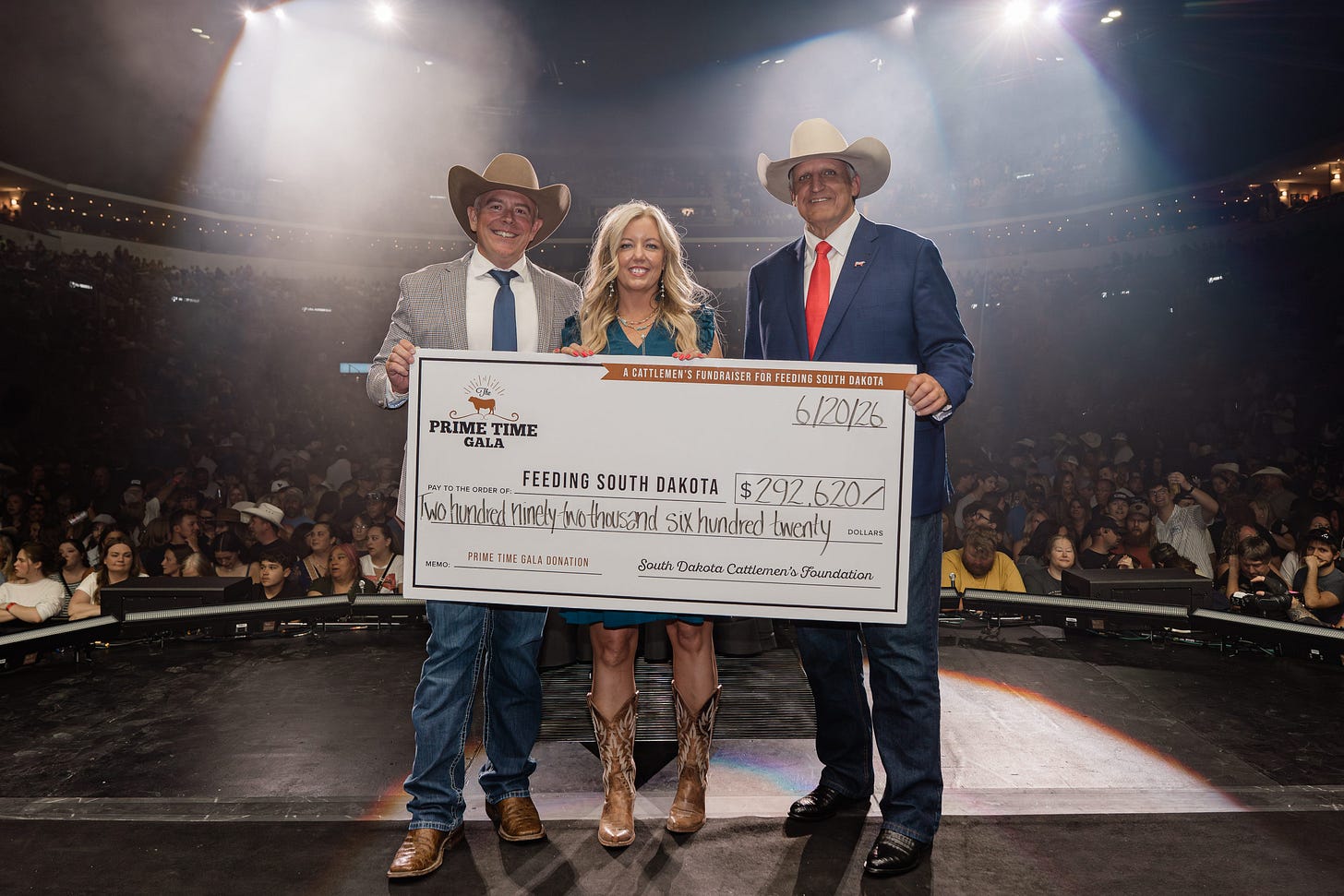
At the South Dakota Cattlemen’s Foundation’s 13th annual Prime Time Gala on Saturday, June 20, 2026, the point of the evening was never far from view: beef, music, scholarships and fundraising all tied back to getting high-quality protein to South Dakotans who need it.
Held at the Sioux Falls Convention Center and Denny Sanford PREMIER Center complex, the Prime Time Gala again brought together cattle producers, agricultural businesses, community supporters and Feeding South Dakota for an upscale dinner, auction program and country concert. The evening opened with a prayer from Ray Larson before moving into the program, awards and live auction.
“Success boils down to one thing, and that’s to all of you who are with us tonight,” foundation leadership told the crowd, framing the event as a collective effort by ranchers, cattle feeders, donors, volunteers and businesses across the state.
Viewpoints
VIEWPOINT | Don’t blame voters for lack of trust in South Dakota politics: Look in mirror

Too much of today’s political conversation revolves around personalities, endorsements and internal political scorekeeping. We argue about who is conservative enough, who is endorsed by the right people, who is supported by the right organizations and who belongs to the right political tribe. While politicians and activists debate those questions, many ordinary voters are simply asking who is focused on solving problems and improving their communities.




See Macy Bryant talk about her cycle, Jefferson softball’s 5-0 start
Sioux Falls Jefferson’s Macy Bryant talks about her cycle against St. Louis Park (MN) and her team’s undefeated start to their state title defense.
The South Dakota High School Activities Association’s fourth year sponsoring softball is in the books, and there were plenty of standout performers during this season.
From Class AA to B, teams made leaps thanks to some top-tier players and were able to place at the state tournament because of them.
Here is the first Argus Leader Starting 9, comprised of athletes from all three classes. They are broken down positionally, with a pitcher, a catcher, four infielders and three outfielders making up the team.
The players are listed in positional order.
Statistical key: IP-innings pitcher, K-strikeouts, ERA-earned run average, WHIP-walks and hits per inning pitched, K/7-strikeouts per seven innings, H/7-hits allowed per seven innings, BB/7-walks allowed per seven innings, AVG-batting average, OBP-on-base percentage, SLG-slugging percentage, OPS-on-base plus slugging, 2B-doubles, 3B-triples, HR-home runs, RBI-runs batted in, R-runs scored, SB-stolen bases
P: Tya Devericks, Jr., Sioux Falls Jefferson
80 IP 112 K 0.88 ERA 0.76 WHIP 9.8 K/7 4.1 H/7 1.3 BB/7
.514 AVG, .590 OBP, 1.000 SLG, 1.590 OPS, 10 2B 3 3B 6 HR 32 RBI 16 R 6 SB
Devericks dominated both in the circle and at the plate, but she put together one of the more impressive pitching seasons imaginable. The South Dakota commit helped Sioux Falls Jefferson allow just 1.2 runs per game, go undefeated and win the Class AA state championship with her dominance, commanding multiple pitches in and around the zone.
“The best part of Tya is her competitive instincts,” Jefferson head coach Ed Whiting said. “This drives everything that she does, and others follow. Outside of being an absolutely dominant pitcher, she is an elite hitter which makes her an outstanding two-way player. Tya has been voted a team captain since her sophomore year. This is due to her strong ability to lead by example on the diamond, in the weight room and in the community.”
C: Claire Loofbourrow, Jr., Freeman/Marion/Freeman Academy
.612 AVG, .634 OBP, 1.328 SLG, 1.962 OPS, 17 2B 2 3B 9 HR 50 RBI 16 R 8 SB
Loofbourrow was one of the top run producers in the state, with her 50 RBIs leading all members of this team. She helped Freeman/Marion/Freeman Academy earn the upset over No. 3 Deuel in the SoDak 16 and finish fifth in the Class B state tournament. She has one more year left in high school, and any more improvement will put her stats in rare air nationally.
“She’s got a pretty good arm for a catcher,” Freeman/Marion/Freeman Academy head coach Kyle Weier said. “But where she’s most beneficial is when she’s got a bat in her hand. She is really solid and always makes contact. She takes a hard swing, so when she makes contact the ball goes and then she’s pretty fast. That’s how it’s always an extra base hit.”
INF: Macy Bryant, Sr., Sioux Falls Jefferson
.784 AVG, .804 OBP, 1.595 SLG, 2.399 OPS, 20 2B 8 3B 8 HR 41 RBI 56 R 16 SB
Bryant put together one of the most special seasons in the nation, with her .784 batting average sitting in the top 10 and her on-base percentage and slugging percentage are both in the top 50. She was also a terrific defender for the unbeaten state champs. Bryant will be going to South Dakota State next year, and she could be a major contributor if this hot stretch continues through the summer and fall.
“Macy is dominant at the plate,” Whiting said. “The problem with pitching to Macy is there is not a pitch that catches a fraction of the plate that she can’t hit hard. The problem with walking her is that other teams have to deal with her aggressive approach on the bases. When on base, which happens eight out of 10 times, she typically ends up touching home. She is a complete player as she has a cannon of an arm and amazing range that makes her hands down the best shortstop in the state.”
INF: Brooklyn Herrera, Sr., Sioux Falls Jefferson
.577 AVG, .595 OBP, .901 SLG, 1.496 OPS, 7 2B 2 3B 4 HR 32 RBI 27 R 7 SB
Herrera was one of the steadiest players in the state on both sides of the ball. She was a middle-of-the-order bat on South Dakota’s best team and was always a threat, even if the power production wasn’t as prolific as others. Add in that Herrera was a very good defender, and she’s more than deserving of making the cut.
“Brooklyn shows up and works downhill at all times,” Whiting said. “Playing the hot corner, her instincts do not let anything get by her. She is a consistent player who rises to the occasion when the stakes are the highest. Whether it’s locking down third base or driving in runs from the cleanup spot, Brooklyn always delivers.”
INF: Kennedy Kokenge, Jr., Harrisburg
.531 AVG, .597 OBP, 1.203 SLG, 1.800 OPS, 4 2B 3 3B 11 HR 37 RBI 28 R 1 SB
Kokenge is one of the most powerful bats in South Dakota, ripping 11 home runs to finish second statewide. The South Dakota State commit provided consistent on-base skills when she wasn’t launching the ball over the fence for the top-scoring offense in Class AA. Kokenge also mixed that with the smoothness to play a quality shortstop for Harrisburg.
“Kennedy Kokenge possesses all the tools of a premier infielder,” Harrisburg head coach Keith Flemmer said. “She has exceptional range, the ability to get to nearly any ball and the arm strength to make throws from anywhere on the field. Combined with one of the quickest and smoothest glove-to-hand transfers I’ve ever seen, she makes difficult double plays look routine. At the plate, Kennedy is equally impressive. She batted .531 this season while tying the team record with 11 home runs. She also struck out just once all year, showing how powerful and consistent she is.”
INF: Kjerstin Kyte, So., Sioux Falls Washington
.535 AVG, .638 OBP, .887 SLG, 1.525 OPS, 6 2B 5 3B 3 HR 28 RBI 43 R 18 SB
Kyte was the engine for a Sioux Falls Washington team that made the Class AA state championship game for the second year in a row. The sophomore had to anchor the offense as the leadoff hitter and the defense as the shortstop. She has two years left to help the Warriors get over the hump and win their first softball state title.
“There are many things that make Kjerstin special,” Washington head coach Kim Bazata said. “For starters, she’s a great competitor. On the rare occasion she makes a mistake in the field, the pitcher better watch out because she is making up for it with her bat. She is constantly stepping up to make things happen for our team. It could be a diving play or an extra base hit. She’s definitely our spark plug. She is very tough to defend at the plate as well. She can hit one over the fence or beat out a bunt. Always a tough out.”
OF: Cydni Kudrna, Jr., Castlewood
.627 AVG, .689 OBP, 1.173 SLG, 1.862 OPS, 10 2B 8 3B 5 HR 37 RBI 36 R 7 SB
Kudrna moved to the leadoff spot for Castlewood this season and flourished as the table-setter. She ripped off 23 extra base hits and helped the Warriors slug their way to the Class B state championship. Kudrna also stepped up as a leader and led Castlewood to its second state title.
“Cydni is a very determined, focused person,” Castlewood head coach Craig Horn said. “We talked with her at the beginning of the year about staying focused throughout the whole game and she increased her batting average by 200 points this year. She clicked all season long. Besides being an incredible talent, she’s a great leader. She would put in the most work at practice and stay after to help the younger kids.”
OF: Kassidy Smith, Jr., Sioux Valley
.537 AVG, .642 OBP, .805 SLG, 1.447 OPS, 7 2B 6 3B 1 HR 26 RBI 43 R 13 SB
Smith spent the first half of the year bouncing around positionally, but she stuck in the outfield in the back half and shined in all phases of the game. She led off and consistently populated the bases for the middle of Sioux Valley’s order, which knocked her in a ton. Smith has one more year to add even more juice to her offensive profile and become one of the top players in the region.
OF: Josalyn Traupel, So., McCook Central/Montrose
.613 AVG, .663 OBP, .838 SLG, 1.501 OPS, 11 2B 2 3B 1 HR 44 RBI 38 R 8 SB
Traupel broke out as a sophomore in a potent McCook Central/Montrose lineup. The Fighting Cougars led Class B in runs scored per game, and a lot of that was because of the sophomore’s ability to deliver with runners on. She, like Smith, can add a little more pop to her bat as she ages to become a truly feared hitter.
“Josalyn has made tremendous strides this season, particularly in the outfield where her confidence and consistency have taken a major leap forward,” McCook Central/Montrose head coach Nick Morrison said. “She approaches every play with confidence, energy and a strong desire to make the next play. Josalyn’s growth, production and competitive mindset have made her an invaluable part of our team. Her ability to impact the game both defensively and offensively sets her apart.”
-

 San Francisco, CA11 minutes ago
Where to watch Athletics vs San Francisco Giants: TV channel, start time, streaming for June 23
-

 Dallas, TX14 minutes ago
Dallas Man Convicted of Distributing Fentanyl
-

 Miami, FL19 minutes ago
Fiery, fatal crash shuts down southbound lanes of Don Shula Expressway in southwest Miami-Dade
-

 Boston, MA26 minutes ago
Editorial: With Boston’s World Cup win, could we host Olympics?
-
 Denver, CO34 minutes ago
When falling housing prices are good news — and when they’re not
-

 Seattle, WA41 minutes ago
Storm edged by Dallas Wings 112-110 in overtime heartbreaker
-

 San Diego, CA44 minutes ago
Who’s playing in the World Cup today? TV schedule for June 23
-
 Milwaukee, WI49 minutes ago
Milwaukee residents react to Giannis Antetokounmpo’s legacy before trade goes through

