Business
Rivian finds a way to shine even as the EV market struggles in the dark


Rivian shocked the market with strong earnings results, proving itself an outlier in the electric vehicle market, which has been struggling with the end of government subsidies and cooling consumer excitement.
The shares of the Irvine-based high-end EV manufacturer skyrocketed 27% on Friday after it announced stronger-than-expected results, indicating that, after years of struggling with losses, it may have at last found a path to profitability.
On Thursday, Rivian reported gross profits for 2025 of $144 million, compared with a net loss in 2024 of $1.2 billion.
In its earnings release, Rivian credited the swing to gross profit to “strong software and services performance, higher average selling prices, and reductions in cost per vehicle.”
Last October, it laid off roughly 600 employees, more than 4% of its workforce.
Rivian delivered 42,247 vehicles in 2025 and produced 42,284 vehicles. The company still reported a $432-million net loss for the year for automotive profits, an improvement from 2024.
“It’s a turnaround for the ages,” said Dan Ives, an analyst with Wedbush Securities. “The past few years have been very frustrating for investors.”
Rivian was founded in Florida in 2009 and made its initial public offering in 2021. It competes with Tesla and other automakers selling all-electric vehicles for a premium price.
Following the expiration in September of the $7,500 federal tax credit for new electric vehicles, companies have been under pressure to offer lower sticker prices. Last year, Tesla launched new variations of the Model 3 and Model Y that start at roughly $5,000 less than the more expensive versions of the same models.
Investors said the discounts weren’t enough and the vehicles, still priced above $35,000, remained out of reach for many consumers. There are only a handful of EVs on the market available for under $35,000.
Rivian is banking its future on the success of its own lower-priced R2 model, which is expected to start around $45,000 with deliveries slated to begin this spring.
The least expensive Rivian model available now, the R1T pickup truck, starts at $72,990.
The company has received positive early feedback on its R2 SUV, according to the earnings release.
“It’s incredibly exciting to see the early strong reviews of the R2 pre-production builds, and we can’t wait to get them to our customers next quarter,” Rivian founder and chief executive, RJ Scaringe, said in a statement.
Ives said the popularity of the R2 will be pivotal for Rivian, which laid off nearly 1,000 workers in 2025.
“It’s going to be the epicenter of their success or challenges,” Ives said.
Rivian shares have risen more than 33% over the last year but are down 8% since the start of 2026.
“They’re back on their flight path with still some turbulence in the air,” Ives said. “


The recall of a popular chip brand over salmonella concerns was recently upgraded to the U.S. Food and Drug Administration’s highest level, just ahead of the Fourth of July holiday and countless backyard barbecues.
On June 24, the FDA designated the recall of several varieties of Zapp’s and Dirty brand potato chips as Class I, meaning it’s “a situation in which there is a reasonable probability that the use of or exposure to a violative product will cause serious adverse health consequences or death.”
FDA has classified the following items as Class I:
Zapp’s
- 1.5-ounce Zapp’s Bayou Blackened Ranch Kettle Chips
- 2.5- and 8-ounce Zapp’s Bayou Blackened Ranch Potato Chips
- 1.5- and 8-ounce Zapp’s Big Cheezy Potato Chips
Dirty
- 1.5- and 2-ounce Dirty Brand Salt and Vinegar Potato Chips
- 2-ounce Dirty Maui Onion Chips
- 2-ounce Dirty Sour Cream and Onion Potato Chips
The chips are produced by Utz Quality Foods, LLC, which on April 28 issued a recall after learning “that a seasoning containing dry milk powder, sourced from California Dairies, Inc. and supplied by a third-party supplier, may contain the presence of Salmonella.”
Salmonella can lead to sometimes deadly infections in elderly people, young children and those with weakened immune systems, according to the FDA.
More than 680,000 bags are included in the recall.
Anyone who has these products should not eat them and should discard them immediately.
What to look for
Salmonella is a foodborne illness that can be fatal to young children, pregnant women, older adults and people with weakened immune systems, according to the National Institutes of Health.
Symptoms may develop 12 to 72 hours after infection, according to the FDA.
The FDA said that people with strong immune systems infected with salmonella may experience fever, diarrhea (which may be bloody), nausea, vomiting and abdominal pain. The illness can last four to seven days.
In rare cases, the infection may produce more severe illnesses such as arterial infections, endocarditis and arthritis, the agency added.
What to do if infected
If you contract salmonella, the Centers for Disease Control and Prevention recommends drinking plenty of fluids to prevent dehydration.
The CDC advises consulting a doctor before taking antidiarrheal medicine or antibiotics. If severe symptoms continue after two days, seek medical help, the agency says.
Because those with diarrhea can spread salmonella to others, it’s also recommended to avoid sharing food or preparing meals for others, sexual contact and swimming in public pools, and to stay home while sick.
Times staff writer Jasmine Mendez contributed to this report.

The Minions took over theaters this weekend as Universal Pictures and Illumination’s “Minions & Monsters” won the top spot at the box office, though with a lower-than-expected domestic haul.
The animated movie, which follows the Minions’ takeover of Hollywood, took in $61.4 million in the U.S. and Canada for the five-day Fourth of July holiday weekend, according to studio estimates. That haul was lower than analysts’ expectations for a domestic opening of about $68 million. The movie’s three-day total was $36.4 million.
But the Minions performed well internationally, bringing in about $85 million. In total, “Minions & Monsters” made $159.9 million worldwide on a production budget of about $85 million.
The film is the latest in the powerhouse franchise that began with “Despicable Me” in 2010. Across its previous six installments, the “Despicable Me” and “Minions” franchise has made more than $5.6 billion at the global box office. The last movie, 2022’s “Minions: The Rise of Gru,” made more than $940 million worldwide.
“Minions & Monsters” marks the lowest opening for the franchise. Part of the issue could be timing — the box office can be negatively affected when the Fourth of July lands on a Saturday, said Paul Dergarabedian, head of marketplace trends at Rentrak.
Walt Disney Co. and Pixar’s “Toy Story 5” came in second at the box office this weekend with a domestic three-day gross of $31 million. Angel Studios’ biopic “Young Washington” ($20.8 million), Warner Bros. and DC Studios’ “Supergirl” ($9.6 million) and Universal’s “Disclosure Day” ($6 million) rounded out the top five, according to Rentrak.
The haul for “Minions & Monsters,” coupled with the strong holdover performance of “Toy Story 5,” proved again that family films are making a dent in the summer box office.
“Toy Story 5” has now brought in a total of $764.3 million worldwide, and last month, Universal, Illumination and Nintendo’s “The Super Mario Galaxy Movie” crossed $1 billion at the global box office, becoming the first film of any kind to do so this year.
The rest of the summer theatrical lineup is also expected to bring in audiences and push domestic box office totals closer to pre-pandemic figures. Next week, Disney will release its live-action “Moana,” followed by Christopher Nolan’s “The Odyssey” and Sony Pictures’ “Spider-Man: Brand New Day.”
To date, the summer box office is now about $2.3 billion, a nearly 12% increase compared with the same period a year ago, according to Rentrak data. Compared with pre-pandemic 2019’s numbers, however, it is still down about 7%.
Earlier this year, a widely circulated 15-second AI-generated video of Brad Pitt fighting Tom Cruise on a rooftop sparked outrage across Hollywood. One screenwriter called the cinematic clip “terrifying.” The Motion Picture Assn. demanded the company behind the artificial intelligence tool — Chinese tech giant ByteDance — halt its “infringing activity.”
Despite the uproar, the former majority owner of TikTok has quietly continued to court filmmakers, independent artists and executives who are eager to adopt the AI video generation model called Seedance.
Seedance was launched in the U.S. this spring at a Santa Monica event hosted by a group linked to the Chinese government.
ByteDance began hiring for 100 open roles, signed multiple independent filmmakers and artists and held private conversations about financing AI films. The company threw a lavish caviar party at Cannes and in May hosted panels promoting its cinematic tool at Amazon’s AI on the Lot event in Culver City.
“Like any new technology, Hollywood ultimately has no choice but to react to market realities. And that reality is that the new crop of AI-empowered Hollywood creatives see Seedance as having the most powerful video generator in the market right now,” said Peter Csathy of Creative Media, an entertainment and AI business advisory firm.
Joel Kuwahara, the animation producer on early seasons of “The Simpsons,” echoed Hollywood’s quiet embrace.
“Within the industry, I know that a lot of studios haven’t approved Seedance, but yet with a wink and a nod, they’re allowing Seedance to be used. … It’s kind of like a ‘don’t ask, don’t tell’ kind of a thing,’” Kuwahara told The Times.
ByteDance declined to comment on its U.S. expansion.
The race to build the dominant AI video model has created a fierce rivalry, pitting U.S. companies against the fast-closing Chinese competitors. On the American side, there are Google Veo and startups such as Runway and Luma. OpenAI’s Sora has discontinued its video tool.
The Chinese challengers Seedance, Kling and Alibaba’s HappyHorse have rapidly closed the gap on cinematic realism and have upstaged their American rivals by undercutting them on cost.
According to Artificial Analysis, a company that tracks cost and performances of different AI models, China’s Seedance is currently the most cost-effective and high-quality option compared with U.S. competitors. Seedance costs $9 per minute for video with audio generation, significantly lower than the $24 per minute required by Google’s Veo model.
That makes it an attractive tool for independent filmmakers like Rupert Wainwright, who recently met with Seedance executives at AI on the Lot.
He wants to use the the tool to help make his feature-length film called “Sebastian,” about a Christian saint set in 3rd century Rome. The hybrid AI film will be shot partly on location in Europe and partly generated with artificial intelligence.
“It’s the equivalent to when streaming a movie over the internet onto your TV finally became possible,” Wainwright said.
Kavan Cardoza.
(Kayla Bartkowski/Los Angeles Times)

A scene from “The Chronicles of Bone.”
(Kayla Bartkowski/Los Angeles Times)
In May, Steven Schneider, the producer of “Paranormal Activity,” famous for its handheld grainy footage-style filmmaking, announced “Terrarium,” his first hybrid AI horror production. The film’s director, Jason Zada, said it will be entirely generated using Seedance’s model.
Zada’s filmmaking workflow involves writing, casting, prompting and editing all simultaneously, allowing him to rewrite scripts based on “dailies” generated by AI that day.
He estimates that generating 15 seconds of high-definition video costs only $5.
“We could go from a very detailed outline, very detailed characters and have it be a bit more fluid, because we could regen[erate] as much as we want,” Zada said.
Zada plans to shoot the movie first on a soundstage with real actors and will decide later which parts work better traditionally and what should be done synthetically. He’s a member of the Directors Guild of America and said he will be employing union actors for his hybrid AI film.
Seedance also has continued building ties by offering indie creators, AI-native studios and filmmakers free monthly credits and access to unreleased features. These “tastemakers” beta test its models, offer feedback on what works, and use it for their personal filmmaking projects — which creates corporate brand awareness.
Kavan Cardoza is one such breakout filmmaker. His AI fantasy series, “The Chronicle of Bones,” which uses Seedance, features half a dozen distinct storylines and an ensemble of characters. New episodes, each not more than 30 minutes, are released on YouTube once a month. The solo filmmaker averages 3 million views per episode and has cultivated a YouTube audience of 500,000.
Most filmmakers are tool agnostic, but lately Cardoza has become completely dependent on Seedance, he said, because it solves a persistent problem: maintaining character consistency between shots.

Kavan Cardoza unmasked.
(Kayla Bartkowski/Los Angeles Times)
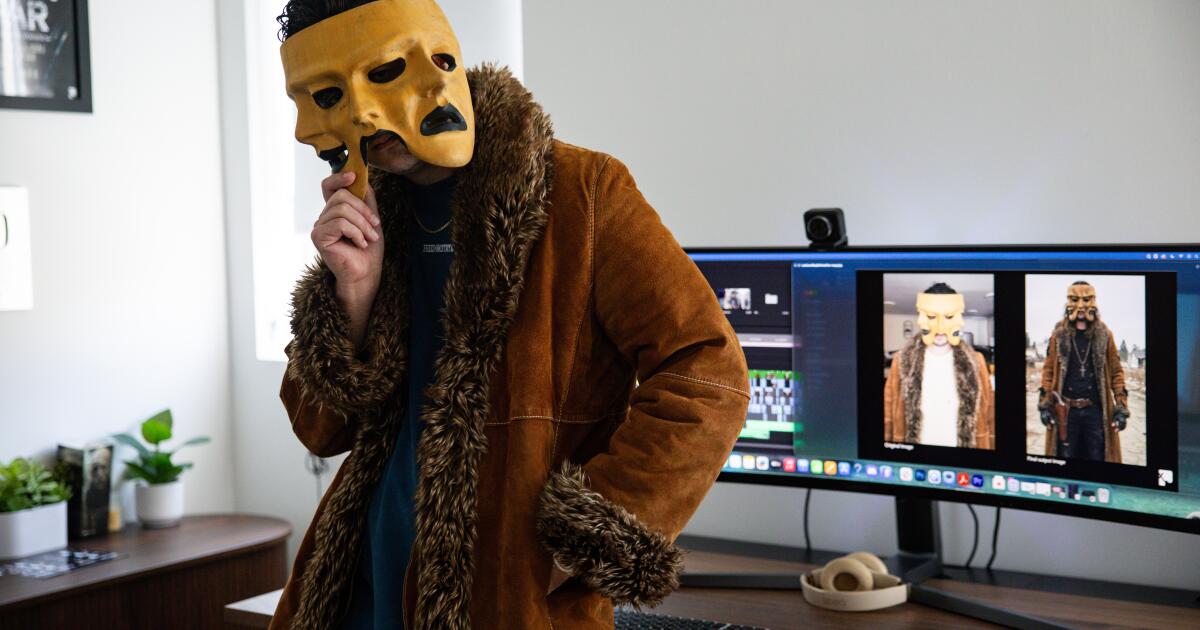
To create one of his characters, “the last lost boy,” Cardoza took self-portraits wearing a three-faced mask and a tattered brown jacket. He used those reference images for the AI character and transforms them into a stylized person, with a personality, backstory and visual details. He fed those images back to Seedance to get consistent characters — repeating the process for each member of the cast.
“I can’t go get Brad Pitt because he costs like $5, 10, 20 million to be in my film,” Cardoza said. “I can probably get a synthetic actor that will act just as good as Brad Pitt in the future. That’s crazy to me.”
Cardoza has copyrighted his script and characters, and aims to eventually attract major studio interest to turn his intellectual property into a film which comes with a built-in fan base.
Such plans are likely to face resistance from the performers union SAG-AFTRA, which has decried the use of synthetic actors such as Tilly Norwood.
“The rise of Seedance comes down to [its] focus on pleasing filmmakers and making things that look filmic,” said Stephan Vladimir Bugaj, senior vice president of JioStar, a joint venture between Disney and India’s Reliance Industries.
ByteDance introduced timeline-based prompting so filmmakers can actually pick specific moments and tweak them, and improved the understanding of camera direction, physics, lighting and fluidity of action. All of this, Bugaj said, “unlocked a kind of spectacle filmmaking that the other models are not delivering quite as well.”
The company’s tool has been in such high demand, Zada said, that Seedance has been quoting some major Hollywood studios $2 million for unrestricted special access.
While acknowledging Seedance’s popularity and its U.S. expansion, Amit Jain, chief executive of Luma, said its ceiling in Hollywood is severely limited. Traditional studios might adopt Chinese models for some preproduction tasks such as concepting, but the geopolitical and intellectual property risks for commercial generations are too prohibitive.
“Can you imagine Disney using the ByteDance model for the next ‘Snow White’? No way,” Jain said. “This is not even a technical argument, really. That’s the reality.”
Luma has been making inroads into Hollywood selling its software but has separately funded a production service company to teach filmmakers to make hybrid AI films using its tools.
Despite conservative production budgets, AI spending by media companies is projected to grow from $2.6 billion to $12.5 billion from 2024 to 2029, according to a State of Generative AI Media report.

Kavan Cardoza flips through pages of his fine-art photography book.
(Kayla Bartkowski/Los Angeles Times)
Bugaj warned that the quality and competitive price of Chinese models should be a “wake-up call” for American players fighting for market share.
“We’re not loyal,” said Zada, the filmmaker. “Whatever is the best, we’re going to use it.”
-

 Finance31 seconds ago
MAS moves to rein in autonomous AI agents in finance
-

 Fitness5 minutes ago
How Jackass Star Chris Pontius’ Simple ‘1-Rep’ Rule Keeps Him Jacked at 51 – and Why it’s so Effective
-

 Movie Reviews16 minutes ago
Movie Review – The Fetus (2025)
-

 World28 minutes ago
India's auto industry defends ethanol fuel mandate amid backlash
-
 Lifestyle1 hour ago
How to enter your Sporty Spice era : It’s Been a Minute
-

 Technology1 hour ago
Some of the nation’s rich are letting AI teach their kids
-

 World1 hour ago
Experts ‘deeply’ concerned over Iran’s work at underground nuclear site
-

 Politics1 hour ago
Trump shares news of ‘crystal clear’ Reflecting Pool, calls for vandalism suspect’s arrest

