Wisconsin
New work requirements are officially in place for FoodShare. What to know


Milwaukee residents share fears over loss of FoodShare benefits
Milwaukee residents express concerns over loss of SNAP benefits amid the ongoing government shutdown.
More than 600,000 Wisconsinites are under new work requirements for the Supplemental Nutrition Assistance Program starting in February.
The new work requirements are part of several changes to SNAP, known as FoodShare in Wisconsin, that were implemented as part of President Donald Trump’s “One Big Beautiful Bill,” passed last summer.
Between confusing federal guidance and a record-long government shutdown, state and county workers have struggled to implement the new rules within the tight timeline outlined in the bill. Last fall, Wisconsin was among 20 states that sued the Trump administration over the new SNAP eligibility guidelines related to non-citizens, arguing the timeline for implementation was unrealistic and inadequate.
The “One Big Beautiful Bill” also shifted more of the administrative costs of SNAP onto states – a provision which is expected to cost the state Wisconsin more than $32 million in its next fiscal year. Overall, Trump’s massive spending bill cut an estimated $186 billion from SNAP funding through 2034, according to the Congressional Budget Office.
Here’s what to know about the new FoodShare work requirements in Wisconsin:
When did the new FoodShare work requirements go into effect?
The new work requirements for SNAP, or FoodShare, went into effect Sunday, Feb 1.
Who has to meet the new FoodShare work requirements?
The new work requirements apply to FoodShare members who are ages 18 to 64, able to work and who do not have children 14 or under living in their home, according to the U.S Department of Agriculture.
Previously, the top age for the work requirement was 55, and people with children under 18 were exempt, per USA TODAY. Veterans, unhoused people and people 24 and younger who recently aged out of foster care are also no longer exempt from the work requirements.
What are the FoodShare work requirements?
FoodShare recipients can meet the work requirements in three main ways, per the Wisconsin Department of Health Services.
Who is exempt from the FoodShare work requirements?
Though the the U.S. Department of Agriculture hasn’t updated its guidance after the implementation of the “One Big Beautiful Bill,” the following groups are generally exempt from SNAP work requirements:
- People who are under 18 or over 64
- People who have children under 14 or under living in the home
- People unable to work due to a physical or mental limitation
- People enrolled in a school, training program, or college at least half-time.
- People participating in an alcohol or other drug abuse treatment program
- People who are getting or applied for unemployment compensation
- Pregnant people
- Tribal members
What happens if you do not meet the new FoodShare work requirement?
If you cannot meet the 80-hour requirement in a certain month, you should contact your local agency and explain why you were unable to meet the requirement. If your reasons fall under the approved “good causes” for missing hours, then you can still get benefits for the month, per DHS.
Approved good causes include:
- Personal health problems or the health problems of others
- Poor weather
- A lack of reliable transportation to your job
- Legal issues or a court appearance
- Observing a religious holiday
- Your workplace closing due to a site-specific holiday
- Discrimination or unreasonable demands at a job
- Another type of crisis or emergency, such as death, domestic violence or a temporary workplace shutdown
Is Wisconsin one of the states implementing SNAP food purchase restrictions in 2026?
Along with the new work requirements, 18 states are placing restrictions on which foods can be purchased with SNAP benefits starting in 2026. Some of banned items include soda, candy, energy drinks and prepared desserts.
Wisconsin is not one of the states with an approved SNAP Food Restriction Waiver as of Feb. 2, according to the USDA’s website.
The state does, however, ban the purchase of alcohol, tobacco products, vitamins, medicines and hot foods with FoodShare benefits, among other items. You can find a full list on the state DHS website at www.dhs.wisconsin.gov/foodshare/spending.htm.
How many Wisconsin residents rely on FoodShare benefits?
As of May 2025, more than 689,000 Wisconsinites, or about 12% of the state’s population, rely on FoodShare benefits.
About 60% of SNAP, or FoodShare, participants in Wisconsin are in families with children, according to the Center on Budget and Policy Priorities. More than 36% of participants are in families with disabled or elderly adults, and more than 45% are in working families.



MILWAUKEE — Milwaukee has no shortage of ways to celebrate this weekend, from a Pride bar crawl to Father’s Day deals around the city and Juneteenth celebrations.
Summerfest and Northcott Neighborhood House are hosting a Juneteenth celebration filled with music and culture at the Summerfest grounds.
Watch: Kidd O’Shea breaks down this weekend’s events:
Wisconsin Weekend in a Minute: June 19-21
The event kicks off right after the traditional Juneteenth Day Festival wraps up.
Pride Bar Crawl
The 9th annual Pride Bar Crawl kicks off Saturday at 4 p.m. at Walker’s Pint.
Tickets include drinks and access to exclusive specials at partner bars. Twenty percent of proceeds will benefit the Milwaukee LGBT Community Center.
The crawl wraps up with an after-party and drag show at La Cage Nightclub.
Father’s Day
On Sunday, The Motor Restaurant at the Harley-Davidson Museum is offering a free beer for dad when purchased with a meal, along with free admission to the museum. Reservations are highly encouraged.
Families can also take dad to the Milwaukee County Zoo, where all fathers receive free admission on Sunday.
Let’s talk:
Hey there! At TMJ4 News, we’re all about listening to our audience and tackling the stuff that really matters to you. Got a story idea, tip, or just want to chat about this piece? Hit us up using the form below. For more ways to get in touch, head over to tmj4.com/tips.
It’s about time to watch on your time. Stream local news and weather 24/7 by searching for “TMJ4” on your device.
Available for download on Roku, Apple TV, Amazon Fire TV, and more.
Report a typo or error // Submit a news tip

Vessels are anchored along the Strait of Hormuz.
Amirhossein Khorgooei/ISNA/AFP via Getty Images
hide caption
toggle caption
Amirhossein Khorgooei/ISNA/AFP via Getty Images
The war in Iran was a costly blunder, according to swing voters in the battleground state of Wisconsin.
NPR observed two online focus groups on Tuesday featuring voters who supported Joe Biden in 2020 and then Donald Trump in 2024.
President Trump had just announced a framework agreement to end the war, which he signed on Wednesday.
Yet among the focus groups’ 13 participants, no one said they thought the conflict with Iran was “worth it,” and nine said they felt that the U.S. is coming out of this conflict weaker than before.
Corey M., a 33-year-old independent voter, said he is concerned that the U.S. expended “so much financially and so much of our arsenal,” with little to show for it. (All participants agreed to be part of the focus groups on the condition that they be identified by their first name and last initial only.)
“We essentially got nothing out of it,” he said. “It’s hurt our economy and increased expenses for the everyday American, and it accomplished the square root of nothing.”
Focus groups are not scientifically significant like polling. But they provide insight into how Americans are thinking about what they see in the news.

These focus groups — made up of 10 self-described independents, two Democrats and one Republican — were conducted by messaging and market research firms Engagious and Sago as part of the Swing Voter Project. NPR is a partner on the project.
Rich Thau, president of Engagious, moderated the focus groups. He has been asking voters in key states about this conflict since March. And he said voters have been consistent.
“They were never on board,” Thau said. “Not the beginning. Not in the middle. And as we just learned, not at the end either, judging from what we heard from Wisconsin swing voters.”
Sam M., a 30-year-old independent, said from what he read about the deal, it wasn’t leaving the U.S. in a better position than before the war. In fact, he said he thought the Iran nuclear deal brokered by the Obama administration — which Trump backed out of — was a better deal for the United States.
Anger over high gas prices
For most voters, though, their biggest concern has remained the high gas prices that are a consequence of the war.
Tammy S., a 53-year-old independent voter, said Americans have been unfairly caught in the middle.
“I just don’t think the way that everybody else had to suffer through the tantrums of these two playing tug-of-war — I just don’t think that it was fair to the American people,” she said. “I don’t think that anybody was a real winner here.”

Several voters said they’ve felt squeezed by costs and as a result have given up something that had been a regular part of their life. They’ve cut vacations and eating out or are getting their hair done less often.
“I’ve given up all my extracurricular hobbies … paddleboarding, yoga,” said Jaylyn M., a 27-year-old who identifies as a Republican. “And then a lot of my subscriptions I’ve cut out, along with my daily coffee, which is minor, but all things that I’ve had to give up to make ends meet.”
“I had to raise all my deductibles on everything — my car insurance, my health insurance — to lower my premiums, so that I can continue to make it,” added Robyn T., a 63-year-old independent.
Trump owns the economic problems
The latest NPR/PBS News/Marist poll, out Thursday, finds that only a third of Americans approve of how Trump is handling the economy.
In the focus groups, nine of the 13 voters said they are more anxious about the economy than they were before Trump took office last year. And all but one voter said that “President Trump himself is responsible for those higher prices” because of the war.
“And 10 said he’s out of touch with their economic concerns,” Thau told NPR. “So for them, there’s a clear disconnect between how the president’s operating on the economy and what their needs are.”
And heading into what could be some tough midterm elections for Republicans, voters are really frustrated that Trump isn’t delivering a better economy by now.
“It seems to me, like, pick your issue, and things are not going well for him,” said Josh K., a 29-year-old independent voter. “I mean, we got this stupid war in Iran, and it turns out that we actually aren’t getting anything out of it. I mean, all we got was $4 gas. I mean, pick your issue — the economy, things are more expensive.”

A federal judge has ordered the release of the president of Wisconsin’s largest mosque, after finding that immigration officials probably detained him in retaliation against his public advocacy for Palestinian rights, suppressing his first amendment rights in the process.
The US district judge James Patrick Hanlon’s order on Thursday marked a sharp rebuke against Trump officials, including the secretary of state, Marco Rubio, who had tried to paint Salah Sarsour as a national security threat.
“Salah Sarsour, who has lived in this country for more than three decades and served as a core pillar in his community without any issues, should never have been detained in the first place,” his legal team wrote in a statement. “While we continue to fight these baseless claims in court, today is about celebrating a family being reunited. It is also a sober reminder that, if the government can target Mr Sarsour, everyone’s free speech rights are at risk.”
Sarsour describes himself as a stateless Palestinian, according to the order. Immigration and Customs Enforcement (ICE) says that he is a Jordanian citizen. He has lived in the United States for more than three decades, becoming a legal permanent resident in 1998. Immigration officials approved Sarsour’s citizenship application decades ago, though he did not naturalize.
Sarsour has garnered public attention as a champion for Palestinian rights, and serves as a board member of an advocacy group called American Muslims for Palestine.
But Rubio personally signed off on a memo to the DHS last year describing Sarsour as deportable despite his green card, because “his actions undermine US foreign policy to combat antisemitism around the world”. The memo, cited in Hanlon’s order, accuses Sarsour’s group of being “found to have been involved in activities providing funds to Hamas”.
A group of plainclothes ICE officers from at least 10 unmarked vehicles swarmed Sarsour on 30 March of this year, arresting him and putting him in deportation proceedings. ICE ultimately detained him in Clay county jail in Indiana.
Sarsour lost 30lb while detained, the order says. His lawyers told the court that he was “at constant risk of developing serious complications from diabetes given that the medical staff only checks his blood-sugar levels once a month”. Tightly controlling diabetes typically requires multiple glucose checks daily.
Hanlon’s order says that homeland security officials and Rubio probably trampled on Sarsour’s first amendment right to free speech and appeared to have arrested him in retaliation for his Palestinian rights advocacy.
The order cited a New York Times story and the website for the Heritage Foundation, the conservative thinktank that dreamed up Project 2025,
The Heritage Foundation presented the White House with the idea to present prominent foreign-born Muslims and Palestinian rights leaders as terrorists in order to sue them, deport them or pressure employers to fire them, the order says, citing reporting from the Times and Heritage’s own website. Sarsour was probably among the targets of that campaign, the order says.
The federal government, through its lawyers, contended that Sarsour should be deported based on two convictions from more than three decades ago in Israel – one for throwing a molotov cocktail and the other for attempting to store weapons and ammunition.
Sarsour denies having committed those crimes.
But Hanlon viewed those crimes as a non-issue for justifying his incarceration, noting that the federal government knew about them since the 1990s and approved his legal permanent residency and his citizenship application anyway.
Sarsour’s speech on Palestinian rights “is core political speech and squarely within the scope of the First Amendment”, the order says. “Mr Sarsour has submitted evidence allowing a reasonable inference that his protected speech was ‘at least a motivating factor’ in Respondents’ decision to detain him.”
A spokesperson for homeland security described Sarsour as a “terrorist”, citing the convictions from his youth in Israel.
Government lawyers had argued that Sarsour did not have the same first amendment rights as US citizens. If he were released, they said, he should have to pay a $25,000 bond, wear an ankle monitor, check in routinely with ICE and remain confined to his house.
Instead, Hanlon ordered his release on personal recognizance, meaning that Sarsour does not have to pay a cash bond to compel him to show up in court again. The order, however, requires him to remain in the state of Wisconsin.
-

 Sports30 seconds ago
World Cup Red Cards: 2026 Has More Red Cards Than Each Of Last 2 World Cups
-

 Technology3 minutes ago
China’s brain chip breakthrough raises big questions
-
 Business8 minutes ago
Ranch lovers can soon travel with a TSA-friendly kit of the popular American dressing
-
 Entertainment15 minutes ago
At the Fonda, Jane Remover’s violent yearning heralds a new kind of stardom
-
 Lifestyle18 minutes ago
Beer, with a twist? SoCal dads find solidarity through an unexpected activity
-
 Politics24 minutes ago
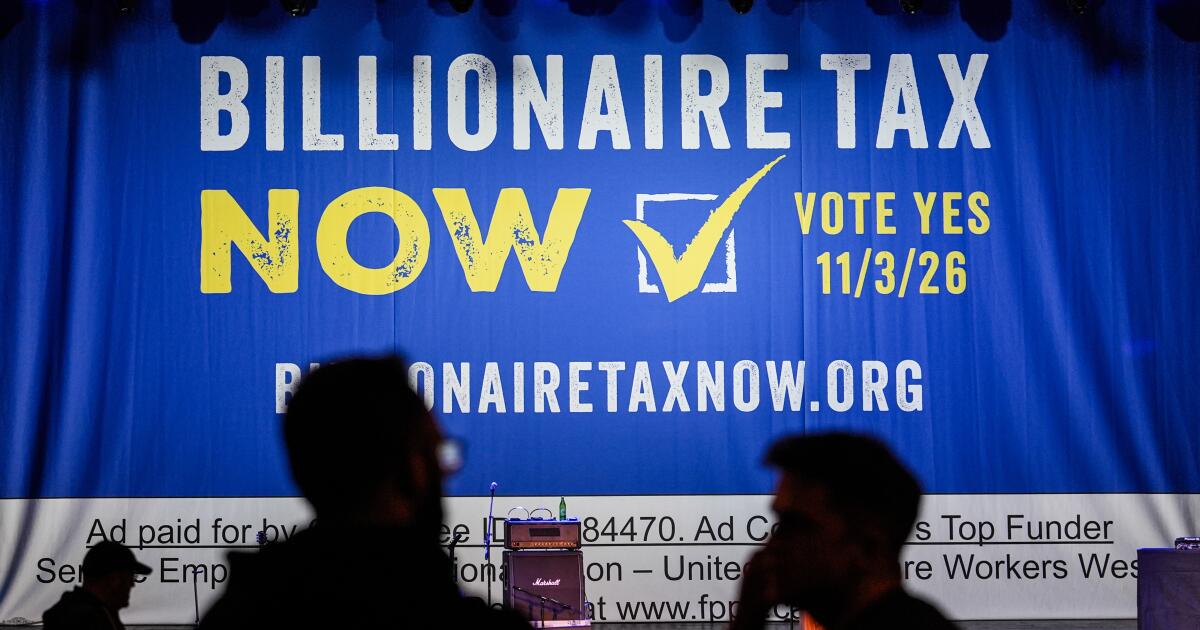
Billionaire tax proposal faces hurdles as it moves closer to November ballot
-
 Science30 minutes ago
Here’s why the Lincoln Memorial Reflecting Pool went green so fast
-
 Sports33 minutes ago
Shohei Ohtani out of Dodgers’ lineup vs. Orioles for birth of his second child

