Science
We Asked for Environmental Fixes in Your State. You Sent In Thousands.


It’s been a tough year for the environment. And yet, people all over the country are working hard to reduce greenhouse gases, reverse the harms of pollution, save imperiled species and restore pockets of nature. In our 50 States, 50 Fixes series this year we featured one success story from every state.
We also asked readers to share eco-friendly projects, big and small, underway in their communities. More than 3,200 submissions poured in, 14 of which we featured.
As 2025 draws to an end, we’re highlighting just a few more of the ideas that stood out but that did not make it into the series.
The following submissions have been edited and condensed.
— Cara Buckley and Catrin Einhorn
Looking out for the little guys
I’ve been rescuing bugs from the trap of nighttime lighting, like the ones that flew into my aunt’s house last night when the doors were open, drawn in by the glow. Sometimes I can save 20 in an hour. It’s thrilling. It’s empowering.
And it makes you wonder: Why are we even here, if we’re letting animals die simply because we don’t notice them? If there’s one place you can be a hero, it’s your own house, your own backyard. You can save so many animals just by paying attention. It’s really a mindset shift.There’s so much magic in our neighborhoods. So much heartbreak, too. But wow, definitely some magic. — Nicola Plowman, California
Greening the homeowner association
Our large homeowner association in Irving, Texas, has recently earned the National Wildlife Federation’s Community Wildlife Habitat certification. We switched to native plantings in nine parks and 20 common areas, converted four acres to native pollinator-friendly wildflowers and grasses, planted native trees and installed dark sky public lighting. We also educate residents, who have now certified 135 individual homes and a commercial property. Volunteers with the Valley Ranch Association’s green club did it with help and funding from the federal government, national nonprofits, local businesses, our H.O.A. and private donors. Our community is working hard to protect our urban wildlife and pollinators. — Nancy Payne, Texas
A Nebraska-shaped solution
The Central Nebraska Public Power and Irrigation District
When we say Mary Bergstrom plants Nebraska, we mean that literally! Mary created a pollinator garden in the shape of Nebraska, including a walking path through the middle of the garden that replicates how the Platte River winds its way through the state.
Featuring 27 species of plants, flowers and grasses, many native to the Great Plains region, the garden, which was made possible by a 2023 grant from the PlantNebraska foundation, provides food and habitat to a legion of pollinators, from the monarchs that travel through Nebraska on their migration from Canada to Mexico, to native bees and more. Mary, who lives on the shores of Johnson Lake, Neb., spent 20 years as a librarian at Lexington High School and said she wanted to create a garden that could be a geography lesson, too.
— Michelle DeRusha, Nebraska
Protecting a pair of piping plovers
Chicago’s motto is “city in a garden,” but our cutest conservation success story has to do with two federally endangered piping plovers, Monty and Rose (named after Montrose Beach, where they nested). After settling on the beach in 2019 they were spotted by birders, and a little spit of land was protected for them to breed. They became the first successful pair of piping plovers to breed in the city in 71 years, and their offspring became famous, too.
— Rebecca Silverman, Illinois
In 2021, the Chicago Park District expanded the protected natural habitat around the plovers’ nesting ground by 3.1 acres, an area that was renamed the Monty and Rose Wildlife Habitat last year.
Planting an urban forest
Tree Fredericksburg is an organization of citizen volunteers dedicated to the restoration of the urban forest in Fredericksburg, Va. Since 2008, we have planted over 10,000 trees along the street, in the parks and in the schoolyard. We have also given away over 60,000 native trees and shrubs to the general public. Last fall, an inventory of the trees in the city was conducted and it showed that Tree Fredericksburg is responsible for 47 percent of the trees now growing in the city in the public right of way.
Volunteers have come from all walks of life, including Scouts, students from the local schools and university, churches, civic associations and even from as far away as Northern Virginia. We have had students from George Mason University and the local mosque in Manassas, Va.
We believe trees to be the answer for many problems in our city: the heat island effect, stormwater management, walkable city streets and just plain beauty. There was no city arborist from 2008 to 2023 and so Tree Fredericksburg was the de facto arborist for our city. We have had a strong partnership with the city of Fredericksburg and great support from our political leaders. We have been a Tree City for 37 years. — Anne Little, Virginia
Bringing buffalo back
For over three decades, I’ve run the Black Feather Buffalo Ranch on 3,000 leased acres in Oglala Lakota County, S.D., on the Pine Ridge Reservation. Named after John Black Feather, who entrusted me with this legacy, the ranch represents far more than a business. It’s a living testament to our Lakota heritage, a way of bringing our people back to our most sacred relatives, the buffalo. In the past few years, I’ve invested in new fencing to create a rotational grazing structure. Traditional, Native methods also encouraged buffalo to move around the land. Now it’s classified as a climate-smart activity by the U.S.D.A. When I look out over my herd, I think of my ancestral knowledge, and the generational knowledge my elders, including my uncle John Black Feather, passed down to me: that buffalo represent abundance and hope.
Each animal represents a living connection to our past and a promise for our future. As a single parent raising both my children and my buffalo, I’m proud to continue this sacred work. I wish my uncle was alive to see how much our herd has grown, how we’re bringing our buffalo back and we’re keeping our culture alive, one buffalo at a time.
— Virgil Two Eagle, South Dakota
Installing solar in low-income places
Southern Energy Management
In North Carolina, we are U.N.C. students who created the nonprofit SolarEquity to bring affordable renewable energy to low- to moderate-income communities. In the Southeast, it is difficult to implement renewable energy in affordable ways due to regulations and utility constraints, so we decided to be the intermediary between communities, affordable housing organizations and financial entities to bring solar and energy efficiency to places often left out of the energy transition, while decreasing carbon emissions.
— Kaya Johnson, North Carolina
Planting pollinators
Skateport is a rollerskating events and lessons service based in Connecticut. We had concrete poured in the heart of downtown in order to place a shipping container onsite to house our rental roller skates and decided to plant a public pollinator garden to offset the heat island effect and support our local ecosystem and pollinators!
— Takina Pollock Shafer, Connecticut
Celebrating the natural world
Procession of the Species Celebration is a 30-year-old event that highlights community-made art to celebrate and appreciate nature. Each year, the community has a parade or procession that includes floats, live music and dancing, with large-format art of different species. It was started by Earthbound Productions and is organized by the community. Leading up to the event, there are two months of free and open studios and workshops to create the collective artwork. Art, culture and community are essential in fostering an ethic of environmental stewardship and protection.
— Natalie Weiss, Washington
Teaching climate change in business class
Mike Belleme for The New York Times Appalachian State is now requiring all undergraduates to take at least one class in the sustainability and climate literacy arena as a general education requirement. I teach the Walker College of Business’s version of the class. I really want my opening line to be in The N.Y. Times lol: “This class is not to discuss whether we think climate change is real or not, or who is to blame, that is a waste of oxygen. This class’s charge is to come up with better business processes to not treat the Earth like shit.”
— Scott Bowie Gray, North Carolina
Recycling rainwater
Brad Lancaster in Tucson, Ariz., has, for 30 years, advocated for and installed citywide rainwater harvesting infrastructure and planted thousands of trees native to the Sonoran Desert. The savings in deferred groundwater use run to the millions of gallons per year.
— Eric Wagner, Arizona
Mr. Lancaster said he’s helped neighbors plant more than 1,800 native food-bearing trees and thousands of understory plants, which are irrigated by more than one million gallons of stormwater harvested annually from neighborhood rain gardens.
Decomposing yard signs
In Berkeley, Calif., Berkeley High School parents and families stopped receiving lawn signs for free when their seniors graduated earlier this year. As a result, a group of parents began selling eco-friendly seed paper signs, which decompose and grow into native flowers after it rains, unlike typical plastic lawn signs. The idea for a biodegradable sign started with an opinion article in the high school newspaper, and the signs were sold to hundreds of parents and families in the district. It’s an idea that’s very small and the families hope it will incite a bigger movement.
— Sydney Lehrer, California
Ron Levi, a parent of a recently graduated senior, spearheaded the effort, and said leftover proceeds from the sale of the signs went to a nonprofit parent group that raises funds for the school.
Reducing fire risk
In Oakland, Calif., volunteers are busy reducing the risk of fire while restoring the open spaces. Parts of the hills here are classified as a high fire hazard zone where the forests are packed with overgrown underbrush and deadwood. But these open spaces are also beloved green oases in this highly urban city, used by thousands of bikers, hikers and picnickers. They need care, but the city doesn’t have the capacity to properly maintain them.
A nonprofit called Friends of Sausal Creek musters up scores of volunteers every weekend to steward multiple locations in the parks, removing invasive plants and shrubs, planting native plants, reducing the fire risks and maintaining Sausal Creek, where a small population of wild trout lives.
— Wendy Tokuda, California
Sharing vegan delights
I write a vegan recipe and educational column called Recipe for a Healthy Planet for our local newspaper, The Monadnock Ledger-Transcript. I worked on a web portal of the same name for our local environmental education center, the Harris Center. We’re educating people about how food choices affect the environment.
— Lisa Murray, New Hampshire
Building without gas
In terms of decarbonizing buildings, everybody despairs about getting America’s builders, HVAC contractors and homeowners to accept electrification. There are so many people to persuade! A big New Mexico developer has figured it out: He doesn’t put gas infrastructure into his new developments in the city of Las Cruces, which saves him millions of dollars in unnecessary infrastructure. Just like that, a development is on the path to being 100 percent decarbonized. He is in the middle of a 6,000-lot housing project now, with homes selling out quickly. He can’t figure out why more developers aren’t doing it.
— Don Kurtz, New Mexico
The developer, John Moscato, said not adding gas lines to developments saved him $3,000 per lot.
Running from plastic
I have been a runner for over 50 years. The vast majority of plastic is not recycled, and I don’t like the single-use plastic bottles given at races. I have been trying to get races to use paper cups with water canisters instead. Some smaller races in New York, New Jersey and Pennsylvania have made progress, like the Scott Coffee Moorestown 8K, the Cooper Norcross Run the Bridge 10K and the Finger Lakes Runners Club’s Twilight 5K. I have tried to get the Broad Street 10 miler in Philadelphia to give up plastic, as it would save nearly 100,000 plastic water bottles from the landfill or ocean. I speak to race directors at every race I attend.
I am 86.
— Sandra Folzer, Pennsylvania
This year, Ms. Folzer became the world record holder for women aged 85-90 in the indoor mile.
Keeping textiles out of the landfill
I thought you might be interested in a project near me in Kent, Ohio. It’s called The Socially Responsible Sweatshop of Kent. From their flier: “The Socially Responsible Sweatshop is committed to repurposing landfill-destined textiles into useful, beautiful items. These items are lovingly crafted and priced affordably. Proceeds from the sales of these items are donated to provide extra funds for food-insecure community members.”
They sell their wares at the Haymaker Farmers’ Market in Kent year round and online and a couple of local stores. I discovered this organization at the farmers’ market about a year and a half ago and ended up donating my late mother’s sewing machine to them. I have since donated fabric and other machines and sewing supplies when I can. Last year they raised $50,000, 100 percent of which went to the food-insecure of Portage County.
— Kyle A. Klever, Ohio
Grabbing trash on the go
Heidi Cramer/Piscataway Public Library I’m writing on behalf of my friend, Douglas Johnston, who lives in Piscataway, N.J. An avid hiker, Doug serves his community and his environment by picking up trash from the trails. He never leaves the house without a trash bag and grabber. Doug knows I’m submitting this; he’s too humble to do it himself. He’s making a difference quietly.
— Kate Baker, New Jersey
Doug also picks up trash around Piscataway, often pulling over to clean up garbage from roadsides, and said he needs to wash out his car a lot.
Eating invasive species
Young, small-operation Rhode Island fishermen are fighting the European Green Crab invasion, spearheading new legislation and encouraging everyone to get out there and trap the crabs. A bill to create a more affordable, accessible license to commercially harvest the green crabs passed the R.I. General Assembly unanimously, and I, a 17-year-old, proposed it! The restaurant demand for the crabs is growing in the state, and there are a few fishermen leading the charge.
— Liam Cromie, Rhode Island
Imitating beaver dams
We are a small group of fly fishers concerned about cold, clean water. We have constructed more than 100 beaver dam analogues to keep more water on the landscape. These B.D.A.s not only store, cool and spread water but also provide habitat for many species of animals and plants.
— William Young, South Dakota
Pivoting careers
I left my cushy tech job at Adobe this spring to open a native plant nursery. In Utah, we are way behind the rest of the country when it comes to environmentally conscious landscaping. Kentucky bluegrass lawns continue to dominate residential landscapes even though we live in a high desert. I’ve only been in business for six months but I’ve already made over $100,000 in gross sales. I believe Utahns are ready and businesses like mine are emerging to meet the growing demand.
— Sara Southwick, Utah
Fighting for marine forests
In an effort to protect the coastline, Sebastian Ford, a high school student from Bainbridge Island, Wash., worked with the Seattle Aquarium, the Puget Sound Restoration Fund and tribes to raise awareness of bull kelp and get it designated as the state’s “marine forest.” His work became House Bill 1631 and was signed into law on April 16. He was also named Washingtonian of the day.
— Rebecca Robins, Washington
Sebastian Ford is the grandson of the reader who sent in this submission.
𓆑



Few substances are as deeply woven into everyday life as alcohol. It is a fixture at holiday celebrations, work-related social gatherings, sporting events, airports, and brunch or dinner tables. All demonstrate how deeply alcohol has become embedded in social customs and cultural traditions.
Yet alcohol contributes to millions of deaths globally each year and is linked to cancer, liver disease, unintentional accidents, violence and, importantly, dependence and addiction. Despite this, the disconnect between alcohol’s cultural role and its serious health burden is striking. An estimated 2.3 billion people worldwide consume alcohol.
As a physician working in addiction medicine, I regularly care for patients whose alcohol use affects nearly every organ system. It is often not until these patients end up admitted to the hospital that they learn the effects of alcohol on various parts of their body besides their liver.
Newer evidence challenges assumptions about what was long considered “safe drinking.” Even moderate drinking carries risk and is not as harmless as people, including experts, once thought.
Many people associate alcohol risk primarily with addiction or dangerous behaviors such as driving while intoxicated. However, its effects extend far beyond this, into nearly every aspect of a person’s well-being.
While alcohol may transiently improve mood and ease social anxiety, long-term alcohol use can lead to a worsening of mood, cognition and sleep, which can further compound use.
A 2021 literature review found that consuming approximately two standard drinks roughly doubles the odds of sustaining injuries — with or without a vehicle involved. The review also found that heavy episodic (binge) drinking can increase the risk of injury by 50-fold, depending on the amount of alcohol consumed and the type of injury. While alcohol’s effects on the liver are well known, it can also lead to gastrointestinal complications and heart disease
The World Health Organization estimates that 2.6 million deaths each year are attributable to alcohol, accounting for nearly 1 in every 20 deaths worldwide.
While many people recognize the risks of alcohol addiction, people are generally much less aware of the links between alcohol use and cancer risk.
The World Health Organization classifies alcohol as a Group 1 carcinogen — the same category as tobacco and asbestos. In 2025, the U.S. surgeon general emphasized that alcohol increases the risk of at least seven cancers, including cancers of the breast, colorectal, liver, oral, esophagus and larynx. An advisory called for updated warning labels.
Yet fewer than half of Americans recognize alcohol as a risk factor for cancer, particularly for cancers such as breast cancer that are not commonly associated with alcohol use.
Throughout the 1990s and early 2000s, observational studies suggested that moderate alcohol consumption might offer cardiovascular benefits. Over the past decade, however, higher-quality studies have challenged these findings, suggesting that much of the apparent benefit may have reflected differences in the health and lifestyles of moderate drinkers rather than a protective effect of alcohol itself.
Current evidence increasingly suggests that even low levels of alcohol may increase cancer risk.
Federal guidelines acknowledge that adults should “consume less alcohol for better overall health.” However, the most recent version of the “Dietary Guidelines for Americans,” updated in January, removed the previous recommendation to limit intake to no more than one drink per day for women and two for men. It also omitted explicit discussion of alcohol’s links to cancer.
These changes have drawn criticism from public health experts, who argue that the revised language plays down the growing evidence of alcohol-related harms and provides less specific guidance to consumers. The current administrator of the Centers for Medicare & Medicaid Services characterized alcohol as a “social lubricant” that brings people together, rather than emphasizing its well-established health risks.
This may be true physiologically, at least temporarily, but obscures the fact that relying on it as a social lubricant can lead to chemical and psychological dependency. In my view, statements to that effect are shortsighted, prioritizing short-term social effects over more insidious and long-term issues, including addiction.
While many dangerous mind-altering substances are hidden from public perception, alcohol is often placed at the center of it – a trend that shows no sign of changing imminently.
Further, large companies often profit from ads that appeal to young people.
Looking back at the history of tobacco smoking provides some helpful insights. In 1965, 42.4% of the U.S. population smoked. By 2022, that figure had dropped to 11.6%.
This steep decline did not happen because of a single intervention, but through decades of accumulating scientific evidence, public education campaigns, warning labels, restrictions on advertising, smoke-free policies, higher tobacco taxes and shifts in social norms. Together, these efforts transformed smoking from a widely accepted social behavior into one broadly recognized as a major health risk and correspondingly, less socially accepted.
Although alcohol consumption has modestly declined in recent years, it remains deeply embedded in social life in ways cigarette smoking no longer is.
People often assume that if a substance is legal, common and widely socially accepted — even encouraged — it must also be safe. But public health history suggests those assumptions can and should change.
Emma Fenske is an addiction medicine fellow and internal medicine physician at Oregon Health & Science University. This article was produced in partnership with the Conversation.
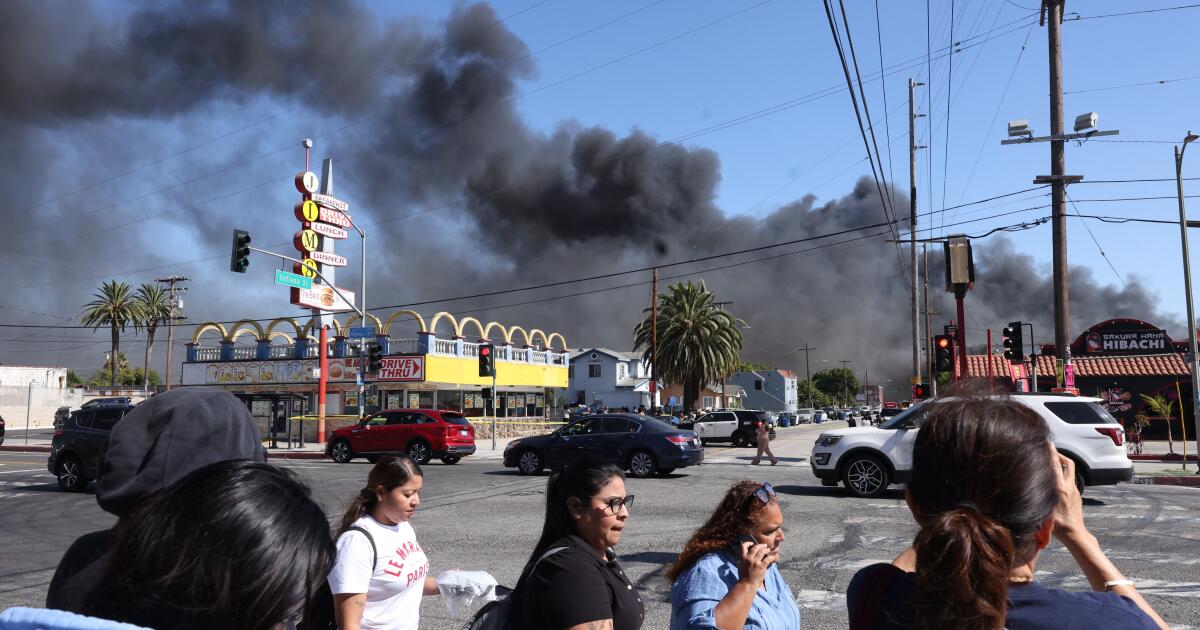
The air near the Lineage refrigerated warehouse fire in Boyle Heights carried astronomically high levels of smoke and soot, surpassing some of the worst air pollution during the Los Angeles County fires in January 2025, according to preliminary data from air officials.
The fire spewed thick black smoke for days. From downtown Los Angeles to the San Gabriel Valley, tens of thousands were enveloped in unhealthful levels of smoke, even as some local officials told residents that the air posed no danger.
As the days wore on, worst off were communities nearest the blaze. On June 19, three days after the facility ignited, a temporary air quality monitoring station at Eastman Elementary in unincorporated East Los Angeles measured an extremely hazardous 755 micrograms per cubic meter of fine particles for more than an hour, according to the South Coast Air Quality Management District.
For comparison, a Caltech air monitor in Pasadena recorded about 650 micrograms per cubic meter during the Eaton fire.
These high levels of fine particles, known as PM 2.5, probably resulted in the surge of residents into local emergency rooms during the fire, according to local health officials. But even now with the smoke gone, people still have not been told what chemicals they were breathing in during the weeklong ordeal.
Michael Jerrett, an environmental health professor at the UCLA Fielding School of Public Health, said his concern is the composition of materials emitted when the building burned.
“These contain many particularly toxic components,” Jerrett said, “and we know little about how these mixtures affect health.”
There is no completely safe level of fine particulate pollution, he noted, meaning higher concentrations are always worse.
During the 2025 L.A. County fires, local air officials announced that several monitors downwind had detected elevated levels of brain-damaging lead and cancer-causing arsenic from toxic paint and construction materials used in older homes.
The Lineage warehouse, built in 2018, is likely to contain different materials of concern. Thick insulation foam required for a massive refrigeration operation, solar panels and refrigerants were burned, leaving many residents on edge.
Even though three public agencies conducted air monitoring, the picture is still murky.
“[Public officials] are speaking with a lot of confidence but not a lot of information,” said mark! Lopez, a community organizer with East Yard Communities for Environmental Justice. “We’ve gotten in the room with folks to discuss where the gaps lie and where assumptions are being made. And I think they are realizing these agencies supposed to protect our air and our health aren’t as reliable as they thought they were.”
In response to the Boyle Heights fire, the South Coast air district deployed a mobile monitoring vehicle to screen for toxic substances in the community near the fire, according to Nahal Mogharabi, a spokesperson for the air district. It found increased levels of bromine, a chemical commonly found in fire retardant, and chlorine, often released from burning plastic. Both were below short-term health-based exposure thresholds.
Toxic metals, including lead and arsenic, were not elevated, according to air district data.
“That was the reassuring piece, that they were not picking up any of the metals,” said Dr. Nichole Quick, chief medical advisor for the Los Angeles County Department of Public Health. “But … that smoke is unhealthy. “You don’t want to be breathing it, regardless.”
The U.S. Environmental Protection Agency set up air monitors around the perimeter of the facility to test for toxic air contaminants, has the results and has not made them public. Julia Giarmoleo, an EPA spokesperson, said the monitors did not detect elevated metals, but would not provide a copy of the data without a federal records request.
The Los Angeles Fire Department’s hazardous material team also tested for ammonia, which is used in refrigeration, and hydrogen fluoride, a toxic chemical that could be released by burning lithium-ion batteries and solar panels.
Fire officials previously said they measured low levels of hydrogen fluoride on the second day of the fire. But the department would not answer questions about its air monitoring. It also told a reporter to submit a public records request.
It remains unclear whether any agency has tested for hydrogen cyanide or isocyanates, highly toxic gases that could be released from burning chemical-laden insulating foam inside the building.
“The real issue is what monitoring has not been done to protect the fence-line community from the air toxics,” said Jane Williams, executive director of California Communities Against Toxics.
Without the EPA or LAFD data, what is known of the smoke’s toxicity rests on the air district’s mobile monitoring.
Jerrett, the UCLA researcher, said that is not ideal for understanding the kind of plume released by the Boyle Heights fire, which rapidly changed direction with the wind.
“This can in some instances lead to levels that look low, but they are resulting from a mismatch between the location of the vehicle and the plume,” he said.
The Boyle Heights blaze, similar to the Eaton and Palisades fires, has revealed the region’s air monitoring can’t always tell people what they’ve been exposed to in a disaster.
“We do need a better monitoring system in place,” he said.
Local officials are now shifting their focus to the rancid odors from millions of pounds of rotting food in the ruined wing of the warehouse. Decomposing food can release hydrogen sulfide, a toxic gas synonymous with landfills and garbage. Lineage hired contractors who are measuring this noxious gas and other pollution. Their data indicate they have not detected hydrogen sulfide.
As Lineage workers haul the rotting food to local landfills, they are using deodorizing mist and have discussed using shrink wrapping to suppress the stench and minimize issues for nearby homes.
At this point, the odors are believed to be an inconvenience rather than a public health threat, according to Quick, the county medical advisor. She said running air purifiers may help to reduce odors indoors.
“It’s very important for folks to understand that the odors themselves do not indicate any dangerous levels of toxins, mold, bacteria, and so forth,” Quick said. “But the odors are a public nuisance.”
The air district is still encouraging residents to report odors to its online complaint system or by calling (800) 288-7664.

Federal employees who were axed during waves of cuts by the Trump administration have fought back against the dismantling of a key climate science website, Climate.gov, and put up a new site, Climate.us, that can now do everything the original did.
The site, with millions of users each year, was known for colorful charts that anyone could freely download and that simplified giant sets of data, such as temperature readings. Now it refers to another page and is no longer being updated.
Daniel Swain, a UC Agriculture & Natural Resources climate scientist, called the resources available at Climate.gov “the most efficacious dollars spent by NOAA on public-facing science, possibly ever.” He has used graphics from the former website on his popular weather blog.
“I am a terrible artist or illustrator. It would be very bad if I had to create those on my own.” Swain said. The website didn’t just make graphics that were beautiful, he said, they were accurate and reliable because of the network of researchers who fact-checked them.
Rebecca Lindsey was the editorial lead and program manager for Climate.gov until February 2025, when her position at the National Oceanic and Atmospheric Administration was eliminated by the Elon Musk-led Department of Government Efficiency, or DOGE. She explained that the online resource was “a bridge between scientists, data and the public.”
Lindsey and her team have now rebuilt the bridge piece by piece, if just a bit further downstream.
The team is made of the same editorial and technical staff that ran Climate.gov. It’s paid for through a crowdfunding campaign and one large, anonymous donation.
The group has raised some $380,000, about $100,000 of which came in the last week. They also have recruited 80 scientists who are willing to volunteer as subject matter experts and fact checkers. It’s enough to keep the work going through February while they seek more long-term funding.
The first iteration of Climate.us went online in 2025 to keep the last 15 years of work from the government website available. The newest version restores the full function of the previous website.
For Californians, the timing could be important.
“We’re headed for a very strong El Niño event that will have significant implications for Southern California,” Swain said. “Climate.gov and the scientists behind it did a great job walking people through the last one, and I would expect that’s the case this time as well.”
Climate.gov excelled at tapping into a pool of academic experts to explain what was happening in nearly real time. This allowed the public to see how events such as wildfire, drought or large weather patterns such as El Niño were shaping their lives when they needed the information most. Research from academic institutions, by contrast, can take years to publish results from major natural disasters.
Swain emphasized that cuts to resources that give context to hard-to-interpret data is not just a loss for the research community.
“It’s getting more and more difficult for the American public to access the science and the scientists that their tax dollars have supported for over half a century,” he said.
With the revival of Climate.us, Swain said he plans to directly use the site and its graphics to keep Californians connected to the world of climate science.
-

 Louisiana15 seconds ago
Louisiana wildlife officials urge safe boating ahead of Fourth of July weekend
-

 Maine7 minutes ago
Lewiston home fire erupts on Goffe St.
-

 Maryland10 minutes ago
July Brings New Laws Affecting Minimum Wage, Eviction Notices And More
-

 Michigan15 minutes ago
Fourth inmate from Michigan’s female prison dies after cardiac event
-

 Massachusetts22 minutes ago
Peabody man claims $500,000 Massachusetts State Lottery prize
-

 Minnesota25 minutes ago
Flooding in southeast Minnesota closes some state parks
-

 Mississippi30 minutes ago
What stores near Jackson sell fireworks to celebrate July 4th
-
 Missouri37 minutes ago
Kansas City, Missouri, city council takes action to ‘bring new life’ to downtown landmark

