Finance
Mike Burkhold: A Blueprint for South Carolina’s Financial Future – FITSNews


“I am running because the system needs to be fixed and I have the skills and mindset to do it…”
by MIKE BURKHOLD
***
Earlier this month, at the invitation of Virginia Secretary of Finance Steve Cummings, I spent a full day in Richmond meeting with leaders from across that state’s financial infrastructure. These were not ceremonial handshakes. These were working meetings — substantive, focused and highly instructive.
I met with teams overseeing budgeting, taxation, regulatory oversight, accounting and administration. What I found was a modern, integrated and disciplined approach to managing public money. And it made me even more certain of one thing: South Carolina is ready for change.
***
TEAMWORK AND TALENT MATTER
What stood out most in Virginia was the cohesion. From top to bottom, everyone I met shared the same mission — being responsible stewards of the taxpayers’ money. No silos. No blame games. Just a united focus on efficiency, transparency and performance.
That mindset doesn’t happen by accident. It is baked into the culture. The Secretary of Finance meets quarterly with department heads to review budgets, resolve audit findings and keep teams on track. There is accountability at every level. And it works.
That is what I want to bring to South Carolina. As Comptroller General, my job is to revitalize and modernize a critical finance function and to do it in close partnership with the legislature, the governor and the treasurer. I want to build an office that operates with precision, earns trust and gives lawmakers the clarity they need to govern wisely.
***
THIS IS BIGGER THAN ONE SEAT
I am not running for this office because I want a long political career. I am running because the system needs to be fixed and I have the skills and mindset to do it.
If part of that fix means rethinking whether this seat should remain an elected position then I welcome that conversation. In other states like Florida, voters elect a Chief Financial Officer with broad oversight. In Virginia, the Secretary of Finance is appointed by the governor and oversees all fiscal functions. Either model can work – but both reflect a commitment to modern coordinated financial management.
What matters most is that we have a structure that delivers results and earns the public’s trust. That structure needs to be part of a bigger conversation focused on delivering value to citizens – not maintaining fiefdoms or political turf.
***
RELATED | S.C. ‘REPUBLICANS’ REBUFF TRUMP ON REDISTRICTING
***
PUBLIC SERVICE STARTS WITH LEADERSHIP
One of the most inspiring parts of my trip was seeing the caliber of leaders who had left high-paying private sector roles to serve the people of Virginia. They brought with them a culture of excellence and a belief that good government is possible when the right people step forward.
We have that kind of talent in South Carolina. We just need to encourage more of it. I am stepping up because I believe in servant leadership. I see a seat that has not been led this way in a long time and there is a lot to fix. Not just the systems and operations but also the teamwork and coordination across agencies.
My goal is not what is best for Mike. It is what is best for South Carolina. I want to rebuild the Comptroller General’s office into a trusted partner, a respected institution and a model for modern financial leadership. Then I want to help figure out what structure will best serve the next generation.
***
A MOMENT OF OPPORTUNITY
The recent $3.5 billion error exposed just how outdated and fragile our current systems are. But we are not starting from scratch. We are starting from a place of strength. We have smart people, a strong economy and the will to do better.
Now we need to modernize our expectations. We need to align talent. We need to redesign the systems that manage $40 billion of taxpayer money. And we need leadership that sees the big picture, listens well and gets the details right.
South Carolina’s future is full of promise. But to get there, we need to treat government finance with the same rigor, discipline and urgency as any top-performing business.
That is why I am running. Not to keep a seat – but to serve the mission.
***
ABOUT THE AUTHOR…
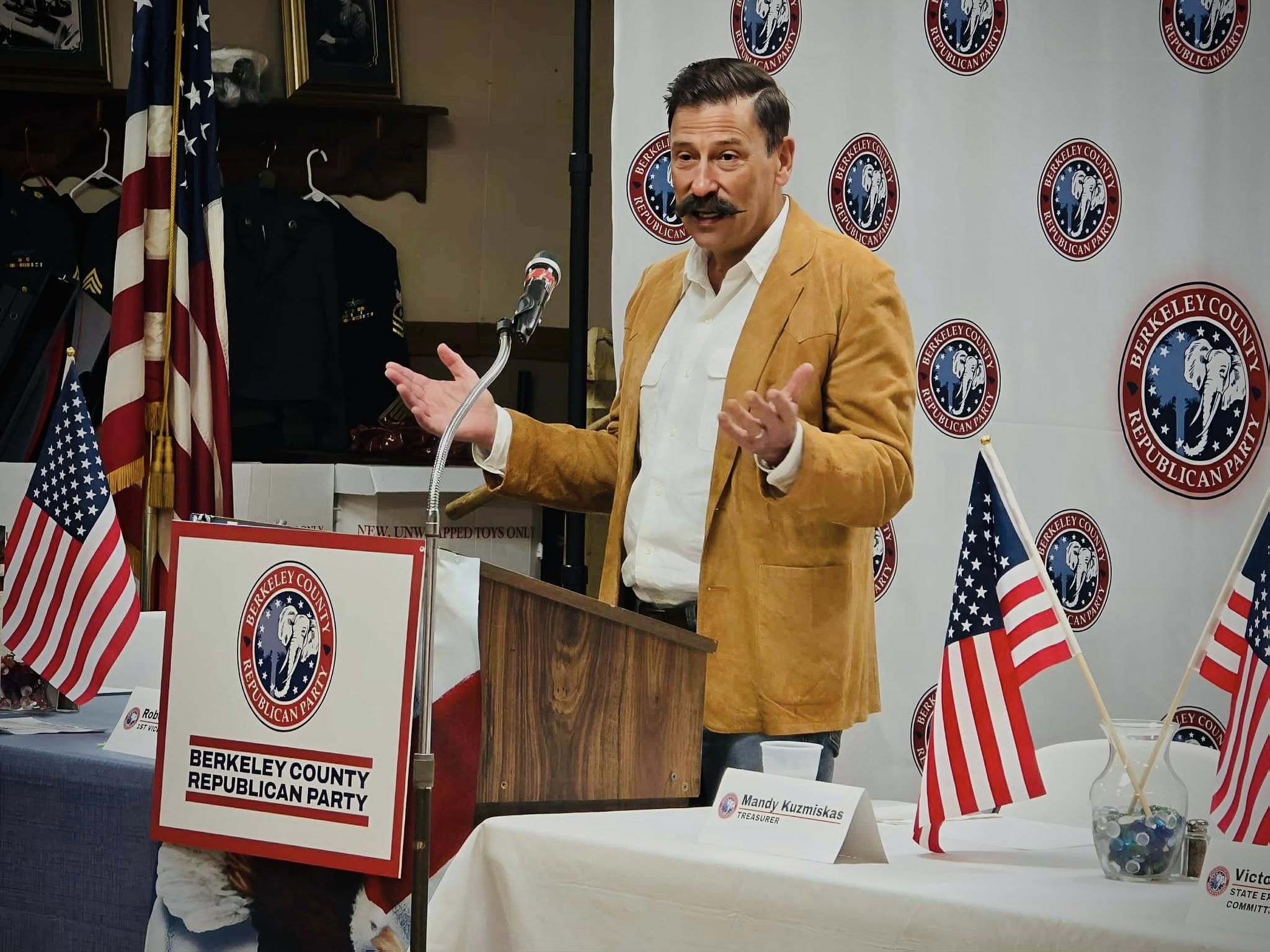
Mike Burkhold is a Republican candidate for comptroller general of South Carolina.
***
WANNA SOUND OFF?
Got something you’d like to say in response to one of our articles? Or an issue you’d like to address proactively? We have an open microphone policy! Submit your letter to the editor (or guest column) via email HERE. Got a tip for a story? CLICK HERE. Got a technical question or a glitch to report? CLICK HERE.


A girl from a disadvantaged rural family in central China topped this year’s gaokao, attracting numerous live-streamers eager to finance her education, which she declined.
The home of 18-year-old secondary school graduate Han Yaping in a Henan province village was recently bustling with live-streamers.
This attention came after Han achieved an impressive score of 699 out of 750 in the gaokao, China’s national college entrance exam.
She has received offers from China’s two leading universities, Tsinghua University and Peking University.
Han’s accomplishment is particularly remarkable given her family’s impoverished circumstances.
Her mother suffers from ankylosing spondylitis, an inflammatory arthritis affecting the spine, preventing her from working. Her father, who earns a living through farming and odd jobs, serves as the family’s sole provider. Han also has a younger sister.

The UK’s Financial Conduct Authority (FCA) published a landmark review on Monday that proposes recommendations to regulate the impact of artificial intelligence (AI) on the financial decisions made by consumers.
The review, titled the Mills Review, anticipates that both consumers and firms will start delegating “more financial decision-making to AI systems,” including for agreements, initiating transactions, and executing decisions “within agreed parameters.” One of the key findings of the review outlined that while AI can help bridge advice gaps and “support growth,” there remain risks “associated with fraud, cyber security, and consumer harm.” Conducting the review, Sheldon Mills highlighted that “AI can also amplify risks: bias, discrimination, exclusion, opaque decision-making (particularly when multiple AI models interact), misleading or hallucinatory advice and erosion of consumer trust.”
The review stated that presently, one in five adults in the UK are “already open to AI making decisions for them,” particularly when decisions feel “complex or high stakes.” It found that roughly 26 percent of the population “trust general-purpose tools such as ChatGPT, Claude or Gemini for financial advice” with little awareness that such platforms provide no “formal routes to recourse” or protections.
Overall, the Mills Review identified four areas that it anticipates will be impacted by AI in the financial sector: “the transformation of firms,” “new consumer journeys,” “a reshaped competition landscape,” and “amplified financial crime and cyber risk.” The FCA projected the shift in how consumers and firms consult AI to take place by 2030.
The Mills Review put forth seven “priority” recommendations to be considered by the FCA Board. It recommended that any transitions to autonomous AI models be monitored and that regulatory frameworks and perimeters be adapted and secured. The review called for the strengthening of “system-wide coordination and oversight,” the scaling up of the FCA’s AI Lab to enable it to support AI models and innovation for agentic finance, and an “AI-enabled agentic supervisory model” to be built and adopted. Finally, it recommended that a trusted “public-interest AI-enabled financial capability service” be developed.
The FCA announced, in the press release, that it will launch an AI “good and poor practice publication” in late 2026.
Finance
Fayette County Public Schools Board of Education approves audit contract, new finance director position

LEXINGTON, Ky. (WKYT) – The Fayette County Public Schools Board of Education approved a one-year audit contract capped at $131,750 plus $225 per hour during a virtual meeting Monday, along with a new finance director job description.
The contract is with Mauldin & Jenkins Certified Public Accountants, an Atlanta-based firm, and covers the 2025-26 fiscal year and the restatement of the 2024-25 fiscal year and ancillary services through FY 2029-2030. The work is set to be completed by Nov. 15.
The board approved the contract in a 5-0 vote.
Audit contract details
Interim Chief Financial Officer Kyna Koch said the cost is already accounted for in the district’s budget.
“And is actually less than we expected given our current situation — we were thrilled with the bid,” Koch said.
Koch said she believes this is Mauldin & Jenkins’ first school district audit in Kentucky, but that the firm works with school districts of more than 100,000 students throughout the Southeast.
“Quite frankly when I spoke to the folks at KDE they were thrilled because we’re running kind of short of auditors who want to do school district audits — so all around I think this was a win-win for everyone,” Koch said.
New finance director position
The board also approved a new job description for the position of Director of Finance. Acting Superintendent Dr. Bill Bradford said the title will replace two associate director positions.
“Which will not only save the school district money but it’s also going to streamline our work and align internal controls to make room for a more efficient unit,” Bradford said.
Koch said the position will be posted as soon as possible following the board’s approval.
Closed session
The board went into closed session for more than an hour to discuss pending investigations that could lead to employee discipline. When the board returned, it took no action and adjourned the meeting.
Copyright 2026 WKYT. All rights reserved.
-

 Louisiana11 seconds ago
Heart of Louisiana: Lafitte Wetlands
-
 Maine5 minutes ago
Maine’s 10 most expensive home sales from June
-

 Maryland12 minutes ago
Maryland Lottery Mega Millions, Pick 3 results for July 7, 2026
-

 Michigan15 minutes ago
Michigan Supreme Court rules rape admission invalid due to LSD use
-

 Massachusetts20 minutes ago
Massachusetts man dies in Fiji after becoming critically ill on sailing trip
-

 Minnesota27 minutes ago
Giordano’s deep dish pizza bringing second location to Minnesota
-

 Mississippi30 minutes ago
Police investigating video of Nolan Wells’ alleged argument on Horn Island before Mississippi teen went missing
-
Missouri35 minutes ago
Missouri Lottery Mega Millions, Pick 3 winning numbers for July 7, 2026

