Entertainment
‘It was by the kids, for the kids’: Chain Reaction’s former booker reflects on the O.C. club’s legacy


My name is Jon Halperin. I booked and managed Chain Reaction from 2000 to 2006. It started by accident while I was running a one-person record label. I went to the club to see the band Melee perform and the prior talent buyer for the club had just quit that day. I told owner Tim Hill I’d do it (having only booked three shows ever at a coffee shop). We slept on it, and I was hired the next day.
I joined Ron Martinez (of Final Conflict). He was booking the punk and hardcore shows. I booked the indie, ska, emo, screamo and pop punk stuff. We made a great team. Best work-wife ever.
Story time. My friend Ikey Owens (RIP) hit me up and told me that he and the guys from At the Drive In were going to be starting a new band. I’d booked Defacto (their dub project) before, and we agreed to throw them on a show and just bill it as “Defacto.” There were maybe 200 people there to see the first show for a band that would soon be known as the Mars Volta.
That wasn’t out of the ordinary. Chain Reaction had many artists grace that stage that went on to bigger things: Death Cab for Cutie, Avenged Sevenfold, Maroon 5, Fall Out Boy, Panic at the Disco, Taking Back Sunday, Pierce the Veil, My Morning Jacket. The list goes on and on.
Jon Halperin, who booked Chain Reaction from 2000 to 2006, stands in front of the club during its heyday.
(From Jon Halperin)
I used to make a deal with the kids. Buy a ticket to “X” show, and if you didn’t like the band, I’d refund you. I never had to. I knew my audience and they trusted my curation of the room. … It was by the kids, for the kids, except I was 30 at the time. I had to think like a teenager. My friend Brian once called me “Peter Pan.”
Halfway through my reign, social media became a thing. There was Friendster and a bit later MySpace. YouTube stated just a few years after. But those first few years of me at the venue, it was word of mouth. It was paper fliers dropped off at coffee shops and record stores. It was the flier in the venue window. It was Mean Street Magazine and Skratch Magazine.
I’d tease the press when they wanted to review a show. If you don’t show up with a pen and paper, you aren’t getting in (sorry, Kelli).
Most music industry went to the Los Angeles show, but smart industry came to us. Countless acts got signed following their shows. You’d often see the band meeting with a label in the parking lot near their tour van.
It was a dry room when I was there. No booze or weed whatsoever. We made only one exception to the weed rule. An artist in a band with Crohn’s disease who traveled with a nurse. Not saying bands didn’t drink backstage, on stage, in their vans (we rarely had buses), but what we didn’t see didn’t happen.

Touche Amoré performing at Chain Reaction in 2010.
(Joe Calixto)
We were often referred to as the “CBGB’s of the West,” and for a lot of bands, locals and touring acts alike, we were just that. We were the epicenter. There were other venues of course, but for some reason, we were the venue to play. Showcase Theater in Corona was edging toward its demise. Koo’s Cafe in Santa Ana was done. Back Alley in Fullerton wasn’t active. Galaxy Theater [in Santa Ana] was still, well, the Galaxy. There was no House of Blues Anaheim. Bands would drive a thousand miles to play one show at Chain Reaction. We were where the local bands started as first of four on a bill and would be headlining us within a year. We were their jumping-off point. We were where the kids came out. The real fans, many of whom started bands themselves.
Thankfully, there are other smaller venues out there today fostering the all-ages scene: Programme Skate in Fullerton, the Locker Room at Garden AMP [in Garden Grove], Toxic Toast in Long Beach, the Haven Pomona, but it’s just not the same. It was a moment in time. A time that will be forgotten in a few decades, but for today, my social media is being inundated with memories of a room that was a second home for thousands of kids.
Zero regrets. It was the best and worst times of my life. Working a day gig and then heading to the venue nearly every day of the week was rough. Relationships and friendships were hard, being that I couldn’t go out at night. I couldn’t get a pet. I was constantly tired. But I wouldn’t trade those six years for the world.
RIP, Chain Reaction.


Carolina Caroline, 2025.
Directed by Adam Rehmeier.
Starring Samara Weaving, Kyle Gallner, Kyra Sedgwick, Jon Gries, Tommy G. Kendrick, P.J. Sosko, Gregg Gilmore, Jamald Gardner, Matthew Smitley, Ed Formica, and Robert Stevens Wayne.
SYNOPSIS:
A young woman joins a charming con man on the run, leaving a trail of crime and passion as they hustle through the Southeast in search of her estranged mother.

The eponymous Caroline of director Adam Rehmeier’s Carolina Caroline has never properly met her mother. That woman abandoned her and her father (Jon Gries) before she was one year old. Moving to South Carolina and growing up there, it’s also safe to say that the unfulfilled Caroline, working at a local convenience store and coming home to a father with no ambitions to leave his comfortable home chair let alone get out and see the world (actively dismissing soccer in the process, suggesting that there also might be some unsurprising internalized racism given his age and having only known the South), hasn’t properly lived.
A chance encounter with scuzzy but charming con man Oliver (Kyle Gallner, playing in the type of role he regularly excels in), which mostly consists of Caroline observing a mental-manipulation hustle at the cash register, swapping dollar bills with confused clerks to come away with more money than he entered with, lures her to him. Impressed with her ability to pick up on the small-time psychological heist, Oliver decides to take Caroline on as his protege and partner in crime. Naturally, his fascination is also romantic, considering Caroline is an attractive woman played by Samara Weaving.

While going out to dinner together, Oliver also demonstrates a wealth of knowledge about human behavior that helps him predict how people will react in certain situations, opening the door for him to steal something of value or play successful mind games. This also greatly intrigues Caroline, as part of the reason she has never expanded her horizons beyond her small South Carolina town is that, deep down, she fears there are similarities to her mother and that she will end up hurting someone. Meanwhile, as we are watching this, we justifiably wonder if trusting Oliver at all will come back to haunt her.
Nevertheless, as the duo embarks on a string of crimes across the Southeast that gradually escalates in seriousness (at first, it is teaching Caroline how to perfect the cash register con, but not long before moving into identity theft and actual bank robberies resembling Bonnie and Clyde), it is called into question which one here might be more dangerous in the grand scheme of their characterizations. The eventual destination is South Carolina, where Caroline will hopefully meet her mother and get answers to her burning questions, including why she and her father were abandoned in the first place.

And while there is no denying that Carolina Caroline is an effectively performed film with layers and nuances that fortunately saved the film from one-dimensionality, often drawing immersion from lived-in locales (whether it be towns themselves or the bars and banks characters end up in), with the occasional person who comes across more as someone pulled off the street rather than a traditional actor, some of the screenwriting here from Tom Dean borders on hokey and unconvincing.
This also leaves the film feeling as if it is sometimes nervously afraid to commit to the story’s grimy grittiness, more concerned with keeping the characters likable than with pushing them a step too far into moral ambiguity. It’s all a bit too clean and safe for a movie about a woman slowly becoming a career criminal whilst smitten with her mentor/friend, either testing herself to see if she can be destructive like her mother, or as a means to find a semblance of freedom in justified thieving and separate herself from a boring life. Samara Weaving is terrific throughout, but especially in the later stages, determined to push back against a terrible hand of cards dealt to her in life, ready to make her own future at any cost.

To put it bluntly, though, too much is accomplished by depicting robberies and intimacy through montages, typically filled with country songs, that don’t necessarily allow one to invest in the characters and their actions. There is a hollowness underneath the otherwise entertaining surface. Even the title and nickname Carolina Caroline feels like a misguided eccentricity, and something that belongs in that straight-up romance. Thankfully, the direction and performances capture the humanity of the characters and the story, making the inevitable third-act tragedy engaging and heartbreaking.
Flickering Myth Rating – Film: ★ ★ ★ / Movie: ★ ★ ★
Robert Kojder
https://www.youtube.com/watch?v=embed/playlist
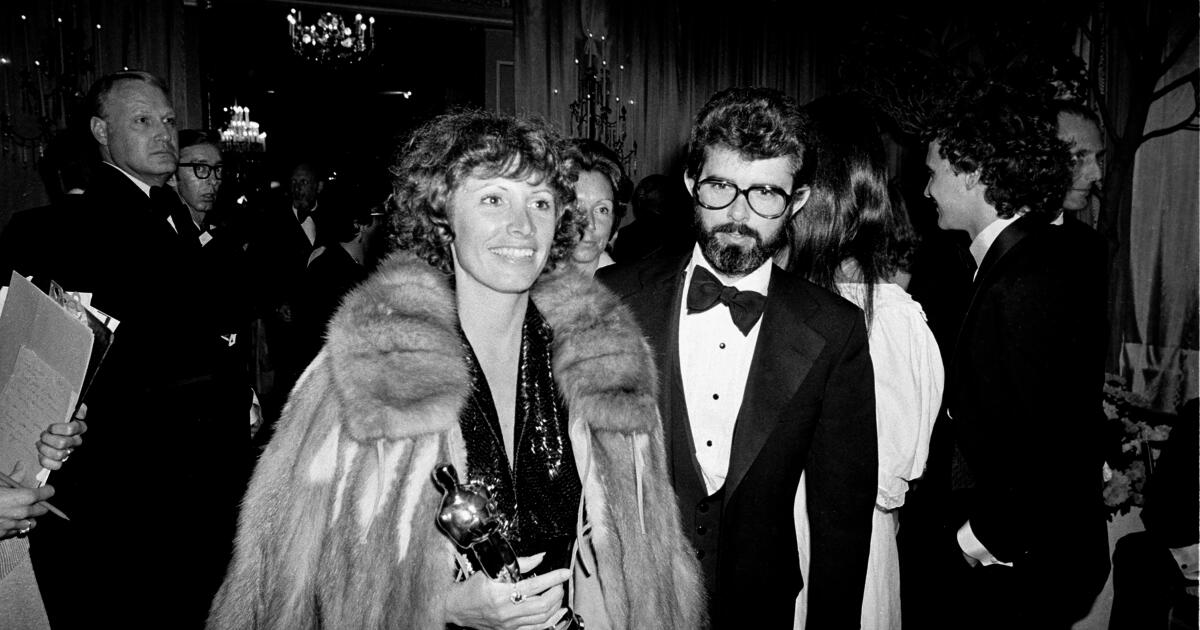
Marcia Lucas, the Oscar-winning film editor of “Star Wars,” died Wednesday in Rancho Mirage after a battle with cancer. She was 80.
“Marcia will be remembered as a brilliant storyteller, a trailblazer for women in film, a loving mother and grandmother, a generous host, and a loyal friend whose humor and sparkle filled every room she entered. Her influence on film is indelible, but those who knew her best will remember the way she made life feel more vivid, more beautiful, more fun, and more full of love,” a family statement said. “Her work was known for its emotional intelligence, rhythm, and humanity — a rare ability to find the truth of a scene and bring heart, momentum, and clarity to the screen.”
Marcia, who was married to George Lucas for more than a decade, was widely regarded as instrumental in making the “Star Wars” trilogy the juggernaut it became. But she garnered urban legend status for making the call to kill off one major and beloved character.
“If there was anything that was dramatic or emotional, George gave it to Marcia and George always said: keep one person whose opinion you trust to the very end, and that was Marcia,” said editor and director Duwayne Dunham.
She also co-edited “American Graffiti,” which nabbed her an Oscar nomination, Martin Scorsese’s “Alice Doesn’t Live Here Anymore,” “Taxi Driver,” “New York, New York,” and then in 1978, she won an Oscar for “Star Wars: Episode IV — A New Hope,” alongside co-editors Richard Chew and Paul Hirsch.
Mark Hamill, who starred as Luke Skywalker in the “Star Wars” franchise, posted a tribute to Lucas on social media, writing that he and his wife, Marilou York, are deeply saddened by the loss of their “lifelong friend, Marcia.”
“Not just a gifted, innovative artist, she also happened to be a genuinely nice person,” he continued. “Smart, funny, & just plain fun to be around. Thankfully, her memory lives on and we will never stop missing her.”
Lucas was born Marcia Lou Griffin on Oct. 4, 1945, in Modesto but was raised in North Hollywood. She told True West Film Center that she was a “real rags to riches story” and was raised by a single mother. “We lived hand to mouth, paycheck to paycheck,” she said. “I never knew anybody in the film business, the music business, the radio business. … I didn’t go to school with people who were kids that were associated with the industry. But when I used to go home after school, I would sit and watch old movies. It was like I was getting an education in movies.”
When she was 18, she landed a job as an apprentice film librarian at the Sandler Film Library in Hollywood. When the library was slow, the assistant editor taught Marcia about post-production and TV commercials. When he left, she took over.
By the mid-1960s, Marcia was ready to move on from the Sandler but was told editors “didn’t want women in the cutting room,” so she worried her ambition to make it big in the field was at a dead end. “But then I had a friend who had a friend who knew a woman in Van Nuys — Verna Fields — who liked to hire women.”
Marcia was hired.
It was while she was working for Fields as an assistant that she met George Lucas, then a USC film student whom Fields considered talented. Because Marcia was the most experienced assistant, Fields asked her to help the young filmmaker.
Marcia described him as “very intense” in the cutting room. “We worked together, and then after the film was done, we started dating,” Marcia told True West Film Center. “I used to say, ‘I don’t understand why you’re such a cold fish,’ and George would say, ‘I may be a cold fish, but you’re full of beans’ — and that was our chemistry. That chemistry worked for us for many years.”
The couple married in 1969 and divorced in 1983, but during their time together they made the original “Star Wars” trilogy. The couple split before “Return of the Jedi” was released but waited to publicly announce their divorce until shortly after the film hit theaters.
“I’m sort of known in Star Wars,” Marcia told True West Film Center. “I killed Obi-Wan Kenobi.”
According to Marcia, George was convinced he’d be laughed out of Hollywood because in the original script characters were running around and shooting at one another and nobody was getting hurt. “I said, ‘What if Obi-Wan Kenobi let Darth Vader strike him down?’ and George said, ‘I kind of like that.’”
Marcia suggested that Obi-Wan Kenobi could then be a ghostly presence. She said that the change to the script added a spiritual strangeness to the film and gave the second act a real climax, because no one expected to lose the Jedi master.
“Anyway,” she said. “I killed him.”
Marcia is survived by daughters Amanda Lucas and Amy Soper; grandchildren Felix Hallikainen, Aeliana Hallikainen, and Knox Soper; and her chosen family Sarah Dyer and Jon Taylor.

I watched Christopher Nolan’s Insomnia before I watched the original. I was in my early twenties. I thought the film was fine and I moved on. It took me until Second Sight dropped this 4K edition to find out what fine had been covering up for twenty four years. I feel pretty bad about that. Not bad enough to not tell you to skip Nolan and start here, but bad.
Erik Skjoldbjærg’s 1997 original is a Norwegian thriller about a Swedish detective named Jonas Engström who goes to Tromsø to investigate a teenage girl’s murder and instead dismantles himself in daylight. Stellan Skarsgård plays Jonas. He is not a good man doing a bad thing. He is a man who was already doing bad things who then does a worse one, and the film is about watching him hold that together under a sun that will not go down.
The Sun Is the Monster Here
Skjoldbjærg called it “a reversed film noir with light instead of darkness as its dramatic force,” and that is exactly right, and also a polite way of saying the Arctic summer is doing something genuinely horrible to this movie. Tromsø in June means no night. No dark corner. No 3am where you can tell yourself it was a dream.
Cinematographer Erling Thurmann-Andersen shoots the whole thing overexposed and grey, and in the new 4K restoration that greyness lands like a fist. Every interior feels too bright. Every window is a problem. Jonas cannot sleep, cannot hide, cannot find a single hour that looks different from the one before it. That is the film’s horror, and it is more effective than it has any right to be.
What Skarsgård Actually Does
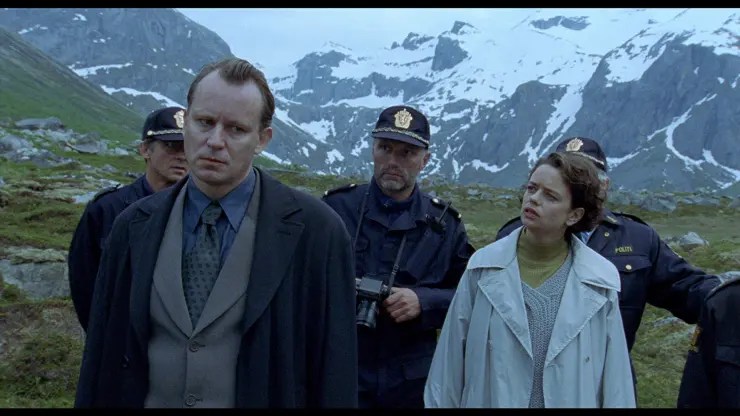
The performance does not announce itself. That is the whole thing. Skarsgård plays Jonas going still when he should flinch, pausing a half-beat too long before answering simple questions, watching every room he enters with the focus of a man who needs to know who in it already knows. He is calculating. He is also dissolving.
Roger Ebert compared the film to Dostoevsky when it opened stateside in 1998. The Crime and Punishment parallel is real, with one difference, Raskolnikov is tormented almost immediately. Jonas keeps choosing not to be. That is the colder read and the better film.
What Nolan Did With It

The 2002 remake moved everything to Alaska, added about 20 minutes, and made the detective a fundamentally decent man destroyed by circumstance. Al Pacino does the thing Pacino does. Robin Williams is genuinely unsettling in a way the film earns. Hilary Swank does more with her role than the script deserves. It is a competent Hollywood thriller and I have not thought about it since I watched it.
The key structural difference, in Nolan’s version, the detective dies. Some weight lifted. In the original, Jonas lives. Goes home. Carries it. That is the correct ending and the more disturbing one, and I will not call it a spoiler because you needed to know.
About This Release

Second Sight did not cut corners. The 4K restoration carries a director-approved HDR grade with Dolby Vision, and Thurmann-Andersen’s washed-out oppressive whites have never looked this punishing. The dual format edition puts the feature and bonus material on both the UHD and Blu-ray, which is a small detail that collectors notice and appreciate.
The physical package is a rigid slipcase with new art by Peter Strain, a 120-page book with essays from Jenn Adams, Mitchell Beaupre, Barry Forshaw, Francesco Massaccesi, Priscilla Page, and Travis Woods, and six collector art cards. The book reads like it was commissioned from people who actually watched the film. That sounds like a low bar. It is not.
What Is on the Discs

The audio commentary with Skjoldbjærg and co-writer Nikolaj Frobenius is the feature you will come back to. A director revisiting his debut nearly thirty years out has usually dropped the defensiveness and kept the honesty, and this one has that quality. Two new interviews accompany it: “Running on Instinct” with Skjoldbjærg, and “Falling Into It” with producer Petter J. Borgli. The producer interview fills in context the film itself never bothers to explain.
Alexandra Heller-Nicholas contributes a piece called “Private Prisons” that treats the film analytically without treating it as a sacred object. Three of Skjoldbjærg’s short films are included: Spor, Close to Home, and Near Winter. Watch those first if you want to know where Insomnia came from.
Buy It or Don’t

If you have never seen this film, the answer is yes. Full stop.
If you own the Criterion edition and you are doing upgrade math. The restoration is the definitive visual presentation and the commentary is new material unavailable anywhere else. Whether that moves the needle depends on you.
Insomnia is a Norwegian film about guilt dressed as a detective story. Jonas Engström did not need the midnight sun to lose his mind. He was already most of the way there.
-

 Hawaii53 seconds ago
Fight against Rapid Ohia Death advances – West Hawaii Today
-

 Idaho4 minutes ago
Idaho Remains Red, White, and Blue for America 250
-

 Illinois9 minutes ago
Fireball sightings reported in at least 8 states including Illinois
-

 Kansas14 minutes ago
Kansas City Mayor promises new conversion therapy ban amid ongoing fallout | Jefferson City News-Tribune
-

 Indiana16 minutes ago
Indiana man charged with rape after allegedly assaulting 18-year-old woman in barn
-

 Iowa19 minutes ago
Iowa joins wave of states forcing porn sites to verify users’ ages
-

 Kentucky31 minutes ago
Way-Too-Early Louisville 2026 Opponent Preview: Kentucky
-
 Louisiana34 minutes ago
Louisiana Fortify Homes Program opens registration for $80 million roof grant initiative

