Cleveland, OH
Abrupt funding freeze leaves Ohio manufacturing programs with uncertain future

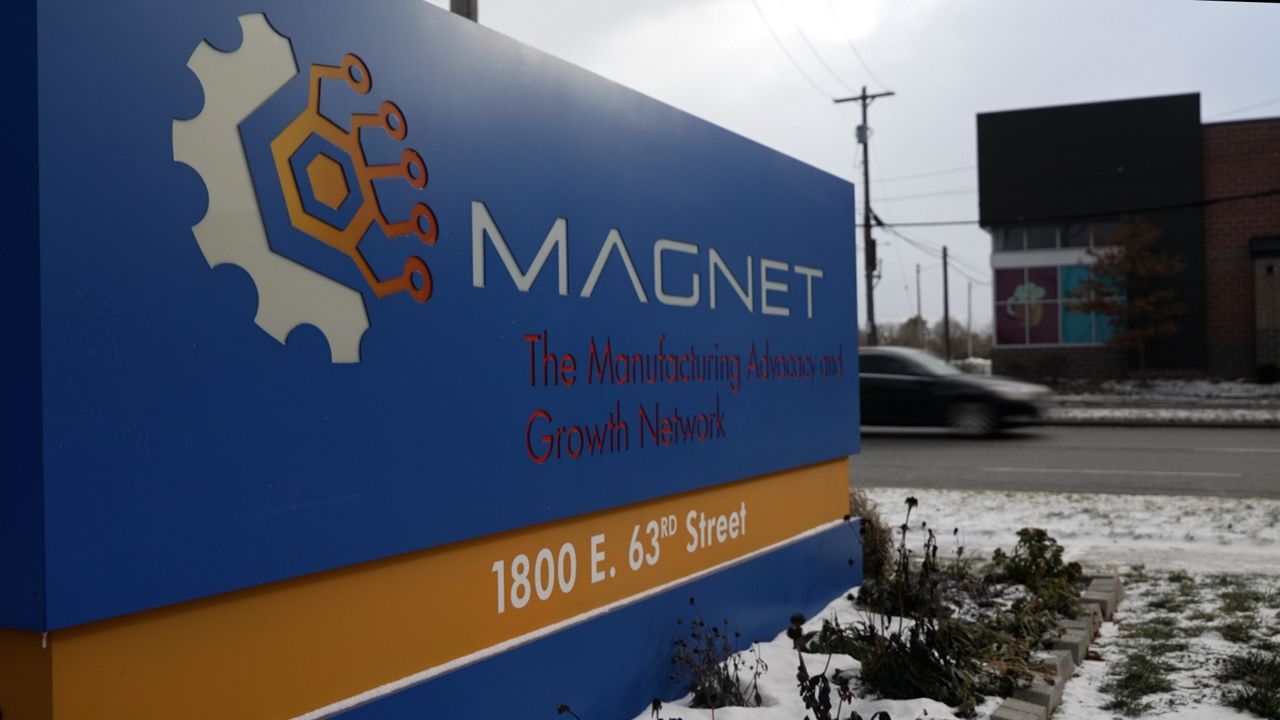
CLEVELAND — On Friday, Ohio’s Manufacturing Advocacy and Growth Network, known as MAGNET, learned that its public funding had been frozen, effective immediately.
“I was initially shocked. Immediately after it, it was action mode: how do we get to all the people that understand how important it is and what’s at stake?” said Ethan Karp, President and CEO of MAGNET.
“We help small and medium manufacturers, as a nonprofit, grow,” Karp explained.
The Cleveland-based nonprofit has assisted local manufacturers for over 40 years. This includes helping them implement new technology to stay competitive, providing workforce training to help fill positions in manufacturing, and helping companies create prototypes.
“That’s a start-up who has an idea on the back of their napkin that makes changing air filters easier,” Karp said. “This space we would actually prototype for those companies.”
They get state and federal funding through Ohio’s Manufacturing Extension Partnership Program, or MEP program, which funds six similar organizations throughout the state that aim to assist local manufacturers.
The funding freeze was announced in a letter from the National Institute of Standards and Technology, the federal agency that funds Ohio’s Department of Development. The Ohio Department of Development is the department that runs the MEP program.
In the letter, the NIST cites an ongoing audit as the reason for the freeze.
“Preliminary findings in connection with an active financial assistance audit being performed by the DOC Office of Inspector General (OIG) which identifies various instances of material noncompliance by the Recipient and/or its Subrecipients, several of which were confirmed by the Recipient or the applicable Subrecipient.” – Letter from NIST to Ohio’s Department of Development announces funding freeze
The audit of Ohio’s MEP program started over a year ago, and the results aren’t set to be published until Spring 2026.
The letter specifically cites three MEP programs for misreporting income. MAGNET is not one of the programs mentioned specifically in the letter.
One program that is mentioned is the Center for Innovative Food Technology (CIFT). In the letter announcing the freeze, CIFT states:
“CIFT did not report 2.3 million in unreported program income on the earlier five-year award. CIFT has acknowledged at least 1.8 million is unreported program income.”
CIFT President and CEO Rebecca Singer denies any wrongdoing and says the discrepancy is because of unclear guidelines about what a program should report as income.
“CIFT has fully cooperated with the audit and the statements are misleading and inaccurate,” Singer said in a statement. “Any issues that occurred were administrative in nature and we are prepared to address them once a drafted report is provided. There is consistency in the findings among the organizations further demonstrating lack of clarity and understanding on administrative reporting. Several OIG audits of other state programs have noted under-reporting of program income but they have been given the opportunity to counter findings.”
Singer said that the typical process of an audit has not been followed, and CIFT did not see a draft of the audit and respond, which she said is the standard process for a financial audit.
According to Singer, because of the freeze CIFT lost $1.6 million in public funding and, as a result, they are suspending operations on Monday, Dec. 15. Singer said 13 employees will be affected as well as 22 businesses that rely on CIFT’s mini food processing kitchen, which allows them to make their products to sell at retail outlets.
With the freeze of federal funds, the state of Ohio has also frozen its portion of funding to the MEP program.
In a statement, Mason Waldvogel, the Deputy Chief of Media Relations for Ohio’s Department of Development, explains that the state funding is tied to federal funding.
“The majority of state funding provided to Ohio MEP partner organizations consists of matching dollars, which cannot be spent without corresponding federal funds. Therefore, the Department of Development has suspended the program at the state level.”
The freeze affects roughly $14 million in funds to Ohio manufacturing nonprofits over the next year, with MAGNET receiving $5.9 million of those funds.
Karp said MAGNET has been complying with the audit and is frustrated the freeze was started before there had been communication with the MEP programs about the findings.
“If there is an issue, then you need to tell somebody there is an issue and give somebody a chance to fix it. In this case, there’s nothing for us to fix because we don’t know what, or if, there are findings and a report. That lack of transparency, that lack of process makes no sense,” Karp said.
Karp said the funding cut-off will change how MAGNET functions, prompting decisions to be made about potential lay-offs of their staff of roughly 75 people.
“We’re going to have to structurally make huge changes at MAGNET to continue at a much smaller scale,” Karp said.
According to Karp, approximately 35% of their budget comes from state and federal funding. The rest is from a private industry that pays for MAGNET’s services. However, Karp said they can only provide many of those services because of their public funding.
“Helping people understand that the investment that the state and federal governments have been making for 40 years, this is a 40-year partnership — shouldn’t be turned off at a moment’s notice, depriving all these people and companies of necessary support.”
This funding freeze could impact the manufacturing sector in Ohio.
“We’re saying we want to restore manufacturing? Well this is not how you restore manufacturing. This is not how you bring jobs back from overseas; we are actually going to be cutting Ohio jobs as a result of this decision,” said Jack Schron, President of Jergens Incorporated, a Cleveland-based manufacturer.
Schron sits on MAGENT’s board and has used its resources to test out Jergens products.
Micheal Canty, president and CEO of Alloy Precision Technologies, said the freeze will impact small and medium-size companies the most.
“I think it will be devastating to manufacturing,” Canty said. “If MAGNET and all the MEP’s are gone, then a lot of those projects to develop and promote smart manufacturing and manufacturing in general go away.”
Karp said the irony is that MAGNET’s goals align with the current administration’s efforts to make U. S manufacturing more competitive.
“I desperately want tariffs to help companies. Every single day I am out there talking about how we need to compete against international sources and how our companies need to be the most technologically advanced in the world. It is the same thing the Trump administration says, and we are totally aligned. So it is ironic that this is happening to us now,” Karp said.



ERIE COUNTY, Ohio (WOIO) – Ohio troopers said a 13-year-old boy died Thursday from injuries stemming from an ATV crash on Sunday afternoon.
The highway patrol has identified the victim as Lamonie Campbell from Cleveland.
The crash, which also hurt a 10-year-old boy, took place around 1:45 p.m. in the eastbound lane of State Route 113 in Milan Township.
The 10-year-old was operating an ATV, with Campbell as the passenger, when the crash happened.
A Toyota, operated by a Berlin Heights man, struck the ATV as it entered State Route 113 from a private drive, troopers said.
According to the highway patrol, the ATV caught fire as a result of the crash, which also sent the Toyota off the roadway before it rolled and struck a pole.
First responders first took the boys to Fisher-Titus Medical Center for treatment.
Troopers said the 13-year-old was later flown by medical helicopter to a Cleveland hospital.
There’s no update at this time on the 10-year-old’s condition.
State Route 113 was closed for approximately one hour and 50 minutes.
The highway patrol will continue to investigate the crash.
Copyright 2026 WOIO. All rights reserved.
Cleveland, OH
Colt Emerson Leads Mariners Past Guardians In Return to Ohio – WHIZ – Fox 5 / Marquee Broadcasting

CLEVELAND, OH – Some three years ago, Colt Emerson was tearing it up in the Muskingum Valley League for John Glenn, on his way to being named the Gatorade Player of the Year, right here in Ohio. Now, fast forward to 2026, he returns home for the first time as a pro, as the Mariners faced the Guardians in a true homecoming for Emerson.
“Being here is special. A lot of games growing up, coming here. So it’s going to be pretty surreal” said Emerson before game one of the series in Cleveland. “I love the game, you know? I respect the game, and I’m just so grateful to be here.”
Growing up a lifelong baseball fan in Ohio, Colt always knew this day would come, but that doesn’t mean he doesn’t have to pinc himself every now and again when he puts on the Mariners jersey.
Emerson continued, “If ten-year old me can see me sitting here, see me on the field, that’s the only thing that matters. It’s been a fun journey.”
The game started slowly for Seattle, with no runs or even hits to talk about, at least until Emerson took the plate in the third. With one swing of the bat on an inside change up from left handed pitcher Joey Cantillo, he sent one into the right field seats for a home run in his first at bat back in his home state.
“I can’t even describe it” said Emerson, with a broad grin across his face after the game. “When I saw it go out, I took my time around the bases, just to look around, you know? You grew up playing here, and your first at bat, you hit a home run. It’s cool.”
Colt had quite the efficient ball game, reaching base three times with two walks, and accounting for two of the Mariners’ runs in the three to one victory. It is his first career multi-walk, and multi-run game in the major leagues.
Emerson continues to amaze his manager, Dan Wilson, each and every game.
“Like we’ve said before, he just sees the game and he senses the game and knows what to do in the right situation, and tonight was another example of that” said Wilson.
It’s another memorable moment in the remarkable rookie career of one of John Glenn High School’s finest, as Emerson continues to provide a much-needed spark for Seattle.
The Mariners are in Cleveland for two more games this weekend before heading back on Sunday night.

CLEVELAND, Ohio (WOIO) – Heinen’s Grocery Store announced on Friday that it will be closing its downtown Cleveland location on the corner of East 9th Street and Euclid Avenue.
This last day will be on July 31.
The store first opened in 2015.
All associates at the downtown store will be offered roles at other Heinen’s locations, and there will be no layoffs, the release said. This decision affects only the Downtown Cleveland location.
Cleveland Mayor Justin Bibb shared the following statement after the announcement was released:
This is a developing story. Return to 19 News for updates.
Copyright 2026 WOIO. All rights reserved.
-

 Finance35 seconds ago
Campaign finance reports show big contributions in Lubbock council race
-

 Fitness6 minutes ago
Alexandra Daddario, 40, Relies on This Underrated Crunch Upgrade for Strong Abs – Here’s How to Do It Properly
-

 Movie Reviews16 minutes ago
‘House of Criticism’ Review: A Pensive and Touching Portrait of Married Art Critics Jerry Saltz and Roberta Smith (It Is Only, at Moments, a True-Life Christopher Guest Movie)
-

 World28 minutes ago
Annecy Colombian Short ‘Once in a Body’: Fiction Rooted in Real Experiences
-

 Health51 minutes ago
This Protein Smoothie Trick Helps Women Over 40 Lose Twice as Much Fat
-
 Lifestyle1 hour ago
‘Wait Wait’ for June 27, 2026: With Not My Job guest Stephen Malkmus
-

 Technology1 hour ago
Margaret Atwood says the problem with AI is ‘garbage in, garbage out’
-

 World1 hour ago
Gulf countries strongly condemn Iran’s drone attack on Bahrain as rising tensions threaten MOU

