Science
Beloved eagle, a school mascot, electrocuted on power lines above Bay Area elementary school

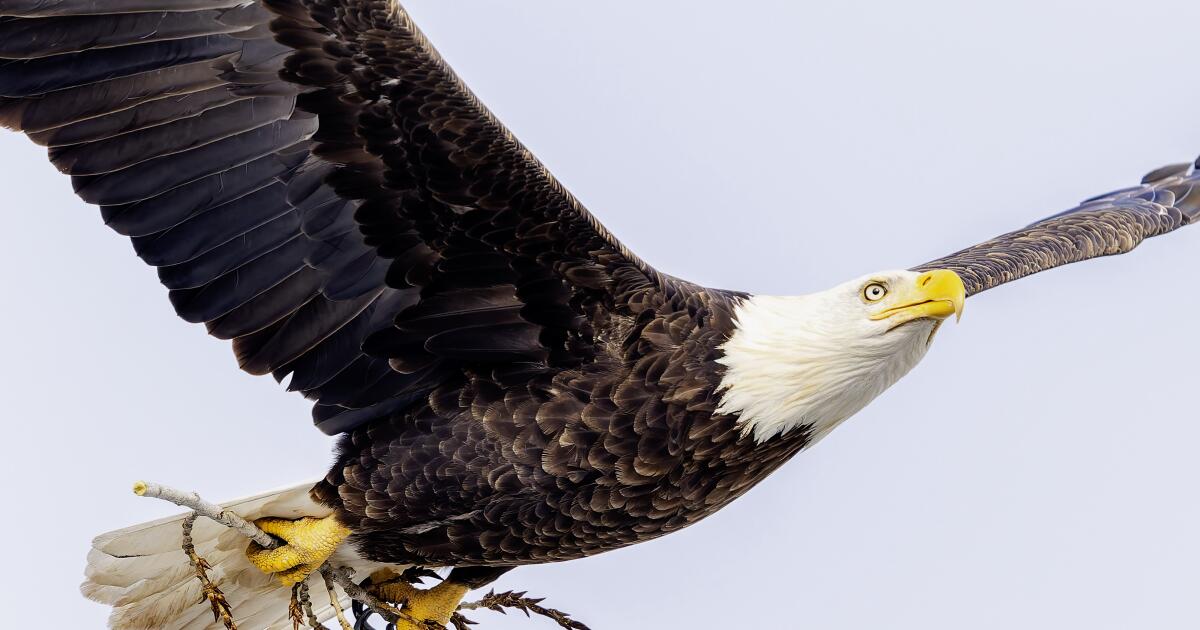
MILPITAS, Calif. — As scores of students swarmed out of their Milpitas elementary school on a recent afternoon, a lone bald eagle perched high above them in a redwood tree — only occasionally looking down on the after-school ruckus, training his eyes on the grassy hills along the western horizon.
The week before, his mate was electrocuted on nearby power lines operated by PG&E.
Kevin Slavin, principal of Curtner Elementary School, said the eagles in that nest are so well-known and beloved here that they were made the school’s mascots and the “whole ethos of the school has been tied around them” since they arrived in 2017.
What exactly happened to send Hope the eagle off the pair’s nest in the dark of night and into the live wires on the night of Nov. 3 is not known (although there’s some scandalous speculation it involved a mysterious, “interloper” female).
According to a spokesperson from PG&E, an outage occurred in the area at around 9 p.m. Line workers later discovered it was caused by the adult eagle.
The death, sadly, is not atypical for large raptors, such as bald and golden eagles.
According to a 2014 analysis of bird deaths across the U.S., electrocution on power lines is a significant cause of bird mortality. Every year, as many as 11.6 million birds are fried on the wires that juice our televisions, HVAC systems and blow driers, the authors estimated. The birds die when two body parts — a wing, foot or beak — come in contact with two wires, or when they touch a wire and ground source, sending a fatal current of electricity through the animal’s body.
Because of their massive size, eagles and other raptors are at more risk. The wingspan of an adult bald eagle ranges from 5.5 to 8 feet across; it’s roughly the same for a golden eagle.
An eagle couple in Milpitas, before the female was electrocuted when coming into contact with high-power electrical lines earlier this month.
(Douglas Gillard)
According to a report from the U.S. Fish and Wildlife Service’s National Forensics Laboratory, which analyzed 417 electrocuted raptors from 13 species between 2000 and 2015, nearly 80 percent were bald or golden eagles.
Krysta Rogers, senior environmental scientist at the California Department of Fish and Wildlife Investigations Laboratory, examined the dead eagle.
She found small burns on Hope’s left foot pad and the back of her right leg. She also had singed feathers on both sides of her body, but especially on the right, where Rogers said the wing looked particularly damaged. She said most birds are electrocuted on utility poles, but Hope was electrocuted “mid-span,” where the wires dip between the poles.
Melissa Subbotin, a spokesperson for PG&E, said the poles and wires near where the birds nested had been adapted with coverings and other safety features to make them safe for raptors.
However, it appears the bird may have touched two wires mid-span. Subbotin said the utility company spaces lines at least 5 feet apart — a precaution it and other utility companies take to minimize raptor deaths.
“Since 2002, PG&E has made about 42,990 existing power poles and towers bird-safe,” Subbotin said. The company has also retrofitted about 41,500 power poles in areas where bird have been injured or killed.
In addition, she said, in 2024, the company replaced nearly 11,000 poles in designated “Raptor Concentration Zones” and built them to avian-safe construction guidelines.
Doug Gillard, an amateur photographer and professor of anatomy and physiology at Life Chiropractic College West in Hayward, who has followed the Milpitas eagles for years, said while there is safety equipment near the school, it does not extend into the nearby neighborhood, where Hope was killed.
Gillard said a photographer who lives in the neighborhood took a photo of the eagle hanging from the wires that Gillard has seen. The Times was unable to access the photo.
Not far from the school is a marshy wetland, where ducks, geese and migrating birds come to rest and relax, a smorgasbord for a pair of eagles and their young. There are also fish in a nearby lake.
Gillard said one of the nearby water bodies is stocked with trout, and that late fall is fishing season for the eagles. He said an army of photographers is currently hanging around the pond hoping to catch a snapshot of the father eagle catching a fish.
Rogers said the bird was healthy. She had body fat, good muscle tone and two small feathers in her gut — presumably the remnants of a recent meal. She also had an enlarged ovary and visible oviduct — an avian fallopian tube — suggesting she was getting ready for breeding, which typically happens in January or February.
Slavin, the principal, said that a day or two before the mother’s death, he saw the couple preparing their nest, and saw a young female show up. “It was a very tense situation among the eagles,” he said.
Gillard, the photographer, said the “girlfriend” has black feathers on her head and in her tail, suggesting she isn’t quite five years old.
Gillard and Slavin say they’ve heard from residents there may have been some altercation between the mom and the interloper that sent Hope off the nest and into the wires that night.
The young female remains at the scene, and is not only being “tolerated” by the father, but occasionally accompanies him on his fishing trips, Gillard said.
Eagles tend to mate for life, but if one dies, the other will look for a new mate, Gillard said. If the female eagle sticks around, it will be the dad’s third partner.
Photographers can identify the father, who neighbors just call “Dad,” by the damaged flexor tendon on his right claw, which makes it appear as if he is “flipping the bird” when he flies by.


Federal agricultural inspectors detected a case of New World screwworm larvae — maggots that burrow into the flesh of living animals and sometimes humans — on a 3-week-old calf in south Texas, near the U.S.-Mexico border. Officials anticipated the arrival of screwworm in the United States and say they’re prepared to contain it.
New World screwworm, also known as Cochliomyia hominivorax, is starkly different from the average maggot that feeds on decaying organic matter such as garbage, rotting food or dead animals, said Tom Talbot, veterinarian and member of the California Cattlemen’s Assn.
That’s because a screwworm larva “attacks living flesh,” Talbot said.
On Thursday, the U.S. Department of Agriculture confirmed the detection of New World screwworm in the umbilical area of a bovine in Zavala County, Texas, more than 60 miles from the northern Mexico border.
As of Friday morning, there have been no additional cases of infected animals reported.
Screwworm is endemic in South America and parts of the Caribbean, according to the Centers for Disease Control and Prevention. However, the parasitic fly has been steadily moving north from Central America to Mexico since 2023.
The USDA says it has actively monitored the fly’s movement. Last month, the USDA was aware of more than 200 active screwworm infestation cases in the border states of Nuevo León and Tamaulipas, according to Mexico’s Secretary of Agriculture and Rural Development dashboard. There are currently more than 2,000 active cases throughout Mexico.
It was believed that the New World screwworm would enter the U.S. in 2025, “however, thanks to the hard work across the entire Trump administration and our industry, state, and local partners, we were able to buy time for this moment,” said Dudley Hoskins, undersecretary for Marketing and Regulatory Programs for the USDA, in a statement.
The potential economic impact of New World screwworm on the cattle industry due to import restrictions, reduced productivity and animal loss is substantial, said Sally DeNotta, director of the University of Florida’s Equine Performance Laboratory.
Last year, 175 key agricultural organizations signed a letter urging additional federal funding for screwworm-control measures, emphasizing USDA estimates that a New World screwworm outbreak in the U.S. could cost producers $4.3 billion annually and cause economic losses of more than $10.6 billion across the southern United States.
“While the fly does not survive at temperatures at or below freezing, infected animals could carry the parasite northward and spread infection during the summer months, and the temperate climate of Southern California could certainly support year-round New World screwworm populations,” DeNotta said.
Talbot said from the federal to the local level, everyone in the ranching community has been talking about the arrival of screwworm and how to combat it.
“My expectation is that there will be a minimal number of cases of [New World screwworm] in California,” he said.
That’s because there are several stations on the border in Southern California, he said, that are collecting data, monitoring for any incidents of the parasitic fly and trapping them.
Talbot says he’s confident that the proactive measures on behalf of the federal government will mitigate the screwworm’s reach and therefore not impact the beef supply locally or nationally.
How screwworm infection spreads
Female screwworm flies are attracted to the smell of wounds — that can be as small as a tick bite — and body openings such as the nose, eyes, ears and mouth where they can lay eggs, according to the CDC.
A female screwworm fly can lay 200 to 300 eggs at a time and may lay up to 3,000 eggs during her 10 to 30-day lifespan.
When the eggs hatch into maggots, the maggots eat live tissue, causing a worsening, often painful and foul-smelling wound, according to the CDC.
Screwworm has hit the United States before
There was a screwworm outbreak in the southwestern region of the United States in 1965 that prompted Mexican and U.S. livestock producers to sign a declaration to establish a joint program for the eradication of the screwworm from the states on either side of the Mexico-U.S. border, according to the National Agricultural Library.
By 1966, the United States had eradicated screwworms, but livestock remained vulnerable to reinfestation from screwworms migrating from Mexico.
Eradication was possible through the sterile insect technique, which uses gamma radiation to irradiate screwworm pupae and create sterile male flies.
The U.S. Department of Agriculture’s Animal and Plant Health Inspection Service maintains a screwworm pupae sterilization facility in North America and is currently building a new center in southern Texas.
When produced and released in large numbers, sterile male flies mate with wild female flies, which then lay unfertilized eggs, according to the USDA.
“Since female screwworm flies normally mate only once, the population progressively reduces and is, ultimately, eradicated,” according to USDA officials.
Last year, the Trump administration cut thousands of grants and programs from the U.S. Agency for International Development, which includes U.S.-funded animal disease monitoring projects operated by the United Nations Food and Agriculture Organization, Argi-Pulse Communications reported. Among the slashed programs were some dedicated to monitoring and containing New World screwworm in Central America.
Today, screwworm infestations aren’t a regular occurrence in the U.S., but cases have occurred in travelers returning from areas where the flies are present, according to the CDC.
Can infected animals be treated?
Infected wounds are cleaned and debrided to remove any screwworm larvae, after which the animal is treated with an approved insecticide, DeNotta said.
Last month, the U.S. Food and Drug Administration issued an emergency use authorization for several insecticides known to be effective against screwworm.
There are approved systemic and topical options for a variety of species, including cattle, horses, small ruminants, cats and dogs, DeNotta said.
“Multiple days of treatment are often required, and antibiotics and analgesics may also be administered to treat secondary infection and control pain,” she said.
If left untreated, the tissue destruction caused by flesh-eating larvae can be extensive and severe, often resulting in debilitation and eventual death of the host, DeNotta said.
“Animals that survive may suffer weight loss, poor growth and reduced productivity as a result of pain and discomfort,” she said.
Screwworm can infect humans
Human infection is rare, DeNotta said, but it can happen.
Humans are at risk of being infected by screwworms if they travel to an area where the flies are present, such as South America and the Caribbean, according to the CDC.
CDC officials said your risk of screwworm infection increases when you:
- Spend a lot of time outdoors during the day, especially if sleeping or unable to keep the flies at bay.
- Have any open wounds. A small break in the skin, including from a scratch, insect bite or recent surgery, may attract screwworm flies.
- Have a medical condition that causes bleeding or open sores, such as from skin or sinus cancer, or from treatments that can create breaks in the skin.
- Live, work or spend an extended amount of time with or near, livestock or other warm-blooded animals in areas where screwworm flies are present.
The symptoms humans experience when infected by screwworm
The following are symptoms of screwworm according to the CDC:
- Feeling maggots move or seeing maggots within a skin wound, sore or body opening.
- Painful skin wounds or sores that worsen within a few days.
- Foul-smelling odor from the site of the infestation.
- Bleeding from open sores.
Bacteria can also infect wounds where screwworm maggots are present and may cause an infection that can lead to symptoms like fever or chills.
To treat a screwworm infection, DeNotta said, people undergo the same combination of wound debridement and insecticides used in animals.

California researchers are leading a nationwide effort to find out why some Asian American communities have high rates of certain cancers.
It comes as health experts see rising rates of lung cancer among Asian American women who have never smoked and increasing rates of early-onset breast cancer.
“Asian Americans are actually the first racial and ethnic group for whom cancer is the leading cause of death,” said Scarlett Gomez, a cancer epidemiologist at UC San Francisco and a lead on the project.
UCSF joins researchers from UC Irvine, UC Davis, Cedars-Sinai and Temple University in launching a $12.5 million National Cancer Institute-funded study called the ASPIRE Cohort, that will follow 20,000 Asian Americans over time. Researchers say it’s the first large-scale longitudinal cancer study focused on Asian Americans.
Lung cancer incidence has declined across much of the United States as smoking rates have fallen. However, researchers have observed a slight increase among Asian Americans, despite relatively low smoking rates, particularly among women. More than half of Asian American women diagnosed with lung cancer are nonsmokers, they say.
Many existing studies of lung cancer risk among nonsmokers have been conducted in Asia, where exposure patterns can differ significantly from those in the United States, said Iona Cheng, a molecular epidemiologist at UCSF and also a lead on the project.
Researchers know that outdoor air pollution, secondhand smoke and cooking oil fumes can contribute to lung cancer risk. But it’s not clear if these explain disease patterns among Asian Americans in the United States.
Rising rates of breast cancer among Asian American women are also driving the push.
“Early onset breast cancer” — diagnosed before age 50 — “is going up the fastest among Asian Americans,” Gomez said. Recent data show rates among Asian Americans, Native Hawaiians and Pacific Islanders are approaching those of non-Hispanic white women, she said. Cancer experts don’t know why.
One of the central goals of the ASPIRE study is to move beyond treating Asian Americans as a single category. The term can include people with roots in dozens of countries from Sri Lanka to China’s border with Russia to Pacific islands, with completely different exposure patterns and cuisines.
“When we separate and look at all the distinct Asian ethnicities, we see a wide variation,” Cheng said.
Filipino women have a higher incidence of thyroid cancer, and stomach cancer has been more common among some Korean and Japanese people. Combining all Asian Americans into one category can make those differences impossible to detect.
The study also seeks to address longstanding gaps in representation. Although Asian Americans make up nearly 8% of the U.S. population, they have historically received little research funding.
Existing cancer studies have also often included too few Asian Americans to draw meaningful conclusions about specific ethnic groups, researchers said. Salma Shariff-Marco, a social and behavioral scientist at UCSF and also a lead on the projects, aid that has made it hard to show the need for more targeted research. The ASPIRE cohort, she said, is designed to show the variation by including a broader range of ethnic groups and more contemporary exposures than previous work.

Last summer, a NASA-funded asteroid impact warning system detected a mysterious object speeding through the solar system.
Scientists determined the object had entered the solar system from deep space, making it the third known object to have come from another star system.
NASA called it Comet 3I/ATLAS and said it didn’t pose a threat. But its discovery in July led to wild speculation that the object was a piece of extraterrestrial technology — maybe even an alien spacecraft.
The SETI Institute, a nonprofit that explores the origins of life and searches for extraterrestrial intelligence, said this week that a team of scientists had used a radio telescope to try to detect signals that could indicate extraterrestrial life on the comet.
But they found none.
“While observations strongly indicate that 3I/ATLAS is a natural object, interstellar visitors are also compelling technosignature targets because an artificial object — however unlikely — could represent detectable extraterrestrial technology and potentially provide the first evidence of life beyond Earth,” the institute said in a news release.
SETI scientists said they used the Allen Telescope Array at the Hat Creek Radio Observatory in Northern California to scan the object for seven hours, covering a spectrum of 1 to 9 gigahertz.
“This broad range allows scientists to search for narrowband radio signals, which are not produced in nature and would be evidence of technology,” the news release said.
The institute said the team identified nearly 74 million narrowband signals, but ultimately traced them back to technology on the Earth’s surface or orbiting satellites.
“The results from 3I/ATLAS show how realistic it is to detect a signal with the technology we have today,” said Valeria Garcia Lopez, one of scientists on the SETI team. “That is why it is important to keep searching for technosignatures, even from objects we might not expect to have signals.”
The institute said the researchers also can learn more about the natural properties of interstellar objects as they travel through our solar system.
“As more interstellar objects are discovered, each offers a new opportunity to probe the cosmos for technosignatures, advancing our understanding of both natural and possible technological phenomena beyond our Solar System,” the SETI statement said.
-

 Los Angeles, Ca1 hour ago
Protests mark 1-year anniversary of federal agents storming L.A.’s Fashion District
-

 Detroit, MI1 hour ago
Hundreds gather for rally against gun violence on Detroit’s east side
-

 San Francisco, CA2 hours ago
San Francisco unveils iconic Pink Triangle to kick off Pride Month
-

 Miami, FL2 hours ago
Miami Dolphins Discussion: Could He Be The One
-

 Dallas, TX2 hours ago
Dallas Hoops Journal Podcast: James Barlowe Details Mavs’ NBA Draft Options
-

 Boston, MA2 hours ago
NBA insider believes Giannis Antetokounmpo’s intrigue in Celtics ‘is real’
-

 Denver, CO2 hours ago
Denver weather: More hot weather Sunday
-

 Seattle, WA2 hours ago
PHOTOS: West Seattle High School alums gather for 2026 All-School Reunion

