Lifestyle
How the turkey trotted its way onto our Thanksgiving tables — and into our lexicon

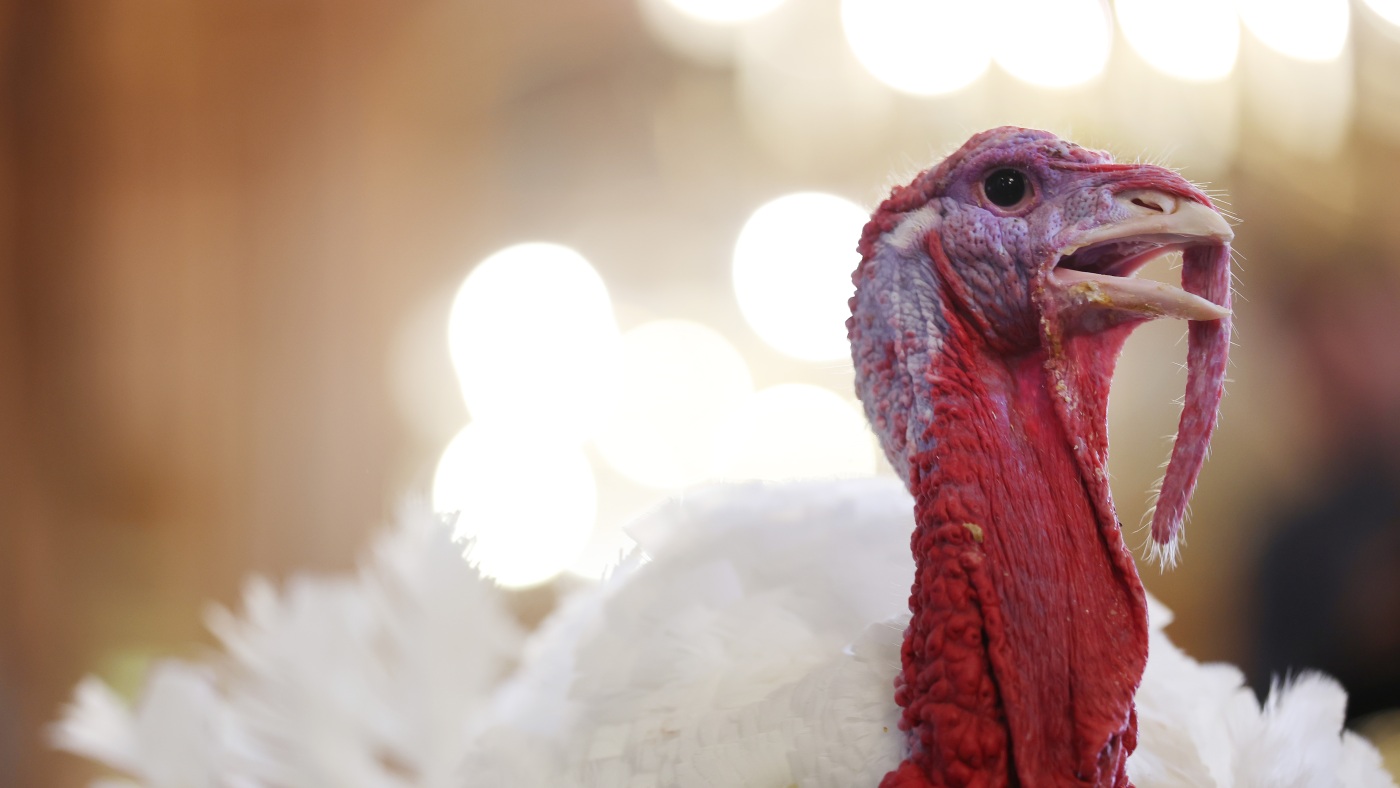
One of the two national Thanksgiving turkeys, Waddle and Gobble, which were presented to journalists in the Willard Room of the Willard InterContinental on November 24, 2025 in Washington, DC., for the 78th annual Turkey Pardoning at the White House.
Anna Moneymaker/Getty Images
hide caption
toggle caption
Anna Moneymaker/Getty Images
In the English language, the turkey gets kind of a tough break.
Talking turkey requires serious honesty and speaking harsh truths. Going cold turkey is, often, an onerous way of quitting something completely and suddenly. Being a turkey is a rude zinger thrown at movie and theatrical flops, as well as unpleasant, failure-prone people.

Yet, in the culinary world, the turkey looms large, particularly during November. This year, Americans are expected to eat about 30 million of them on Thanksgiving day, according to the National Turkey Federation. It’s a fitting legacy for a bird that’s been a fixture of holiday meals ever since it was first brought across the Atlantic to Europe by colonists.
But for all its cultural ubiquity, much of the turkey’s early history is shrouded in uncertainty, historians and etymologists say. That’s particularly true of how the bird got its name.
“‘Turkey’ is a very confusing, confusing name,” says Anatoly Liberman, a linguist and etymologist at the University of Minnesota, Twin Cities.
So in this week’s installment of “Word of the Week,” we trace the origins of that confusing name — all the way back to pre-Columbian Mexico.
A case of mistaken identity
The species of Thanksgiving turkey that we know today, meleagris gallopavo, was domesticated in the Americas centuries before the arrival of Europeans, according to food historian Andrew F. Smith’s book The Turkey: An American Story. They were found in what’s now Mexico and the U.S. Southwest, though the exact details of who domesticated the birds and when aren’t quite clear, Smith writes. And, thanks to fairly shoddy record-keeping, it also isn’t quite clear which European explorers can be credited with bringing turkeys back home with them.

But by the 1520s, the birds were being raised in Spain and served on the dinner tables of the upper-class, Smith writes. Over the decades, farmers across the continent began to raise them, too.
From there, though, the American bird became a victim of mistaken identity, according to lexicographer Erin McKean. Prior to meleagris gallopavo‘s arrival, the Europeans already had a bird they called the turkey: the African guinea fowl. The two game birds look similar and were ending up on people’s dinner tables in basically the same way, McKean says.

A guinea fowl is seen in January 2020 in Johannesburg, South Africa. Prior to the arrival of meleagris gallopavo, the African guinea fowl was the bird that Europeans called a “turkey.”
Warren Little/Getty Images
hide caption
toggle caption
Warren Little/Getty Images
“I bet they look a lot more similar when they’re denuded of their feathers, roasted and on a plate,” she says.
As a result, meleagris gallopavo got stuck with the name “turkey,” too.
But the American turkeys began to eclipse the popularity of their African doppelgangers, Smith writes. And they began showing up in historical documents; in 1550s Venice, for example, they were subject to sumptuary laws, which governed which members of society had access to particular luxuries, McKean says.
“So only certain people were allowed to eat turkey at that point,” she says.
One thing that’s not clear in the historical documents, though, is how the term “turkey” came to apply to guinea fowls in the first place. Smith writes that Europeans often added the word “turkey” onto items that were foreign and strange, like “turkey corn” from the Americas. McKean says that the name is thought to have come from the guinea fowl being brought by traders into Europe through the Turkish region.
But the word’s origin isn’t settled fact, she says. “I’m not sure we’re ever going to know.”
For his part, Liberman says that it’s a myth that the bird has anything to do with the country of Turkey.
“The Europeans knew nothing about [the turkey’s] origin and invented all kinds of names. They were not sure where the bird came from and ascribed its origin to all kinds of foreign lands,” he says.
In that sense, the bird is in good company: Liberman says that the origins of most bird names are mysterious. “Some are entirely fanciful, and some are the product of confusion,” he says.
Back to the Americas, and into the English lexicon
Over the decades, the English grew particularly fond of turkeys, which became a central part of celebrations like Christmas, Smith writes in The Turkey. So when English colonists came to North America and created settlements like Jamestown in the early 17th century, they brought their beloved domesticated turkeys along with them.
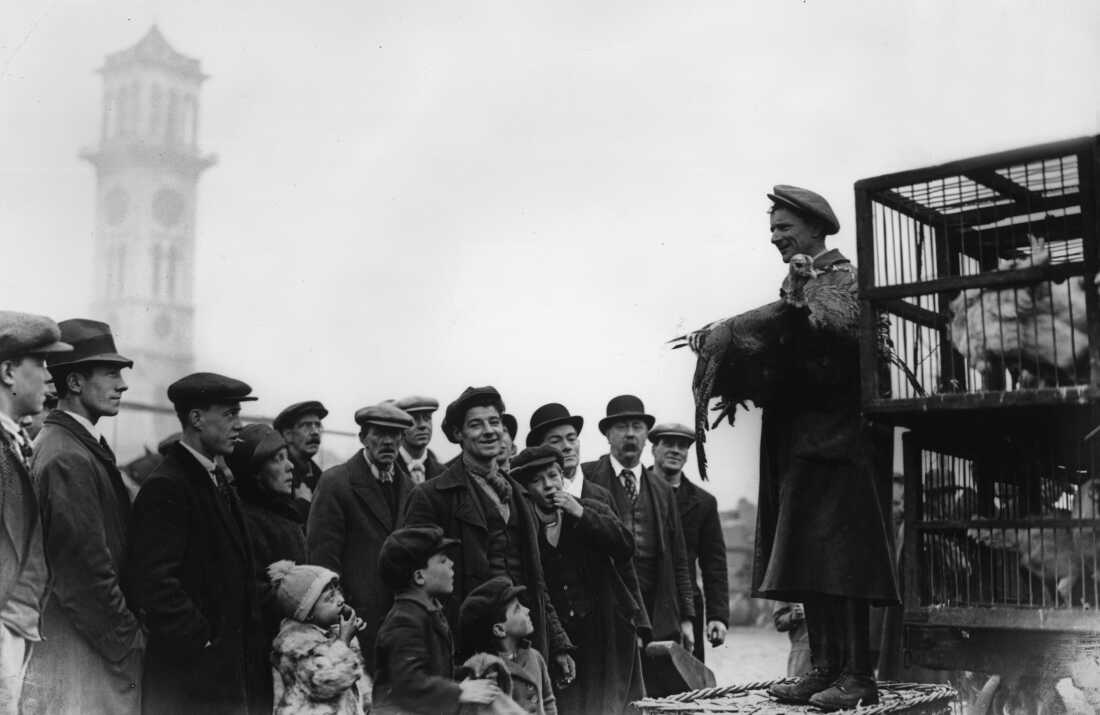
Crowds buying their Christmas turkeys at the Caledonian Market, London.
John Warwick Brooke/Topical Press Agency/Hulton Archive/Getty Images
hide caption
toggle caption
John Warwick Brooke/Topical Press Agency/Hulton Archive/Getty Images
The rest is history. Over the next two centuries, colonists’ celebrations of thanksgiving for good harvests and military victories became tradition, Smith writes. And by the time President Abraham Lincoln declared Thanksgiving to be a national holiday in 1863, turkeys were a mainstay of those meals.
Ever since, the turkey has remained on Thanksgiving tables — and in our colloquialisms, though they’ve continued to evolve.
Take “cold turkey,” for example. Now, the phrase is often associated with quitting an addiction – but that wasn’t the case when the first uses of the idiom started popping up in the late 19th century, according to Dave Wilton, the editor of WordOrigins.org. It simply meant that something was done quickly, he says, in reference to the fact that cold turkey is a dish that requires no preparation.
The meaning of “talking turkey” has also evolved, he says, from being “social” and ” agreeable” in the early 19th century to talking plainly and frankly around the beginning of the 20th.
Calling someone a “turkey” as an insult comes from theatrical slang, he says. Starting in the late 1800s, second-rate thespians were deemed “turkey actors”. It’s also come to describe box office failures.
Why all the negativity? McKean has a theory: “It’s an ugly bird that struts like a peacock without the beautiful feathers to justify showing off.” (Ouch.)
But it’s a word that has had staying power, despite the fact that it’s likely a misnomer in the first place.
“One thing we can’t lose sight of is that turkey is pretty much a fun word to say,” McKean says.
At the very least, it’s catchier than meleagris gallopavo.

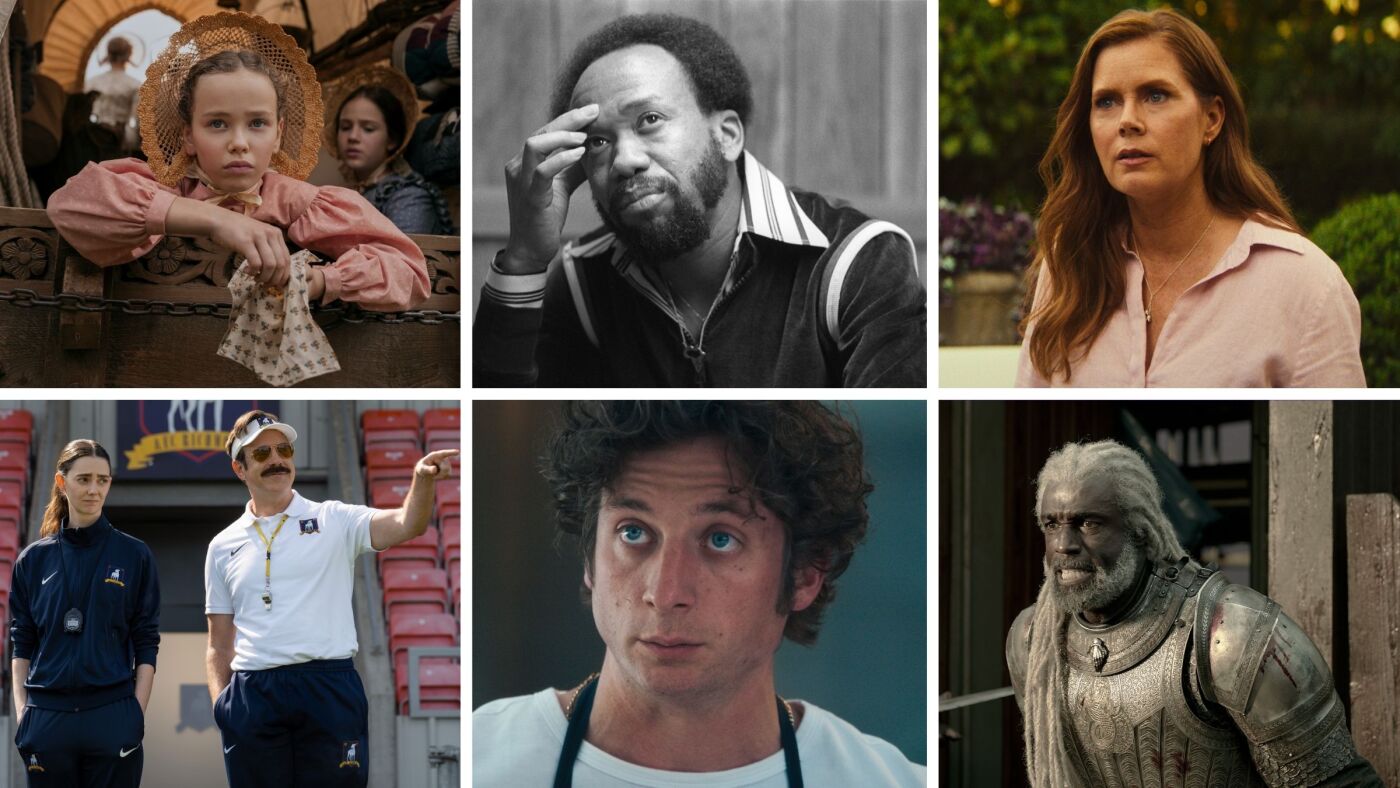
Clockwise from top left: Little House on the Prairie; Earth, Wind & Fire (To Be Celestial vs. That’s The Weight Of The World); Cape Fear; House of the Dragon; The Bear; Ted Lasso.
Netflix; HBO; Apple TV; HBO; FX; Apple TV
hide caption
toggle caption
Netflix; HBO; Apple TV; HBO; FX; Apple TV
Summer is when people are trying to get away from screens — headed outside to enjoy weather and time off.
But in the modern age, TV never sleeps, so streaming and premiere television outlets have lined up a slew of attention-getting new and returning shows competing with vacations and sunny days over the next few months to pull in viewers and attention.
Fans can choose from remakes of classic films and TV shows like Cape Fear and Little House on the Prairie, the final season of FX’s fading dramedy The Bear, Larry David’s intriguing new HBO project made with Barack and Michelle Obama’s Higher Ground productions and the return of a series many fans thought was over and done with — Apple TV’s hit comedy, Ted Lasso.
Here’s a look at what’s coming when, and why it matters:
Cape Fear, Apple TV, June 5
YouTube

It’s tough to imagine an actor who could bring a creepier vibe than Robert DeNiro in 1991’s film thriller Cape Fear — playing a wiry, pathological felon who blamed his public defender for purposefully tanking his case. But Javier Bardem is that actor, raising the stakes for Apple TV’s modern streaming series with a deliciously wily performance as Max Cady — a man exonerated after serving 17 years in prison for murder. Amy Adams is Anna Bowden, the former public defender who defended Cady, but wound up marrying the prosecutor that put him away, raising all kinds of suspicion over how she handled his case. Lots of it is preposterous and heavy-handed, but Bardem plays Cady with more intelligence and sophistication than DeNiro’s version, dismantling his former lawyer’s perfect life with horrifying glee. Toss in as executive producers Steven Spielberg and Martin Scorsese — who directed the 1991 version, itself a remake of a 1962 classic — and you’ve got a powerful combination.
Earth, Wind & Fire: (To Be Celestial vs That’s the Weight of the World), HBO and HBO Max, June 7
YouTube
R&B stars Earth, Wind & Fire provided the soundtrack for Black America in the late 1970s — a hit machine which cranked out classics like “Shining Star,” “That’s the Way of the World” and “September,” courtesy of driven bandleader Maurice White. Tonight Show bandleader Ahmir “Questlove” Thompson — who has made a name as a Oscar-winning documentarian with groundbreaking films on the 1969 Harlem Cultural Festival, the music of Saturday Night Live and Sly Stone — offers a relatively traditional look at the band’s story. He covers all the bases in the arc of White’s own story, from his roots as a drummer for jazz legend Ramsey Lewis, to his eventual death in 2016 due to complications from Parkinson’s disease. But with on camera sources ranging from Barack and Michelle Obama to Stevie Wonder — who reveals how “Shining Star” inspired the writing of his hit, “I Wish” — Thompson still manages an enlightening, compelling story.
House of the Dragon Season 3, HBO and HBO Max, June 21
YouTube
This feels like a make-or-break season for HBO’s Game of Thrones spinoff, following a lackluster collection of episodes last year which some critics — OK, me — lambasted for too little forward motion. Based on events in the Game of Thrones prequel novel Fire & Blood, this season focuses on a bloody civil war between two factions, the Blacks and the Greens, for rule over the fictional continent of Westeros. Early press indicates this season will feature lots of dragons and epic battle action, which seems necessary. It’s been two years since the second season, so that level of spectacle might be needed to remind viewers about this long-running franchise.
The Bear Season 5, Hulu, June 25

FX’s towering dramatic comedy will present its final season here, dropping its last eight episodes at once. It’s an opportune moment to conclude the story of driven chef Carmy Berzatto’s bruising efforts to build a Michelin starred restaurant from his family’s humble hole-in-the-wall Italian beef shack in Chicago. The show has a maddening habit of presenting standout episodes even during mediocre seasons. But critics have cooled on a show where the number of unspectacular episodes has grown and the latest plot twist — Jeremy Allen White’s Carmy deciding to leave the restaurant, forcing the family of workers he assembled to seek that Michelin star without him — feels perilously close to a Hail Mary pass thrown by writers running out of ideas.
Life, Larry and the Pursuit of Unhappiness: An Almost History of America, HBO and HBO Max, June 26
YouTube
Higher Ground, the production company founded by Barack and Michelle Obama (Rustin, Leave the World Behind), takes its biggest swing yet here — producing a sketch series from Curb Your Enthusiasm star Larry David. The show celebrates America’s 250th anniversary a little differently, offering seven episodes filled with sketches lampooning key historical moments, featuring David — whose history as a failed writer for Saturday Night Live might not inspire loads of confidence. Still, the Obamas have assembled an impressive track record as producers and David remains a quirky, effective comedic voice who could have easily sat back on his Curb laurels, rather than offering a bold counterpoint to the official celebrations of America’s history.
Little House on the Prairie, Netflix, July 9
YouTube
Gen Z viewers likely don’t know the original series which dominated ratings back in the mid-’70s and early ’80s, featuring Michael Landon as the patriarch of a family struggling to establish a home in Minnesota during the late 19th century. Netflix’s series returns to the largely autobiographical books written by novelist Laura Ingalls Wilder as inspiration, featuring the family struggling to stay together after moving to Kansas not long after the Civil War. The initial series debuted on NBC back in 1974, when family-oriented shows like The Waltons were still popular. But will today’s streaming audiences embrace a series which brings a modern lens to questions of slavery and white people moving into the American west?
Star Trek: Strange New Worlds Season 4, Paramount+, July 23
YouTube
It’s one of TV’s longest-running science fiction franchises, celebrating its 60th anniversary this year. But the future of Star Trek remains uncertain, as Paramount finishes production on two live action Trek series, with no new iterations yet planned for TV or film. This season of Strange New Worlds — centered on the adventures of the Starship Enterprise before the days of Captain Kirk depicted in the original series — is the second-to-last batch of episodes for the series, which will end with an abbreviated fifth season. Strange New Worlds has a bit to prove, coming off a third season largely considered a disappointment by many fans. Ultimately, producers have admitted the show will conclude with Kirk taking the captain’s chair — but it’s going to take a lot of attention-getting episodes to get there.
Ted Lasso Season 4, Apple TV, Aug. 5
YouTube
Many fans thought this series effectively ended after its third season back in 2023, when the show’s folksy lead character returned home to America after leading a British soccer team to success. But never underestimate TV’s urge to keep tapping into a hit — star and executive producer Jason Sudeikis found a new story to tell about Coach Lasso, who returns to lead a second division women’s football team in Britain. Over its first three seasons, the show emerged as one of Apple’s most successful series, with a slew of Emmy, Golden Globe and Critics Choice awards. This fourth season will have to answer a new question: Can lightning strike twice for the same series?
Lanterns, HBO and HBO Max, Aug. 16
YouTube
This series offers a chance to reinvent one of DC Comics most beloved superheroes for today’s TV scene, casting Friday Night Lights alum Kyle Chandler as Hal Jordan — a grizzled hero with a power ring capable of creating any construct from the energy of his will. Jordan is a Green Lantern, part of a corps of intergalactic space cops handed the rings by a powerful group of immortal beings. That all sounds like a lot for a streaming TV series; initial teasers for the show focus on Jordan’s work training/vetting new Lantern candidate John Stewart, played by Aaron Pierre. The two will work to investigate a murder on Earth in an uneasy alliance which feels an awful lot like the first season of HBO’s True Detective — balancing a gritty, authentic environment with a ring that allows flight, space travel and lots of superheroic adventures. This superhero nerd absolutely cannot wait to see where it all goes.



When it comes to exploring Los Angeles, there are three things that actor and comedian Randall Park loves to do: shop, eat and run. Park, a native Angeleno, grew up on the Westside, attended UCLA, chose a career here and can’t imagine living anywhere else.
“I consider myself a small town person who happened to be born in the big city,” Park says. “I’ve traveled a lot for work, and have gotten a greater appreciation for L.A. There’s a little part of everywhere here. There’s so much good food in L.A., so many fun things to do and really great people here.”
In Sunday Funday, L.A. people give us a play-by-play of their ideal Sunday around town. Find ideas and inspiration on where to go, what to eat and how to enjoy life on the weekends.
The son of Korean immigrants, Park grew up in the South Robertson area, “a part of L.A. that was extremely diverse,” he says. “My friends, growing up and to this day, are all different backgrounds, races and religions. We were like a bunch of punk kids running around the city.”
Park is known for his roles as Agent Jimmy Woo in the Marvel Cinematic Universe, FBI Special Agent Edwin Park in the Netflix series “The Residence” and Taiwanese American patriarch Louis Huang in the ABC sitcom “Fresh Off the Boat.”
Recently, Park, his wife (actor Jae Suh Park) and their 13-year-old daughter Ruby left Studio City, where they had lived for 15 years, to move back to the Westside. When asked what his ideal Sunday would include, Park’s answer was jam-packed. It was so jam-packed that it would be impossible to fit it all in one day. So, take his schedule with a grain of salt. This is his magical Sunday where time bends, L.A. traffic doesn’t exist and bellies are never too full.
This interview has been lightly edited for length and clarity.

9 a.m.: Go for a run before a day of delicious eats
I’d sleep in, then go for a run to the beach and run around Venice. Sometimes my daughter’s up earlier. She’s on the autism spectrum, and really loves art and making stuff. We have a little art room that’s dedicated to her. She’s always painting, drawing, making little sculptures, just always creating.

10 a.m.: Breakfast and then pastries
Rae’s in Santa Monica is a very old-school diner, and we really love it there. They do these biscuits and gravy that are really good. They’re probably not that good for you, but I just ran, so it’s OK. There’s also a great bakery-cafe that we like to go to called Röckenwagner. So breakfast at Rae’s, then a coffee and pastry at Röckenwagner. We’ll be eating all day, which is why I ran in the morning.
11 a.m.: Stroll the farmers’ market
Next, we’d hit up the farmers’ market in Mar Vista. We’ll get fruits and vegetables for later in the week. There’s a hummus stand that I really love. There’s always a band playing, so we just soak it all in. It’s a really nice walk.

Noon: Shopping, with more eating along the way
Then I’d go shopping, and would either drag my family with me, or I’d go alone while they did their thing. First, there’s a small shop called General Quarters on La Brea. I know the owner there, Blair Lucio, and they always carry the coolest stuff. They specialize in California heritage-style clothing for men. Another store I love is Sid Mashburn in the Brentwood Country Mart. They do suits and really cool menswear. I discovered it in Atlanta when I was working on a job and loved it so much that every time I’d be in Atlanta, I’d go to it. Then I discovered they had one in L.A.
Or, I’d go to Sawtelle Boulevard. That whole street is fun with so many great stores. The Giant Robot store there has a lot of pop culture, Japanese and Asian pop culture, a lot of art, graphic novels. There’s also a great record store called We Share Records. It’s mostly vinyl and a lot of it is from Japan. They’ll even have American artists, but the Japanese editions of their records, so it’s really cool to see the Japanese versions of a Whitney Houston album. The last thing I bought there was a Hall & Oates record from Japan.
For lunch, I’ve been really into a place called Sun Nong Dan on Sawtelle. They have a few locations, but the newer one in Sawtelle is the only one that I go to since I’m on the Westside. I usually get either the Galbi-tang, which is a short rib soup, or the Tta Roh Guk Bap, which is a brisket and dried cabbage soup, or the Dduk Mandu Guk, which is a rice cake and dumpling soup. Very much Korean comfort food. Plus, they’re open 24 hours, which sometimes comes in handy.
If not there, I’d go to El Tepeyac Cafe in Boyle Heights, which is one of my all-time favorites as a kid that my dad would take me to. It’s very homestyle Mexican food, and I would get their Hollenbeck burrito, which is pretty epic.
6 p.m.: Baseball or dinner out
If there’s a Dodgers game, I’d go to the game. Growing up in L.A., there’s a lot of nostalgia with the Dodgers for me. I’ve always been a fan. My wife and I will go to the games and eat Dodger Dogs and nachos.
If not, we’d go to Musso & Frank Grill to get a shrimp cocktail and steak dinner. It’s very Old Hollywood, and you can feel the history in there. A lot of the leather booths have a story. I love when L.A. preserves its landmarks. Getting a sense of the history of the city through these restaurants is really fun.
For something more low-key, there’s this restaurant in Koreatown called Kobawoo House. They specialize in bosam, which are wraps with [fillings like] pork. They also specialize in Korean seafood pancakes that are so good.
If we’re going to go fancy, which we don’t often do, there’s a restaurant called Kato at the Row, near downtown. It’s a Michelin-starred Taiwanese omakase-style restaurant that’s so good. You don’t order. They just give you courses, and you can pair it with wine or just order cocktails. I usually just order an Old Fashioned, which is really good there. The food is just out of this world.
8 p.m.: A little night jazz
After dinner, we’d drive down to South Pasadena where there’s a bar and grill called the Barkley. My childhood friend Richie Glaser has a jazz band [the Richard Glaser Quartet] and they play at the Barkley every Sunday night. We’d get a cocktail, listen to the band and hang out.

9:30 p.m.: Winding down for bedtime
We’d come home, relax and watch TV, probably old episodes of “The Dick Van Dyke Show.” My daughter would go to bed before us, and would be asleep before we officially go to sleep. The end of the day is very low-key and quiet. Every Sunday is different, but my ideal Sunday would be one of food, family, friends and frolicking throughout the city.

Gold medalist Elana Meyers Taylor of Team United States celebrates after winning the Women’s Monobob Bobsleigh Heat 4 on day ten of the Milano Cortina 2026 Winter Olympic games at Cortina Sliding Centre on February 16, 2026 in Cortina d’Ampezzo, Italy. (Photo by Julian Finney/Getty Images)
Julian Finney/Getty Images
hide caption
toggle caption
Julian Finney/Getty Images
This week’s show was recorded in Austin with host Peter Sagal, judge and scorekeeper Alzo Slade, Not My Job guest Elana Meyers Taylor and panelists Brian Babylon, Rachel Coster, and Tom Papa. Click the audio link above to hear the whole show.
Who’s Alzo This Time
Birthday Party Scramble; Hollywood Smashes the Like and Subscribe Button; Tarps Off!
Panel Questions
Ladies Vs. Zootopia
Bluff The Listener
Our panelists tell three stories about a twist on a quintessential summer thing, only one of which is true.
Not My Job: Olympic bobsledder Elana Meyers Taylor answers our questions about White Castle
Peter talks to legendary Olympic bobsledder Elana Meyers Taylor. Elana plays our game called, “Sledder, meet Slider.” Three questions about White Castle hamburgers.
Panel Questions
Club Med’s Scary New Feature; A New Reason to Rumspringa
Limericks
Alzo Slade reads three news related limericks: Fresh Eggs At Your Estate; A Catholic Calendar Conundrum; Spreading the Good Creamy Word
Lightning Fill In The Blank
All the news we couldn’t fit anywhere else
Predictions
Our panelists predict, what will be the next trend at baseball stadiums?
-

 Missouri21 seconds ago
North Harrison graduate honored when inducted into the Missouri Hall of Fame – Bethany Republican-Clipper
-

 Montana5 minutes ago
OPINION: We aren’t mad enough about PFAS in Montana’s rivers
-

 Nebraska12 minutes ago
68th Nebraska Shriners Bowl
-

 Nevada15 minutes ago
Golden Knights recover for 2OT victory against Hurricanes in Game 3 of Cup Final | NHL.com
-

 New Hampshire20 minutes ago
From farm to… freezer? A new approach could help close N.H.’s local food gap. – The Boston Globe
-

 New Jersey27 minutes ago
7 Of The Most Welcoming Towns In New Jersey
-

 New Mexico30 minutes ago
Gender-affirming care protected in New Mexico — but not always easy to access
-
North Carolina30 minutes ago
NC Lottery Powerball, Pick 3 Day results for June 6, 2026

