Entertainment
Review: ‘Thoughts & Prayers’ examines shooter preparedness in the face of political apathy

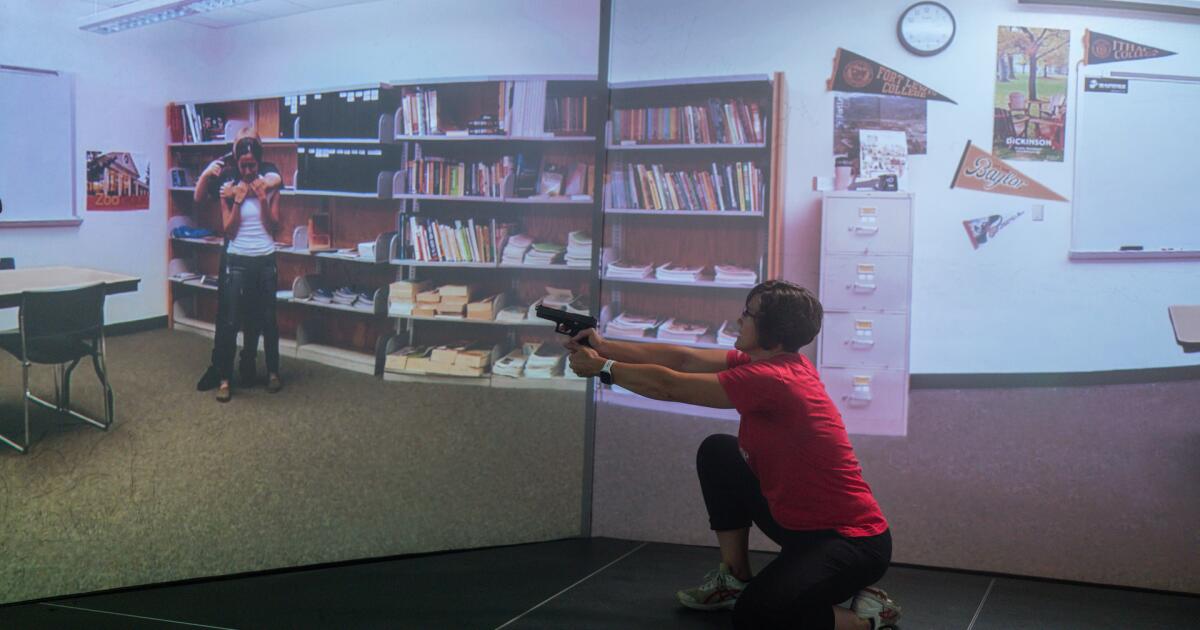
“Thoughts & Prayers,” premiering Tuesday on HBO, is a documentary film about the $3-billion “active shooter preparedness industry,” that space where American failure meets American entrepreneurism. Though it approaches its subject with a certain formal neutrality, the title, a phrase now synonymous with political emptiness, does suggest a point of view. (Its subtitle is “How to Survive an Active Shooter in America.”)
That industry includes various forms of training involving teachers, students and first responders and products theoretically created to increase security — locks, alarms, robot dogs, bulletproof backpacks, bulletproof glass and bulletproof shelters that sit in the corner of a classroom. One company will put an image of your choice on a bulletproof wall hanging and sells a “skateboard [that] will outperform any other skateboard on the market, but it’s also a self defense shield.” “Every time there’s a tragedy, it economically benefits my family,” its founder admits. “We could be a $300-million company by the time this documentary airs.”
One company makes tourniquets “easy to apply in case of a mass casualty incident”; another specializes in latex bullet wounds for use in mass shooter drills: “the gunshot through and through to the neck … the multiple gunshot wound to the abdomen.” One senses in these endeavors a not insincere overreaction that substitutes for political action, shifting responsibility onto potential victims and accepting the problem as intractable. (Or as the Onion headline, published 38 times since 2014, has it, “No Way to Prevent This, Says Only Nation Where This Regularly Happens.”)
Directed by Zackary Canepari and Jessica Dimmock, it’s a sad black comedy, an Errol Morris sort of subject, shot in an Errol Morris sort of way — formal, neutral. The cinematography, by Jarred Alterman, is quite handsome and composed, amplifying the seriousness and eeriness, but also the banality and absurdity of the matter. Subjects face the camera head on, sometimes to speak, sometimes to sit silently for a portrait that might find them covered in fake blood and wounds from a role-playing exercise. The film gets a lot of mileage just settling on faces, tracking reactions, or lack of reaction. The camera is static, steady; action moves in and through the frame, sometimes in slow motion, like movie violence. This observational approach is regularly undercut, unfortunately, by a heavy-handed soundtrack that makes the film feel less trustworthy. It’s an aesthetic and rhetorical failure, but not a fatal one.
The documentary states that 95% of American school children practice lockdown drills.
(HBO)
More than 20 million adults have had active shooter training, learning how to keep doors shut or disarm a shooter, participating in multiplayer video simulations. In Provo, Utah, teachers learn to shoot. (“Breathe in through our nose, out through your mouth — let all that tension come out of you.”) But “Thoughts & Prayers” is most powerful when looking at or listening to the kids: 95% of American schools, we’re told, practice lockdown drills, which can begin as early as Pre-K (with “dinosaurs” substituted for gunmen, to, I don’t know, reduce trauma).
The film’s last act follows a massive reenactment at a Medford, Ore., high school, where a “mass casualty drill” was scheduled after a janitor turned himself into police before acting on homicidal thoughts. (They discovered many weapons in his home, and a written plan of attack.) Kids, made up as victims, litter the halls and gym field. Masked “shooters” go room to room. The police chief gives, as a sign on the podium reads, a “fake press conference.”
“This is the reality, this is where we are in this country, where we are in this valley,” says the school superintendent afterward. “But I do not want to lose the fact that it is still a sad thing that we have to do this. Still, you may wonder what good it will actually do, and hope not to find out.”
What passes for a gun debate is relegated to some warring soundbites from the floor of Congress, and the opinion of one trainer (named Thrasher) that guns aren’t the problem, but “family structures” and “the lack of tribalism.” But here’s Quinn, a high school freshman from Long Island, N.Y., as close as anyone here gets to addressing the issue. It’s worth giving her the last word.
“I don’t think that a lot of adults care about our opinions. We go through this every single day. We go through, like, being afraid of going to school because we might get shot, or we might lose a friend, or we might lose a teacher. And a lot of people care about their … rights, I guess, more about, ‘Oh well, I want to have the ability to own a gun, and so I don’t care if you get shot in your class.’ It’s just kind of disheartening. ‘Cause it’s like, oh, you care more about yourself than all of the students in America.”


Let’s just say that the wedding band has never occupied the most exalted rung of the ladder in music.
Playing “September” and “Celebration” is often what’s most required. As one member of the Bride and the Groove, the band at the center of John Carney’s new film, puts it: They’re not rock stars. They’re human jukeboxes.
But in “Power Ballad,” a wedding band singer and pop star cross paths. For one night, all of the stratification of the music world falls away. “Power Ballad” starts like a fairy tale.
Since 2007’s “Once,” the Irish writer-director has focused his films on the redemptive capacity of music. Carney, who was once a bassist for the Frames, knows from experience. From “Sing Street” to “Flora and Son,” he has made unabashedly earnest tales where a song, or just picking up an instrument, changes lives.
This can, undoubtedly, lead Carney into sentimental territory. Lucky for him, his chosen subject — music — is more worthy of sentiment than almost anything else. Yet the song doesn’t quite remain the same in “Power Ballad,” a movie that begins with the gentle sweetness Carney is known for, but detours into something more discordant.
Rick (Paul Rudd) is an American musician who gave up on his once-promising rock band’s future to instead live with his wife (Marcella Plunkett) and teenage daughter (a spunky, underused Beth Fallon) in Dublin. His former group was called Octagon, a perfect former band name if there ever were one.
But for years, Rick has fronted the Bride and the Groove. It’s an unromantic day job (or rather a night one) that hasn’t entirely sapped his belief in his own songwriting. During an encore at one wedding, he plays an original tune and is mentally transported to an arena full of swaying fans. When he snaps out of it, he’s staring at an empty dance floor and faces that say: That wasn’t Kool & the Gang.
At another wedding at at a castle, the band is asked to let a friend of the newlyweds sit in. They reluctantly agree, and are surprised to see the very popular boy band veteran, Danny (Nick Jonas), step on stage. He sings Stevie Wonder’s “I Wish,” and it’s great. Though Rick had just dismissed Danny’s music as “manufactured content for young, excitable teens,” he discovers Danny is a genuine musician.
But, later that night, something even more remarkable transpires. Rick bumps into Danny, and the two quickly hit it off. They begin jamming together and sharing songs that need work. They are both so jazzed by their unlikely collaboration that they play into the next morning.
The actual moment of artistic creation, and the craft it requires, is something the movies almost always skip over. But capturing collaborative juices flowing is exactly what Carney excels at. You can feel his joy in it. So it’s fitting that one of the unfinished songs Rick plays for Danny, “How to Write a Song (Without You),” is about creative invention.
It’s here when you wonder where “Power Ballad” is headed. Is this, for Rick, the beginning of a beautiful friendship? Will they turn into the next great songwriting duo, lifting Rick out of weddings and proving to the world that Danny is more than a boy-band pretty face?
That is very possibly the movie Carney might have made a decade ago. But “Power Ballad,” which he co-wrote with Peter McDonald (who also co-stars as a band member), shifts six months ahead in time. Rick is standing in a shopping mall when the familiar lyrics of “How to Write a Song” softly float through the stores. He stands dumbfounded in the gleaming halls of commerce, a befuddlement that slowly turns into outrage the bigger and bigger Danny’s smash hit grows.
“Power Ballad” loses some of its steam in its second half, which follows Rick’s struggle for justice. Making things considerably harder is that he can find no recorded demo of the song. His family and his band don’t even really believe him.
But even as the movie struggles to sustain its opening refrain, Carney’s film is always riffing on ideas of authenticity and aspiration in music. That Jonas is, himself, a former boy band star who has at times gone it alone, lends the movie a direct connection to contemporary music, where tussles over authorship are increasingly common.
Jonas has been good in other films (notably the “Jumanji” movies), but this is his most ambitious and convincing performance to date. It’s a testament to the movie that Danny’s theft isn’t a purely villainous act. He gives the song a bridge and the vocal power to take it to another level. He’s under mounting pressure from his label to deliver a hit. An executive (Jack Reynor) wants “Danny 2.0” but has little faith he can supply it.
But it’s an even more well-tailored role for Rudd. He memorably and very goofily played a bassist in the 2009 comedy “I Love You, Man.” But while he sings well, it’s not his musical chops that lift the performance. It’s more that Rick, a contented family man with unrealized rock-star dreams, gives the exceptionally genial Rudd more notes to play as an actor. Rudd makes for a very likeable everyman out to convince the world he is capable of a beautiful song.
And that’s the abiding belief of Carney’s. No matter all the struggles, the artistic injustices, the corporate hegemony, he still believes that if you make something truly soulful, it will break through. It will claw its way to the surface, and move people. It’s undoubtedly gotten harder since “Once,” this movie seems to admit. The world is against you. But what one person can offer, a ballad or otherwise, still has power. Fairy tale or not, that’s worth believing in.
“Power Ballad,” a Lionsgate release in theaters Friday, is rated R by the Motion Picture Association for “language throughout and some drug use.” Running time: 108 minutes. Three stars out of four.
Entertainment
Review: Muscling past a flat script, a big-screen ‘Masters of the Universe’ embraces its own silliness

What will today’s kids think of He-Man, the muscle-bound ’80s relic with the most iconic bob after Anna Wintour? Launched in an era where machismo meant a goofy wrestler or metal singer with an eight-octave falsetto, the steroidal beskirted barbarian has always been a bit ridiculous. C’mon, his name is He-Man. What in the testosterone is that?
And so, director Travis Knight (“Bumblebee”) has made his reboot of “Masters of the Universe” a dopey, friendly comedy about modern masculinity in crisis with a He-Man who openly wonders what kind of a man to be. Hurtled out of the kingdom of Eternia as a boy, this Prince Adam (a terrifically game Nicholas Galitzine) came of age in Oklahoma City as a sweet guy who happens to be obsessed with swords. Instead of transforming into the strongest man in the galaxy to protect his throne from the evil duo of Skeletor (voiced by Jared Leto) and Evil-Lyn (Alison Brie), earthbound Adam parries HR complaints while sitting behind a desk plate that labels his gender identity not as He-Man but He/Him.
Times have changed. Even He-Man’s talking pet tiger (Tom Wilton) asks for consent before giving him a lick.
Galitzine’s He-Man is more Clark Kent than Superman, a gentle, funny, under-estimated dweeb. On a blind date, his descriptions of magical griffins and burning deserts sound humiliatingly immature. Dumped before dessert, he sulks home where his bro-y roommate (Christian Vunipola) secretly watches the weepie “The Notebook” when no one is looking as the soundtrack spins an acoustic cover of the Cure’s “Boys Don’t Cry.” Every man in this movie has a public persona and a private one. Even Adam’s irritable female boss, Suzie (Sasheer Zamata), hides under a people-pleasing mask. “This is my mega-serious face,” she says with an unnerving grin.
The performances are good; the plot, postcard-sized: Adam returns to Eternia, unleashes his alter-identity He-Man and wrestles with the pressure to live up to his new biceps. Although Adam must rescue his royal parents (James Purefoy and Charlotte Riley) from Skeletor, he reaches for empathy before a blade. Could Skeletor really be that bad, he asks his childhood friend Teela (Camila Mendes). “He has a skull for a face,” Teela insists. In this world, everyone’s measured against their looks.
Here’s another question: Could Skeletor really be Jared Leto? Physically, of course not. Skeletor is all pixels with a clattering jaw perfect for chewing the scenery. (The bully is especially hilarious when the story transplants him to an ordinary weight-lifting gym — call him Skele-Chad.) Leto’s grumbling Brit-inflected baritone is an unrecognizable concoction of trilled r’s and plummy vowels — and the best performance he’s done in years. With apologies to Bette Midler, you should hear the gravitas Leto brings to calling his minions “the buttworms beneath my feet.”
Yes, that’s the humor level of the dialogue. Chris Butler, Aaron Nee, Adam Nee and Dave Callaham have written a heavy-handed script in which, when Castle Grayskull comes under attack, Idris Elba’s soldier is forced to yell, “We’re under attack!” You know, in case the exploding laser beams weren’t obvious.
Obviousness is this film’s handicap — and the main joke. In this movie’s lore, juvenile Adam, played by an adorable Artie Wilkinson-Hunt, is the guilty child who invented his meathead He-Man moniker, as well the nicknames of his allies Ram-Man, Mekaneck and Fisto, who all look exactly as they sound to their chagrin. “I don’t fist anyone,” Fisto (Jóhannes Haukur Jóhannesson) protests. The grown-ups in the audience snicker.
Knight was a kid himself when the cartoon version of “He-Man and the Masters of the Universe” debuted on television. As with his “Transformers” spin-off “Bumblebee,” he makes movies like a child who loves taking his action figures out of the box and giving them a silly soul.
He’s no hack: Knight’s debut film, “Kubo and the Two Strings,” was nominated for an Academy Award for animation. Raised with an affection for brands (his father, Phil Knight, is the co-founder of Nike), he also feels obliged to include so much fan service for his generation that kids will have to swashbuckle through confusing callbacks to discover He-Man for themselves. One battle scene is scored to 4 Non Blondes’ “What’s Up?” simply as a nod to a He-Man mash-up video that went viral back in 2005, a clash as wonky as it sounds. Yet Daniel Pemberton’s opening theme music is a rousing crescendo of stadium rock synthesizers. You can hear Queen guitarist Brian May in the score — not merely as an influence. It’s actually him.
Culturally, hyper-machismo has oscillated from cool to lame to ironically cool and back again for decades. Even Queen itself was deemed lame until “Wayne’s World” resurrected “Bohemian Rhapsody” as headbanging slapstick. If you spot a guy swaggering like a brute from Eternia on the sidewalk, masked or not, he probably thinks he’s more awesome than everyone else does. Likewise, when He-Man smashes skulls to a wailing metal soundtrack, I no longer know if I’m meant to be snickering with the electric guitars or at them. Neither does the movie, which seems to decide each scene’s individual tone on a coin flip.
Frankly, the dorky version of Adam is more fun than the heroic He-Man, even with Knight hammering us every minute to laugh that he’s a total weakling. Galitzine embraces the indignity. Zooming through the air in a flying Sky-Sled, he wedges his face into a triple chin. Dazed and enthusiastic, Galitzine’s human charm counterbalances Eternia’s synthetic feel, a blandscape of bright forests and cliffside dungeons that looks dated — not to 1983 but to last decade’s greenscreen-heavy would-be fantasy franchises like “Clash of the Titans” and “John Carter.”
Please don’t make Galitzine do five of these movies, even though he’s very good. An unusually pretty leading man who is quirkier and funnier than he looks, Galitzine is the kind of rising talent Hollywood rarely knows how to handle. In his previous roles, he gave off the impression of being flummoxed by his own attractiveness, whether as a queer prince (“Red, White & Royal Blue”), a Harry Styles-esque pop star (“The Idea of You”) or a popular football jock whose high school classmates are oblivious that he has the IQ of a second-grader (“Bottoms”). Here, Galitzine multiplies that self-conscious gag times a thousand, visibly dazzled by his own six-pack when he transforms from himbo to gym-bro. Even Skeletor is agog over the “big long sword dangling between his thighs.”
Smartly cast, Galitzine could prove to have the potential of Brad Pitt, another blond hunk who longed to get weird, chafing against roles that made him take off his shirt until he hit 55 and realized it was a flex. But shouldering a wobbly, expensive summer tentpole is a risk — just ask Sam Worthington or Taylor Kitsch. If “Masters of the Universe” tanks, here’s hoping Galitzine summons the strength to dig himself out of the rubble.
‘Masters of the Universe’
Rated: PG-13, for sequences of violence/action, some suggestive material, and language
Running time: 2 hours, 21 minutes
Playing: Opening Friday, June 5 in wide release

NEW YORK (OSV News) – As America’s Catholic bishops prepare to mark the semiquincentennial by consecrating the nation to the Sacred Heart of Jesus, a French docudrama that can aid viewers in understanding the full significance of such an action makes its timely appearance.
A Fathom Entertainment presentation, “Sacred Heart: His Reign Has No End” will have a limited theatrical run June 9-11 and June 14. The version screening on June 10 will be dubbed in Spanish.
Following its initial release in France last fall, the film proved to be phenomenally popular, with ticket sales reaching the half-million mark in a country usually regarded as deeply secular. This unusual development clearly indicates that the movie resonated with audiences in a way that even its creators may not have expected.
Filmmakers Sabrina and Steven J. Gunnell examine the origins, meaning and enduring relevance of devotion to the Sacred Heart. They begin their exploration even before the landmark revelations received in the 1670s by St. Margaret Mary Alacoque, a Burgundian Visitation nun, showing that earlier saints had focused on the subject in medieval times.
Using reenactments, interviews and archival images, the Gunnells also highlight the theological connection between the Sacred Heart and the Eucharist. This is done, in part, by recounting a few of the many Eucharistic miracles granted to the Church over the centuries.
By profiling contemporary devotees of the Sacred Heart, including formerly inactive Catholics, the picture demonstrates the impact the insights given to St. Margaret Mary continue to have on the lives of people around the world. Locations visited range from the gang-infested streets of a Parisian suburb to the once war-torn Central American country of El Salvador.
An excellent and enjoyable catechetical resource, the feature is also both moving and uplifting. It can be recommended for all but the youngest kids.
For theater locations and showtimes, go to: sacredheartfilm.us
Dubbed into English.
The film contains gory images of the Crucifixion. The OSV News classification is A-II — adults and adolescents. Not rated by the Motion Picture Association.
Read More Movie & Television Reviews
Copyright © 2026 OSV News
-

 Rhode Island5 seconds ago
Clergy sex abuse bill passes RI Senate on unanimous vote. What’s next
-

 South-Carolina5 minutes ago
The 3 Democrats vying for SC governor’s seat take jabs at each other in SCETV debate
-

 South Dakota12 minutes ago
Tornado watch in effect as severe storms target South Dakota
-

 Tennessee15 minutes ago
Tennessee Baseball Breakout Star Announces He Won’t Enter the Transfer Portal
-

 Texas20 minutes ago
Central Texas soldier dies in Iraq during training incident, Department of Defense says
-

 Utah27 minutes ago
New program at University of Utah aims to keep up with growing Utah industry
-

 Vermont30 minutes ago
Vermont seeks dynamic pricing for state park access
-

 Virginia35 minutes ago
West Virginia commit announces decision by blasting ‘Country Roads,’ lighting a couch on fire

