Tennessee
Tennessee judge blocks deployment of National Guard in Memphis


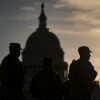
Members of the National Guard stand watch at the intersection of B.B. King Blvd. and Beale Street, Friday, Oct. 24, 2025, in Memphis, Tenn.
George Walker IV/AP
hide caption
toggle caption
George Walker IV/AP
MEMPHIS, Tenn. — A Tennessee judge on Monday night blocked the use of the National Guard in Memphis under a crimefighting operation by President Donald Trump but also put the order on hold, giving the government five days to appeal.
Davidson County Chancellor Patricia Head Moskal’s decision sides with Democratic state and local officials who sued, contending that Republican Gov. Bill Lee cannot deploy the Tennessee National Guard for civil unrest unless there is rebellion or invasion, and even then, it would require action by state lawmakers.
The plaintiffs also said another provision spells out a need for a request from a local government to use the Guard in some scenarios, including a “breakdown of law and order,” they said.
The state has said Tennessee law gives the governor “the authority to dispatch the Guard when needed and to determine when that need exists.”
In a statement posted on X, Shelby County Mayor Lee Harris, a plaintiff in the case, said he is pleased with the decision. “The injunction does not take effect immediately, and the state has a chance to seek leave to appeal,” he wrote. “However, this is a positive step toward ensuring the rule of law applies to everyone, including everyday Tennesseans and even the Governor.”

Since their arrival on Oct. 10, troops have been patrolling neighborhoods and commercial areas of Memphis, including near the iconic Pyramid in downtown, wearing fatigues and protective vests that say “military police,” with guns in holsters. Officials have said Guard members have no arrest power.
The Guard is part of a task force established by an order from Trump. It also involves a slew of other law enforcement agencies whose officers have patrolling the city now for weeks.
For years, Memphis has dealt with high violent crime, including assaults, carjackings and homicides. While this year’s statistics show improvement in several categories, including murders, many acknowledge that violence remains a problem.
Trump announced in September that the National Guard would be deployed to combat crime in Memphis alongside authorities from a slew of federal agencies as part of the so-called Memphis Safe Task Force. The task force, which includes hundreds of personnel attached to various federal and state law enforcement agencies and Memphis police, has made more than 2,500 arrests since it began operating in Memphis.

Arrests have been made on charges ranging from drug and weapons violations to immigration warrants to homicides.
Lee has said the National Guard would “play a critical support role” for local law enforcement.
Memphis Mayor Paul Young, a Democrat, said he never requested that the Guard come to his city. But after Trump made the announcement and Lee agreed, Young, who is not involved in the lawsuit, and others has said they wanted the task force to focus on targeting violent offenders.
Young has said operations include some 150 Guard members.
Both the plaintiffs and the state acknowledged that the governor did not issue an order to trigger the deployment, but sent a news release.
Lee has said that, “As the the commander-in-chief, Gov. Lee has the authority to authorize the Title 32 strategic mission to Memphis.”
“Every Memphian deserves to feel safe in their community, and through state, local, and federal partnerships, the Memphis Safe Task Force has created a generational opportunity that is already delivering remarkable results to enhance public safety,” Lee’s spokesperson Elizabeth Lane Johnson said after the lawsuit was filed. “We are confident the court will uphold the Governor’s constitutional authority.”


Tennessee
Tennessee Football Commit, Phillip Fulmer’s Grandson on Rocky Top for Official Visit | Rocky Top Insider


As Tennessee football looks to build on its 2027 recruiting class, it’s also strengthening the relationship it has with its current commits. This includes the first player to pledge to the Vols in the cycle, linebacker JP Peace.
Peace is a local recruit, initially playing for West High School in Knoxville before transferring to Maryville. He’s also as connected to the program as it gets. His father is Robert Peace, a former UT linebacker from 2000-03. His grandfather is former Tennessee national championship head coach and co-captain as a player, Phillip Fulmer.
Peace is ranked as a three-star recruit by 247 Composite. He is listed as the No. 583 player in the nation, No. 46 linebacker and No. 26 player from the state of Tennessee.
More From RTI: Kenneth Simon II Takes Official Visit to Tennessee Football After Flipping From Alabama
Other offers on the table for Peace include Florida State, Kentucky, Maryland, Ole Miss, Virginia Tech, West Virginia, App State, Georgia State, Marshall, Memphis, South Florida, Southern Miss, MTSU and UAB. However, he’s been strong in his commitment to UT, which he announced back on June 16, 2025.
While this marks Peace’s official visit, he’s made his way to campus plenty of times in the recruiting process. This includes as recently as March of this year for spring practice.
Peace is one of 16 commitments in the class for Tennessee to this point. The group ranks as the No. 42 class in the country on 247.
He’s one of two linebackers in the group, joining Kenneth Simon II. Simon is also a legacy recruit and is the son of former UT star linebacker Kevin Simon. He recently flipped his commitment from Alabama to Tennessee and ranks as the No. 139 player in the class by 247 Composite. Naturally, both Peace and Simon’s primary recruiter at UT is linebackers coach William Inge.

As the Supreme Court weakens voting rights protections, Tennessee’s Jim Crow history offers a stark warning about race, power and representation.

Southern states race to redraw district maps following SCOTUS ruling
Supreme Court decision, which split along conservative and liberal lines, essentially nullified section 2 of the landmark 1965 Voting Rights Act.
Recent developments concerning race and democracy have prompted much discussion about the American experiment and the meaning of citizenship. This series of guest essays examines major issues, such as race, slavery, Jim Crow and civil and voting rights, in the context of their collective meaning in our present.
These guest essays help us understand the importance of these topics in light of the U.S. Supreme Court’s decision on the Voting Rights Act of 1965.
The Supreme Court has nakedly attacked the most significant legislative achievement in American history: the Voting Rights Act. Justice Samuel Alito argued that Louisiana’s use of the law to support minority majority congressional districts was an unconstitutional “racial gerrymander.”
Louisiana v. Callais will be remembered as the culmination of a decades-long effort by conservative politicians and jurists to undermine one of the central underpinnings of American democracy. The brazenness of the Court’s action is as disturbing as it was predictable. Many have argued the Court’s actions will lead to a new Jim Crow.
As the nation comes to grips with a new legal paradigm regarding civil rights, imposed by an unelected and hyper-partisan Court, it is time to reexamine just what Jim Crow actually meant to Tennessee and the South, as well as what it might portend for our future.
What Jim Crow was and how it took hold
The Jim Crow era, de jure and de facto, existed from the end of Reconstruction to the late 1960s. The term is the center identifier for all the laws, rules, and customs that governed the period. It originated around 1828, when Thomas Dartmouth “Daddy” Rice originated the character of “Jim Crow” in New York. Wearing “blackface,” Rice regaled audiences with dance and song in blackface, using burnt cork makeup to give the appearance of Black skin.
By 1840, “Jim Crow” was incredibly popular because of its deeply offensive representations of Black people. The outrageous stereotypes meant to dehumanize Black America would, by the 1890s, take on an even more menacing tone.
How Tennessee built a segregated society
Tennessee was the first state to reenter the Union in June 1866. Our state had a long history of holding people in bondage. Enslaved people were chattel, meaning they were little more than property to be bought, sold and possessed. After the war, Tennessee designed laws to make Blacks into second-class citizens.
In 1875, Tennessee created one of the first frameworks for a segregated society, which allowed a variety of public-facing entities – hotels, businesses, transportation and others – to refuse service and/or admission to Black Tennesseans. This was in response to Congress passing the 1875 Civil Rights Act, which promised equal treatment for Black people in public places and the right to serve on juries.
By the start of the 20th century, Tennessee, like the rest of the South, erected all kinds of laws to trap Blacks into second-class citizenship. Everything was segregated, from housing to hospitals to cemeteries to water fountains to bathrooms to lunch counters. The Supreme Court gave its blessing to segregation in 1896 when it decided the infamous Plessy v. Ferguson decision. The federal government had given Tennessee and the rest of the South its blessing to enforce a deeply dehumanizing, two-tiered apartheid system.
The vast majority of Blacks were disenfranchised by a series of official acts of the Tennessee legislature in 1889. Laws regarding poll taxes and literacy tests restricted many from accessing the ballot. Lynchings served to intimidate Black Tennesseans from challenging the new laws.
At least 177 Black Tennesseans were lynched during Jim Crow. Ida B. Wells began her career in Memphis documenting the scourge of lynchings in her Free Speech newspaper. She was terrorized by angry whites, and after her press was burned by a white mob, she remained in the North, where she continued her work. The murders and mayhem undergirded Jim Crow in Tennessee.
Why change required sustained pressure
Today, it is not enough to say these laws have changed. Too often, it is noted that the country has moved past race. Brown v. Board of Education came to pass. The Civil Rights Act came to pass. The Voting Rights Act came to pass. The Fair Housing Bill came to pass. These advancements came about because of the courage of Black Americans, white and Jewish allies, and others who demanded change toward justice. Commentators point out these changes as if the country should be rewarded for finally delivering on basic rights already guaranteed by the Constitution.
Congress and the statehouses did not change because they felt morally responsible for the plight of Blacks. The changes came because people said “enough.”
How today’s disputes reflect unresolved history
In 2026, our problems remain rooted in the Jim Crow past. A great many Americans, including those in Tennessee, never accepted the racial progress of the 1950s and 1960s. Some argue our new congressional maps are simply an exercise in partisanship and power.
Poppycock! Such measures will result in the disenfranchisement of Tennesseans. If some are not able to elect representatives who are in alignment with their political and policy views, then something most vile has been reawakened in the Volunteer State.
Basic issues such as support for public schools, public works, infrastructure and investment will subside as political attention is devoted to areas of the state perceived to be more authentically Tennessean at the expense of Black and poor residents. The irony is that the supermajority has forgotten that less than 20 years ago, they were in the minority and were quite sensitive about violations of the rights of the minority.
The stakes for voting rights and representation
To argue that race no longer plays a role in American life simply does not pass the smell test. Conservatives are missing an opportunity to gain traction, followers and, most importantly, voters because many are unwilling to put down the barbed clubs of grievance and shortsightedness.
The Voting Rights Act was not a radical legislative solution. Its design was very basic and conservative in its purpose: to develop a series of mechanisms to enforce and ensure equal opportunity and access for all Americans to taste the richness of American democracy.
Daryl A. Carter, Ph.D., is associate dean, director, and professor of history at East Tennessee State University.
-
West Virginia1 second ago
Over 26,000 West Virginia students have applied for full Hope Scholarship funding – WV MetroNews
-

 Wyoming5 minutes ago
CAUGHT ON CAMERA: Massive landspout swirls over Wyoming field – East Idaho News
-

 Crypto12 minutes ago
Former South Lake Tahoe man found guilty of cryptocurrency schemes
-

 Finance15 minutes ago
London Mayor: UK Tops Green Finance Rankings for Eighth Straight Year | OilPrice.com
-

 Fitness20 minutes ago
Busy mum Gemma Atkinson uses this exercise to build strong shoulders fast – here’s why it’s so time efficient
-

 Movie Reviews30 minutes ago
Film Review: “Leviticus”
-

 World40 minutes ago
US Authorizes Iranian Oil Sales Amid Talks on Final Peace Deal
-

 News50 minutes ago
Video: The Rise of Deadly Trucks and S.U.V.s

