Southwest
Car used by missing California girl’s mom on road trip had license plates swapped to ‘avoid detection’

NEWYou can now listen to Fox News articles!
The rental car that a missing 9-year-old California girl was last seen traveling in with her mother had its license plates swapped during a road trip “to avoid detection,” police revealed.
The whereabouts of Melodee Buzzard, of Lompoc, California, remained unknown Tuesday. She was “last seen along the return route via video surveillance on October 9, 2025, in the region between the Colorado–Utah border,” according to the Santa Barbara County Sheriff’s Office. It added that her 35-year-old mother, Ashlee Buzzard, “has remained uncooperative and has not confirmed Melodee’s location or welfare.”
“Through their investigation, detectives have confirmed that Ashlee left California with Melodee in a white 2024 Chevrolet Malibu, initially bearing California license plate 9MNG101, on October 7, 2025. Detectives believe that Ashlee and Melodee traveled as far as Nebraska, with a return trip that included Kansas,” according to the sheriff’s office.
“Beginning October 8, 2025, the Malibu was observed with a New York license plate HCG9677. It is unknown when the plate was installed or whether additional plates were used at other times during travel. The New York plate seen on the car does not belong to the vehicle or to Ashlee,” the sheriff’s office added. “Investigators believe it was used as a false or switched plate to avoid detection. When the vehicle was returned to the rental agency in Lompoc, California, the assigned California plate was on the vehicle.”
MELODEE BUZZARD DISAPPEARANCE: NEW SURVEILLANCE PHOTOS SHOW MISSING CALIFORNIA GIRL, 9, IN POSSIBLE DISGUISE
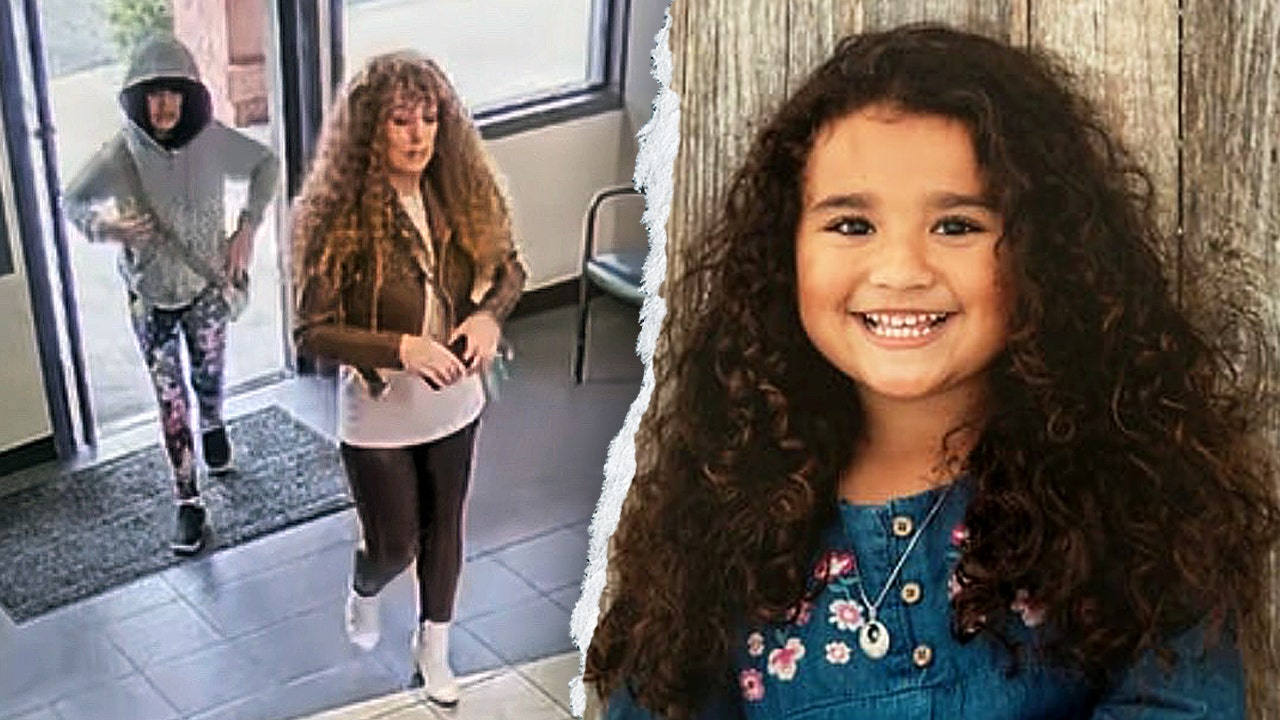
The Santa Barbara County Sheriff’s Office released a new surveillance image, left, of Ashlee and Melodee Buzzard captured at a rental car location in Lompoc, California, on Oct. 7, 2025. (Santa Barbara County Sheriff’s Office/FBI)
Investigators believe the rental vehicle traveled through Green River and Panguitch in Utah, northwest Arizona, Primm in Nevada and Rancho Cucamonga in California on or around Oct. 9.
“Detectives are seeking anyone who may have had contact with Ashlee or Melodee at any point from October 9-10, 2025, or any video footage from their route of travel,” the Santa Barbara County Sheriff’s Office said.
FBI, DETECTIVES EXECUTE SEARCH WARRANTS AS ‘AT-RISK’ 9-YEAR-OLD REMAINS MISSING
The Santa Barbara County Sheriff’s Office released an image of Melodee Buzzard “captured at a local car rental business” on Oct. 7, 2025. (Santa Barbara County Sheriff’s Office )
The sheriff’s office said investigators are sharing additional surveillance images of Ashlee and Melodee that were captured at a rental car location in Lompoc at the start of their road trip on Oct. 7.
“Both Ashlee and Melodee appear to be wearing wigs with Melodee’s appearing darker and straighter than her natural hair,” the sheriff’s office said.
The Santa Barbara County Sheriff’s Office previously said its investigation into the disappearance of Melodee Buzzard began on Oct. 14 after a school administrator reported her extended absence. Deputies then responded to her home in Lompoc and encountered her mother, Ashlee, but “Melodee was not at the home, and no verifiable explanation for her whereabouts was provided,” according to the office.
The Santa Barbara County Sheriff’s Office said a surveillance image showed Melodee Buzzard “wearing a hooded sweatshirt with the hood pulled up and what appears to be a wig that is darker and straighter than her natural hair.” (Santa Barbara County Sheriff’s Office)
CLICK HERE TO DOWNLOAD THE FOX NEWS APP
Melodee Buzzard is described by police as being around 4 feet, 6 inches tall and weighing approximately 60 pounds with brown hair and brown eyes. The FBI’s Los Angeles Field Office is assisting in the search.
Read the full article from Here



Children and teens can enjoy a free lunch this summer at more than 90 parks across Los Angeles.
The annual Summer Food Service Program is sponsored by the city’s Department of Recreation and Parks.
From June 12 to July 31, anyone under 18 years old can grab a free lunch at a participating local park.
Menu offerings may include fresh fruits and vegetables, milk, salads, deli sandwiches and other nutritious meal options.
City officials said the program helps to ensure that children and teens continue to have access to healthy meals while school is out for the summer.
No application or proof of income is needed. Adults and guardians can simply bring their child to a participating location to receive food.
Meals must be consumed onsite and are available at no cost. Serving times will vary by location but typically range between 11:30 a.m. to 12:45 p.m.
“Summer should be a time for children to learn, play and create lasting memories, not worry about where their next meal will come from,” said Jimmy Kim, General Manager of the Department of Recreation and Parks. “Through our partnership with LAUSD, we are proud to provide free, nutritious meals in safe and welcoming park environments where young people can stay active, connect with their communities and thrive throughout the summer.”
A full list of participating parks and serving times can be found here.
The public can also call 818-346-2700 or text “Summer Meals” to 97779 for a list of parks. Flyer information in Spanish can be found here.
More information about the city’s 2026 Lunch Program can be found here.

A resident was assaulted after two armed suspects forced their way into a home in Los Angeles’ Fairfax District early Saturday morning, police said.
The home invasion robbery was reported around 4:32 a.m. in the 800 block of North Detroit Street, according to the Los Angeles Police Department.
Police said two suspects, both described as adult males, entered the property while armed with handguns.
The resident was assaulted during the confrontation, though authorities did not immediately release information about the victim’s injuries.
-

LAPD officers investigate a reported home invasion robbery in Los Angeles’ Fairfax District after two armed suspects allegedly assaulted a resident and stole jewelry and cell phones. June 2026. (KTLA) -
LAPD officers investigate a reported home invasion robbery in Los Angeles’ Fairfax District after two armed suspects allegedly assaulted a resident and stole jewelry and cell phones. June 2026. (KTLA)


Investigators said the suspects stole jewelry and cell phones before fleeing the area in an unknown vehicle.
Video from the scene showed LAPD officers investigating outside a modern residential property as daylight broke Saturday morning. Several patrol vehicles were parked nearby while officers canvassed the area.
No arrests had been announced as of Saturday afternoon.
Anyone with information about the robbery is urged to contact the LAPD.

Loved ones are devastated after a woman and a man were found shot to death at a Pomona apartment complex and the woman’s boyfriend was arrested after leading officers on a dangerous pursuit.
On Friday, friends and family gathered outside the Pomona apartment complex where Veronica Lopez, 24, and Richard Brady, 48, were found fatally shot.
On June 18, Pomona police were called to the Monterey Station Apartments at 180 E. Monterey Ave. just before 3:30 p.m. on reports of a shooting.
Officers made their way up to a fourth-floor apartment hallway where they found two victims suffering from gunshot wounds.
-
Veronica Lopez, 24, is seen in a family photo. -
Richard Brady, 48, is seen in a family photo. -
A 48-year-old man was arrested in connection with a double homicide in Pomona after a lengthy and dangerous high-speed chase on June 18, 2026. (KTLA) -
A man wanted out of Pomona believed to be armed and dangerous was taken into custody after a lengthy chase through Southern California on June 18, 2026. (KTLA) -
A 48-year-old man was arrested in connection to a double homicide in Pomona after a lengthy and dangerous high-speed chase on June 18, 2026. (KNN News) -
A 48-year-old man was arrested in connection to a double homicide in Pomona after a lengthy and dangerous high-speed chase on June 18, 2026. (KNN News) -
A 48-year-old man was arrested in connection to a double homicide in Pomona after a lengthy and dangerous high-speed chase on June 18, 2026. (KNN News) -
Loved ones gathered at a growing memorial outside the Pomona apartment complex where the victims and the suspect all lived on June 19, 2026. (KTLA) -
A 48-year-old man was arrested in connection to a double homicide in Pomona after a lengthy and dangerous high-speed chase on June 18, 2026. (KNN News) -
Veronica Lopez, 24, is seen in a family photo. -
Veronica Lopez, 24, is seen in a family photo. -
A 48-year-old man was arrested in connection to a double homicide in Pomona after a lengthy and dangerous high-speed chase on June 18, 2026. (KNN News)


Despite life-saving measures, both were pronounced dead at the scene. The suspect and Veronica’s boyfriend, Robert Galtman, 48, had fled the scene in a Kia sedan.
Around 5 p.m., California Highway Patrol officers spotted his vehicle on the freeway and he led them on a high-speed, hour-long chase before officers successfully performed a PIT maneuver that disabled his vehicle. He surrendered and was taken into custody.
Friends and family members are devastated over the victims’ deaths and have so many unanswered questions.
“I don’t understand,” said Sheila Lopez, Veronica’s mother. “She didn’t deserve this.”
Sheila had spoken to her daughter just hours before the deadly shooting. She told her daughter she would call her later after work, but when she did, her daughter never answered the phone.
Her family later learned that Veronica had been shot and killed and that her boyfriend of several years, Galtman, was under arrest.
Lopez’s family said that Veronica was in an abusive relationship and they believe she was trying to leave her boyfriend when she was killed. They had also previously urged her to leave.
“I believe she was walking away,” Sheila told KTLA’s Lindsey Pena. “I think she should’ve just walked away. This is why this all happened.”
They also believe the other victim, Brady, was likely just trying to help her. Brady’s close friend and the mother of his child, Heather Cantu, agreed, saying helping others in a situation like that is something he would’ve done.
“I just think that if she was in an abusive relationship, that’s what he was doing,” Cantu said.
-
Richard Brady, 48, is seen in a family photo. -
Richard Brady, 48, is seen in a family photo.

His brother told The Daily Bulletin that he was aware of Veronica’s abusive relationship.
“My brother helped her out of that situation,” he told the outlet. “They became friends. My brother stuck up for those who couldn’t stick up for themselves. Unfortunately, he walked into a situation out of his control.”
Cantu described him as a loving father to two children and a kind man and who will be greatly missed.
“We’ll all remember how happy he made everybody,” Cantu said. “He was a jokester. He was always happy and he always tried to make everybody else feel good.”
On Friday night, loved ones gathered at a growing memorial outside the Pomona apartment complex where the victims and the suspect all lived.
Sheila said Veronica was the youngest of her five daughters, who always lit up a room and brought joy to those around her.
-
Loved ones gathered at a growing memorial outside the Pomona apartment complex where the victims and the suspect all lived on June 19, 2026. (KTLA) -
Loved ones gathered at a growing memorial outside the Pomona apartment complex where the victims and the suspect all lived on June 19, 2026. (KTLA) -
Loved ones gathered at a growing memorial outside the Pomona apartment complex where the victims and the suspect all lived on June 19, 2026. (KTLA) -
Sheila Lopez, (on right) Veronica Lopez’s mother, speaks to KTLA in Pomona on June 19, 2026. (KTLA)


“She’s definitely someone to miss,” Sheila said. “She’s a great skateboarder. She loves to go to games and she loves her family.”
In a GoFundMe page, loved ones said Veronica “had a way of making everyone around her feel loved and valued. The pain of losing her is unimaginable, and our hearts are broken.”
Galtman remains in custody on $3.1 million bail.
A GoFundMe page to help Veronica’s family with funeral expenses can be found here.
A GoFundMe page to help Brady’s family with funeral expenses can be found here.
The investigation remains ongoing. Anyone with additional information is asked to call the Pomona Police Department’s Detective Bureau at 909-620-2085.
-

 Technology22 seconds ago
Sony’s Xperia 1 VIII is still a phone for the fans
-

 World7 minutes ago
Trump-backed ‘El Tigre’ looks to crush cartels, end Colombia’s socialist era in pivotal election
-

 Politics10 minutes ago
Obama Center visitors say project symbolic of ‘Black excellence,’ claim scandal-free legacy while Trump ripped
-

 Health15 minutes ago
Poison centers link growing Benadryl abuse among teens to dangerous social media trends
-

 Sports22 minutes ago
Bryce Harper hits for cycle, Kyle Schwarber blasts three homers in Phillies blowout win over Mets
-

 Technology25 minutes ago
Meta offers paid training for AI data center jobs
-
 Business30 minutes ago
‘I got crushed’: AI giants are funding ad wars in races across the country
-
 Entertainment37 minutes ago
A fake mountain and real magic transform Paris’ oldest bridge

