Politics
Trump admin responds to ‘Dilbert’ creator’s plea to ‘help save my life’ by expediting cancer treatment


NEWYou can now listen to Fox News articles!
Cartoonist Scott Adams said in a social media post Sunday that he plans to appeal to President Donald Trump for help scheduling a cancer drug treatment that he believes could prolong his life.
Adams, the creator of the “Dilbert” comic strip, announced earlier this year that he had metastasized prostate cancer.
He wrote in a post on X that his healthcare provider, Kaiser Permanente – Northern California, approved his application to receive a new FDA-approved drug Pluvicto.
“But they have dropped the ball in scheduling the brief IV to administer it and I can’t seem to fix that. I am declining fast,” Adams wrote.
BIDEN ‘RANG THE BELL’ AFTER COMPLETING RADIATION THERAPY FOR PROSTATE CANCER
Scott Adams, cartoonist and author and creator of “Dilbert,” poses for a portrait in his home office with copies of his book “How to Fail at Almost Everything and Still Win Big: Kind of the Story of My Life.” (Lea Suzuki/The San Francisco Chronicle via Getty Images)
“I will ask President Trump if he can get Kaiser of Northern California to respond and schedule it for Monday. That will give me a fighting chance to stick around on this planet a little bit longer. It is not a cure, but it does give good results to many people.”
Health and Human Services Secretary Robert F. Kennedy Jr. responded to Adams’ viral post, asking how to reach him.
“The President wants to help,” RFK Jr. wrote.
Robert F. Kennedy delivered a fiery speech to WHO member states over the U.S.’s withdrawal (Jason Mendez/Getty Images)
COMEDIAN TIG NOTARO DESCRIBES FALLOUT WITH CHERYL HINES OVER HUSBAND RFK JR
Dan Scavino, White House deputy chief of staff and head of personnel, also responded to Adams, saying, “No need till [sic] wait until Monday—@realDonaldTrump, @RobertKennedyJr, and @DrOz are all tracking now, Scott.”
Fox News Digital reached out to Kaiser and the White House for comment.
Adams said in a video posted to his YouTube channel in May that he is in pain every day and has been using a walker for months.
CLICK HERE TO DOWNLOAD THE FOX NEWS APP
“If you’re wondering if I’ll get better, the answer is no, it will only get worse,” he said on his “Real Coffee with Scott Adams” show. “There’s only one direction this goes.”
Roughly 1 in 8 men will be diagnosed with prostate cancer during their lifetime, according to the American Cancer Society. Prostate cancer is the second most common cause of cancer death among American men, after lung cancer.



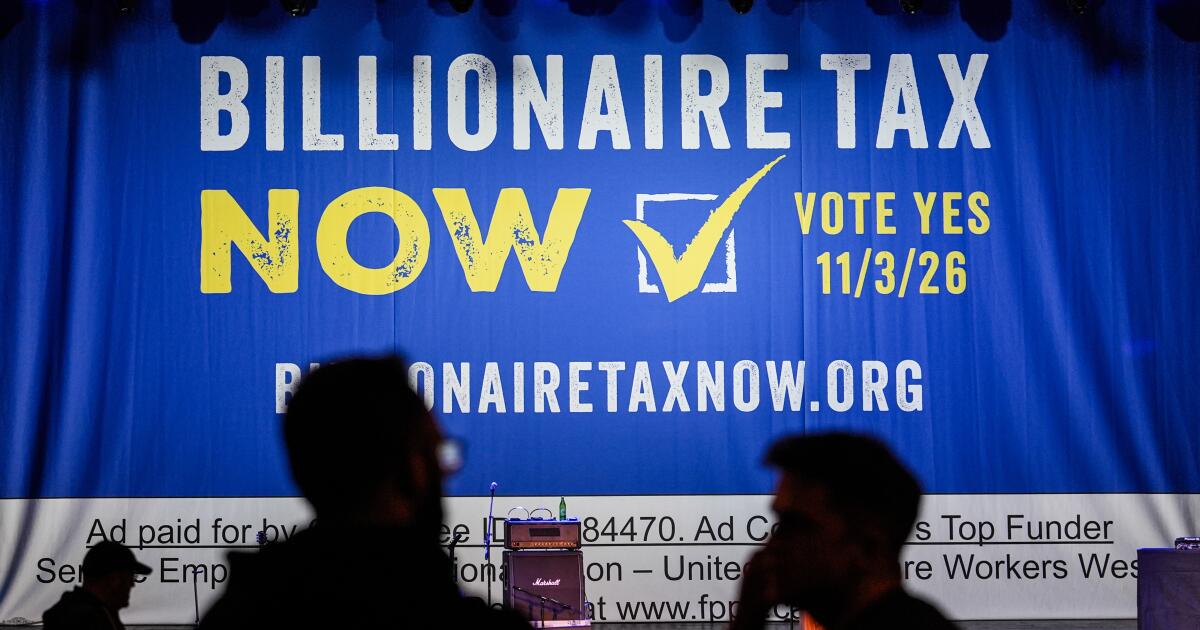
A contentious proposal to tax California billionaires to alleviate federal healthcare cuts moved closer to landing on the November ballot this week, but efforts to defeat the measure before it reaches voters have already escalated.
The California secretary of state’s office said Wednesday that the proposal had enough valid signatures to be eligible for the Nov. 3 ballot. But discussions that have included the governor’s administration and lawmakers are underway about a potential deal that could prevent the initiative from being put in front of voters, according to people familiar with the negotiations.
Supporters have until June 25 to withdraw the initiative or go forward with placing it on the ballot. The negotiations highlight the escalating debate surrounding the billionaire tax, an idea that has divided the Democratic Party and drawn fresh opposition from healthcare and education groups. The negotiations are in flux, and the outcome remains uncertain.
The initiative would impose a one-time tax of up to 5% on taxpayers and trusts with assets valued at more than $1 billion, with some exceptions, such as property. The levy could be paid over five years. Ninety percent of the revenue would fund healthcare programs, and the remaining funds would be spent on food assistance and education programs. The proposal would cost the state’s richest residents about $100 billion if a majority of voters support it.
Backers of the proposed tax say it’s crucial to compensate for federal healthcare funding cuts, approved by President Trump and the Republican-controlled Congress, that will harm millions of the state’s most vulnerable residents. In April, supporters of the billionaire tax submitted nearly 1.6 million signatures, roughly double the number needed to qualify.
A poll released in March showed 52% of registered voters supported the billionaire tax, while 33% said they opposed it. Fifteen percent were undecided. The survey was conducted by UC Berkeley’s Institute of Governmental Studies and co-sponsored by The Times.
Opponents of the measure say the proposal is an ineffective attempt to address the long-term effects of the healthcare cuts and would harm California’s economy and budget.
The state budget in California is already largely dependent on income taxes paid by its highest earners. Because of that, revenues are prone to volatility, hinging on capital gains from investments, bonuses to executives and windfalls from new stock offerings, and are notoriously difficult for the state to predict.
The proposal already triggered a fierce debate, accentuating the divide between the rich and poor in a state that’s expensive to live in.
The Service Employees International Union-United Healthcare Workers West and other supporters of the billionaire tax say that it would raise $100 billion, offsetting federal funding cuts to healthcare as well as funding education and state food assistance. The SEIU-UHWW has spent more than $31 million qualifying the proposal for the ballot.
“David won the second round against Goliath, but healthcare workers and our allies won’t quit until we protect patients from the looming California healthcare collapse manufactured by Trump and Congress,” said Debru Carthan, a spokeswoman for the Billionaire Tax Now Coalition in a statement. The SEIU-UHWW funds the group.
But supporters face strong opposition from billionaires and influential groups with deep pockets. Tech executives and other business leaders oppose the idea and some have moved to other states. Opponents say taxing billionaires would harm California’s economy while not addressing underlying financial issues.
Campaign efforts against the proposal intensified this week with the launch of a new bipartisan coalition that’s fighting the wealth tax proposal. The group, called the Californians to Protect Funding for Schools, Healthcare and Public Safety, posted a long list of opponents that include healthcare groups, labor unions, business organizations, politicians and more.
An ad released by the group calls the wealth tax “a dangerous experiment” that could cost Californians tax revenue, send jobs out of state and cut funding. Planned Parenthood, the California School Boards Assn. and labor unions are cited in the ad as opponents.
“California can’t afford the reckless wealth tax experiment,” the ad says. The California Primary Care Assn. and California Medical Assn. are funding the coalition.
Jodi Hicks, chief executive and president of Planned Parenthood Affiliates of California, said that while the group believes that the wealthy should pay their fair share of taxes, the proposal fails to get at the root of the problem.
“We believe that this particular measure is shortsighted, doesn’t have specificity and accountability. It’s volatile,” she said.
The group wants to focus on holding Congress accountable and restoring critical funding rather than finding a “temporary solution that may do more harm,” Hicks said.
The proposal also has divided progressive politicians, including influential members of the Democratic Party. California Gov. Gavin Newsom spoke out against the billionaire tax, expressing fears that those wealthy residents would move out of the state. But U.S. lawmakers such as Rep. Ro Khanna (D-Fremont) and Sen. Bernie Sanders (I-Vt.) have backed a billionaire tax, saying the rich should pay their fair share to fund essential services.
Newsom tried to stop the proposal’s supporters from placing it on the ballot because he feared it would affect the state’s finances regardless of whether voters approved it, according to a person connected to the governor who was involved in the negotiations. After these efforts failed, the governor’s advisors sought to create a broad coalition opposing the proposal in order to weaken the union’s bargaining powers.
The union proposing the billionaire tax urged Newsom on Thursday to support a bill enacting a 2% tax on the state’s billionaires and said that if he got it approved by the state Legislature, it would withdraw its proposed ballot measure by the June 25 deadline.
Saying that Newsom has vocalized how devastating the federal healthcare funding cuts will be to California’s most vulnerable residents, a coalition funded by the union argued in an open letter that their proposed stopgap measure could prevent needless patient deaths.
“Governor Newsom, you have taken bold action when California needed it in the past,” the letter read. “This is one of those moments. The ask is clear. The timeline is tight but achievable. And the payoff — preventing widespread hospital and community clinic closures and saving patient lives — is real and immediate.”
A Newsom representative bluntly opposed the proposal.
“The Governor has been clear that he is strongly opposed to a California-only wealth tax,” said spokesperson Tara Gallegos in a written statement. “The Governor supports making the wealthiest Americans pay their fair share, but this poorly designed state-only measure will defund teachers, schools, clinics, and public safety. Changing the tax rate doesn’t change this measure’s fundamental flaws that harm working Californians.”
Business executives have already poured millions of dollars into groups that oppose the billionaire tax or are promoting alternative solutions to wealth inequality.
Tech executives, venture capitalists and business leaders have donated roughly $118 million to a nonprofit called Building a Better California, according to data on the secretary of state’s website. Most of the funding comes from Google co-founder Sergey Brin, who has given more than $82 million to the group. Executives from DoorDash, Ripple, Stripe and other companies also have contributed.
The group says it supports policies such as expanding access to affordable housing, protecting innovation, requiring government transparency and securing more stable education funding.
PayPal and Palantir co-founder Peter Thiel has contributed $3 million to the California Business Roundtable, which opposes the tax. Former Google Chief Executive Eric Schmidt donated $1 million to that group as well.
California would probably collect tens of billions of dollars from the wealth tax if it passed, but it could also lose other tax revenue, a December letter from the state legislative analyst’s office said. The office also mentioned that it’s tough to predict the exact amount the state would collect due to factors that can affect a billionaire’s wealth, such as fluctuating stock prices.
California billionaires who were residents of the state as of Jan. 1 would be affected by the ballot measure if it passes. Some wealthy residents announced plans to move out of state. On Dec. 31, venture capitalist David Sacks announced he was opening an office in Austin, Texas, the same day Thiel publicized his firm had opened a new office in Miami.
Measures that could nullify the billionaire tax are another hurdle facing the initiative’s supporters. One initiative known as the Improving Transparency, Effectiveness & Efficiency in California Government Act could cancel out the billionaire tax.
It appears likely that the transparency act will also qualify for the ballot, as its supporters have said they’ve gathered enough signatures. If voters approve conflicting ballot measures, the one with more “yes” votes would take effect.

By John Ismay, Gilad Thaler, Nikolay Nikolov, Rafaela Balster, Stephanie Swart and Whitney Shefte
June 19, 2026
Politics
Reporter’s Notebook: How Trump’s surprise move on DNI confirmation upended key Senate deal on FISA

NEWYou can now listen to Fox News articles!
They didn’t know what to do.
Just before 4 a.m. ET on Wednesday, President Trump blindsided everyone in the U.S. Senate. In a post on Truth Social, the president declared he was “cancelling the Senate hearing” for his Director of National Intelligence nominee Jay Clayton. Moreover, the President said he would withhold Clayton’s nomination from “going forward until Jamie McDonald is approved to be U.S. Attorney.”
If confirmed, Clayton would vacate his post as U.S. Attorney for the Southern District of New York. That’s the slot for which the President is nominating McDonald.
TRUMP SAYS SENATE HEARING ON DNI NOMINEE IS CANCELED UNTIL US ATTORNEY REPLACEMENT CONFIRMED
Jay Clayton, U.S. Attorney for the Southern District of New York, speaks next to Jessica S. Tisch, New York Police Department commissioner, during a press conference at NYPD headquarters following the arrest of suspects charged with igniting IEDs near Gracie Mansion, the home of New York City Mayor Zohran Mamdani, in New York City on March 9, 2026. (REUTERS/Brendan McDermid)
So what would happen with the hearing?
Lawmakers and aides scrambled as they woke to the news Wednesday morning. After all, Trump is the president. He doesn’t have the authority to cancel a Senate hearing.
“Yeah. I don’t think that’s his call,” said Sen. Martin Heinrich, D-N.M., a member of the Intelligence Committee.
One senior source told Fox News they presumed that Clayton’s confirmation hearing would forge ahead. Another told Fox the fate of the hearing was “undetermined.”
On one hand, lawmakers and aides had to first digest what was happening. Was the President withdrawing Clayton’s nomination? Was he saying he just wasn’t allowing Clayton to testify? Did the head of the executive branch really believe he could bigfoot a congressional hearing? Or was this the president flexing his political muscle, testing Senate Republicans to see how compliant they might be with his intimation — and potentially cancel the hearing on their own?
So was Clayton’s hearing on or off?
“Are we going to have an Intelligence Committee confirmation hearing today?” yours truly asked panel Chairman Tom Cotton, R-Ark., as he slid behind a backdoor to a hearing in the Dirksen Senate Office Building.
Silence from Cotton.
SCOOP: TOP GOP SEN. COTTON TO MEET WITH EMBATTLED TRUMP DEFENSE NOMINEE AS DOUBTS SWIRL
Sen. Tom Cotton, R-Ark., arrives for a vote in the U.S. Capitol on April 30, 2025, stating the war with Iran will continue for weeks as the U.S. limits their offensive capabilities. (Bill Clark/CQ-Roll Call, Inc via Getty Images)
“Do you know the answer?” I followed up.
“Do you think the President overstepped his bounds, saying he was canceling the hearing?” I continued.
By that point, Cotton was well behind the doorway and it closed.
“I have never seen anything quite like this,” said Sen. Ron Wyden, D-Ore., one of the longest-serving members on the Intelligence Committee in Senate history. “Everybody else is going to have to keep guessing for a while.”
It was Washington whiplash.
“Things change around here pretty quick, Chad,” quipped Sen. John Hoeven, R-N.D.
But a bit later, Cotton finally weighed-in when he posted on X that the hearing would proceed. The Arkansas Republican then materialized again in the hallway, heading for an elevator bank.
“To be clear, you will proceed with the hearing and you expect Jay Clayton to be there despite what the President said?” I asked.
A steel-faced Cotton stared straight ahead at the green elevator door.
“Chad, you have our statement,” said a terse Cotton.
But an hour later, Cotton ditched the hearing after the President blocked Clayton from testifying.
“It’s regrettable that the President has directed Jay Clayton not to appear at his confirmation hearing today,” said Cotton in a new statement on X. “While today’s hearing is now unfortunately postponed, I look forward to proceeding with his confirmation in the near future.”
The stunning reversal left everyone trying to grasp what happened. And what might be next.
SPRINT TO CONFIRM TRUMP NOMINEES KICKS OFF IN JANUARY
U.S. President Donald Trump attends a morning work meeting to “revive balanced, inclusive, and sustainable economic growth for the benefit of all” in the presence of the G7 countries, partner countries, the International Monetary Fund, and the OECD, as part of the G7 summit, in Evian, eastern France, on June 17, 2026. (Ludovic MARIN / AFP via Getty Images)
“I am not sure whether Jay Clayton has simply been postponed or withdrawn,” mused Sen. Mark Warner, D-Va., the Vice Chairman of the Intelligence Committee. “I wonder whether Jay Clayton knows whether he has been postponed or withdrawn.”
Democrats and Republicans brokered a fragile agreement weeks ago to renew FISA Section 702. The intelligence community argues that program is the powerful tool in the American arsenal to track and combat potential terrorism. Congress repeatedly punted a full renewal for months.
But with both bodies on the precipice of reauthorizing the program, President Trump announced he would install housing czar Bill Pulte as interim DNI. Democrats balked at Pulte, noting he had no intelligence experience. Plus, they viewed him as a political hack who would run roughshod over America’s intelligence apparatus.
So Democrats pulled their support from the FISA compromise.
Most Republicans weren’t exactly enamored with Pulte, either. And those worried about the nation’s security pushed to block Pulte from entering the DNI’s office. That’s why Cotton scheduled Clayton’s confirmation hearing so quickly. It was thought that the Senate might be able to pivot after the hearing and confirm Clayton on the floor late this week or early next.
Rapid confirmation of Clayton was essential. Such a scenario would unlock Democrats’ votes to reauthorize FISA Section 702 after the program’s congressional blessing expired a week ago.
That was the plan. At least until the president initiated the firestorm over Clayton’s confirmation hearing this week.
“Another Trump victory gets upended by an impulse,” vented Sen. Kevin Cramer, R-N.D. “It’s frustrating.”
WHY TRUMP PICKED BILL PULTE TO LEAD US INTELLIGENCE AS CRITICS QUESTION HIS QUALIFICATIONS
Sen. Kevin Cramer, R-N.D., spoke to reporters at the U.S. Capitol in Washington, D.C., on April 1, 2025, before the weekly Republican Senate policy luncheon. (Kayla Bartkowski/Getty Images)
But wait. There’s more.
President Trump inserted another chestnut — or hot potato — into his pre-dawn Truth Social screed. Especially if you thought the president was going to make it easy for Congress to hastily re-up FISA as soon as the Senate confirmed Clayton.
“To add a slight bit of intrigue but, for the Good of the Nation, and the People of our Country, I will not approve FISA without THE SAVE AMERICA ACT going along with it,” Trump said.
He added that his plan was for Pulte to “remain as the Acting Director of National Intelligence” and declared that “Republicans fell into a trap.”
The SAVE America Act is the touchstone of President Trump’s 2026 legislative agenda. It requires proof of citizenship to vote. However, the bill has never garnered even 50 yeas in the Senate on two previous test votes.
“We’ve got to pass the SAVE America Act and conditioning passage of FISA on the prior passage of SAVE America would be a great thing,” said Sen. Mike Lee, R-Utah.
Other Senate Republicans were more realistic, based on the legislative history of the SAVE America Act.
“You can’t always get what you want,” said Sen. John Kennedy, R-La. “I mean, I want a Porsche for my birthday. I’m not going to get it.”
TRUMP, THUNE CLASH ON VOTER ID ULTIMATUM AS GOP REMAINS DIVIDED ON PATH FORWARD
Sen. John Kennedy, R-La., said a classified briefing reinforced his view that Iran’s leaders would use a nuclear weapon if they obtained one during a Senate Judiciary subcommittee hearing in Washington, D.C. (Elizabeth Frantz / Reuters)
Democrats seethed about national security as Republicans squirmed.
“We had a path forward as of yesterday (on FISA) and today we don’t,” said Sen. Mark Kelly, D-Ariz. “This has become a complete debacle and now it’s up to the White House to figure out a path forward here.”
CLICK HERE TO DOWNLOAD THE FOX NEWS APP
No one knows what’s next for Clayton. Or McDonald. Or FISA. And there’s high skepticism anything happens on the SAVE America Act. So it’s all in a cryogenic Congressional freeze.
Regardless, Clayton’s confirmation hearing never happened. Such hearings are the responsibility of the legislative branch. But by the end of the day, there was no question who canceled it.
-
 Entertainment6 minutes ago
At the Fonda, Jane Remover’s violent yearning heralds a new kind of stardom
-
 Lifestyle9 minutes ago
Beer, with a twist? SoCal dads find solidarity through an unexpected activity
-
Politics14 minutes ago
Billionaire tax proposal faces hurdles as it moves closer to November ballot
-
 Science21 minutes ago
Here’s why the Lincoln Memorial Reflecting Pool went green so fast
-
 Sports24 minutes ago
Shohei Ohtani out of Dodgers’ lineup vs. Orioles for birth of his second child
-

 World36 minutes ago
Lebanese influencer organises World Cup event amid Israel’s attack on Leban
-
 News59 minutes ago
Air Force One, gifted to Trump from Qatar, arrives at Joint Base Andrews
-

 New York2 hours ago
Video: Fans Show Up to the Parade in Their Best Knicks-Themed Attire

