Midwest
Sophie Cunningham criticizes WNBA’s new expansion cities: ‘Not so sure what the thought process is’


NEWYou can now listen to Fox News articles!
The WNBA announced Monday it is expanding to 18 teams by the end of 2030, with franchises headed to Philadelphia, Detroit and Cincinnati.
It is continued growth for the league, which has the Golden State Valkyries, its 13th team, playing in its inaugural season. Toronto and Portland are due to get teams next season.
Despite more opportunities, one WNBA star isn’t exactly thrilled with the move.
Indiana Fever guard Sophie Cunningham runs up the court during a game against the Dallas Wings at the American Airlines Center June 27, 2025. (Jerome Miron/Imagn Images)
Sophie Cunningham, a teammate of Caitlin Clark’s on the Indiana Fever, praised the league for its efforts, saying, “You want to listen to your players, too,” while doubting players will be excited to be in the Midwest.
“Like, where do they want to play? Where are they going to get excited to play and draw fans? I think Miami would have been a great one. Everyone loves Florida. Nashville is an amazing city. Kansas City — amazing opportunity. There’s a huge arena downtown that no one’s using,” Cunningham added Tuesday afternoon. “I’m not so sure what the thought process is there.
“At the end of the day, you don’t want to expand our league too fast. We don’t want teams to totally dominate and some that aren’t. It’s a hard situation, but, man, I don’t know how excited people are to be going to Detroit or [Cleveland].”
Each city Cunningham mentioned submitted a bid for expansion.
Indiana Fever guard Sophie Cunningham in the second half against the Connecticut Sun at Gainbridge Fieldhouse in Indianapolis June 17, 2025. (Trevor Ruszkowski/Imagn Images)
SOCIAL MEDIA ERUPTS AS FELLOW PLAYERS RANK CAITLIN CLARK 9TH-BEST ALL-STAR GUARD: ‘THESE GIRLS ARE LAUGHABLE’
This will mark the second time the WNBA will be in Detroit. The Shock won three WNBA titles before relocating to Tulsa in 2010. They then moved to Dallas to become the Wings.
Cleveland will begin play in 2028, Detroit in 2029 and Philadelphia the season after, assuming they get approval from the NBA and WNBA Board of Governors.
“The demand for women’s basketball has never been higher, and we are thrilled to welcome Cleveland, Detroit and Philadelphia to the WNBA family,” WNBA Commissioner Cathy Engelbert said. “This historic expansion is a powerful reflection of our league’s extraordinary momentum, the depth of talent across the game and the surging demand for investment in women’s professional basketball.”
Other cities to submit expansion bids were St. Louis, Austin, Denver, Charlotte and Houston, the latter of which had the Comets, which won the first four WNBA championships.
Indiana Fever guard Sophie Cunningham poses for a photo April 30, 2025, during Indiana Fever media day at Gainbridge Fieldhouse in Indianapolis. (Grace Smith/IndyStar/USA Today Network via Imagn Images)
“There are a variety of cities that obviously bid, and one of those I wanted to shout out — because they have such a strong history in this league and their great ownership group — is Houston,” Engelbert said. “The Houston Comets were just an amazing one, the first four inaugural championships in the WNBA. So, I would say that’s the one, obviously, we have our eye on. (Owner) Tilman (Fertitta) has been a great supporter of the WNBA, and we’ll stay tuned on that.”
The Associated Press contributed to this report.
Follow Fox News Digital’s sports coverage on X, and subscribe to the Fox News Sports Huddle newsletter.
Read the full article from Here



Milwaukee, WI
Brewers, Salvation Army pack hundreds of lunches for Milwaukee children through Feed the Kids program
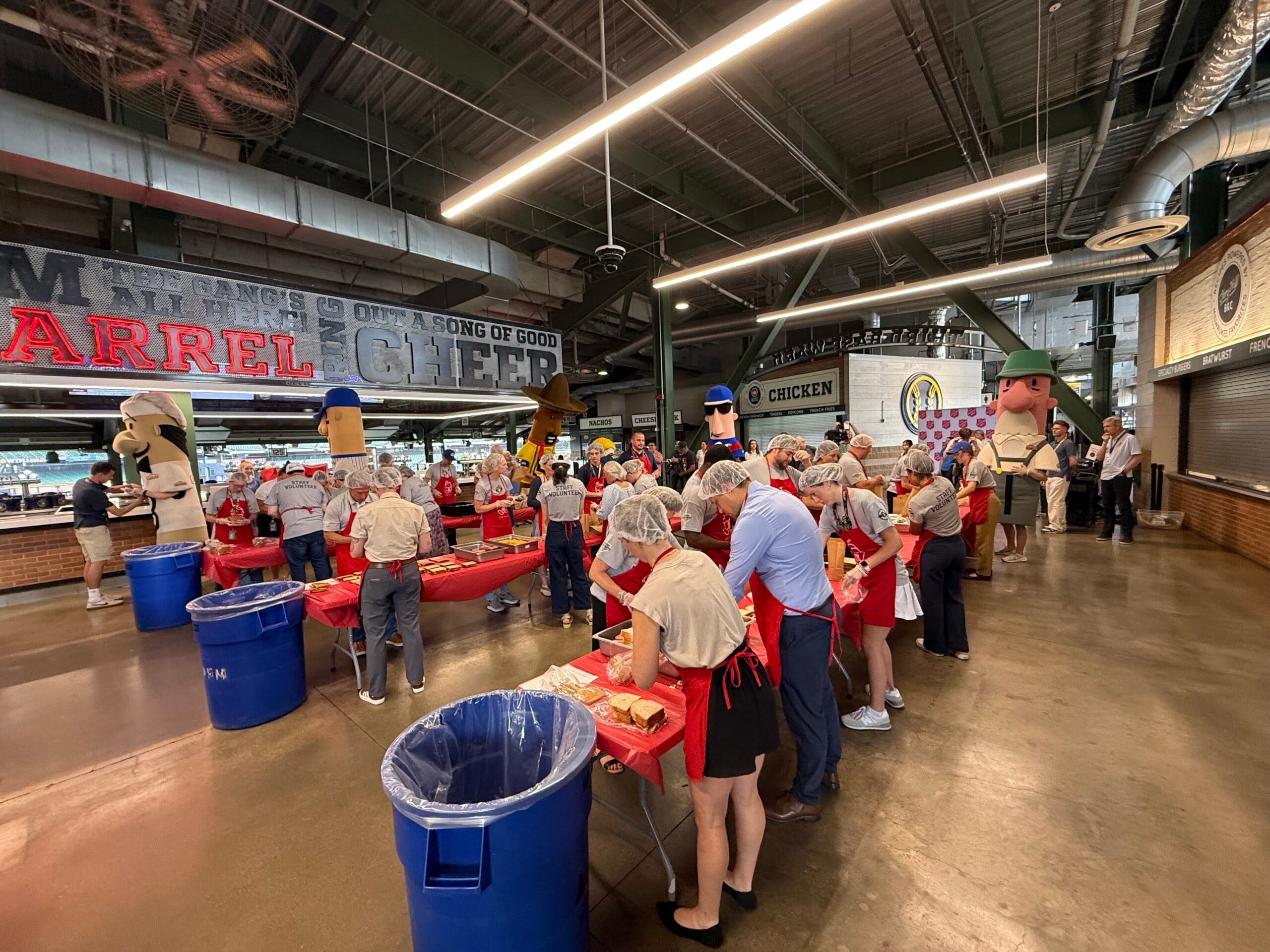
MILWAUKEE—- The Milwaukee Brewers and The Salvation Army teamed up Monday to help fight childhood hunger by packing hundreds of lunches for children across Milwaukee County.
Brewers front office staff, volunteers, and community leaders assembled 600 lunches at American Family Field as part of the annual Feed the Kids summer meals program.
Each lunch includes a turkey sandwich with cheese, fruit, vegetables, and milk. The meals will be distributed to children on weekdays through August 21st at six locations throughout Milwaukee County while school is out for the summer. The locations include Salvation Army Citadel Corps, Cold Springs Corps, Tiefenthaler Park, Westlawn Gardens, Salvation Army Distribution Center, and Carver Park. The Salvation Army also reminds attendees that all meals must be eaten on-site in accordance with USDA policy.
Milwaukee Mayor Cavalier Johnson, The Salvation Army of Milwaukee County Area Commander Major Beverly Gates, and Brewers players Andrew Vaughn and Chad Patrick joined volunteers during the event.
“While school is out, many children lose access to the meals they depend upon during the school year,” Major Beverly said. “Feed the Kids helps to fill that void, making sure that children have something nutritious to eat and reminding them that they are valued, that they’re important and that they’re supported.”
The Feed the Kids program began in 1990 and has provided more than 2.8 million meals to children facing food insecurity across Milwaukee County.
“I think just the act of making a sandwich may not seem like a lot, but really, for the kids across Milwaukee, it means a ton,” Mayor Johnson said. “For kids in Milwaukee and for kids in cities, the hunger really spikes when they’re no longer in school, when they don’t have, you know, that sort of structured programming around them. So the work that you’re doing today, it may seem pretty simple making a sandwich, but it really goes much farther than that.”
Organizers say the program helps fill the gap for families who rely on school meal programs during the academic year, ensuring children continue to have access to nutritious lunches throughout the summer.
Minneapolis, MN
Minneapolis City Council member Aisha Chughtai taking mental health leave for a month

Minneapolis City Council member Aisha Chughtai said Monday she will be taking a monthlong leave to seek outpatient care for her mental health.
Chughtai said her “office will remain open to continue serving the people of Ward 10,” but she will miss the council meeting on July 16. She plans to return before the July 30 meeting.
“I love representing the people of this Ward. It’s the greatest honor of my life. And that’s why I feel obligated to do so to the best of my abilities,” Chughtai said in a statement. “Because of the current state of my mental health, I fear falling short of that obligation. That’s why I’m briefly stepping back. I fully expect to return energized and ready to give more than ever for the people of Ward 10 and everyone in the city.”
In her statement, Chughtai cited “a high-stakes election … several mass shootings, and a federal occupation” as recent stressors on her mental health.
Chughtai said she has notified the council and Mayor Jacob Frey, and encouraged Ward 10 residents to contact her office via email with any questions or concerns.
“I know that when I return, I’ll be back stronger, ready to form deeper partnerships, and ready to fight even harder for our neighbors,” she said.
Chughtai was first elected in 2021 to represent Ward 10, which includes the south Minneapolis neighborhoods of East Bde Maka Ska, East Isles, Lowry Hill East, South Uptown and Whittier.
If you or someone you know is in emotional distress, get help from the Suicide and Crisis Lifeline by calling or texting 988. Trained crisis counselors are available 24 hours a day to talk about anything.
In addition, help is available from the National Alliance on Mental Illness, or NAMI. Call the NAMI Helpline at 800-950-6264 or text “HelpLine” to 62640. There are more than 600 local NAMI organizations and affiliates across the country, many of which offer free support and education programs.
-

 Lifestyle49 seconds ago
Inside Hearts On Fire’s Plan For a New Era of Diamond Jewellery
-
 Politics4 minutes ago
Anthropic partners with California to expand AI use by government workers
-
 Sports16 minutes ago
Lions release cornerback Terrion Arnold soon after judge sets his bond at $1 million
-

 World24 minutes ago
EU will ‘come to its senses’ on Israel, former Netanyahu adviser says
-
 News49 minutes ago
Senate Ethics Committee dismisses complaint against Sen. Ruben Gallego
-

 New York2 hours ago
Read the Indictment of Malik Beasley
-

 Los Angeles, Ca2 hours ago
Stolen Sea Scouts boat found in Marina del Rey, suspect arrested
-

 Detroit, MI3 hours ago
Michigan House passes bill to restrict big investors from amassing single-family homes

