Maine
Hundreds of students attend Maine Learning Technology Initiative Student Conference


ORONO, Maine (WABI) – Hundreds of school students from across the state attended the annual Maine Learning Technology Initiative Student Conference in Orono Thursday.
The event was hosted on the University of Maine campus by the Maine Department of Education.
It focused on educating students in a fun way on topics such as robotics, AI, and cyber security.
Those from the department say it’s important to stay up to date on teaching kids about those emerging fields.
“When technology comes on the scene, it tends to stick around. So, we try to do our best to prepare students not only for what’s here right now, but also what they are gonna see in five years from now and how can we lay the foundational principles for them so that they can be successful no matter what the next technology advancement is,” said Emma Banks, event coordinator, Maine Department of Education.
“They kind of just make it more entertaining for the kids so we’re not just sitting in a college class. We’re actually doing fun entertaining hands-on work,” said Zoie Elliott from Windsor Elementary School and presented at the event.
Activities ranged from an AI training camp to a Lego robotics session.
Copyright 2025 WABI. All rights reserved.



Maine’s blueberry barrens, which have been part of the state’s iconic scenery since before Europeans first arrived, are not as permanent as some might think.
Many are not just used for growing the state’s signature wild fruit, but also are beloved spots for hiking, hunting and picnicking, and provide important habitat and food for many species of animals and birds. The barrens are also testament to an ancient, and continuing, interplay of human stewardship and the unique features of the land.
But the fate of these Maine landscapes is increasingly uncertain, and preserving them for future generations is not so simple, according to land stewards and nonprofit groups that help protect parcels throughout the midcoast from being developed.
More than a thousand acres of blueberry land are currently on the market or have been sold recently. Larger blueberry producers are withdrawing from the region in the face of low prices and the intensifying effects of climate change, which has made weather patterns more erratic, sometimes whipsawing between early frosts, soggy conditions and drought in a single growing season.
Adding to the uncertainty is the fact that some large tracts of blueberry land that were for sale have recently been withdrawn from the market. Some of this land appears to be being cultivated for berries again this year, though it’s unclear whether it will be put back up for sale after the harvest.
“With what’s happening with our blueberry land, we’re seeing how vulnerable we are when private corporations have been holding or stewarding something that is a community asset and a part of the community’s local food system,” said Alivia Moore, a citizen of the Penobscot Nation and co-director of Niweskok, a Wabanaki-led nonprofit focused on reconnecting Wabanaki people with the land and their cultural food systems. The group has a farm and education center in Swanville.
The midcoast blueberry parcels that are for sale include several plots owned by Wyman’s, including 122 acres on Clarry Hill in Union priced at $499,000 and 40 acres in Penobscot being sold for $299,000. It also includes a 247-acre parcel known as Patterson Hill in Belfast being sold for $1.8 million by a member of the family that operates Allen’s Wild Maine Blueberries.
Worried that this land will be lost to development, a couple of local efforts have sprung up in recent months to try to protect some blueberry land. A group of women in Searsport is gaining traction in their effort to raise $750,000 to save more than 150 acres of land being sold by Wyman’s.
And on June 15, Northport voters overwhelmingly approved a moratorium on new RV parks, “glampgrounds” and event centers after a Massachusetts couple bought over 100 acres, much of it in blueberry barrens, with plans to turn the parcel into an RV park with up to 80 sites and geodesic domes.
Wyman’s did not respond to requests for comment.
In neighboring Hancock County, a would-be developer faced strong local opposition last year to converting a Blue Hill blueberry barren into house lots. He ended up selling the 38-acre property, which used to be owned by blueberry businessman Kermit Allen, to the project’s opponents.
Small-scale blueberry producers have also stepped in in some cases to buy fields or contract with land trusts to manage blueberry fields they already steward. But despite public concern, and the unusually large amount of blueberry land currently at stake, there is no large-scale coordinated effort to protect the midcoast’s blueberry barrens from being developed into new uses.
When it comes to an emblem of local culture, “blueberries are second only to lobsters,” said Ian Stewart, the executive director of Coastal Mountains Land Trust, which is headquartered in Camden.
But “it’s hard to react” to so much blueberry land being on the market at the same time, he said.
It’s not that people don’t care, Stewart said. His group, which manages large blueberry barrens at its Beech Hill Preserve in Rockport, hears frequently from people who are worried that this land will be lost to development.
Many local land trusts already have some blueberry land in their portfolios but adding more presents real challenges, he said. The land needs to be managed in perpetuity in order to keep it from reverting back to forest, and finding people to take that on isn’t easy.

When the land trust protects a block of forest, it takes a “fairly hands-off approach,” Stewart said. It may just leave the forest alone, or manage invasive species, or build a trail.
“Blueberry land is quite the opposite,” he said. It requires mowing and bushogging in perpetuity, otherwise it will revert to scrub and then forest.
Coastal Mountains has a reserve account for maintaining its blueberry land at Beech Hill. Stewart estimates that it costs $25,000 to $35,000 per year in staff time and other costs to manage the land trust’s blueberry land.
It’s with these costs in mind that the land trust evaluates opportunities to conserve more blueberry land.
“We’re aware that it is a real investment, so we don’t take it on lightly,” Stewart said.
“Conservation isn’t the tool that keeps [this land] blueberries,” said Linnea Patterson, land conservation manager at Georges River Land Trust, which is headquartered in Rockland. “Managing is what keeps it blueberries. And a lot of land trusts aren’t equipped to become a commercial-scale blueberry grower or steward.”
The fact that many of the parcels currently for sale cost hundreds of thousands of dollars makes conserving some of the tracts on the market even more challenging, she said.
Still, she says that blueberry barrens have a lot of qualities that make them good candidates for conservation such as scenic views, habitat, and potential for public access.
Georges River Land Trust currently works with blueberry growers at two of its preserves and the land trust is eager to help find a solution to protecting the region’s blueberry landscapes, Patterson said.
“It’s a very emotional thing to think about losing native Maine blueberry fields,” she said.
Moore, of Niweskok, said the current moment presents “an important, sudden, fragile opportunity.”
Wabanaki people are a big part of the reason we have so many blueberry barrens in Maine, she points out. “Yes, it’s the soils, it’s the topography, it’s the geology. It’s also the millenia of relationship and stewardship of Wabanaki people.”
That relationship, which she characterized as “caretaking for collective abundance,” provides a way forward that could help protect land and also restore communities’ stewardship of the land.
This could include land trusts, farming coops and other grassroots efforts to protect and care for the land, she said.
“I think there’s a really important opportunity with so much land [listed] for sale right now where we can reorient and shift away from private land holding of something that really needs to be part of stabilizing our local food system and putting it back into local community control,” Moore said.
One grassroots effort, The Wild Blueberry Collective, has been organizing to protect a tract of land that Wyman’s is selling in Searsport. They have approached land trusts but found the groups were able to offer resources, but not to take on the effort to buy the land.
“It feels like the way to make this happen is through grassroots organizing,” she said.
Instead of putting the land directly on the market, Wyman’s has offered the group a purchase and sale agreement if they can raise the funds by October. To date, the group has raised $100,000 in grants and $35,000 from donors and small fundraisers. They also have an agreement with an entity that will loan them half of the money if they can come up with the first half, said Gloria Pearse, though she declined to provide more specifics about the agreement.
While the collective is currently focused on fundraising to protect the parcel in Searsport, they would not be opposed to working to protect other blueberry landscapes, Pearse said.
“Land is being developed and here’s our opportunity to protect the reason why we like where we live,” she said. “This is the time to save that land.”

Purchase this image
FREEPORT — Flo Edwards and Alexus Bond have been shucking oysters under a tent and serving them to mollusk enthusiasts from all over the country for three days.
Their bounty is helping the 5th annual Maine Oyster Festival reach a new record for oyster sales, which is predicted to be well over last year’s 40,000.
The event started in 2021, when a group of oyster farmers approached Visit Freeport to ask about a statewide oyster festival, lead planner Margaret Hoffman said.
“They really desired to have a festival in Maine that was free and open to the public, low cost, broke down barriers, because people think oysters are this kind of exclusive thing that you can only eat in fancy restaurants,” Hoffman said. The farmers also wanted an event that welcomed farmers from anywhere in Maine.
Dozens of restaurants, artists and marine specialists take over the parking lot behind the iconic L.L. Bean flagship store in Freeport. At any given time during the three-day event, 20 of these tents represented oyster farms.

Purchase this image
“The best office I’ve ever worked in is out on the water during the daytime,” Edwards — whose main gig is dentistry — said. She and Bond, a logistician, started their business, Indigo Oyster Co., three years ago.
Indigo is a two-woman job, the lifelong friends said. They had spent years bonding over their shared love of oysters until one day they asked each other: “Should we try this?” Then, they started their farm in Yarmouth.
“Usually women who look like us are in the factories where they’re just shucking or canning, like not taking part in the ownership,” Bond said.
They chose the name “Indigo” because it honors Bond’s Asian heritage and Edwards’s African heritage. Taking the leap to launch a life on the water meant an opportunity to highlight women and people of color — two underrepresented populations in oyster farming, Bond said.
This was their first year at the festival, and it went well. Some visitors even saved their last oyster ticket to return to the booth, labelling Indigo oysters as their favorite of the weekend.
Hoffman said turnout this year has been great thanks to the weather and the offerings, with some farms selling out on the second day of the festival. She met one woman who said she had driven from Arizona just for the event.

Purchase this image
Freeport welcomed farmers and educators from as far south as Eliot, and as far north as Brooksville, all eager to teach visitors about the world of oyster farming.
Most oyster farmers in Maine use a top culture method, where oysters are harvested in a cage at the surface of the water. Top culture harvesting is relatively fast, and produces small oysters, said John Clapp, the owner of Mimi’s Oysters.
“We’re really focused on dive harvesting and working on our bottom sites,” Clapp said. They are one of a few farms in the state that uses both top and bottom culture.
All of Mimi’s oysters spend an entire season on the surface, but the largest get planted directly on the bottom where they grow for another two years. Bottom culture makes for a bigger oyster and a more complex flavor palate, Clapp said.
“Despite the extra time that it takes to get there, we feel that the, you know, the more time you spend with the oyster, the better product that you’re getting in the end,” he said.
Clapp and his team came to the festival with 4,000 oysters. After selling 2,400 on Saturday, the crew was confident they’d sell out of their remaining 1,600 Sunday.
Between sampling dozens of oysters, browsing the goods for sale and listening to live music, visitors had the opportunity to watch the festival’s culminating event on Sunday; an oyster shucking competition.

Purchase this image
No two oysters are the same, and no one knows that better than the professional shuckers who competed this year.
Spectators gathered as Kelly Punch, Firat Kocan and defending champion Chad Michael Egeland carefully slid their shucking knives between each oyster shell. Any leftover grit or cracks in the shell resulted in a penalty.
Egeland finished first, followed by Kocan and Punch. After a few minutes of inspection, judges wrote down final scores on the lid of a paper takeout box, crowning Egeland winner for the second year in a row.
The oysters were slightly dry and gave the competitors some trouble this year, Egeland — who is also the raw bar sous chef at Portland’s Scales — said. But, he couldn’t be happier with his win.

Sen. Susan Collins had just finished taking photos in front of a new fire station in the town of Sweden when a television reporter asked her about Graham Platner.
Four days earlier, on June 9, the political newcomer secured the Democratic nomination to take on Collins. Instead of addressing his victory, Collins pivoted to talk about her position on the Senate Appropriations Committee, a leadership role that in many ways is the culmination of her three decades in office.
The fire station, she said, was an example of what she has been able to do as chair “of the most powerful committee in the Senate.”
“These communities cannot, on their own, build a new fire station,” Collins said in an interview with the Portland Press Herald/Maine Sunday Telegram after the event. “They just don’t have the tax revenue.”
Maine’s top ranking Republican worked for years to get to the position of influence so she can make more fire stations like this a reality. As appropriator-in-chief, she directs earmark spending to cities, towns, hospitals, organizations and universities; influences selections for competitive grants for things like transportation infrastructure; and inserts programs and rules into congressional bills that specifically benefit Maine and its industries.
She’s running for reelection to her sixth term largely on these hard-won abilities. At every opportunity, she talks about the approximately $1.5 billion in earmarks she has brought to Maine since her last election. One of the major questions facing voters this year will be just how much that matters.
Collins’ federal earmarks since her last election have supported the construction or renovation of 45 firehouses in Maine, a Press Herald review shows, as well as 43 wastewater treatment facilities, at least 31 state road improvements, 17 childcare centers, six YMCAs and hundreds of other beneficiaries from affordable housing to historic preservation.
“The amount of funding she has secured for Maine is astonishing,” said Heideh Shahmoradi, an appropriations expert who worked for the Senate Appropriations Committee and is now a bipartisan consultant in Washington.
While all senators can bring money to their states, there is ample evidence that Collins’ success couldn’t be replicated by a freshman.
It’s attributable to more than her seniority, though. Collins has broken with the Republican Party to support programs that create pots of funding that could benefit Maine; and she’s having to defend Congress’ spending power against a Trump administration that wants to take some of it away.

But Platner argues that the money Collins has brought home has failed to address the underlying issues that have made Maine less affordable for many, which is a key motivating issue in this election.
As a senator, Platner says he would work to massively expand the country’s social safety net.
“For all of the money that Susan Collins brags about earmarking for Maine, the reason we’re still seeing housing become unaffordable, we are still seeing our healthcare system collapse, we’re still seeing our wages collapse while the price of goods and services go up,” he said at a May event in Phippsburg, “is that she never did a thing to change the structures.”
Platner’s ambitious policy talk would be difficult to achieve: Medicare for All would likely need 60 votes in the closely divided Senate to become law. Collins’ earmarks, officially known as Congressionally Directed Spending, and grant awards regularly get approved within a year.
Some voters, including people who supported Collins in the past, said in interviews that they don’t plan to vote for her this year, despite the funding she brings home.
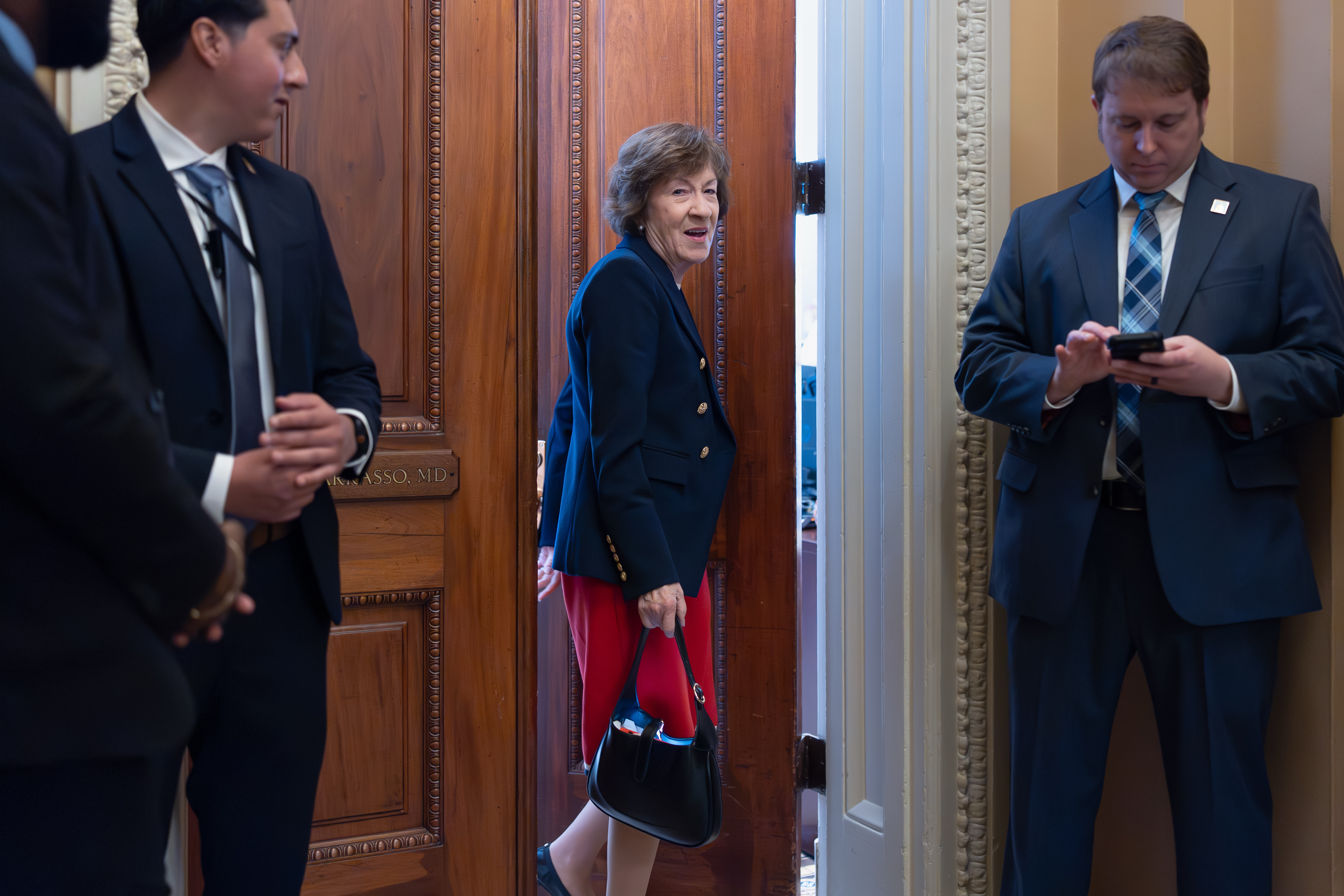
On primary election day, outside a Sanford library that was recently expanded with a $3 million congressional earmark from Collins, Mallory Mulrath said she uses the library three or four days a week as part of her work with children.
“I love this library,” she said. “(But) I do feel like there’s more important things. The old library needed updates, but not to this extent.”
This November, Mulrath said she is voting on economic issues and does not plan to vote for Collins. She’s paying more for gas, groceries and car insurance.
“No one can afford to pay bills, let alone actually live and have fun,” she said.
PRIORITY ON APPROPRIATIONS
Earlier in her Senate tenure, Collins chaired the Homeland Security and Aging committees. She felt like she did important work, but said it became increasingly evident that, “You can pass the best legislation imaginable, but if it’s not funded by the Appropriations Committee, you can’t accomplish the goals.”
That’s one reason why she made it her focus to get on the committee.
She also noted that Maine is what she calls a “low-income state” that needs federal support, and that she could use her position to benefit the state’s defense and biomedical research industries.
Appropriators are able to go through each federal spending bill and write amendments to help their states. Collins was appointed to the committee in 2009, and in 2015 became chair of the subcommittee on transportation, housing and urban development. She was a leader of the subcommittee on defense, and became chair of the full committee in 2025.
Former staffers say Collins stands out for her attention to detail and passion for following Senate rules and that, as an appropriator, she makes sure she understands each budget request.
Shahmoradi, who was clerk and staff director of the subcommittee Collins chaired, said one of the questions Collins asked about each item in front of her was, “What are the benefits to Maine?”
Of the five senators she worked with, she said Collins was the most strategic about bringing money to her state.
One way she does that is by putting language directly into spending bills to solve a specific Maine problem or support an industry. Since the Appropriations Committee touches each obscure part of the federal government, the possibilities are vast.
For example, logging industry leader Dana Doran said Collins funded a grant program to support biomass for wood energy in 2018; and she incorporated language in appropriations bills starting in 2016 that classify wood biomass as a carbon-neutral fuel source.

Purchase this image
In another instance, starting in 2009, trucking business owner Brian Bouchard said his industry and big companies like Irving, Dead River and Poland Spring told Collins they were frustrated with a federal rule that prohibited them from driving 100,000-pound loads on interstates. It was causing safety issues on local roads, and made trucking less efficient.
Collins was able to use an appropriations bill to increase the weight limit along Maine’s section of Interstate-95.
“Senator Collins just bulldogged this thing,” said Brian Parke, president of the Maine Motor Carriers Association.
The longtime head of the construction industry group in Maine, Matt Marks, said infrastructure upgrades have been sorely needed in Maine and while he’s grateful for the entire congressional delegation, Collins in particular has become like the third leg of the stool to get any project done. (He counts the industry as one leg, and state and local governments as another.)
There is evidence that appropriators like Collins also help steer money to their states through competitive grants. For example, she was one of three members of her party who voted for the Obama-era stimulus package after the 2008 financial crisis (former Maine Sen. Olympia Snowe was another), which created a pool of money for states to compete to fund transportation projects.
The federal transportation department chose recipients for the so-called TIGER grants, but in Collins’ first campaign ad released this spring, she made clear that she had input on who got selected.
The ad shows a flash of light and rows of boats bobbing in the ocean when a breakwater collapsed in Eastport on the northeastern tip of the state in 2014. A local official in the ad thanks Collins for bringing $6 million to help restore the breakwater. According to a news release from Collins’ office sent when the rebuild was complete, the money was secured a year before the breakwater’s collapse through a TIGER grant, when it was already clear the breakwater was in bad shape.
Members of Congress routinely write letters of support for applications from their home states and try to help them get approved. Though Shahmoradi, who had previously worked at the federal transportation department and reviewed TIGER applications in years prior to the Eastport project, said there was not enough money to fund all the worthy applications.
During her time on staff, when the department needed a secondary way to choose among the high-scoring applications, it would look to politics.
“That’s the reality in making these selections,” she said.
Smaller states and projects would not have prevailed without the kind of influence members like Collins had, Shahmoradi believes. The nonprofit news outlet APM Reports came to a similar conclusion when it analyzed TIGER grantees and found that all of Maine’s 13 applications got funded.
Molly Reynolds, vice president of the centrist Brookings Institution, said that kind of power can extend across the federal government. “If you know that Sen. Collins has a lot of power in the appropriations process, you’re more likely to want to say yes to things she wants to see in other legislation.”
Collins’ office said since she joined the Appropriations Committee, she’s helped Maine win more than $1 billion in competitive transportation grants, including through a rural bridge program she helped create.
If she were voted out, said Daniel Schuman of the American Governance Institute, “You’re not going from all to nothing. You’re going from all to less.”
EARMARKS GALORE
Competitive grants gave appropriators a way to get money for their home states during a decade-long period in which Congress suspended direct earmarks. Since 2022, when Congress restarted them, senators can make an unlimited number of requests for specific projects, although members have to compete to get their requests funded.
“It truly is your seniority on the committee, your seniority in the Senate, that determines how much money you’re going to get,” Shahmoradi said.
Collins’ success in bringing money home increased as she moved her way up the committee’s ranks. In 2024, she had the most in earmarks of any member of Congress: $577 million. The only state that got more per capita was Alaska, according to the independent watchdog Citizens Against Government Waste.
Some of the requests go to tiny places, like the $1.15 million to support the fire station in Sweden, which has a population of about 450. Penobscot, Collins’ home county of Aroostook, and Washington have drawn the most funding from Collins per capita. All three lean significantly more conservative than southern parts of the state.
Maine’s most populous and most liberal county — Cumberland — has drawn 7% of Collins’ earmarks but has 22% of the state’s population. Collins said that’s in part because some places make fewer requests, and because when she’s selecting projects she considers an area’s ability to pay its own way.
At times that’s left communities off of Collins’ funding list even when their projects match the kinds of things she regularly touts. For example, Falmouth asked for funding for a new fire station this year, and South Portland is about to borrow $58 million to upgrade its wastewater infrastructure.
Both are on the request list submitted by Sen. Angus King, an independent who caucuses with Democrats, but his success rate has been much lower than Collins’: She gets nearly 100% of her requests funded, while King was at about 50% in 2024 and 26% in 2026 (though King asked for nearly twice as much funding).
“I very much value her position and what she brings to the table,” South Portland Economic Development Director Lea Duffy said of Collins. But Duffy is disappointed not to have Collins’ financial support to lessen the rate increases for residents and companies.
“We have some really important industries that happen to be located in South Portland,” she said, like technology companies she said keep the state relevant in the 21st century. They’ll see big increases in their sewer costs to pay for the upgrades.
In response to any suspicion that her selections are political, Collins pointed to several earmarks she’s directed to places that didn’t vote for her, like drinking water infrastructure in Brunswick and mental illness treatment in Rockland.
“If I made political assessments, Portland would not be getting any money,” she said. Instead, she pulled out a printed book to show where Portland has gotten funds for a food bank, teen shelter, a residential treatment center and more.
Some cities have had repeated success. Auburn has gotten an earmark from Collins each year since 2022, for a public safety center, a youth community center, a riverwalk expansion and utilities for housing. (Auburn is a politically purple city; voters supported both Collins and Democrat Joe Biden in 2020.)
VOTERS WEIGH IN
Collins hopes these community investments are persuasive in an election when the economy will drive decisionmaking, according to University of Massachusetts Lowell pollster John Cluverius. He said it’s the most important issue for the narrow slice of voters whose choices will determine the outcome of the election.
In Auburn in May, voter and retiree Mike Heon was asked about the Senate race. “Why would you want to give up Susan Collins? Are you kidding me?” he said.
If other voters disagree and replace her with a freshman senator, Mainers can expect its share of federal earmarks to drop. When Vermont Sen. Patrick Leahy left Congress, and his post as Appropriations chair, his successor brought in just 20% of Leahy’s total.
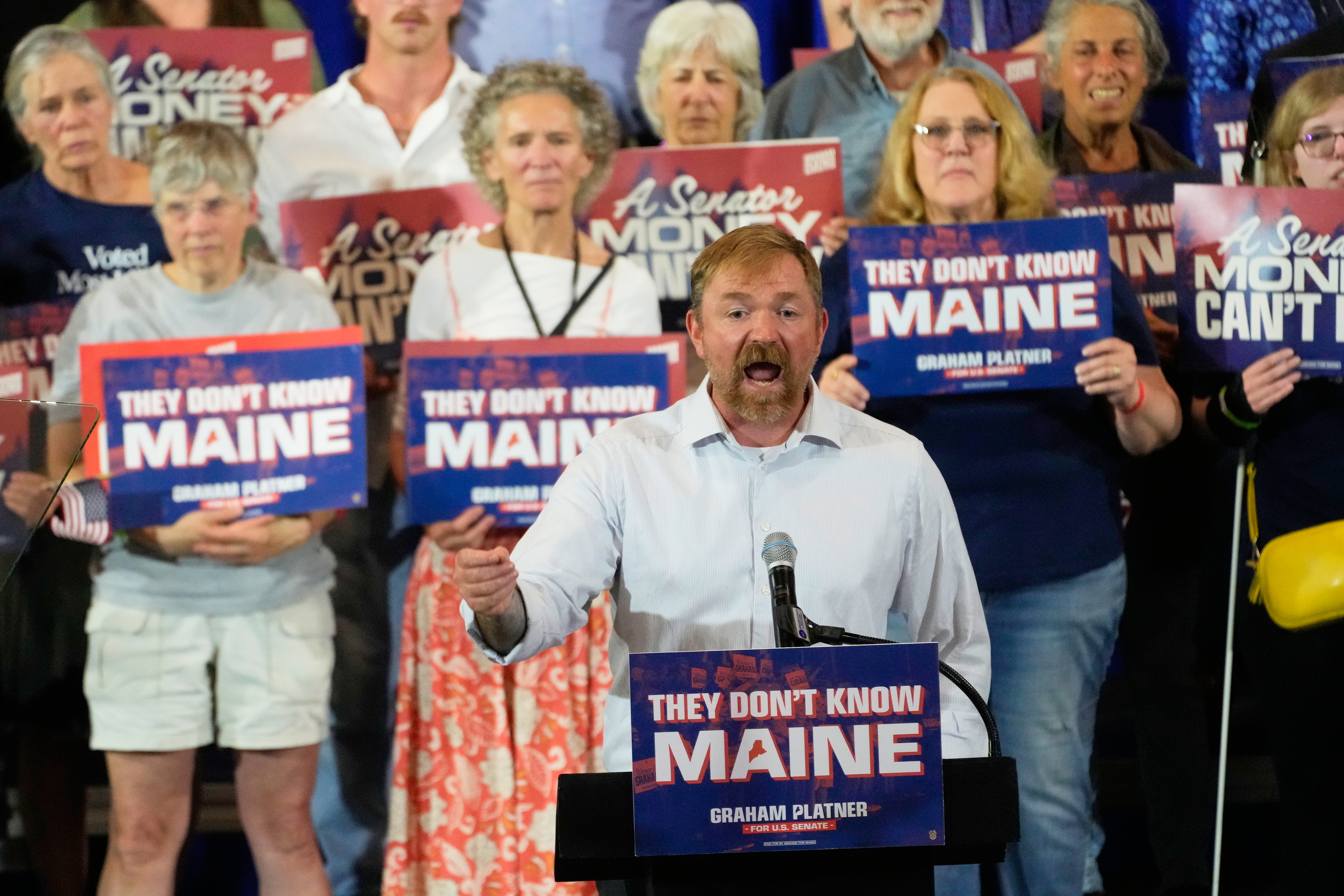
Platner said in Phippsburg that if he joins the Senate, he’ll have the time to rebuild the power she has, while also advocating for systemic changes.
Mainers could hope Platner follows in the footsteps of Georgia Sen. Jon Ossoff, who was appointed to the Appropriations Committee by party leaders just a few years into his first term.
Platner’s earmarks could differ from Collins’ ideologically, as well. Researchers at the University of Texas and the University of Illinois Chicago found liberal Democrats have used earmarks to accomplish their core policy goals, while moderate Democrats and Republicans spread them out on other issues, when they analyzed House appropriations requests from 2022.
While Maine’s members of Congress have largely used earmarks to support infrastructure, there are also some that reflect ideological priorities. Rep. Chellie Pingree’s lists include a couple of items to support clean energy and environmental sustainability, for example.
But no one, not even Collins, got earmarks in 2025, when Congress couldn’t agree on spending bills and decided to continue its prior year budget instead of passing new ones. That kind of gridlock resulted in three distinct federal shutdowns in just the last year. It makes Collins’ job much harder, and means she may not get to use all the power her position traditionally afforded, experts said.
She has also contended with a Trump administration that has tried to make big cuts to priorities she likes to fund, like the low-income energy program.
Bath resident Margaret Allen said on primary day this month that she’s voted for Collins five times before. “She’s done good things,” Allen said. But she doesn’t plan to vote for Collins again. This time around, she doesn’t care about the money Collins has brought home.
“The national issues are way more important than anything Susan Collins is going to do for fire stations,” she said.
Allen is a retired data researcher and said she worries about Social Security, America’s place in the world, the environment and what will happen when the One Big Beautiful Bill Act’s health insurance cuts take full effect.
Maine is expected to lose billions of dollars, not all of which will be replaced by a rural hospital fund Collins championed — one indication that while she has brought money home to Maine, money has also been taken away on her watch.
“I’m not OK with what the Republicans are getting away with,” Allen said.
In Sanford, voter Kevin Mulherin, who works in IT for an engineering firm, said he voted for Collins in 2020 but doesn’t plan to in November.
He said her ability to bring funding to Maine has favored some businesses and industries.
“That’s great for those people that’ll benefit, but at the end of the day I’m still working with less money,” he said.
Not all moderate voters agree. Also voting in Sanford during the primary, Bill Frederick said the cost of living matters to him quite a bit, and he doesn’t think the Trump administration is doing good things, but he plans to vote for Collins.
He said she keeps money coming to Bath Iron Works, which builds naval ships, and Pratt & Whitney in North Berwick, which manufactures aircraft engines, as well as the nearby Portsmouth Naval Shipyard.
That money could go elsewhere, Frederick said, but Collins makes sure it comes to Maine.
Coming soon: How Collins and the Trump administration are jockeying for control of the federal budget, and what it means for Maine.
-

 Illinois2 minutes ago
Illinois Lottery Pick 3, Pick 4 results for June 28, 2026
-

 Indiana7 minutes ago
Visitors slam Trump’s ‘snitch signs’ at Indiana national parks
-

 Iowa14 minutes ago
Vote: Class 1A Iowa High School Baseball Midseason Player Of The Year
-
Kansas17 minutes ago
Kansas Lottery Pick 3, 2 By 2 winning numbers for June 28, 2026
-

 Kentucky22 minutes ago
Missing teen Marly Kinney ID’d as body found in Kentucky lake days after vanishing from boat party
-

 Louisiana29 minutes ago
Letlow, Davis win Senate primary runoffs in Louisiana; will face off in November
-
Maine32 minutes ago
Preserving Maine’s blueberry landscape proves difficult as barrens put up for sale
-
Maryland37 minutes ago
Maryland Lottery Pick 3, Pick 4 results for June 28, 2026

