Politics
A woman's grisly death inflames debate over how California manages problem black bears


DOWNIEVILLE, Calif. — Patrice Miller, 71, lived by herself in a small yellow house beneath towering mountain peaks on the edge of a burbling river in this Sierra County village. She doted on her cats and her exotic orchids, and was known to neighbors for her delicious homemade bread. One fall afternoon, after Miller had failed for several days to make her customary appearance at the town market, a store clerk asked authorities to check on her.
A short time later, a sheriff’s deputy found Miller’s lifeless body in her kitchen. Her right leg and left arm had been partially gnawed off. On the floor around her were the large paw prints of a bear.
Months after her death, officials would make a stunning disclosure, revealing that an autopsy had determined that Miller had likely been killed by the animal after it broke into her home. It marked the first known instance in California history of a fatal bear attack on a human.
But amid the contentious politics around black bears and other apex predators in California, not everyone accepts the official version of how she died.
“We don’t believe the bear did it,” said Ann Bryant, executive director of the Bear League in the Tahoe Basin. “And I will go on record as saying that. … We’ve never had a bear kill anybody.”
The story of Miller’s grisly end — and the increasingly heated battles around predators in California — have come roaring into the state Capitol this spring. Lawmakers representing conservative rural districts in the state’s rugged northern reaches argue that their communities are under attack, and point to Miller as one example of the worst that can happen. One solution they have pushed is changing the law to allow people to set packs of hunting dogs after bears to haze them. A similar measure has been floated — for now unsuccessfully — to ward off mountain lions considered a threat.
Wildlife conservation advocates are aghast. They say turning dogs on bears is barbaric and won’t make anyone safer. They contend the proposed laws don’t reflect a scientifically backed approach to managing wild populations but instead are pro-hunting bills dressed up in the guise of public safety. The real solution, they say, is for humans living near bears to learn to safely co-exist by not leaving out food or otherwise attracting them.
“These people are using [Miller’s death] to try to start hounding bears again,” said Bryant, who maintains that Miller, who was in poor health, must have died before the bear came into her home and devoured her. “She would roll in her grave if she knew that in her death people would create a situation where people were going to mistreat bears, because she loved bears.”
In a recent report, the Department of Fish and Wildlife estimates there are now 60,000 black bears roaming California and notes a marked increase in reports of human-bear conflicts.
(John Axtell / Nevada Department of Wildlife)
Founded in 1849, Downieville, population 300, is one of California’s oldest towns, and also one of its quaintest. Colorfully painted wooden buildings sit at the junction of two rivers, beneath majestic pines and mountain peaks.
Along with tourists, who flood in in the summer for rafting and mountain biking, the town also receives frequent visits from bears and mountain lions. More recently, wolves have arrived with deadly force, snatching domesticated cattle off the open pastures that stretch across the plains on the other side of the mountains east of town.
Miller wound up here about a decade ago, at the end of a rich, complicated life. She had worked in an oil refinery, and also as a contractor. She was a master gardener, expert at transplanting Japanese maples, according to her neighbor, Patty Hall. She was a voracious reader and a skilled pianist. But she was also in poor health and had struggled with substance abuse, according to neighbors and officials.
Longtime residents in the area were used to the challenges of living among wild animals. But in the summer of 2023, Sierra County Sheriff Mike Fisher said he started getting an overwhelming number of calls about problem bears.
“We had three or four habituated bears that were constantly here in town,” said Fisher. “They had zero fear. I would say, almost daily, we were having to go out and chase these bears away, haze them.”
But bears have a sharp sense of smell, a long memory for food sources and an incredible sense of direction. If a tourist tosses them a pizza crust or the last bits of an ice cream cone, or leaves the lid off a trash can, they will return again and again, even if they are relocated miles away.
That summer, Fisher said, no matter what he did, the bears kept lumbering back into town. It was unlike anything he had experienced, he said, and he had grown up in Downieville. “A police car with an air horn or the siren, we would push the bear up out of the community. Fifteen minutes later, they were right back downtown,” he said.

Founded in 1849, Downieville, population 300, is one of California’s oldest towns and also one of its quaintest.
(Myung J. Chun / Los Angeles Times)
And then there were the bears harassing Miller and her neighbors.
“There were three bears,” recalled Hall, who lives just up the hill from the home Miller rented. “Twice a night they would walk up and down our [porch] stairs. The Ring cameras were constantly going off.”
Fisher said some of Miller’s neighbors complained that she was part of the lure, because she was not disposing of her garbage properly. Some also alleged she was tossing food on her porch for her cats — and that the bears were coming for it. Miller’s daughter later told sheriff’s officials that bears were “constantly trying” to get into her house, and that “her mother had physically hit one” to keep it out. One particular bear, which Miller had nicknamed “Big Bastard,” was a frequent pest.
Fifty miles from Downieville, in the Lake Tahoe Basin, the Bear League was getting calls about Miller, too. The organization, which Bryant founded more than two decades ago, seeks to protect bears by helping residents coexist with them. This includes educating people about locking down their trash and helping to haze bears away from homes.
“We got calls [from her neighbors] that told us she had been feeding the bears, tossing food out to them, and let them come into her house,” Bryant said. She added that some thought, erroneously, that the Bear League was a government organization, and “maybe we had the ability to enforce the law” against feeding bears.
Hall, Miller’s friend, told The Times that Miller was not feeding bears. Still, the problems continued.
Eventually, officials with the California Department of Fish and Wildlife were called and told Miller she could sign a “depredation permit,” after which authorities could kill bears trying to get into her house. But Miller declined to do so, Fisher said.
In early November, Miller stopped showing up around town, prompting calls for a welfare check.
A little before 3 p.m. on Nov. 8, 2023, Deputy Malcolm Fadden approached Miller’s home, which was a short walk from the sheriff’s office. The security bars on the kitchen window had been ripped off. The window itself had been busted from the outside.
“I knocked on the door,” Fadden wrote in his report, but got no answer.

Patrice Miller was found dead in her rental cottage in November 2023. Bear advocates take issue with an autopsy report that said she probably was killed in a bear attack.
(Jessica Garrison / Los Angeles Times)
Through the window, he saw blood streaked across the living room floor. He took out his gun and burst into the house, where he was greeted by a giant pile of bear scat. He found Miller in the kitchen, her half-eaten body surrounded by food and garbage, which, Fadden wrote, had been “apparently scattered by bears.”
Fisher was horrified. Already frustrated at what he saw as the Department of Fish and Wildlife’s lackluster response to the escalating bear incursions that summer, now he wanted the bear that had fed on Miller to be trapped and killed.
He said the department told him that for the bear to be killed, “the person who lives at the house has to sign the [depredation] permit.” Fisher said he responded: “How many times do I have to tell you the person who lives at that house was eaten by the bear?”
This was the start of a long-running conflict between the sheriff and agency officials that would complicate the release of the autopsy findings about Miller’s death, and also convince Fisher that more aggressive steps were needed to protect his community.
Eventually, Fisher managed to get a depredation permit for the bear that had fed on Miller; his deputies tracked down her landlord, who as the homeowner could sign it. Wildlife officials set up a trap near Miller’s house, and in short order, a bear was caught.
But, according to Fisher, officials initially said it wasn’t the same bear. They said DNA tests showed that the bear who had eaten her was male, and the bear they had caught appeared to be female. They intended to release the bear, he said.
Fisher padlocked the cage, and threatened to call the media. In response, he said, wildlife officials sent a biologist, who determined the bear in the trap was male. It was shot that night.
At that point, few people, including Fisher, believed that the bear had actually killed Miller, as opposed to feeding on her after she died of natural causes. Though there are recorded instances of fatal black bear maulings in other U.S. states, they are rare, and there had been no reports of one in California. Fisher issued a news release saying that the death was under investigation, but that “it is believed that Patrice Miller passed away before a bear, possibly drawn by the scent or other factors, accessed the residence.”
After performing an autopsy, however, the pathologist on contract with Sierra County came to a different conclusion. She issued a report that found that Miller had “deep hemorrhage of the face and neck“ as well as “puncture injuries (consistent with claw ‘swipe’ or ‘slap’).” These injuries, she noted, were “characteristics more suggestive of a vital reaction by a living person.” In short: The pathologist found that Miller was probably killed by the bear.
Because of Fisher’s feud with Fish and Wildlife, that autopsy report, dated Jan. 4, 2024, wouldn’t become public for months.
Fisher said the state agency was refusing to provide him with copies of the DNA analysis of the bear that had been trapped in Miller’s yard. He wanted to see for himself that it matched the DNA evidence collected at her home, saying he hated the thought that a bear that had feasted on a person might still be roaming his town.
“I requested DNA from Fish and Wildlife, and they refused to provide it to me,” he said. “So I withheld the coroner’s report. We stopped talking.”
He said he verbally told department officials that the pathologist believed Miller had been killed by the bear — a seemingly noteworthy development. He said that officials responded: “I guess we’ll see when we get the report.”
In an email to The Times, state wildlife officials confirmed that Fisher had verbally shared the results of the autopsy report, but said they felt they needed to see the report to do their “due diligence before making an announcement about the first fatal bear attack in California.” The agency had sent an investigator to the scene after Miller’s death, who like Fisher and his deputies, thought the evidence suggested she had died of natural causes, said agency spokesperson Peter Tira.
By the time Fisher got the autopsy report, it was deep winter in the mountains, and bear activity decreased. Then came spring, and along with the blossoms, the bears came back to Downieville.
Bears were knocking over trash cans and breaking into cars. In May, residents on Main Street reported that a bear had broken into multiple houses, including one incursion that involved a bear standing over 82-year-old Dale Hunter as he napped on his couch.
A few days later, a bear tried to break into the cafeteria at Downieville High School while students were at school.
Fisher declared the bear a threat to public safety. Fish and Wildlife eventually issued a depredation permit, and the bear was shot.
That led to a story in the Mountain Messenger, the local paper. In it, the sheriff dropped a bombshell: “Miller was mauled to death after a black bear entered her home,” the paper reported. The story went on to say that the sheriff had made “numerous attempts” to inform Fish and Wildlife “about Miller’s death and more recent dangerous situations.”
After the story ran, state Sen. Megan Dahle, a Lassen County Republican who at the time served in the Assembly, set up a conciliatory meeting between Fish and Wildlife and Fisher. They have been meeting regularly ever since, Fisher said.
Fisher got his DNA results confirming that the bear trapped in Miller’s yard was the same bear that had eaten her. And Fish and Wildlife officials finally got a copy of the pathology report, which said Miller was probably alive when she encountered the bear.
The revelation made headlines around the state. “We’re in new territory,” Capt. Patrick Foy of Fish and Wildlife’s law enforcement division told the San Francisco Chronicle.
Bryant and other bear advocates found the release of such a significant finding so long after the fact confounding.
“I absolutely do not believe it,” Bryant said. If the bear had killed her, Bryant added, “the evidence should have been so clear, like immediately.”
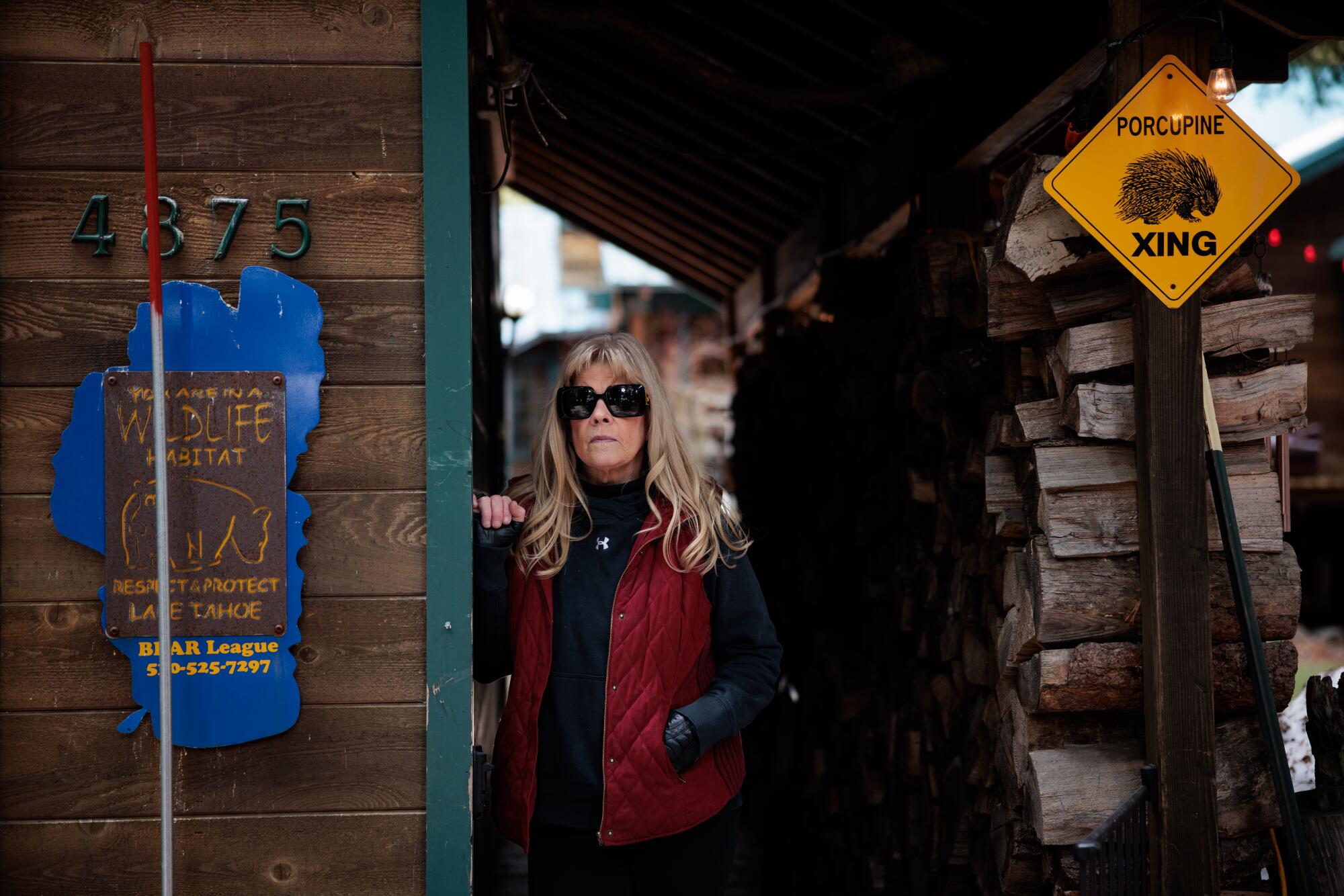
“We don’t believe the bear did it,” Ann Bryant, executive director of the Bear League, says of Patrice Miller’s death. “We’ve never had a bear kill anybody.”
(Max Whittaker / For The Times)
The Downieville saga unfolded as bears seemed to be making news all over California.
To many, it seemed there were just many more bears encroaching on human settlements. A Fish and Wildlife report released last month estimated there are now 60,000 black bears roaming the Golden State, roughly triple the figure from 1998, the last time the department issued a bear management plan. That’s the highest population estimate for anywhere in the contiguous U.S., although the report also suggests that California’s bear population has been stable for the last decade.
In the Lake Tahoe area, where 50,000 people live year-round and tens of thousands more crowd in on busy tourist weekends, bears were breaking into houses and raiding refrigerators; they were bursting into ice cream shops and strolling along packed beaches.
State and local officials went into overdrive, trying to teach residents and tourists how to avoid attracting bears. The state set money aside for distribution of bear-proof trash cans and “unwelcome mats” that deliver a jolt of electricity if bears try to break into homes.

The Bear League will loan Tahoe Basin residents “unwelcome mats” that deliver a little jolt of electricity to bears if they try to break into homes.
(Max Whittaker / For The Times)
The Bear League stepped up its efforts. From a small office on Bryant’s property, the organization’s 24-hour hotline was ringing, and volunteers were rushing out with paintball guns to haze bears and to advise people on how to bear-proof their houses.
The tensions continued to escalate, nonetheless, between people who wanted to protect bears at all costs and those who wanted some problem bears trapped and relocated — or killed. In 2024, after a homeowner in the Tahoe area fatally shot a bear he said had broken into his home, many people were outraged that the Department of Fish and Wildlife declined to file charges.
Advocates also complained that the state has fallen behind in its efforts to help people and bears coexist. In recent years, the state had hired dedicated staff to help people in bear country, but the money ran out and some of those people were laid off, said Jennifer Fearing, a wildlife advocate and lobbyist.
“We have the tools to minimize human-wildlife conflict in California,” Fearing said. “We need the state to invest in using them.”
In Sierra County, the sheriff had come to a different conclusion. “We’ve swung the pendulum too far on the environmental side on these apex predators,” Fisher said.
Earlier this year, Fisher found common cause with newly elected GOP Assemblymember Heather Hadwick. “Mountain lions, bears and wolves are my biggest issue. I get calls every day about some kind of predator, which is crazy,” said Hadwick, who represents 11 northern counties.
In February, she introduced a bill, AB 1038, that would allow hunters to sic trained dogs on bears to chase them through the woods, but not kill them. While California has a legal hunting season for bears, it is strictly regulated; the use of hounds to aid the chase has been banned since 2013.
Hadwick argued that hounding bears would increase their fear of humans, which she said some are starting to lose: “We’re keeping them in the forest, where they belong.”

Bears have a long memory for food sources and an incredible sense of direction. If a tourist tosses them a pizza crust or leaves the lid off a trash can, they will return again and again.
(California Department of Fish and Wildlife)
Wildlife advocates showed up in force last month to oppose Hadwick’s bill in an Assembly committee hearing. Sending hounds after bears is cruel, they said. Plus, hounding bears in the woods would have no impact on the bears knocking over neighborhood trash cans and sneaking into ice cream stores.
Fisher testified in favor of the bill, and spoke of Miller’s death.
Lawmakers listened, some with stricken looks on their faces. But in a Legislature controlled by Democrats, Hadwick did not garner enough votes to send her bill on to the full Assembly; it became a two-year bill, meaning it could come back next year.
Fisher returned to Sierra County, where he has continued to advocate for locals to have more power to go after predators. The current situation, he said, is “out of control.”

Construction workers unfurled a large printed tarp to cover scaffolding installed at the White House’s front entrance. Doug Burgum, the interior secretary, said President Trump had ordered the repairs after noticing damage to columns.
Politics
WATCH: Trump’s Energy chief reveals what escalating Iran tensions could mean for gas prices

NEWYou can now listen to Fox News articles!
Energy Secretary Chris Wright is telling Americans not to be concerned about the possibility of another surge of sharp increases in gasoline prices as tensions with Iran have started to escalate once again.
Asked whether Americans should worry about higher prices at the pump and how the Trump administration is preparing to keep the economy stable if the conflict continues to worsen, Wright told Fox News Digital: “It has not been any good behavior from Iran that’s allowed oil to flow. It’s been the United States military.”
“That’s not changing,” he assured, speaking from the Great American State Fair on the National Mall this week.
US CLAWS BACK KEY CONCESSION TO IRAN AFTER FRESH ATTACKS ON COMMERCIAL SHIPS IN STRAIT OF HORMUZ
(Mario Tama/Getty Images) (Mario Tama/Getty Images)
With Iran striking three commercial vessels transiting the Strait of Hormuz on Monday and Tuesday, Wright doubled down in urging citizens to not credit Iran for the U.S. military’s work to ensure oil shipments continue flowing through the strait.
“Look, the U.S. Military has been the key asset here,” he said. “They have assured the flow of oil and gas through the Strait of Hormuz throughout. Not at the beginning of this conflict, but through the last six weeks.”
Wright said the administration is closely monitoring global oil supplies as the tentative ceasefire with Iran seemingly came to come to a halt, with President Donald Trump telling Secretary-General Mark Rutte the call for peace with Iran is “over” at the NATO Summit in Turkey on Wednesday.
But, he pointed to the continued shipping through the Strait as evidence that markets should remain stable.
TRUMP SAYS IRAN CEASEFIRE IS ‘OVER’ AFTER IRANIAN ATTACKS TRIGGER MASSIVE US RESPONSE
President Donald Trump speaks at the White House on Tuesday, April 22. (AP/Alex Brandon)
“We’re of course constantly watching the supply of oil, the supply of refined products and what’s going on there,” Wright said. “And I think still all positive trends.”
Beyond geopolitical concerns, Wright also praised the new chain of discounted gas stations across Pennsylvania and New Jersey, Freedom Fuel, which promises customers prices below the national average.
The Trump administration, though not involved with the network, has heavily endorsed the new chain and its 25 locations.
“We love it,” Wright said when asked about Freedom Fuel. “I mean, look, any mechanism we can to lower energy costs for Americans of all kinds, we’re all in on.”
“With Freedom Fuels, they’re just lowering it down to their wholesale price of gasoline,” Wright said. “So they’re not making any money selling gasoline, but they’ve got convenience stores. That’s how most gas stations make money.”
NEWSOM UNDER FIRE AS CALIFORNIA GAS TAX HIKE SENDS PUMP PRICES EVEN HIGHER
Gasoline costs are a known concern for many Americans, and amid surging prices there has been a considerable increase in those opting to purchase electric vehicles to save money long-term at the pump — with Tesla dominating the market for these types of models.
Wright argued one of the benefits to living in America is having the option to choose what type of vehicle you drive.
CLICK HERE TO DOWNLOAD THE FOX NEWS APP
“We just want people to buy what they would prefer,” he told Fox News Digital when asked his thoughts on increasing calls for support of the electrification of cars. “Consumer choice — you wanna buy an electric car, you wanna buy a gas powered car, diesel powered car, buy a big truck. That’s the choice.”
“That’s why you live in America. You get the choice of all those.”

In 2023, California regulators levied more than $100,000 in fines against the private operator of a federal immigration facility, kicking off a three-year battle over whether detainees who do work at the facilities should be considered employees.
The question went beyond semantics: If considered employees, the detainees would be subject to state worker protection laws.
A legal settlement announced this week now affirms that private immigrant detention facilities are subject to California’s workplace safety and health requirements.
“Every worker deserves a safe and healthy workplace and should be able to report workplace hazards without fear of retaliation,” said Denisse Gómez, spokesperson for the California Division of Occupational Safety and Health or Cal/OSHA.
“Individuals who perform work in these facilities are entitled to workplace safety protections, and this settlement reinforces Cal/OSHA’s commitment to enforcing those protections and safeguarding vulnerable workers,” she added.
Under the settlement between California and the GEO Group, a Florida-based private prison company, the company recently withdrew its legal challenges and agreed to pay more than $100,000 in the fines.
The GEO Group did not respond to requests for comment.
Back in 2023, Cal/OSHA issued $104,510 in fines against the GEO Group. The agency had found six violations of state code by the company after detainees complained about a lack of protective equipment and proper training while cleaning the facility for $1 per day.
Detainees alleged they routinely wiped black mold off shower walls at the facility, saw black dust spew from air vents and used cleaning solutions that lacked instructions during the COVID-19 pandemic.
The biggest fine levied against the GEO Group was for failure to establish and maintain “effective written procedures to reduce employee risk of exposure to aerosol transmissible disease.”
Advocates viewed Cal/OSHA’S recognition of the detainees as workers as a victory that could pave the way for future labor rights fights at other detention centers in the state.
But the GEO Group appealed, arguing that detainees participating in ICE’s voluntary work program make their own schedules and aren’t employees, so hazard exposure couldn’t be “as a result of assigned duties,” as California law states. Plus, the company argued, there wasn’t enough evidence that detainees were exposed to any hazard.
Early last year, the state’s Occupational Safety and Health Appeals Board rejected the GEO Group’s argument and found that detainees should be considered “affected employees.”
The GEO Group sued, but three days before a California Superior Court hearing in May, the company and Cal/OSHA reached the settlement.
Along with paying the fines, the GEO Group agreed to draft plans for avoiding aerosol transmissions at 12 secure and reentry facilities in California, including five detention centers that hold immigrants.
“GEO ensures detainees are afforded the necessary tools, equipment, and personal protective equipment … to safely and effectively perform any necessary tasks,” the settlement states.
Gómez said the settlement also leaves intact the appeals board’s ruling that civil immigration detainees who participate in work programs can participate in proceedings anonymously, “acknowledging the potential for retaliation when individuals raise workplace safety concerns.”
But the question of whether detainees are employees and deserve certain protections isn’t entirely resolved — at least not for the federal government.
Last month, U.S. Immigration and Customs Enforcement released new standards for detention facilities across the country. The revised guidelines “emphasize that detainee volunteers participating in the voluntary work program are not considered facility and/or government employees” and thus not entitled to labor regulations.
Attorney Mariel Villarreal said the timing of the new detention standards made her question whether the GEO Group had asked ICE to specify in its standards that detainees are not workers in response to its battle with Cal/OSHA.
“To me, it’s a reaction to this very settlement,” she said. Villarreal works for the California Collaborative for Immigrant Justice, which filed the original complaint on behalf of detainees who said they worked in unsafe conditions.
Villarreal pointed to a Washington Post report that GEO Group executives privately asked ICE to specify that detainees are not employees of the facilities where they work. Two top Trump administration officials, border czar Tom Homan and acting ICE director David Venturella, previously worked for the GEO Group.
New versions of ICE detention standards take effect as contracts are established or modified, so this year’s rules won’t immediately apply to every facility.
An ICE spokesperson did not comment about the settlement. The spokesperson, who did not provide their name in an emailed statement Wednesday, said the agency has begun transitioning detention facilities to meet the 2026 standards, “building on its longstanding commitment to safe, secure, and professional detention operations.”
“ICE has consistently implemented many of these best practices independently, reinforcing its role as the leader in detention operations,” the spokesperson added.
The GEO Group and other immigrant detention center operators have faced other legal battles over workers’ rights, including lawsuits in Washington, Colorado and California over the $1-per-day payment.
Villarreal said she’s confident that the Cal/OSHA settlement would continue to hold even if California facilities incorporated the new standards. But she said she believes the statements are an attempt by the GEO Group to “sidestep responsibility” and avoid the possibility of being fined under similar circumstances in other states.
“These statements in the new standards are a way for them to try and preserve profits as much as possible,” she said. “GEO and ICE are so intertwined at this point that they have the same motives.”
-

 Alabama4 minutes ago
Final 2026 MLB mock draft projections for Alabama’s Justin Lebron
-
 Alaska7 minutes ago
Watch My Buddy Matt Not Get Eaten by Bears in Alaska
-

 Arizona12 minutes ago
Roller derby still has a home in Arizona despite myriad obstacles
-

 Arkansas19 minutes ago
Freshman OL Tucker Young never wavered through Arkansas football coaching changes | Whole Hog Sports
-

 California22 minutes ago
Northern California high school graduation shooting suspect arrested in Texas
-

 Colorado27 minutes ago
Colorado to weigh daily hunting limits, ban on fur sales for wildlife hunted for fur
-

 Connecticut34 minutes ago
Woman arrested, accused of murdering man in Farmington in March
-

 Delaware37 minutes ago
Rehab center, denied in Montchanin, buys Fort DuPont site | Exclusive

