Washington, D.C
‘We are bracing for impact’: Federal funding cuts slash supplies at DC-area food banks – WTOP News


Some D.C.-area food banks are in a bind as President Donald Trump’s administration has made major cuts to programs providing them federal aid while demand for food banks has simultaneously soared.
Some D.C.-area food banks are in a bind as President Donald Trump’s administration has made major cuts to programs providing them federal aid, while demand for food banks has simultaneously soared.
At a food bank and pantry in McLean, Virginia, Food for Others Executive Director Deb Haynes told WTOP they’re feeling the effects of cuts made in March as inflation drives up the cost of replacing the canceled supply deliveries.
“We are expecting to probably have to feed more people with less food or with more expensive food,” Haynes said.
In March, the Trump administration cut $1 billion from federal programs aimed at getting American-grown food to people who are having trouble affording groceries.
Haynes said they’re still crunching the numbers on how supplies will be impacted by $500 million in cuts to the Department of Agriculture’s Emergency Food Assistance Program.
“It’s possibly going to cut how much of that food we receive by 50% to 100%. We don’t have hard numbers yet,” Haynes said. “We don’t know if the cuts are going to be spread out evenly over the country.”
Through that program, which is sometimes abbreviated as TEFAP, the USDA buys nutritious food and gets it into the hands of state’s distributing agencies.
“We are bracing for impact here,” Haynes said. “About 20% of the food that we distribute is through that program. We feed, at peak, about 4,500 families in a month with that food.”
Haynes said she estimates they’ll need about $1.5 million to replace the food from TEFAP.
In the case of the D.C. area, food from TEFAP is distributed by the Capital Area Food Bank. That organization was expecting to get food from 55 tractor-trailers from April through June.
Back in March, Capital Area Food Bank President and CEO Radha Muthiah said the organization found out it would only receive half those supplies.
Another $500 million was cut from the Local Food Purchase Assistance Cooperative Agreement. Through that initiative, states were provided funding to buy crops grown by U.S. farmers and processed in the country. It was distributed to organizations such as the Capital Area Food Bank at no cost, and given out to people in need.
That program is not being renewed.
“We can no longer count on funding from USDA that we would use to purchase hundreds and thousands of pounds of good, nutritious food from local area farmers for our community members in need,” Muthiah said.
Food banks are also keeping an eye on the Farm Bill — legislation that’s being debated in Congress that would fund food benefits for low-income families. Haynes said there’s concern cuts could be made to Supplemental Nutrition Assistance Program, commonly known as SNAP.
“The more SNAP is cut, the less buying power families have to bring home groceries for their children and themselves,” Haynes said. “And if those school meals (get) cut, that’s a radical impact on children’s nutrition.”
Countering the loss in supplies
With hopes of countering the loss in funding, Haynes said Food for Others is boosting its food drives and looking to expand its program where it buys food that would otherwise go to waste at area grocery stores.
“We’re also looking at running different scenarios of where can we purchase food, how much it would cost, talking to our vendors, trying to get some estimates and be prepared, so that if we get hit with a big wave of need, that we’re prepared to bring in the food to meet it,” Haynes said.
The Capital Area Food Bank is working to make up for some of the lost meals for its local partners such as Food for Others.
“What we’re doing is pivoting to the other two sources of food that we rely on, and that’s donated food from area retailers, wholesalers, food drives, as well as purchased food,” Muthiah said.
Muthiah said it can be difficult to get more donated food quickly.
“We are having to purchase more food than we thought we might have to do at this stage of our year, and that we can only do with the generosity of our community to be able to help us,” she said.
The strain on supplies comes as several factors put pressure on food banks. Energy prices have made it costly to transport food, and should tariffs go into place, premiums on aluminum could make canned goods more expensive.
“Our dry goods vendors started raising prices even before the tariffs went into place,” Haynes said.
Inflation is making it more expensive to buy the food itself, which has driven more people to reach out for support. Haynes said Food for Others’ emergency referral program is up 25% compared to this time in 2024.
“We’re watching that very closely, and we’re shifting some of the incoming food to make sure that we’re meeting the need in that program, because those are families in crisis that do not have food,” Haynes said.
In the case of Food For Others, high grocery prices could be behind its dip in donations and spike in visitors.
Tens of thousands of federal workers have lost their employment, and as they run through their savings, local food banks expect to see a surge in visitors. Those layoffs have ripple effects — for example, people who work in the service industry may lose gigs as former federal workers cut back on paying for services like getting their homes cleaned.
“It’s an interesting perfect storm that’s developing with a reduction in supply, at the very same time, when we’re seeing more people in need of help from us,” Muthiah said.
“We met the challenge of COVID, and we will meet this challenge as well,” Haynes said. “That is in large part because everybody understands that everyone needs healthy food, and so we’re confident that we can meet the need and that our community will rally around us and help us do that.”
Get breaking news and daily headlines delivered to your email inbox by signing up here.
© 2025 WTOP. All Rights Reserved. This website is not intended for users located within the European Economic Area.



Washington, D.C
What’s that noise? What you need to know about D.C. flyovers Friday and Saturday – WTOP News

Reagan National Airport will close for America 250 flyover rehearsals Friday and celebrations Saturday featuring the Thunderbirds, Blue Angels and more.

Reagan National Airport will close from 10 a.m. to 1 p.m. Friday for rehearsals ahead of this weekend’s America 250 celebrations, meaning people around D.C., Arlington and Alexandria may hear and see low-flying military aircraft.
According to Freedom 250 event organizers, Friday’s “Wings of Freedom” demonstrations over the National Mall will feature parachute teams, helicopters and military aircraft, including the U.S. Marine Corps’ MV-22 Osprey and F-35B, the Navy’s F-18F and F-35C, the Air Force’s F-22 Raptor, the Thunderbirds and a tri-bomber formation.
On Saturday, the FAA will close the airport from noon to midnight for the full celebration. All arrivals and departures at Reagan National are scheduled to end before noon.
Flyovers and demonstrations are scheduled throughout the afternoon and evening along the National Mall and Washington Monument grounds, including appearances by Air Force One, the Thunderbirds, Blue Angels, military aircraft fleet reviews, parachute demonstrations and B-2 stealth bombers.
Highlights include an Air Force One flyover scheduled for 7:03 p.m., a Thunderbirds demonstration beginning at 6:25 p.m., a tri-bomber formation at 6:02 p.m. and a stealth aircraft flyover at 7:38 p.m.
Friday’s schedule of flyovers and demonstration rehearsals along the National Mall and Washington Monument
- 10 a.m.: Golden Knights, Leap Frogs
- 10:15 a.m.: Army Helo Flyover
- 10:20 a.m.: USMC V-22 Osprey Demo
- 10:35 a.m.: USMC F-35B STOVL Demo
- 10:50 a.m.: USN F-18F Demo
- 11:10 a.m.: USN F-35C Demo Team
- 11:30 a.m.: USAF F-22 Raptor Demo
- 11:50 a.m.: NASA F-5s
- 12 p.m.: HUGE (1) Formation
- 12:05 p.m.: USAF Thunderbirds
- 12:55 p.m.: USAF Tri-Bomber
Saturday’s schedule of flyovers and demonstration along the National Mall and Washington Monument
- 1:14 p.m.: – NASA F-5 Flyover
- 1:24 p.m.: -NASA Fleet Review
- 1:44 p.m.: USCG Helo Flyover
- 1:54 p.m.: USCG Fixed Wing Flyover
- 2:09 p.m.: Golden Knights, Leap Frogs
- 2:29 p.m.: Army Helo Flyover
- 2:44 p.m.: USAF Fleet Review – Wave 1 – Heavies
- 2:54 p.m.: USAF Fleet Review – Wave 2 – AFSOC
- 3:04 p.m.: USAF Fleet Review – Wave 3 – Fighters
- 3:29 p.m.: Executive Rotary Wing Airlift
- 3:39 p.m.: USMC Fleet Review – Wave 1 – Rotary
- 3:49 p.m.: USMC Fleet Review – Wave 2 – Fixed Wing
- 3:59 p.m.: USN Fleet Review – Wave 1 – Rotary
- 4:09 p.m.: USN Fleet Review – Wave 2 – Fixed Wing
- 4:19 p.m.: USN Fleet Review – Wave 3 – Fighters
- 4:21 p.m.: USN F-18F Demonstration
- 4:59 p.m.: USN Blue Angels
- 5:26 p.m.: USMC MV-22 Osprey Demonstration
- 5:44 p.m.: USAF Fleet Review – Fighters
- 6:02 p.m.: USAF Tri-Bomber Formation
- 6:05 p.m.: USN F-35C Demonstration
- 6:25 p.m.: USAF Thunderbirds Demonstration
- 7:03 p.m.: Air Force One Flyover
- 7:07 p.m.: USAF Thunderbirds Delta Break
- 7:17 p.m.: HUGE 1 Flyover Led by the Newly Renovated Air Force One
- 7:38 p.m.: U.S. Stealth Airpower Flyover
- 7:39 p.m.: F-22 Raptor Demo
- 7:53 p.m.: F-22 Raptor in Afterburner
- 7:59 p.m.: B-1 Flyover
- 8:07 p.m.: B-1’s in Afterburner
- 8:11 p.m.: HUGE ONE Fly Over Review
- 8:22 p.m.: Golden Knights Twilight Jump
- 10:36 p.m.: B-1 Afterburner Night Pass
Get breaking news and daily headlines delivered to your email inbox by signing up here.
© 2026 WTOP. All Rights Reserved. This website is not intended for users located within the European Economic Area.

An Air Force major was arrested in uniform on the steps of the Capitol after he called for the impeachment of President Donald Trump.
U.S. Capitol Police arrested Jason Watson, an active-duty service member, on Wednesday afternoon following remarks at a news conference where he said Trump and Vice President JD Vance should be removed from office.
The event was organized by the Removal Coalition, a group that lobbies members of Congress to impeach Trump, and attended by Rep. Al Green, D-Texas, who has repeatedly introduced articles of impeachment against Trump.
“I’m here with him because Rep. Green is the only member of Congress that has demonstrated the courage and conviction to … force a vote on articles of impeachment,” Watson said at the event. “If Congress followed his example, we could remove the entire Trump administration, but Congress remains unconvinced of the urgency and necessity for them to honor their oaths, so we must persuade them with our unrelenting, uncompromising civil resistance.”
Watson said he is not a Democrat and does not share policy positions with Green, who lost his re-election bid this year. Green’s office did not immediately respond to a request for comment on Watson’s arrest.
Capitol Police said in a statement that it “is generally against the law for the public to demonstrate on the House Steps unless they are with a Member of Congress.”
“Yesterday afternoon, a man was escorted to the House Steps by a Member of Congress,” the statement said. “When the Member of Congress left the area, our officers gave the man lawful orders to stop the illegal demonstration or he would be arrested. The man refused our lawful orders.”
Capitol Police identified the man as Watson, adding that he was arrested on charges of “Crowding, Obstructing, and Incommoding” and that it is legal to protest in other spots on the Capitol grounds.
Service members are subject to stricter laws than the average citizen when it comes to protesting. The Uniform Code of Military Justice prohibits officers from “using contemptuous language towards the President, Vice president, the Secretaries of War and of a military department, Congress, and certain other officials,” according to an Air Force memo last year.
An Air Force spokesperson said in a statement Thursday: “Service members must comply with all laws, regulations and policies governing conduct and the wear of the uniform. All Department of the Air Force personnel are expected to uphold the highest standards of discipline and professionalism, both on and off duty.”
All service members, not just members of the Air Force, are prohibited from participating in “political activities” in uniform.
Watson’s criticism of Trump and Vance focused on the administration’s actions in Venezuela and Iran, calling them “an unconstitutional usurpation of Congress’ authority and a violation of the War Powers Clause.”
“These violations resulted in the deaths of 13 service members and injuries of hundreds more,” he said, referring to the number of U.S. military deaths tied to the Iran war. “For this, the president and vice president must be impeached, convicted and removed.”
Watson also called the administration’s immigration policies and tactics unconstitutional.
The Removal Coalition did not immediately respond to a request for comment, and Watson could not be reached.
President Donald Trump responded to criticism of a financial disclosure that listed $1.4 billion in crypto earnings largely driven by meme coins.
Berk Kutay Gökmen
02 July 2026•Update: 02 July 2026
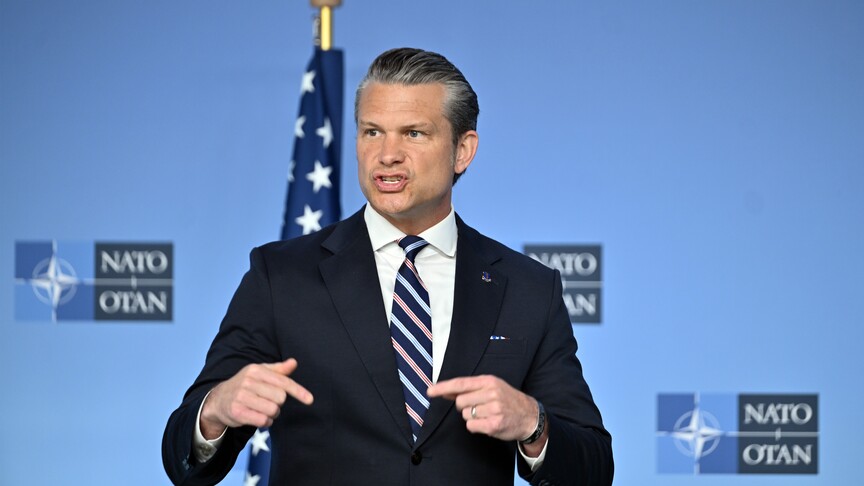
US Defense Secretary Hegseth on Thursday faced protesters while hosting the Trump administration’s DC Safe and Beautiful Task Force ceremony in Washington DC.
During the ceremony at Meridian Hill Park, which saw the gathering of National Guardsmen, dozens of demonstrators gathered near the park to protest Hegseth.
Footage shows the demonstrators chanting a short distance away from where Hegseth and roughly 200 members of the National Guard had gathered in the park
In social media posts, one protester was seen holding a Palestinian flag, while another person was holding a sign that reads “arrest Hegseth.” The protesters want a “Free DC,” according to social media posts.
In his address to the National Guard, Hegseth said that “this background noise is perfect,” referring to the protests.
“It’s the sound of ingrates, of ingratitude—of people who are so blinded by ideology they can’t see law and order and common sense in front of them,” he said.
Meridian Hill Park was repaired by the National Park Service and the Interior Department as part of a larger initiative to restore and enhance federal parks and public spaces throughout the nation’s capital in preparation for America’s 250th anniversary, which falls on this Saturday, July 4.
Though such beautification projects are typically popular with the public, the current initiative has been controversial both for its choice of projects and the use of no-bid contracts to hire firms to do the work, sometimes with disappointing results.
The work aligns with President Donald Trump’s DC Safe and Beautiful Task Force, established by a March 2025 executive order that directs federal agencies to coordinate public safety and beautification efforts across Washington.
-

 Idaho3 minutes ago
Idaho Falls Chamber of Commerce CEO resigns amid podcast allegations – East Idaho News
-

 Illinois8 minutes ago
Illinois legislation to regulate cannabis market
-

 Indiana15 minutes ago
Prostitution charges filed against two women in Westfield
-

 Iowa18 minutes ago
After convictions for theft and abuse, Iowa nurse faces sanctions from licensing board
-

 Kansas23 minutes ago
Kansas man injured after jet ski incident at Lake of the Ozarks
-

 Kentucky30 minutes ago
Kentucky Picks Up Latvian Record Holder Nikolass Deicmans For Class of 2026
-

 Louisiana33 minutes ago
Republicans outpace registered Democrats in Louisiana for first time in history
-

 Maine38 minutes ago
Maine should have participated in Great American Fair | Letter

