Business
Commentary: Need a balm for these troubled times? I recommend the works of P.G. Wodehouse


Seeking succor when the world seems to be closing in on you is a quintessentially human habit. Some people do it by gorging on comfort food like macaroni and cheese, others choose drink, or drugs, or gardening, or the warmth of a puppy.
I always know when I’m feeling blue, because I feel the gravitational pull of my long shelf of P.G. Wodehouse books.
If you’ve never read Wodehouse, I envy you the pleasure of discovering him for the first time. I’m well past that point; some of his stories and novels I’ve read dozens, even hundreds of times, and they can still make me convulse in laughter. More so when the outside world provides little to laugh about.
Evelyn Waugh, who admitted to learning a hell of a lot from Wodehouse, may have put it best: “Mr. Wodehouse’s idyllic world can never stale,” he wrote in a 1961 essay designed in part to defend Wodehouse over the one blot on his life story (more on that in a bit). “He will continue to release future generations from captivity that may be more irksome than our own. He has made a world for us to live in and delight in.”
And what is that world? It’s timeless, and yet dated. Orwell narrowed it down to the Edwardian era — 1901 to 1919 — long before the irruptions of two world wars and the Great Depression. Its inhabitants are those of “there will always be an England” England: stern vicars, timid curates, lords and earls, penniless titled wastrels living on allowances from their uncles, imperious aunts, upper-crust twits.
They’re all presented on the page by an inspired farceur whose exquisitely penned prose seems effortless, but belies the painstaking craftsmanship needed to make his split-second timing come off.
Some Wodehouse lines are like time bombs, detonating with a momentary delay. My favorite comes in an exchange with the soupy Madeline Bassett in “The Code of the Woosters,” when Bertie comes up with a quote he heard from Jeeves, actually the title of a poem by Percy Bysshe Shelley, to describe his friend Gussie Fink-Nottle as “a sensitive plant.”
“Exactly,” Madeline replies. “You know your Shelley, Bertie.”
“Oh, am I?”
Where to start with Wodehouse? He used several framing devices for his novels and short stories. The golf stories are narrated by the “oldest member” of an upper-class golf club who buttonholes unwary younger members to regale them with his memories of golfers he has known.
The peak of this series, to me, is “Farewell to Legs,” featuring a playboy who takes a house in a placid golfing community and discomposes its dour Scottish golfers with his high jinks: “Angus became aware with a sinking heart that here, as he had already begun to suspect, was a life-and-soul-of-the-party man, a perfect scream, and an absolutely priceless fellow who simply makes you die with the things he says.”
Then there are the fish stories told by Mr. Mulliner at his local pub the Angler’s Rest, involving his inexhaustible circle of relatives. To me, the glory of the Mulliner stories are a sequence of three stories — “Mulliner’s Buck-U-Uppo,” “The Bishop’s Move” and “Gala Night,” all related to his brother Wilfred’s invention of a tonic meant to “provide Indian Rajahs with a specific which would encourage their elephants to face a tiger of the jungle with a jaunty sang-froid,” and what happens when unsuspecting users swallow a tumblerful of something that should be taken by the teaspoon.
Some are set in New York and Hollywood, where Wodehouse spent some time writing lyrics for musicals with Jerome Kern and others. (His best-known song is probably “Bill,” from “Show Boat.”)
But at the summit of Wodehouse’s genius are the stories of Bertie Wooster and his “gentleman’s personal gentleman,” or valet, Jeeves. Of the short stories, all narrated by Bertie, to my mind the greatest are a trilogy beginning with “The Great Sermon Handicap,” continuing with “The Purity of the Turf,” and concluding with what may be the single funniest short story ever penned in English, “The Metropolitan Touch.”
Bertie and Jeeves, as the British essayist Alexander Cockburn once asserted, are a pairing as momentous in literary history as Don Quixote and Sancho Panza, or Sherlock Holmes and Dr. Watson. Wodehouse never exhausted the counterpoint between Bertie’s slangy gibbering and half-remembered literary allusions with Jeeves’ carefully modulated responses: “Very well, Jeeves, you agree with me that the situation is a lulu?” “Certainly a somewhat sharp crisis in your affairs would appear to have been precipitated, sir.”
Bertie is both a classic unreliable narrator and a stock comic character given life. Having inherited a fortune from parents who are almost never mentioned, he’s rich enough for financial difficulties to never be a plot obstruction, though he’s always willing to tide over a pal brought low by “unfortunate speculations” at the racecourse. Jeeves is a deus ex machina; we learn almost nothing about him, except for imperturbability and skill at solving the crises that Bertie falls into through his pure cloth-headedness.
Bertie’s romantic relations are entirely sexless, 20th-century echoes of courtly love, though throughout the oeuvre he gets engaged to at least six women by my count. Among them towers the frighteningly domineering Honoria Glossop. (“Honoria, you see, is one of those robust, dynamic girls with the muscles of a welter-weight and a laugh like a squadron of cavalry charging over a tin bridge.”)
Jeeves extricates Bertie from every one of these entanglements, and thankfully so, because every fiancée begins their relationship with the determination to toss Jeeves out on his ear.
Wodehouse aficionados wage a never-ending debate over which Jeeves and Wooster book is his masterpiece, with “The Code of the Woosters” (1938) and “Joy in the Morning” (1946) typically trading the top two spots.
I’m partial to the former, in part because it features the only overtly political character Wodehouse ever devised. He’s Roderick Spode, a would-be British dictator plainly based on the real-life British fascist and Hitler partisan Oswald Mosley.
Spode is the leader of a gang of fascist toughs known as the Black Shorts. “You mean ‘shorts,’ don’t you?” Bertie says when he first hears about Spode. “No,” he’s told, “by the time Spode formed his association, there were no shirts left. He and his adherents wear black shorts.” “Footer bags, you mean?” Bertie asks, a Britishism for football shorts. “How perfectly foul.”
Spode throws his weight around Brinkley Court, the country estate where the story takes place, harrying Bertie endlessly for reasons we don’t need to go into, until Jeeves provides Bertie with a magic word guaranteed to turn dictator Spode into a shrinking mouse. At the climax, Bertie presses his advantage, informing his nemesis:
“The trouble with you, Spode, is that just because you have succeeded in inducing a handful of half-wits to disfigure the London scene by going about in black shorts, you think you’re someone. You hear them shouting ‘Heil, Spode,’ and you imagine it is the Voice of the People. That is where you make your bloomer. What the Voice of the People is saying is: ‘Look at that frightful ass Spode swanking about in footer bags. Did you ever in your puff see such a perfect perisher?’”
It’s no spoiler to tell you that the magic word Jeeves provides to Bertie is “Eulalie.” As for who or what Eulalie is, and why it reduces Spode to jelly, you’ll have to read the book.
That brings us to that one blot on Wodehouse’s life. When World War II broke out, he was living peaceably in the French resort of Le Touquet. When the Nazis came through in 1940 they interned Wodehouse and transported him to Berlin, from which the Germans persuaded him to make a handful of “nonpolitical” radio broadcasts for his British compatriots.
There was an uproar at home. Newspaper columnists condemned Wodehouse as a “Quisling,” libraries took his books off their shelves, there were condemnatory speeches in Parliament.
The truth is that the broadcasts were indeed nonpolitical; if the Germans thought they had scored a propaganda victory it was instantly evident that they were wrong, and they halted the broadcasts after only five. Wodehouse had displayed nothing worse than the stupidity of the innocent. He knew nothing of the political context, much less that his broadcasts came at a moment when the very future of Britain was in question.
But that fit precisely with Wodehouse’s literary landscape. Farce, of course, depends on its characters’ failure to recognize what is near at hand; Wodehouse in his splendid isolation in France and in a bygone fictional Eden was incapable of recognizing the crisis in Britain was so near at hand that his broadcasts would strike hard at his countrymen’s diminishing morale.
Orwell’s opinion of Wodehouse’s attackers was withering. “It was excusable to be angry at what Wodehouse did,” he wrote in 1946, “but to go on denouncing him three or four years later — and more, to let an impression remain that he acted with conscious treachery — is not excusable. Few things in this war have been more morally disgusting than the present hunt after traitors and Quislings. At best it is largely the punishment of the guilty by the guilty. … In England the fiercest tirades against Quislings are uttered by Conservatives who were practicing appeasement in 1938 and Communists who were advocating it in 1940.”
One could go on. The pleasures of Wodehouse are inexhaustible, so I’ll stop here. With some news about Trump’s tariffs threatening to disturb my peace today, and having just finished a rereading of “The Code of the Woosters,” I will share the next few hours with G. Darcy (“Stilton”) Cheesewright, Zenobia Hopwood, Edwin the Boy Scout, Boko Fittleworth and Percy, Lord Worplesdon, and their horseplay in and around Steeple Bumpleigh, Hampshire.
Looking back on the affair and its satisfying resolution, Bertie tells Jeeves, “There’s an expression on the tip of my tongue which seems to me to sum the whole thing up. … Something about Joy doing something.”
“Joy cometh in the morning, sir?”
“That’s the baby. Not one of your things, is it?”
“No, sir.”
“Well, it’s dashed good.”


Walmart is rapidly expanding its network of electric vehicle chargers designed for customers to use while they shop.
The network could help fill gaps in EV infrastructure in states with greater need for chargers. Walmart, which has more than 5,000 locations in the U.S. and hundreds in California, says more than 90% of Americans live within 10 miles of one of its stores.
The chargers also offer an incentive for customers to choose Walmart — Walmart Plus members will receive a 10% discount off an average price of $0.46 per kilowatt-hour of energy at the company’s chargers.
Walmart chargers are already available at more than 75 locations in 17 states, with Texas boasting the most charging stations, followed by Florida and Arizona.
Matthew Nelson, Walmart’s director of energy policy, said last week on LinkedIn that the network will soon reach 29 states, including California.
“We are delivering on the promise of affordable, reliable and convenient charging,” Nelson said in his post.
According to Walmart’s website, six charging stations are coming to California soon, though the company did not offer a specific timeline.
The chargers will be installed at stores in Antelope, Brea, Fresno, Stockton, Suisun City and Vallejo.
Most charging sites in California will include eight to 16 fast-charging stalls, said Walmart spokesperson Kelsey Bohl.
The company first announced plans in April 2023 to install its own EV chargers at Walmart and Sam’s Club stores, with a goal of installing thousands of chargers by 2030. Partnering with ABB E-Mobility and Alpitronic, it added 25 new charging sites this past May and six more in June.
“Walmart is building a leading retail-integrated EV fast-charging network, focused on delivering an affordable, reliable and convenient charging experience where customers already shop,” Bohl said in an emailed statement. “Customers can charge while they shop, access stations through the Walmart app they already use, and benefit from affordable pricing.”
The charging stations already available include 612 individual charging stalls using 400-kilowatt chargers. Each stall has a dual charging cord with both Combined Charging System and North American Charging Standard connectors. The standard connectors, designed by Tesla, are smaller and lighter than the combined systems.
The primary way to pay for the chargers is through the Walmart app, but the company is also experimenting with built-in credit card readers to allow those without the app to use the stations.
Customers can check charger availability on the Walmart app. The company said the chargers will be available 24 hours a day.

Robotaxis could be turning into robocops.
A self-driving Waymo reported two teens to San Mateo, Calif., police on Monday after they were found drinking alcohol and shooting toy guns in the back of the vehicle.
According to a social media post from the San Mateo Police Department, officers detained two 15-year-olds after the Waymo they were riding in contacted the department and stopped in a parking lot until law enforcement arrived.
“Parents do you know where your teens are?” the San Mateo Police Department wrote on Facebook following the incident. “Waymo does!”
Officers removed both teens from the vehicle and determined they were using toy guns to shoot Orbeez out the windows. Orbeez are small, water-absorbing beads sold at toy stores.
“Toy guns, water guns, and BB guns all pose real dangers, especially to an untrained eye,” the Police Department said. “The simple handling of them can cause fear in [passersby].” “
A video posted on Facebook shows at least five officers and a police dog responding to the scene and approaching the Waymo with their weapons raised.
Waymo did not immediately respond to a request for comment.
Waymo vehicles have internal cameras and microphones that may be used in an emergency or to “promote safety and security,” according to Waymo’s online support page.
The cameras are also used to ensure the vehicles are clean and to help find lost items, according to the support page.
The company said it does not use facial recognition or other biometric identification technologies to identify individuals.
“In more urgent circumstances, support may access live video during a trip,” the Waymo page said.
The San Mateo Police Department’s Facebook post has garnered nearly 60 comments, with one user accusing Waymo of “snitching.”
“At least they got a designated driver?!” one user commented.
Business
Commentary: How right-wing anti-transgender attacks led to a Supreme Court ruling upholding sex discrimination
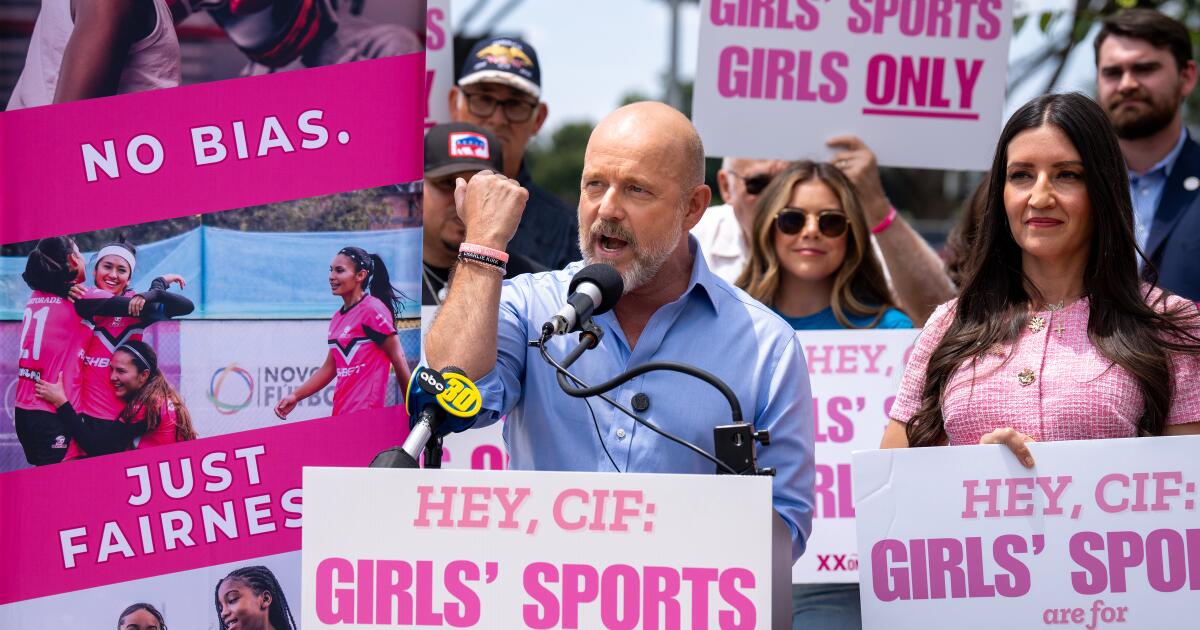
At the Supreme Court, the unfounded fear of boys masquerading as girls in youth sports rolled the clock back on gender equality.
On the surface, the Supreme Court’s June 30 opinion upholding state laws barring transgender girls from women’s and girl’s sports teams looks like a victory for women’s rights.
The 6-3 opinion by Justice Brett M. Kavanaugh certainly presents itself that way. “Females and males have inherent physical differences relevant to athletic performance,” Kavanaugh wrote. “Therefore, in contact sports, forcing female athletes to compete against males can create significant safety risks.” He also asserted that “forcing female athletes to compete against males can undermine competitive fairness.”
The ruling applied to prohibitions enacted in Idaho and West Virginia against “biological” males’ participation on women’s teams in public schools. Federal judges in both states overturned the bans. The Supreme Court majority restored them. The ruling essentially upholds similar bans enacted in 25 other states.
There was no record of any transgender person participating in school sports in the State, let alone any ‘problem’ with transgender students … creating unfair competition or unsafe conditions.
— Justice Sonia Sotomayor, demolishing the Supreme Court’s argument in favor of banning transgender girls from girl’s sports
Kavanaugh, like Donald Trump and others in the anti-transgender camp, maintained that one’s gender is an immutable fact of life, established even before birth.
Anything else, Trump stated in an executive order he issued on inauguration day 2025, could only be the product of “gender ideology extremism.” The U.S., his order stated, recognizes “two sexes, male and female. These sexes are not changeable and are grounded in fundamental and incontrovertible reality.” That’s a “biological truth,” he declared.
In his own version of this overconfident and factually insupportable conclusion, Kavanaugh wrote: “As all agree, females and males have inherent physical differences relevant to athletic performance.”
Science recognizes that some people are “born with sex traits that don’t fit into typical male or female patterns,” to cite a discussion on the Cleveland Clinic web page on the topic “intersex.” The condition “may involve chromosomes, hormones, reproductive organs or genitals.”
From a psychological standpoint, medical science recognizes “gender dysphoria” as a real condition often requiring counseling and medical intervention such as the use of puberty blockers and hormones to stave off the development of secondary sex characteristics until the condition can be resolved.
No one disputes that there are physical differences between the sexes. Few would dispute that on average or even at the median, males may be bigger and more powerful than females, or that in certain contact sports the difference may be telling and on occasion dangerous.
But that’s not the same as asserting that the physical differences between males and females invariably mean that men will invariably prevail over women in all competitions or that their participation will endanger women.
The International Olympic Committee — in a policy statement Kavanaugh cited incompletely — says that in “most running and swimming events,” males have a 10% to 12% advantage over women. That’s a range that would accommodate the full spectrum of outcomes — transgender females win, cisfemales win, they tie. (The “cis” prefix denotes those living consistent with their birth gender.)
West Virginia and Idaho addressed this ambiguity by banning transgender women from all girls’ teams. So under their rules transgender girls can’t play football or soccer with cisgirls. But what’s the argument in favor of banning them from the 100-yard dash, or cross-country track, or diving, or archery?
But something else is going on here. The Supreme Court’s ruling was almost preordained, given the years-long campaign by conservatives to demonize transgender individuals as if they’re members of an alien species.
It will be recalled that during his presidential campaign, Trump spun a despicable fantasy in which children were kidnapped in school and secretly subjected to sex-change operations.
Trump’s executive order wiped out policies aimed at protecting transgender adults from discrimination. He moved to outlaw gender-affirming medical therapies for anyone under 19 by cutting off federal funding for healthcare institutions that provide such care.
He banned transgender individuals from serving in the military and ordered federal prison officials to move transgender inmates into the general populations consistent with their birth genders, which exposes them to physical assault. (Federal Judge Royce Lamberth of Washington, D.C., has blocked the government from transferring three transgender women into the male prison population or terminating their hormone treatments.)
I wrote during Trump’s first term, when his anti-transgender policies were still gestating, that the goal was to show that “one can target any community, as long as it doesn’t have a strong political voice or political power. These are the actions of bullies and cowards, pretending to be strong.”
Last year, the Supreme Court struck its first blow against transgender rights by upholding a Tennessee law banning transgender care, including puberty blockers and hormone therapy, for minors. Similar laws have been enacted in 25 other states. The majority in that ruling by Chief Justice John G. Roberts Jr. was identical to the one in the June 30 ruling — Roberts, Kavanaugh, and Justices Clarence Thomas, Samuel A. Alito Jr., Neil M. Gorsuch and Amy Coney Barrett.
Who are the targets of this ideological campaign? They number only about 1.6 million U.S. adults, or one-half of 1% of the U.S. population. About 300,000 adolescents ages 13 to 17, or 1.4%, identify as transgender, according to a study by UCLA School of Law.
In West Virginia, as Justice Sonia Sotomayor observed in her dissenting opinion, “there was no record of any transgender person participating in school sports in the State, let along any ‘problem’ with transgender students … creating unfair competition or unsafe conditions.”
In endorsing the flat bans directed at transgender women in Idaho and West Virginia, Kavanaugh argued that any attempt to implement case-by-case judgments of students’ requests to join sports teams inconsistent with their biological gender would create “an enormous practical and administrability problem.”
Is that so? That wasn’t the case in Maine, where the annual K-12 population is more than 170,000. There, a committee was charged with determining whether a student’s participation in a sport consistent with their gender identity but inconsistent with their biological sex would “result in an unfair athletic advantage” or present a risk of injury to others. The committee held 56 hearings from 2013 through 2021, or an average of seven per year. During the entire time span, only four involved transgender girls. (The outcome of those hearings couldn’t be learned.)
It was Maine’s policy, one might recall, that provoked a confrontation between Trump and Maine Gov. Janet Mills at the White House last year, when Trump threatened to withhold federal funding from the state unless it barred transgender students from competing on women’s sports teams. “We’ll see you in court,” Mills snapped.
Whether the Idaho and West Virginia laws genuinely protect girls from unfair competition is questionable. (The Idaho law is styled the “Fairness in Women’s Sports Act.”) In practice, the laws may subject women in public schools to “invasive sex verification procedures,” as educational expert George Theoharis of Syracuse University wrote after the court ruling.
They’re also based on a retrograde view of women as fragile creatures needing men’s protection, Theoharis wrote — “the same logic that has historically been used to justify excluding women from making their own healthcare decisions and girls from rigorous math and science; that physically demanding work is simply beyond them.” (There don’t appear to be any state laws barring transgender women from competing in men’s sports.)
Becky Pepper-Jackson, the plaintiff in the West Virginia case, in which she is identified only as B.P.J., is the only transgender girl who sought to join girl’s teams — track and cross-country — in the state. That was in 2021, just after West Virginia passed its law and she was about to enter sixth grade. She didn’t appear to pose any competitive risk to others on the track and cross-country teams she applied to join — her lawyers told the Supreme Court that on those no-cut teams, she “came in near the back.”
Anyway, she had not gone through male puberty, which theoretically might have endowed her with a competitive advantage, because she had been taking puberty blockers and female hormones.
Thanks to the court’s ruling, Sotomayor observed in a dissent joined by Justices Elena Kagan and Ketanji Brown Jackson, West Virginia can deny Becky access to school sports “because it thinks they have an inherent athletic advantage, even if the facts show that they do not.”
B.P.J., Sotomayor wrote, “cannot practice on girls’ teams, even if she would not take anyone’s spot in an eventual competition, even if everyone who tries out for the team makes it, and even if having the chance to participate could aid immensely in treating B. P. J.’s gender dysphoria.”
So whose interest was really protected by the Supreme Court?
-

 Kentucky7 minutes ago
Kentuckians deserve honesty about McConnell’s health | Letters
-

 Louisiana10 minutes ago
Leadership Louisiana Health Fellows Welcomes Inaugural Class – Leaders for a Better Louisiana
-

 Maine15 minutes ago
A hard lesson for Democrats in Maine. Plus, we have some news about Ed Markey. – The Boston Globe
-

 Maryland22 minutes ago
Governor Moore Announces Awardees for $1.23 Million Investment to Help Maryland Workers Thrive in a Changing Economy
-

 Michigan25 minutes ago
‘Big Brother’ season 28 to premiere this week. One guest from Michigan
-

 Massachusetts25 minutes ago
Cool off this summer at these 10 splash pads in central Massachusetts
-

 Minnesota37 minutes ago
EF2 tornado injures two, damages homes near Detroit Lakes, Minnesota
-

 Mississippi40 minutes ago
Mississippi’s first Dutch Bros now open in Pearl

