Maine
Maine’s young people are still leaving — here’s how we keep them


There’s a quiet ache many Maine communities feel today — not from a single event, but from a slow, steady shift. You notice it when a local high school graduation gets smaller each year. When the town store closes early because there’s no one to work. Or when a neighbor’s grandchild leaves for college and never moves back.
Maine is proud of its deep roots and generational ties. We are a state where hard work, close-knit communities and respect for the land are part of everyday life. But we also face a hard truth: Too many young people are leaving and not enough are staying — or coming back. Many want to live here. It’s just too expensive to do so.
This isn’t just a demographic challenge. It’s a serious threat to our economy, our workforce and our future. If we want strong schools, thriving small businesses, working forests and farms, and vibrant downtowns, we need to make Maine a place where young people can build a life — and want to.
That means doing more than just hoping they’ll return. It means making smart, intentional investments in the things that matter most: education, housing, job opportunities and community.
First, we need to expand career pathways that lead to fulfilling, family-sustaining jobs — whether that’s through apprenticeships, trades programs or partnerships between local employers and community colleges. We need to create foundations for young Mainers to become business owners by prioritizing economics and personal finance courses in our schools.
Second, we must address the housing crunch that’s hitting young families especially hard. In many towns, affordable starter homes are almost nonexistent. Rent is up and homeownership feels out of reach for too many. That’s why I’ve introduced and backed legislation to increase investment in affordable housing for Maine’s workforce.
Third, we must expand access to reliable, affordable child care. No young parent can afford to stay in Maine if child care costs more than their paycheck or is impossible to find. Supporting families also means supporting the early educators who make this work possible. I know that when we support Maine families, we’re not just helping individuals; we’re strengthening the fabric of our communities.
Finally, we have to stop pretending that rural life and opportunity are incompatible. From remote work to small-scale farming, small businesses, space exploration or tech startups, there is so much potential in Maine’s small towns and cities — if we support it. That’s why I’m focused on legislation that supports local entrepreneurs, improves rural infrastructure, modernizes and local farms.
We won’t reverse the trend overnight. But we can take meaningful steps, right now, to build the kind of future where young Mainers see a path forward in the place they call home. I believe in Maine’s next generation. And I believe our best days are still ahead — not behind.
I say all of this as someone who thought I would never be able to afford (or have the opportunity) to return home to Maine. I hope that our work here in Augusta ensures young Mainers don’t just leave with a suitcase, but instead return with a future and a plan to stay.
Mattie Daughtry represents state Senate District 23, which covers Brunswick, Chebeague Island, Freeport, Harpswell, Pownal and part of Yarmouth. She also serves as Maine’s Senate president. She can be reached at Mattie.Daughtry@legislature.maine.gov or 287-1515.

When BDN shines a light, policymakers act. Make a gift to help our reporters keep Maine’s leaders informed. Make a donation now.
This story will be updated.
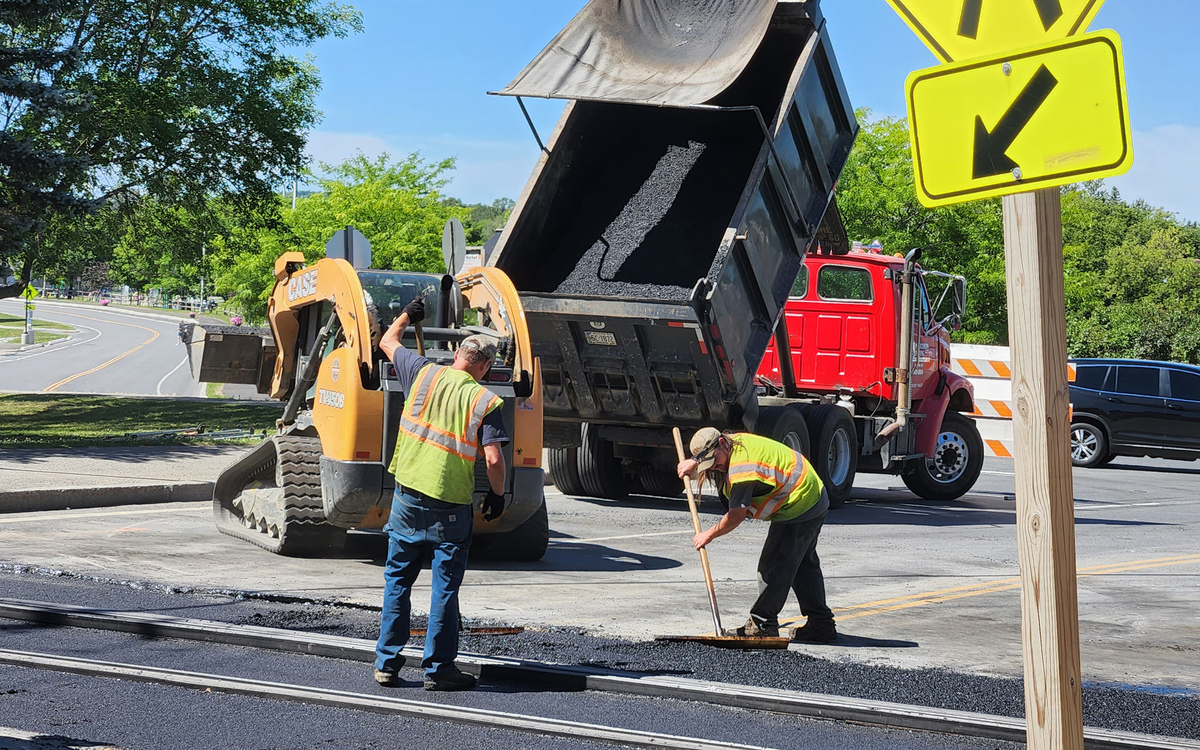
The Maine Department of Transportation is moving to slash up to $400 million in projects from its agenda, a shocking and abrupt cutback that is rattling the state’s construction industry at the start of building season.
Roughly $50 million across six pavement projects have already been delayed, according to a memo exclusively obtained by the Bangor Daily News. The agency plans to cut or delay another $150 million in bridge, highway, intersection and multimodal projects later this month. A further $200 million or more in cuts are planned in the next three-year work plan.
Those figures were outlined by Transportation Commissioner Dale Doughty in the May 18 memo to Gov. Janet Mills that has since circulated widely in the transportation sector, which has been getting drip-by-drip details on the wide scope of the cuts over the past three weeks.
It comes at the beginning of the state’s relatively narrow construction season. Companies have hired workers and ordered materials for projects they expected to begin this summer. The severity of the transportation budget problems was not raised to lawmakers during the 2026 legislative session.
Kelly Flagg, executive director of the Associated General Contractors of Maine, called the shortfall “deeply troubling” in a statement.
“We stand ready to work with policymakers, stakeholders, and industry partners to identify both immediate and long-term solutions,” Flagg said. “Maine cannot afford to fall further behind.”

Insiders saw this first.
This story was broken in Maine Politics Insider, the BDN’s daily premium newsletter for the most ardent political news followers. If you are a new BDN subscriber, you can sign up here. Current subscribers can contact our customer service team to upgrade.
The cuts stem from a structural funding gap of at least $130 million in the state’s current work plan, according to Doughty’s memo. Losses are magnified because state money from the gas tax and other revenue sources is matched by federal funds. Lawmakers have long grappled with politically difficult long-term problems with the state’s transportation budget.
A Mills spokesperson said Wednesday morning that the administration was working on a response to questions from the BDN. The department says it needs roughly $240 million more in state capital funding annually to maintain the existing system, and that anything less than $200 million will erode it over time.
Doughty’s memo the only near-term solution is a series of bonds beginning as soon as possible. Lawmakers would have to return to Augusta to authorize that if one is going to appear on the November ballot.

The BDN Opinion section operates independently and does not set news policies or contribute to reporting or editing articles elsewhere in the newspaper or on bangordailynews.com
Michael Capeci is the former chairman of the Bangor GOP.
Let’s be honest about Maine’s current state.
For many families, the cost of living has become unsustainable. Housing is out of reach for many young people. Energy bills keep rising. Many small businesses are struggling under taxes and regulations that make it harder to grow. Rural hospitals are under strain and despite years of increased state spending, the results are not showing up in people’s daily lives.
Concurrently, Maine continues to lose young workers to other states. That is not a statistic, it is a warning sign.
To me, the question in this Republican primary for governor is not about slogans. It is whether we continue with a political approach that has failed to reverse these trends, or whether we nominate someone with new ideas. I think that someone is Owen McCarthy.
Owen is not a political insider. He is an entrepreneur from Patten, a small town where opportunity is not assumed, it is built. He grew up in a working-class family, became the first in his family to graduate from college graduating from the University of Maine, and founded MedRhythms, a healthcare technology company focused on neurological treatment.
He didn’t just talk about opportunity. He built it. That distinction matters, because Maine’s problem is not a lack of debate it is a lack of results. We have seen the trajectory: higher costs, slower growth, and a steady outmigration of young workers. I believe Owen McCarthy represents a break from that pattern.
His Maine 2040 plan focuses on creating 50,000 new jobs in sectors where Maine has real advantages — maritime and defense, advanced forest products, and life sciences. These are export-driven industries tied directly to Maine’s workforce, geography, and institutions. What sets Owen apart is not only what he proposes, but how he approaches governing.
He prioritizes modernizing permitting so projects do not stall. He supports using technology to reduce costs and increase efficiency. He focuses on making it easier to build, hire, and expand in Maine.
That same practical mindset extends to healthcare. Expanding telehealth, strengthening EMS systems, improving provider flexibility, and shifting toward earlier intervention are not abstract reforms. They are system upgrades designed to improve access while controlling costs.
Maine voters consistently respond to competence. They reward candidates who understand problems and present plans to solve them. I believe they are tired of rhetoric that does not translate into results, and skeptical of politics that prioritizes messaging over execution.
Owen’s approach is grounded in solving the issues that shape daily life — affordability, healthcare access, job creation, and government efficiency. That is not just policy positioning. It is a governing model that speaks directly to voters.
Some will point to his lack of political experience. But I believe Maine’s core problems are not the result of insufficient political experience; they are the result of policies that have failed to deliver measurable improvement. Experience inside a broken system, by itself, is not a solution.
If Republicans want to win, this primary must be taken seriously. From my perspective, it is not about choosing a nominee for governor who can energize the base. It is about selecting someone who can compete in a broader electorate that is frustrated and looking for change.
That requires a candidate who can speak beyond the base, not by abandoning principles, but by demonstrating competence and a credible plan to address Maine’s challenges. I believe Owen McCarthy offers that combination. He represents a shift away from managed decline and toward economic execution.
This is not just another primary. It is a decision about whether Republicans position themselves to win Maine or whether they remain trapped in a cycle of repeating the same strategies and expecting different outcomes.
If Republicans want to compete for Maine’s future, they cannot afford to nominate a candidate who only motivates part of the electorate. They need someone who expands it.
I believe Owen McCarthy is that candidate.
And if the goal is to win Maine, then the choice should be unmistakable

The only notable change in the top-seven of the Varsity Maine baseball poll is that Gorham now has eight first-place votes, two more than last week. The order of the seven teams is identical. In fact, the only change in the top-seven over the past three polls is the swap at the top after Gorham’s win over South Portland on May 19.
Furthermore, Gorham, South Portland, Oxford Hills, Cheverus, Bangor, Mt. Ararat and Fryeburg have been ranked in the top seven for four straight weeks, and six of those squads have been among the top seven in every poll this spring.
Meanwhile, Scarborough is ranked for the first time since May 5, and Ellsworth and Thornton swapped spots.
The Varsity Maine baseball poll is based on games played before June 2, 2026. The top 10 teams are voted on by the Varsity Maine staff, with first-place votes in parentheses, followed by total points.
1. Gorham (8) 89
2. South Portland 79
3. Oxford Hills (1) 75
4. Cheverus 55
5. Bangor 42
6. Mt. Ararat 41
7. Fryeburg Academy 30
8. Ellsworth 27
9. Thornton Academy 25
10. Scarborough 12
Also receiving votes: Washington Academy 8, Monmouth Academy 4, Cony 4, Leavitt 2, Falmouth 2.
-

 Ohio20 seconds ago
Ohio State reaches $100 million settlement with nearly 300 sex abuse survivors | CNN
-

 Oklahoma3 minutes ago
RECAP: Democrat State Superintendent Candidates Address Oklahoma Education Issues in Primary Debate
-

 Oregon8 minutes ago
Oregon man charged with the murders of four women is now accused of killing a fifth
-

 Pennsylvania15 minutes ago
Crash in Warminster Township, Pennsylvania, leaves 1 person dead, police say
-

 Rhode Island18 minutes ago
Clergy sex abuse bill passes RI Senate on unanimous vote. What’s next
-

 South-Carolina23 minutes ago
The 3 Democrats vying for SC governor’s seat take jabs at each other in SCETV debate
-

 South Dakota30 minutes ago
Tornado watch in effect as severe storms target South Dakota
-

 Tennessee33 minutes ago
Tennessee Baseball Breakout Star Announces He Won’t Enter the Transfer Portal

