West
House Democrats to head to US-Mexico border in California to scrutinize Trump security policies


A delegation of House Democratic lawmakers will visit a portion of the southern border on Friday to conduct oversight of the Trump administration’s border policies “firsthand” as authorities continue the president’s mass deportation program.
Rep. Bennie Thompson, D-MS., the ranking member of the House Homeland Security Committee, will lead the delegation.
Also going will be Reps. Lou Correa and Sara Jacobs, both of California; Delia Ramirez of Illinois; LaMonica McIver and Nellie Pou, both of New Jersey; and Tim Kennedy of New York.
TRUMP ADMIN ENDS DEPORTATION PROTECTIONS FOR MASSIVE NUMBER OF VENEZUELANS AMID ILLEGAL IMMIGRATION CRACKDOWN
A group of adult and child migrants are smuggled at the Tijuana-San Diego border. (Carlos Moreno/Anadolu via Getty Images)
Fox News Digital has reached out to Thompson’s office. The lawmakers will visit the U.S. Border Patrol’s San Diego Sector.
San Diego County Supervisor Jim Desmond, who has called for greater border security in the past, criticized the timing of the visit.
“They should have been visiting when we had the southern invasion across our border and thousands of people coming across and there wasn’t as much attention then,” Desmond told Fox News Digital. “But I’m glad they’re here now.
“It does seem like ‘Where were you when we had so many people who were coming across before?” he added. “But I’m glad they’re here now.”
Rep Mark Green, R-Tenn., blasted Democrats for now wanting to visit the southern border following years of denying a crisis as record numbers of illegal migrants flowed into the U.S.
“The American people will not forget how congressional Democrats turned a blind eye as their own party created the worst border crisis in U.S. history,” Green said in a statement. “When the Committee held a field hearing in 2023 in Pharr, Texas, no Democrat members attended. My counterpart, Mr. Thompson, even repeatedly called hearings about the border crisis a waste of time.”
“While the visit tomorrow comes years too late, I am grateful Democrats will be drawing attention to the law and order that the Trump administration has and will continue to restore,” he added. “They will have the opportunity to witness the rising morale of our CBP personnel, who now have the needed support to do their jobs. It clearly was this easy to end the crisis––Democrats just didn’t want to.”
TRUMP REPORTS ILLEGAL IMMIGRANT ENCOUNTERS AT HISTORIC LOWS DURING FIRST FULL MONTH IN OFFICE
Chairman Rep. Bernie Thompson (D-MS) speaks before the House Select Committee. (Getty Images)
The Trump administration has deported more than 100,000 illegal migrants in the weeks since Trump returned to the White House on Jan. 20, according to a New York Post report citing a Department of Homeland Security official.
“He’s doing what he was voted in to do. Point blank!” a U.S. Immigration and Customs Enforcement (ICE) source told the outlet.
A Marine looks towards Tijuana, Mexico, standing between two border walls in San Diego. A group of House Democrats will visit the border in San Diego on Friday. (AP Photo/Gregory Bull)
Trump’s second term, much like his first, has consisted of executive orders, enforcing current laws and hard-line messaging to clamp down on illegal crossings. On his first day back in office, he declared a national emergency at the southern border.
Fox News Digital’s Michael Dorgan contributed to this report.
Read the full article from Here


SALT LAKE CITY — The Environmental Protection Agency awarded Utah and Salt Lake County a total of $3.5 million in grants to assess potentially polluted properties for eventual cleanup and redevelopment.
The agency announced a $2 million grant to Utah’s Department of Environmental Quality and $1.5 million to Salt Lake County to conduct environmental assessments and inventory brownfield sites for cleanup. Brownfields are sites that may be difficult to redevelop or expand because of “the presence or potential presence of a hazardous substance, pollutant or contaminant,” according to the agency.
“These brownfields grants will help Utah communities clean up contaminated sites and unlock opportunities for redevelopment and investment,” EPA Regional Administrator Cyrus Western said in a news release announcing the grants earlier this week. “By transforming underused properties into community assets, EPA is helping create healthier neighborhoods and stronger local economies.”
The two grants awarded to Utah and Salt Lake County are among more than $248 million awarded to nearly 200 communities nationwide for brownfield assessment and cleanup. Utah’s Department of Environmental Quality plans to focus the resources on several areas in Ogden, Heber City and Fillmore, among others, according to Bill Rees, who leads Utah’s brownfield cleanup program.
“What we do is work to secure the funding and then begin to reach out to our communities across the state, say, ‘Listen, there’s opportunity to do some assessment work in your community if you’re interested,’ and then work with our rural partners, work with our urban partners to see if there are sites that will fit that bill,” he told KSL.
The state has received similar grants in the past, and Rees said the money can help local governments determine what to do with ailing properties such as old schools, hospitals or private property that have gone to waste.
“Is there asbestos in it, or is there hazardous material in it? Or could there be something that’s impacting the soil or the groundwater, and a policymaker needs to make a decision?” asked Rees. “Knowledge allows you to make good decisions.”
The $1.5 million awarded to Salt Lake County is the largest brownfields assessment grant the county has ever received, according to a county press release.
“This grant is a real win for our communities,” said Mayor Jenny Wilson. “This funding will let us do vital environmental work on a larger scale and in more neighborhoods. It reflects exactly the kind of partnership between local and federal government that gets results for residents.”
The county grant funds will be used to help create cleanup plans in three areas, including a vehicle storage yard in Salt Lake City’s Ballpark Neighborhood, a 4.26-acre vacant lot in Millcreek and a small commercial building in Magna that was damaged during an earthquake in March 2020, according to the EPA.
Contributing: Don Brinkherhoff
The Key Takeaways for this article were generated with the assistance of large language models and reviewed by our editorial team. The article, itself, is solely human-written.

WashingtonCaps.com is the official Web site of the Washington Capitals. Washington Capitals and WashingtonCaps.com, WashingtonCapitals.com are trademarks of Lincoln Hockey. NHL, the NHL Shield, the word mark and image of the Stanley Cup and NHL Conference logos are registered trademarks of the National Hockey League. All NHL logos and marks and NHL team logos and marks as well as all other proprietary materials depicted herein are the property of the NHL and the respective NHL teams and may not be reproduced without the prior written consent of NHL Enterprises, L.P. Copyright © 1999-2020 Lincoln Hockey and the National Hockey League. All Rights Reserved. NHL, the NHL Shield and the word mark NHL Winter Classic are registered trademarks and the NHL Winter Classic logo is a trademark of the National Hockey League. NHL and NHL team marks are the property of the NHL and its teams. © NHL 2026. All Rights Reserved.
Wyoming
At 6,000-year-old crossing, Gov. Gordon OKs Wyoming’s first-ever designated pronghorn migration route – WyoFile

SUBLETTE COUNTY—Gov. Mark Gordon heralded Wyoming’s first-ever designation to protect a pronghorn migration corridor — a more than 2 million-acre web of habitat — at Trapper’s Point, which he called a “wonderful passageway.”
“How incredibly valuable it is that you are standing here today,” Gordon told the crowd, “to witness this remarkable moment.”
Gordon commemorated the moment with his feet planted on the narrow bulge of high country that splits the Green and New Fork rivers. Thousands of years ago, the site was a well-used hunting ground for Native Americans — it’s the earliest known killing and processing site for pronghorn in North America. Now it boasts a wildlife overpass.
No pronghorn were to be seen during the especially windy Friday afternoon gathering, which attracted 75 attendees from nearby Pinedale and other western Wyoming communities.
Now Trapper’s Point is officially classified as a “bottleneck” for the Sublette Pronghorn Herd — one of 13 such bottlenecks. That classification is supposed to prevent any surface-disturbing activity, with the intent that pronghorn can keep passing through Trapper’s Point for generations to come.

Protecting the ability of the fleet-footed, tawny-and-white ungulates to migrate is a “key factor” in sustaining their population, Wyoming Game and Fish Director Angi Bruce said.
“This becomes even more important in severe winters or extreme droughts,” Bruce said. “Pronghorn are long overdue for recognition.”
Pronghorn in Sublette, Teton, Sweetwater and Lincoln counties travel a long road — some migrate more than 200 miles to escape harsh winters, trekking south into the lower Green River Basin, a semi-arid sweep of sagebrush steppe between Pinedale and Rock Springs. Then in the spring, they retrace those paths, returning to summer ranges, lush with verdant vegetation, even going as far as Grand Teton National Park.
There was also a long road of bureaucracy to get to this point.
Nearly three decades of effort preceded the formal designation of the migration routes used by the Sublette Pronghorn Herd, which is the farthest-traveling and among the largest pronghorn herds in the West.
Jackson Hole biologists long knew that the valley’s pronghorn left in the winter. But details were hazy on where they went and how they got there until around the turn of the century. Using data from tracking collars, biologists like Joel Berger, Steve Cain, Hall Sawyer and Doug Brimeyer helped delineate the route.

In 2008, a Bridger-Teton National Forest plan amendment established a portion of the path as the nation’s first designated wildlife migration corridor.
Popularized by its branding as the “Path of the Pronghorn,” the route has received press in national publications like High Country News and the New York Times.
But the southern reaches of the migration through the energy-rich Green River Basin have faced major political opposition since the early 2000s. Wyoming first attempted to protect those travel corridors in 2019, under a policy administered by the Wyoming Game and Fish Department. That effort was halted after a coalition of industry trade groups and counties protested.
Then, in early 2020, Gordon revamped the migration policy with an executive order. Still, the Sublette Pronghorn Herd proposal gathered dust, even as development threatened the route.
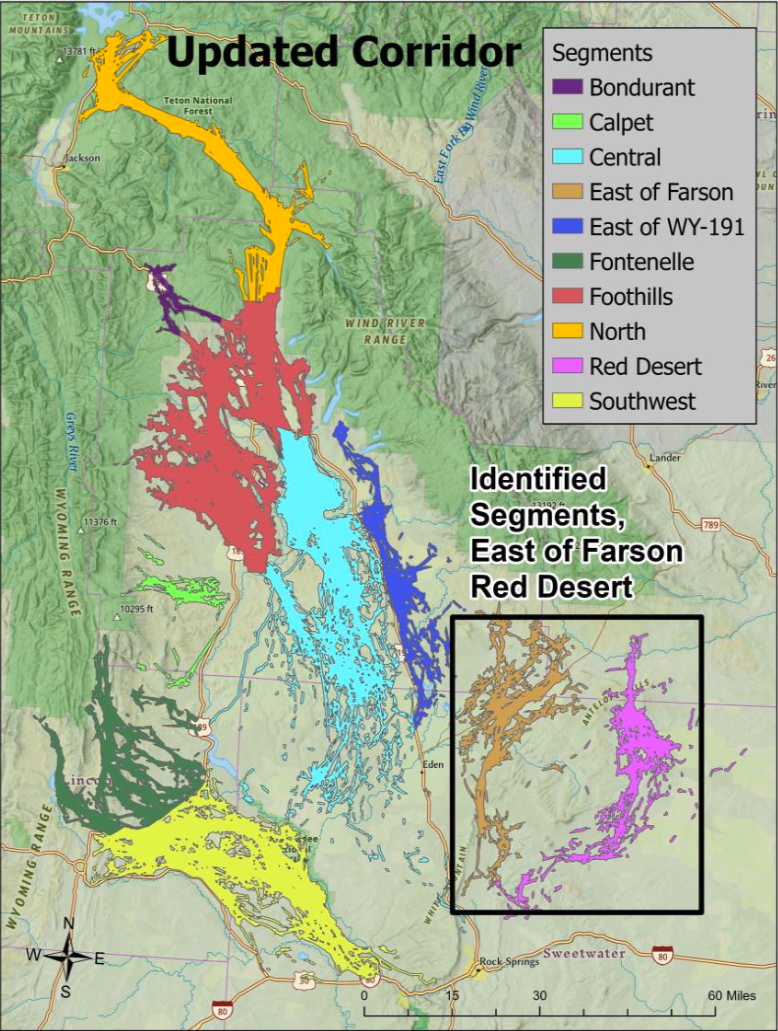
Game and Fish revived efforts to protect the migration in late 2023 and early 2024. Biologists pulled together one of North America’s most comprehensive migration datasets, benefiting from approximately two decades of GPS collar information collected from more than 400 pronghorn.
Some controversy followed the process until near the end. There was a debate about whether to designate the migration’s two easternmost segments, in the Red Desert and east of Farson. The Game and Fish Department proposed excluding the routes, but was overridden by its commission. Then Gordon upended that decision, excluding the two segments.
Vetting the migration corridor through a Gordon-appointed working group was the second-to-last step in the designation process.
“Today’s designation demonstrates that voluntary, locally driven conservation works,” said Robb Slaughter, who chaired the group, during the commemoration at Trapper’s Point.
Time will tell if that’s the case. Wyoming’s migration policy is, by design, permissive of development. Private land is exempt from protections, and designation is not an assurance that new stressors won’t be added to the landscape.

“Today is not the end of the process,” Slaughter said. “It’s the beginning of the next chapter. Continued monitoring, adaptive management, research, and cooperation will ensure these recommendations remain effective as conditions change.”
But Friday was the end of the migration designation process. The governor’s informal OK — no signature was needed — was the last step, said Sara DiRienzo, the governor’s deputy policy advisor.
Wildlife advocates celebrated the moment.
“This is historical,” Bruce said. It’s the first effort to protect the full length of a pronghorn migration corridor in the nation, she said.
-

 Pennsylvania58 seconds ago
Federal government sues Pennsylvania, others over SNAP data
-

 Rhode Island4 minutes ago
Target 12: State of RI’s fire hoses
-

 South-Carolina9 minutes ago
Mississippi State baseball lands Will Craddock, South Carolina transfer infielder
-

 South Dakota16 minutes ago
South Dakota Republicans reject censuring John Thune over stalled SAVE America Act
-

 Tennessee19 minutes ago
Flood watch in effect for Middle Tennessee: 2-3″ of rain expected Saturday
-

 Texas24 minutes ago
Texas state school board approves mandated reading list including Bible passages
-

 Utah31 minutes ago
Utah, Salt Lake County awarded grants for community cleanup
-

 Vermont34 minutes ago
West Rutland man dies in hit-and-run, police seek vehicle

