Science
One Bird Nest, 30 Years of Human Trash


Auke-Florian Hiemstra, a doctoral student at the Naturalis Biodiversity Center in the Netherlands, has spent years studying how birds use human materials in their nests.
Much of his research involves collecting abandoned coot nests and painstakingly logging their contents: drug paraphernalia, earbuds, windshield wipers. “Everything that ends up in the canals in Amsterdam most likely finds its way to a coot nest,” he said.
But in late 2021, he found a piece of trash, buried at the bottom of a large coot nest, that stopped him short: a wrapper from a Mars bar promoting the 1994 World Cup. “That really gave me goose bumps,” he said. “Suddenly we had this big realization. Like, these deeper layers are actually older layers.”
Fittingly, the nest had been built just outside an archaeological museum, atop a metal pipe jutting above the canal’s surface. Mr. Hiemstra wondered if, like an archaeologist, he could peer back in time by dating the artifacts he found in each layer of the nest.
All told, the nest contained 635 artificial items, including foil from cigarette packages and a ticket to Amsterdam’s National Maritime Museum. Roughly one-third of the items were related to food. Mr. Hiemstra carefully examined each object for an expiration date that might indicate roughly when it had been added to the nest.
These were estimates. Highly processed foods could have expiration dates that extended for months or years after when they were eaten. And any given piece of trash might have lingered for a while before a coot added it to its nest.
For a recent paper, published in the journal Ecology, Mr. Hiemstra and his colleagues documented every roughly datable item they found in the nest, opening a small window onto the history of the city’s avian and human residents.
Near the top of the nest was a bounty of candy bar wrappers (including one from a Bounty chocolate bar) bearing 2021 expiration dates, as well as packaging from a protein bar set to expire in 2022.
There was also a thick layer of surgical face masks, which was likely to have been added to the nest sometime after the Covid-19 pandemic began in 2020.
“Face masks, of course, are like a little mattress,” Mr. Hiemstra said. “They’re soft and they may be very warm.” But they can also be dangerous, he added, if the birds become entangled in the masks’ elastic loops.
Much of the food packaging came from items with long shelf lives. But the scientists also found a carton of milk that must have been purchased — and, one hopes, consumed — close to its expiration date of May 2013.
Mr. Hiemstra also found an abundance of trash emblazoned with the logo of a single brand: McDonald’s. The sauce containers were easy to date, as they bore expiration dates on their lids.
A faded plastic foam McChicken box was trickier, bearing only a 1996 copyright date.
“I was in a very deep rabbit hole at a certain point, just talking with these people who were vintage McDonald’s collectors,” Mr. Hiemstra said. “It really felt like a kind of McDonald’s archaeology.”

Ultimately, he was unable to pinpoint a clear date for the container, although the item remained an evocative artifact. “We found the packaging of one bird, a McChicken, as part of the nest of another bird,” he said.
And then, in a deep, mud-covered layer of the nest, which emitted “a distinct canal smell,” was the Mars wrapper that started it all. It carried a FIFA logo with a 1993 copyright and promoted the 1994 World Cup, which took place in the United States and was won by Brazil.
Mr. Hiemstra had no memory of that World Cup; he was born in 1992. “So this wrapper was just as old as I am, almost,” he said.
The nest is a testament to the ingenuity and resourcefulness of wild animals in a rapidly changing world. “It really tells the story of the Anthropocene, but then from the bird’s perspective,” Mr. Hiemstra said.
It’s also a physical embodiment of how profoundly humans are reshaping the environment, he added, and how long-lasting the effects can be.
Roughly three decades ago, some weary commuter or ravenous teenager ordered a McChicken sandwich and then tossed out the box that it came in. “Just one meal from one person — the packaging is still here,” Mr. Hiemstra said. “A bird has been breeding on it for 30 years.”



Video released by Chinese state media shows a state-owned aerospace company launching a rocket and recovering part of it on Friday. The successful launch of a reusable rocket was a major step for China toward challenging SpaceX’s satellite internet dominance.
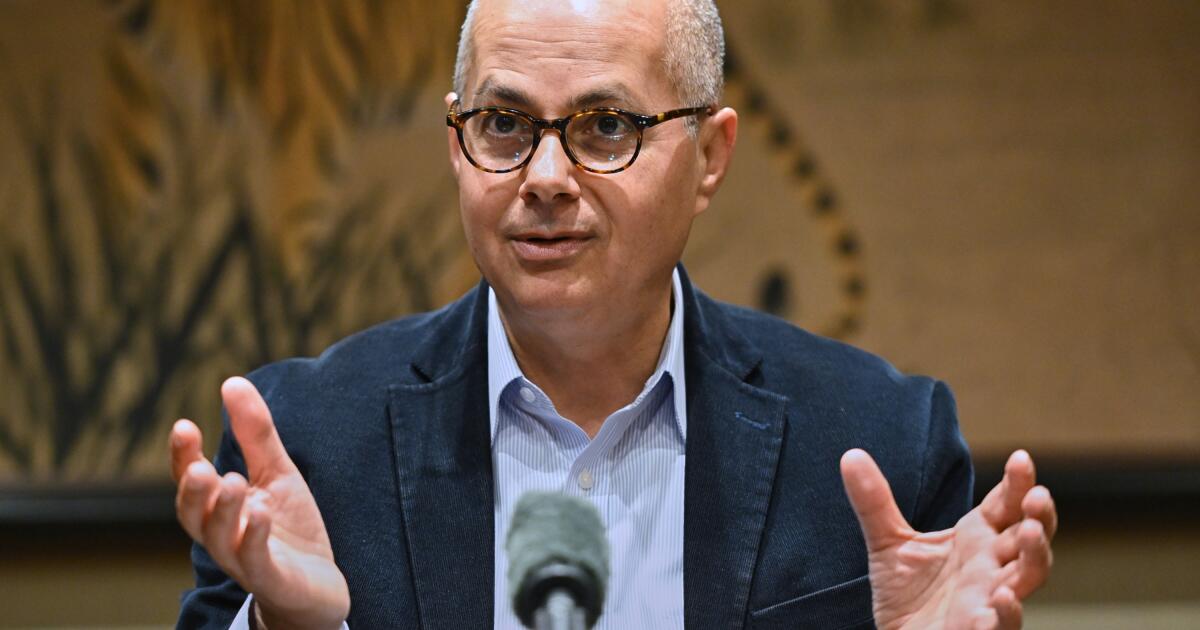
Nobel Prize recipient Omar Yaghi is leaving his role at UC Berkeley to lead the development of a new artificial intelligence institute at Tsinghua University in Beijing, the Chinese university announced.
Yaghi will head the AI Chemistry and Materials Research Institute at Tsinghua, where he was appointed an honorary professor in 2022. Known as AIMATRY (AI × Materials × Chemistry), the new center will focus on material design and synthesis through artificial intelligence, according to a statement from the university.
In 2025, Yaghi shared the Nobel Prize in chemistry with Susumu Kitagawa of Kyoto University and Richard Robson of the University of Melbourne for their development of metal-organic frameworks, a type of super-porous material in which metal ions and carbon-based molecules combine to form crystals with exceptionally large surface areas.
The material has the potential to combat climate change by capturing and storing carbon or other pollutants, and by extracting water from the atmosphere in water-scarce areas. Upon awarding the prize, a member of the Nobel committee likened the technology’s ability to store enormous amounts of stuff in seemingly compact spaces to Hermione Granger’s enchanted handbag in the Harry Potter series.
Yaghi’s Irvine-based company, Atoco, has said it will start taking orders later this year for its technology that harvests water from the air.
A representative for Yaghi said he was not yet available to respond to questions.
China is one of several countries that has been actively recruiting scientists from the U.S., where the Trump administration has slashed science funding, suspended research grants, fired science advisors and tightened immigration restrictions.
“For many, many years, our funding was very competitive; if you worked hard and you were doing good research, you would get funding,” Yaghi said of the U.S. in an interview with Scientific American earlier this year. “The current state is not so encouraging because of the cutting back on grants and support of science by the very agencies that many university researchers rely on.”
Yaghi was born in Jordan to Palestinian refugees, and immigrated to the U.S. when he was 15 to study.
“We’ve learned over and over in human civilization that scholars can move across borders,” Yaghi told the New York Times last year. “This is how knowledge spread and how vast regions of the world lifted themselves out of poverty.”
Science
Trump administration seeks to limit federal funding that doesn’t ‘advance’ presidential policies

A new rule proposed by the White House Office of Management and Budget would fundamentally overhaul the way federal grants are awarded and overseen — a sweeping change that one scientific society said “would all but end the use of scientific merit in the selection of grants and programs across the government.”
Proposed in late May, the rule would give political appointees unprecedented control over federal grants for research, education and infrastructure, and specifies that government funds can only be spent on projects “aligned with administration policies and priorities,” according to a copy of the proposed rule.
The rule would also restrict research topics, limit U.S. scientists’ ability to collaborate with colleagues in other countries and make it easier for the government to suspend or cancel grants at any time.
The changes are intended to improve “transparency, accountability, and oversight for Federal awards” while “ensuring that American tax dollars are not wasted or misused,” according to the White House office.
But critics say that if the rule is implemented, the final sign-off for grants will no longer be in the hands of subject-matter experts within individual agencies, but in those of political appointees.
“This touches all parts of American life,” said Dr. Eric Rafla-Yuan, a psychiatrist who practices at the Veterans Administration and San Diego County’s psychiatric hospital.
“Control of how all of the federal grants and programs are funded will fall under a small group of highly partisan individuals who would have very few limits on how they spend these billions of taxpayer dollars,” said Rafla-Yuan, who also chairs the Committee to Protect Public Mental Health advocacy group. “This touches everyone’s life, even if they don’t realize it.”
OMB published the proposed rule May 29, opening a 45-day comment period that closes July 13.
Opposition to the proposed rule has mobilized multiple sectors of society. Professional groups representing cancer researchers, civil engineers, county governments, medical schools, housing agencies, city and municipal governments, nonprofits and others have publicly expressed concerns about potential consequences.
By midday Thursday, the Federal Register logged nearly 100,000 comments about the proposal, many of them expressing concern.
“I understand the need for oversight, fiscal responsibility, and accountability. That is not the issue,” wrote Jack Feldman, a neuroscientist who holds the David Geffen School of Medicine Chair in Neuroscience at UCLA. “The issue is whether scientific research is to be judged by scientific merit, or whether it can be approved, denied, or terminated according to broad political criteria that may change from one administration to the next.”
Crucially, the rule converts policies governing federal grants from “guidance” into binding regulations that all agencies would be required to follow. It would give political appointees power to override federal agencies’ merit-based reviews and mandate that a political appointee review decisions to ensure that all awards “demonstrably advance the President’s policy priorities.”
The elevation of political appointees in what were previously merit-based decisions has alarmed many scientists.
“The proposed rule changes would all but end the use of scientific merit in the selection of grants and programs across the government,” read a statement from the Planetary Society, a nonprofit dedicated to space research.
Researchers and science groups have also expressed concern about a section of the rule prohibiting the promotion of “theories of disparate-impact liability” — a legal concept that refers to policies that appear neutral but cause disproportionate harm to certain groups.
The section’s vague language and many loopholes could have a chilling effect on any research that studies the effects of a disease, policy or public health intervention on any specific group of people, Rafla-Yuan said.
As an example, he said, “if there’s a specific age range that is at higher risk for suicide, and we want to figure out, well, what’s going on with people that are aged 14 to 19 … we can’t do that under the wording in this rule.”
New restrictions on collaborations with scientists in other countries would hinder opportunities for U.S. researchers and limit innovation, said Joanne Padrón Carney, chief government relations officer for the American Assn. for the Advancement of Science.
“Science is a global enterprise. Especially in biomedical and public health fields, diseases don’t care about borders or government policies,” she said.
California’s congressional delegation sent a letter Wednesday asking OMB to rescind the proposal, outlining concerns about its impact on scientific innovation, U.S. competitiveness and the fiscal stability of local governments, many of which rely on federal grants for local services.
The proposed rule grants the federal government broad powers to suspend or cancel grants for any reason, introducing “unprecedented unpredictability into local governance,” the lawmakers wrote, “leaving vital infrastructure projects unfinished and abandoning vulnerable populations who rely on these services.”
Republican Sen. Susan Collins has also asked the White House to withdraw certain parts of the letter and extend the public comment period, saying the proposed rule as written would “harm small and rural communities, undermine scientific and biomedical research, and conflict with Congress’ control over the federal funding process.”
-

 Technology2 minutes ago
Nintendo’s Switch 2 bundle that includes a game is $50 off
-

 World8 minutes ago
Inside Israel’s mission to train civilians to stop the next Oct 7-like terror attack
-

 Politics14 minutes ago
Trump reveals who he’s eyeing to replace Lindsey Graham
-

 Health20 minutes ago
Notable figures who died from the same heart condition linked to Lindsey Graham’s death
-

 Sports26 minutes ago
Folarin Balogun admits that red-card reversal affected USA World Cup teammates: ‘A lot of outside noise’
-

 Technology32 minutes ago
Humanoid robots perform live surgery in world first
-
 Business38 minutes ago
A ‘next generation studio’ for YouTube creators
-
 Entertainment44 minutes ago
Finn Wolfhard is taking ‘control of the narrative’

