Politics
Newsom calls the Democratic brand 'toxic' as he defends his podcast

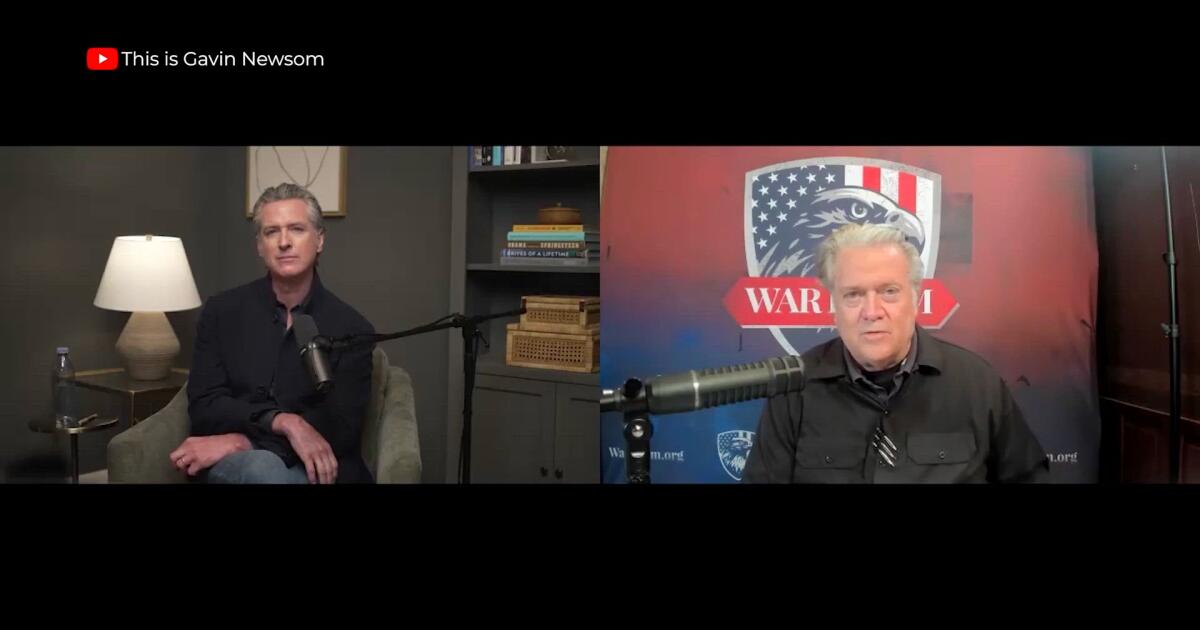
SACRAMENTO — Since his podcast debuted in March, Gov. Gavin Newsom of California has flummoxed Democrats who fear that the politician they considered a liberal prizefighter is turning MAGA-friendly.
The rap against “This Is Gavin Newsom,” in which the governor spoke out against trans athletes competing in women’s sports and disavowed the gender-inclusive term “Latinx,” is that he doesn’t sound like the Newsom they know at all.
“What in God’s name is going on with Gavin Newsom?” asked CNN anchor Erin Burnett, quoting a headline criticizing the podcast, during a recent segment ripping the governor’s apparent shift.
“The country is trying to figure out how he went from progressive hero and governor of the most liberal state in the country to interviewing and spending time with MAGA favorites like Steve Bannon and Charlie Kirk.”
The Democratic governor was also surprised, but by the response.
“I did what I said I was going to do. I mean, when I launched this, I said I was going to have, not debates with people I disagree with, I said we’re gonna have people on we disagree and agree with to have civil conversations to try to understand each other at this time of such polarization,” Newsom said in an interview with The Times on Friday. “And I said I was going to specifically meet with members of the MAGA movement. And then we did it and people were shocked.”
A common takeaway from the podcast is that Newsom is attempting to shape-shift into a moderate as he gears up to run for president in the aftermath of the Democratic Party’s disastrous 2024 election.
Newsom disputed that “exhausting” assumption, which he said others have attributed to actions for more than two decades. The governor offered his own blistering critique of his party to explain why he’s sitting down with controversial GOP figures now.
“Because our party’s getting our ass kicked,” Newsom said. “Because the Democratic Party brand is toxic. Because people don’t think we make any damn sense. They think we make noise. They don’t think we support them. You fill in the generic them. They don’t think we have their values. They think we’re elite. We talk down to people. We talk past people. They think we just think we’re smarter than other people, that we’re so judgmental and full of ourselves.”
The governor paused to say he loves his party, but “we’ve lost our way” and he wants people to know he hears it.
“I think you do that by having people you disagree with [on the podcast] without being disagreeable.”
It’s not the first time the governor has disagreed with his fellow Democrats.
As speculation mounted about whether then-President Biden was fit to run for president last summer, Newsom called the chatter from his own party “unhelpful” and “unnecessary” as he encouraged Democrats to back the president. A year earlier, he scolded the Democratic Party for its passive response to Republicans and for its lack of an offensive political playbook.
Newsom created headlines across the country in the premiere episode of his podcast when he told Kirk, a conservative activist and Trump loyalist, that allowing transgender athletes to compete in women’s sports is “deeply unfair.” Newsom’s comments represented a clear break from progressives.
The backlash from the left was swift. Newsom was accused of deserting his core LGBTQ+ constituency and flip-flopping after old social media posts surfaced with him expressing support for the California law signed by former Gov. Jerry Brown that gave trans students more rights in public schools, including the ability to compete in sports and use bathrooms based on their gender preference.
Newsom’s position aligned with 66% of American adults, who in a Pew Research survey in February said trans athletes should be required to compete on teams that match their sex assigned at birth.
The governor also was criticized for suggesting, in his podcast with Kirk, that no one in his office used the term “Latinx,” a gender neutral term, to describe Latinos, despite direct quotes of the governor that prove otherwise. A Pew poll from 2024 found that only 4% of Latinos describe themselves as “Latinx.”
Eric Jaye, the chief consultant for Newsom’s 2003 mayoral campaign, said the governor is an astute politician, though he disagreed with his decision to speak out against transgender athletes.
“San Francisco has produced many extraordinary politicians — Nancy Pelosi, Dianne Feinstein, Willie Brown, Kamala Harris — but in terms of the ability to adapt to changing political times and climes, Gavin Newsom’s head and shoulders above all of them,” Jaye said. “He’s deeply, deeply attuned to which way the political wind is blowing and he has so far shown an extraordinary ability to navigate changing political weather.”
“Now the challenge is, the question will be, at what point does that stop seeming like someone adapted to changing times and start seeming inauthentic, if not outright fake?”
On Friday, Newsom said he understood why people might view his podcast as a departure from his liberal image, shaped largely by his groundbreaking support for gay marriage as mayor of San Francisco and as an advocate for universal healthcare.
But the governor said his politics has never fit into an “ideological prism.”
Anyone who knows him, he said, remembers when he was the “small business supervisor” in San Francisco, raging against the board for raising fees on business owners and championing “Care Not Cash,” a policy to take welfare checks from homeless people and use the savings to pay for treatment options.
“I’m open to argument,” Newsom said. “I’m interested in evidence. I have very strong values. I’m a progressive but I’m a pragmatic one, and that’s something that anyone who has followed me knows, and people that don’t, they’re learning a little bit about that now.”
Still, Newsom always has been the main architect of his public image.
A wine entrepreneur allied with the business community, he ran as a moderate to win the mayor’s office in 2003 against a Green Party candidate. “Care Not Cash” was widely panned by progressives but helped seal his victory.
When Newsom set his sights on the biggest political prize in California in the 2018 governor’s race, he ran as a progressive advocate for single-payer healthcare and pledged to build more affordable housing.
Yet even as he effused his liberal platform, Newsom couldn’t shake criticism from his opponents that his positions were a mirage.
Former Los Angeles Mayor Antonio Villaraigosa, a moderate Democrat, accused Newsom of selling “snake oil” with his support for single-payer healthcare in order to win over the nurses union and progressives.
Newsom delivered some of his campaign pledges in his first term as governor. He successfully advocated for universal preschool and state-sponsored healthcare coverage to all income-eligible Californians regardless of immigration status. He also paused death row executions.
The governor, who has a close relationship with the tech industry and counts Google founder Sergey Brin and Salesforce Chief Executive Marc Benioff as his friends, has shown more of his moderate side in his second term.
He drew criticism from truck drivers for rejecting their push to require more regulation of autonomous big rigs. He vetoed a marquee bill last year that would have required artificial intelligence developers to put safeguards on the technology. Newsom rebuffed Hollywood unions when he rejected a bill that would have allowed workers to receive unemployment benefits when on strike.
He made a show this year of saying he would veto a bill for a second time that sought to restrict the state prison system’s ability to coordinate with federal immigration authorities attempting to deport felons. He’s also rejected proposals to allow immigrants who are in the country illegally to participate in a subsidized home loan program and to allow undocumented students to work at public universities.
Lorena Gonzalez, president of the California Federation of Labor Unions, said she wasn’t shocked to see Newsom appear more moderate on the podcast.
“He has always been more or less a tech bro from Northern California with the same kind of politics as we thought,” Gonzalez said.
Perhaps, she said, “He’s done playing liberal and now he’s just going to be himself.”
Steve Kawa, Newsom’s chief of staff as mayor, scoffed at the idea that Newsom has changed. He said the governor has always been interested in speaking to people on all sides of a policy idea. Politicians, like regular people, aren’t one-dimensional.
“Maybe he’s moderate on this issue,” Kawa said. “Maybe he’s progressive on this issue. I don’t think he looks at it in terms of under what column is this solution to make life better for the public and I can only be in this column.”
To criticism that he appears too comfortable talking to Bannon, a Trump campaign architect, and Kirk one day and Democrats such as Minnesota Gov. Tim Walz and commentator Ezra Klein the next, Newsom said he meets with people he disagrees with all the time. He mentioned his 90-minute sit-down with Trump in the Oval Office.
“That’s called life,” Newsom said. “I don’t decide who my friends are on the basis of their politics. I’d never met Charlie Kirk. I’d never met Bannon, but I know people that think like them and they’re good parents and they’re good people, and I vehemently disagree with their politics and they’re Trumpers.”
The amicability he displayed in the podcast toward Republican figures whom Democrats perceive as villains doesn’t come as a surprise to people who have closely followed his career.
“He sounds evenhanded about the views of people that you would think he would find an anathema to his being. That’s because of how he is on a path of existence beyond politics and I think that’s reflected in the podcast,” said David McCuan, a professor of political science at Sonoma State University.
“He’s always lived a charmed life in terms of politics, but there’s also been more to him.”

Construction workers unfurled a large printed tarp to cover scaffolding installed at the White House’s front entrance. Doug Burgum, the interior secretary, said President Trump had ordered the repairs after noticing damage to columns.
Politics
WATCH: Trump’s Energy chief reveals what escalating Iran tensions could mean for gas prices

NEWYou can now listen to Fox News articles!
Energy Secretary Chris Wright is telling Americans not to be concerned about the possibility of another surge of sharp increases in gasoline prices as tensions with Iran have started to escalate once again.
Asked whether Americans should worry about higher prices at the pump and how the Trump administration is preparing to keep the economy stable if the conflict continues to worsen, Wright told Fox News Digital: “It has not been any good behavior from Iran that’s allowed oil to flow. It’s been the United States military.”
“That’s not changing,” he assured, speaking from the Great American State Fair on the National Mall this week.
US CLAWS BACK KEY CONCESSION TO IRAN AFTER FRESH ATTACKS ON COMMERCIAL SHIPS IN STRAIT OF HORMUZ
(Mario Tama/Getty Images) (Mario Tama/Getty Images)
With Iran striking three commercial vessels transiting the Strait of Hormuz on Monday and Tuesday, Wright doubled down in urging citizens to not credit Iran for the U.S. military’s work to ensure oil shipments continue flowing through the strait.
“Look, the U.S. Military has been the key asset here,” he said. “They have assured the flow of oil and gas through the Strait of Hormuz throughout. Not at the beginning of this conflict, but through the last six weeks.”
Wright said the administration is closely monitoring global oil supplies as the tentative ceasefire with Iran seemingly came to come to a halt, with President Donald Trump telling Secretary-General Mark Rutte the call for peace with Iran is “over” at the NATO Summit in Turkey on Wednesday.
But, he pointed to the continued shipping through the Strait as evidence that markets should remain stable.
TRUMP SAYS IRAN CEASEFIRE IS ‘OVER’ AFTER IRANIAN ATTACKS TRIGGER MASSIVE US RESPONSE
President Donald Trump speaks at the White House on Tuesday, April 22. (AP/Alex Brandon)
“We’re of course constantly watching the supply of oil, the supply of refined products and what’s going on there,” Wright said. “And I think still all positive trends.”
Beyond geopolitical concerns, Wright also praised the new chain of discounted gas stations across Pennsylvania and New Jersey, Freedom Fuel, which promises customers prices below the national average.
The Trump administration, though not involved with the network, has heavily endorsed the new chain and its 25 locations.
“We love it,” Wright said when asked about Freedom Fuel. “I mean, look, any mechanism we can to lower energy costs for Americans of all kinds, we’re all in on.”
“With Freedom Fuels, they’re just lowering it down to their wholesale price of gasoline,” Wright said. “So they’re not making any money selling gasoline, but they’ve got convenience stores. That’s how most gas stations make money.”
NEWSOM UNDER FIRE AS CALIFORNIA GAS TAX HIKE SENDS PUMP PRICES EVEN HIGHER
Gasoline costs are a known concern for many Americans, and amid surging prices there has been a considerable increase in those opting to purchase electric vehicles to save money long-term at the pump — with Tesla dominating the market for these types of models.
Wright argued one of the benefits to living in America is having the option to choose what type of vehicle you drive.
CLICK HERE TO DOWNLOAD THE FOX NEWS APP
“We just want people to buy what they would prefer,” he told Fox News Digital when asked his thoughts on increasing calls for support of the electrification of cars. “Consumer choice — you wanna buy an electric car, you wanna buy a gas powered car, diesel powered car, buy a big truck. That’s the choice.”
“That’s why you live in America. You get the choice of all those.”

In 2023, California regulators levied more than $100,000 in fines against the private operator of a federal immigration facility, kicking off a three-year battle over whether detainees who do work at the facilities should be considered employees.
The question went beyond semantics: If considered employees, the detainees would be subject to state worker protection laws.
A legal settlement announced this week now affirms that private immigrant detention facilities are subject to California’s workplace safety and health requirements.
“Every worker deserves a safe and healthy workplace and should be able to report workplace hazards without fear of retaliation,” said Denisse Gómez, spokesperson for the California Division of Occupational Safety and Health or Cal/OSHA.
“Individuals who perform work in these facilities are entitled to workplace safety protections, and this settlement reinforces Cal/OSHA’s commitment to enforcing those protections and safeguarding vulnerable workers,” she added.
Under the settlement between California and the GEO Group, a Florida-based private prison company, the company recently withdrew its legal challenges and agreed to pay more than $100,000 in the fines.
The GEO Group did not respond to requests for comment.
Back in 2023, Cal/OSHA issued $104,510 in fines against the GEO Group. The agency had found six violations of state code by the company after detainees complained about a lack of protective equipment and proper training while cleaning the facility for $1 per day.
Detainees alleged they routinely wiped black mold off shower walls at the facility, saw black dust spew from air vents and used cleaning solutions that lacked instructions during the COVID-19 pandemic.
The biggest fine levied against the GEO Group was for failure to establish and maintain “effective written procedures to reduce employee risk of exposure to aerosol transmissible disease.”
Advocates viewed Cal/OSHA’S recognition of the detainees as workers as a victory that could pave the way for future labor rights fights at other detention centers in the state.
But the GEO Group appealed, arguing that detainees participating in ICE’s voluntary work program make their own schedules and aren’t employees, so hazard exposure couldn’t be “as a result of assigned duties,” as California law states. Plus, the company argued, there wasn’t enough evidence that detainees were exposed to any hazard.
Early last year, the state’s Occupational Safety and Health Appeals Board rejected the GEO Group’s argument and found that detainees should be considered “affected employees.”
The GEO Group sued, but three days before a California Superior Court hearing in May, the company and Cal/OSHA reached the settlement.
Along with paying the fines, the GEO Group agreed to draft plans for avoiding aerosol transmissions at 12 secure and reentry facilities in California, including five detention centers that hold immigrants.
“GEO ensures detainees are afforded the necessary tools, equipment, and personal protective equipment … to safely and effectively perform any necessary tasks,” the settlement states.
Gómez said the settlement also leaves intact the appeals board’s ruling that civil immigration detainees who participate in work programs can participate in proceedings anonymously, “acknowledging the potential for retaliation when individuals raise workplace safety concerns.”
But the question of whether detainees are employees and deserve certain protections isn’t entirely resolved — at least not for the federal government.
Last month, U.S. Immigration and Customs Enforcement released new standards for detention facilities across the country. The revised guidelines “emphasize that detainee volunteers participating in the voluntary work program are not considered facility and/or government employees” and thus not entitled to labor regulations.
Attorney Mariel Villarreal said the timing of the new detention standards made her question whether the GEO Group had asked ICE to specify in its standards that detainees are not workers in response to its battle with Cal/OSHA.
“To me, it’s a reaction to this very settlement,” she said. Villarreal works for the California Collaborative for Immigrant Justice, which filed the original complaint on behalf of detainees who said they worked in unsafe conditions.
Villarreal pointed to a Washington Post report that GEO Group executives privately asked ICE to specify that detainees are not employees of the facilities where they work. Two top Trump administration officials, border czar Tom Homan and acting ICE director David Venturella, previously worked for the GEO Group.
New versions of ICE detention standards take effect as contracts are established or modified, so this year’s rules won’t immediately apply to every facility.
An ICE spokesperson did not comment about the settlement. The spokesperson, who did not provide their name in an emailed statement Wednesday, said the agency has begun transitioning detention facilities to meet the 2026 standards, “building on its longstanding commitment to safe, secure, and professional detention operations.”
“ICE has consistently implemented many of these best practices independently, reinforcing its role as the leader in detention operations,” the spokesperson added.
The GEO Group and other immigrant detention center operators have faced other legal battles over workers’ rights, including lawsuits in Washington, Colorado and California over the $1-per-day payment.
Villarreal said she’s confident that the Cal/OSHA settlement would continue to hold even if California facilities incorporated the new standards. But she said she believes the statements are an attempt by the GEO Group to “sidestep responsibility” and avoid the possibility of being fined under similar circumstances in other states.
“These statements in the new standards are a way for them to try and preserve profits as much as possible,” she said. “GEO and ICE are so intertwined at this point that they have the same motives.”
-

 Los Angeles, Ca35 minutes ago
Knee irritation forces Shohei Ohtani out of Friday start, All‑Star game
-

 Detroit, MI57 minutes ago
Detroit Evening Report: Waymo cars blocking first responders – WDET 101.9 FM
-

 San Francisco, CA1 hour ago
San Francisco Mayor Daniel Lurie Blocks Vacant Grocery Store Tax Proposal | KQED
-

 Miami, FL1 hour ago
Oregon Battling Miami, Mario Cristobal for Four-Star EDGE Recruit
-

 Dallas, TX1 hour ago
FC Dallas Forward Logan Farrington Inks Contract Extension
-

 Boston, MA1 hour ago
Red Sox face lengthy travel issues ahead of series vs. Mets
-

 Denver, CO1 hour ago
What’s going on with the Nuggets? Unpacking an NBA offseason on hold
-

 Seattle, WA2 hours ago
Seattle Kraken Sign Goaltender Victor Östman and Defenseman Ville Ottavainen to One-Year Deals | Seattle Kraken

