Sports
'We’re not guaranteed 3,000 at-bats.' What it's like to have a one-game MLB career


SCOTTSDALE, Ariz. — The first time Jeff Banister stepped into a big-league clubhouse, it was 9 o’clock.
In the morning.
That night’s game wouldn’t start for another 10 hours, but when you’ve waited your whole life for that moment, there’s no point in putting it off even a second longer.
The first thing Banister saw when he entered the darkened room was a No. 28 Pittsburgh Pirates’ jersey hanging in a locker with his name, in black letters and gold trim, running from shoulder to shoulder. In the lockers on either side hung the jerseys of Barry Bonds and Bobby Bonilla.
“There was a security light. It was like a beacon on my jersey,” Banister said last month, his voice catching at a memory that is now 34 years old. “It kind of got real at that moment. Like, ‘Hey, I’m in the big leagues.’”
In the seventh inning of that night’s game, an otherwise uneventful 12-3 win over the Atlanta Braves at Three Rivers Stadium, Banister came to the plate as a pinch-hitter and grounded a 1-1 pitch into the hole at short, beating the throw to first for an infield single. Four days later he was gone, optioned back to the minor leagues. Banister would never appear in a major league game again.
But he’s never forgotten the one he did play in.
“It was a surreal moment to walk out on that field,” he said. “I’d seen it so many times on TV, but just the feeling of all the first moments — the first time in the stadium, the clubhouse — they become a little overwhelming.”
Since the first big-league game in 1876, 20,790 men have played in the majors, according to the Baseball Almanac. More will join that list as spring training gives way to the regular season. Yet it remains a small number; more than twice as many people finished the Chicago Marathon last fall.
And Banister’s name will always be among them.
His name is also among the 1,519 players whose big-league career lasted just one game, according to the Baseball Reference website, a list that runs from Frank Norton, who struck out in his only plate appearance for the Washington Olympians on May 5, 1871, to Giants pitcher Trevor McDonald, who threw three hitless innings on the final day of the 2024 season.
San Francisco Giants pitcher Trevor McDonald threw three hitless innings against the St. Louis Cardinals on the last day of the 2024 season.
(Tony Avelar / Associated Press)
In between, Hall of Fame manager Walter Alston, made an error in two chances at first base and struck out in one at-bat in his only big-league game in 1936. Eighteen years earlier, Brooklyn Robins’ pitcher Harry Heitman faced four batters, giving up four hits and four runs, then fled the stadium before the final pitch to join the Navy.
Larry Yount, brother of Hall of Famer Robin Yount, came out of the bullpen to pitch for the Astros in 1971, but hurt his arm warming up; his career ended before he threw a pitch. Then there’s Archibald Wright “Moonlight” Graham, who twice hit better than .325 in eight minor league seasons but didn’t get an at-bat in the majors, playing two innings in right field for the New York Giants in 1905 without touching the ball. Three years later he gave up for baseball to practice medicine in the small mining town of Chisholm, Minn.

Larry Yount, above pitching for the Denver Bears in 1973, hurt his arm warming up after entering a game for the Houston Astros in 1971.
(Barry Staver / Denver Post via Getty Images)
The pathos of Graham’s brief big-league career is romanticized in W.P. Kinsella’s novel “Shoeless Joe” and later in the Kevin Costner movie “Field of Dreams.” Graham made it to the majors, but never got to bat. Others, like Banister, got one at-bat, but never played in the field.
Yet there’s a story behind every one of these brief big-league appearances.
For some of those 1,519 one-game wonders, the journey was more frustration than fruition. After expending so much blood, sweat and tears to reach the majors, their reward was a single yellowed newspaper box score with their name in it.
“I’m proud of what I accomplished. And I think that I accomplished something unique,” said catcher Jack Kruger, who played one inning for the Angels in 2021. “But I think I was capable of more.”
For others like Banister, one of 53 players to retire with a 1.000 batting average, there are no regrets.
“Absolutely zero,” he said. “I loved every minute of it.”
“A cup of coffee” is the idiom baseball has created to describe a short stay in the majors. Here are the stories of four men who got to realize the dream of playing in the big leagues, but only stayed long enough to have a cup of Joe.
It’s been 12 years since Brandon Bantz played in his only big-league game. But he hasn’t forgotten how exciting it felt the first time he stepped onto a major league field in a uniform.
“I just remember looking at the third deck being like ‘it’s a lot bigger than I had remembered,’” he said. “That was that first kind of ‘a-ha’ moment. That was the first time I was thinking ‘that’s pretty cool.’”

The New York Yankees’ Mark Teixeira, right, scores ahead of the throw to Seattle Mariners catcher Brandon Bantz during a game on June 8, 2013 — the only one of Bantz’s MLB career.
(Ted S. Warren / Associated Press)
Bantz was called up from Triple A Tacoma by the Seattle Mariners on June 5, 2013; three days later he would catch eight innings against Andy Pettitte and the New York Yankees, grounding to short and striking out in two at-bats in a 3-1 loss.
Less than a week later he was outrighted back to Tacoma. He would never play in the majors again.
“A lot of times, you get only one chance,” Bantz, 38, says now. “There’s disappointment there, right? Any athlete that goes in has a dream, since you’re a little kid, of playing in the major leagues. Being able to achieve that goal, obviously that’s a big achievement.
“But I think the competitor in me definitely feels like I wasn’t able to really show the ability that I had.”
Yet Bantz overcame long odds just to get those two at-bats. More than four of every five players selected in the Major League Baseball draft never make it to the big leagues.
Bantz, a catcher, wasn’t selected until the 30th round of the 2009 draft; 892 others were taken ahead of him. But he caught a break on the first step of the minor league ladder when John Boles, a special assistant with the Mariners, saw Bantz play for Seattle’s rookie-level team in Pulaski, Va.
“He actually came up to me after the game and said, ‘You’ve got a chance,’” Bantz remembered. “That kind of set the trajectory of changing how people viewed me in the organization.”
When an injury opened a spot in Single-A Everett, Wash., a week later, Bantz was promoted. Although Bantz struggled at the plate — he hit just .234 and never had more than four homers in seven minor league seasons — he threw out nearly half the runners who tried to steal on him, so he continued to climb a level each year, reaching Double A in his first full minor league summer and Triple A a season later.
From there it was a short trip — just 33 miles up Interstate 5 — from Triple A Tacoma to Seattle’s Safeco Field and its intimidating third deck.

Brandon Bantz grounded out to short and struck out in his two at-bats for the Seattle Mariners on June 8, 2013.
(Otto Greule Jr / Getty Images)
Bantz’s only big-league game got off to inauspicious start when he went out to center field to warm up pitcher Joe Saunders and threw the ball over his head, plunking a fan in the leg. But when the game started, the butterflies went away.
“Once the game gets going, it’s just a regular game. It’s the same thing you’ve been doing your whole life,” Bantz said. “If you’re just kind of like, ‘Oh, man this is crazy! That’s Andy Pettitte,’ you’re not in a position to compete.”
Five days later, Bantz was sent back down the freeway to Tacoma and over the next 2 ½ seasons he would be signed and released by the Washington Nationals and Miami Marlins, with a 49-game stint in the independent Atlantic League sandwiched in between.
His baseball career was over before his 29th birthday.
“A lot of people around the game are two things,” said Bantz, the founder and CEO of Catchers Central, which develops baseball and softball players. “They’re either bitter or they can’t close the yearbook. My career was what it was. Sure, every one of us wants to reach the big leagues, play for 20 years, go to the Hall of Fame, win the World Series. However, that’s not going to be the case for everybody.
“The reality is, it’s a game and the journey across that game is what should be celebrated. How my playing journey concluded, that’s what it was supposed to be.”
Jeff Banister’s baseball career nearly ended before it had really started. When he was 15, an examination of a painfully swollen ankle ended in a diagnoses of bone cancer. A bacterial infection in the same leg was eating away at the bone marrow. If the leg wasn’t amputated, a doctor told him, he could die.
The night before the operation, Banister hugged his father and said he’d rather die than lose his leg so his doctor tried another approach and after seven surgeries, Banister walked out of the hospital a year later, cancer free.
A couple of years later he was back in the hospital after a baserunner, trying to hurdle Banister on a play at the plate, instead kneed the catcher in the head, breaking three vertebrae.
“I thought I was dead,” he said.
And he would have been had any sudden movement interfered with his breathing. He was temporarily paralyzed, a condition that required three operations and another year of rehab to cure. By the time he left the hospital with the help of a walker, he had lost nearly 100 pounds. So when the Pirates selected him in the 25th round of the 1986 June draft — a round so deep it no longer exists — it was as much a reward for his tenacity as it was for his talent.
That, at least, was the point Pirates scout Buzzy Keller made when he signed Banister for a $1,000 bonus over lunch at a Wendy’s in Baytown, Texas.
“He told me, ‘I’m not going to make you rich. But you’ve earned an opportunity,’” said Banister, who at 61 has the tan, chiseled good looks and plain-spoken manner of a Western movie sheriff. “And so I got to thinking about that and he was right. What I did with the opportunity was make the most out of that.”
He struggled to hit at his first three minor league stops but put together a solid fourth season, hitting .272 in a year split between Double A and Triple A. So four months into the 1991 season, he was called up by the Pirates after backup catcher Don Slaught pulled a muscle in his rib cage.
Banister, then 27, still remembers the date.
“July 23, 1991,” he says without prompting.
The call came so fast, no one in his family could make it to Pittsburgh for his big-league debut. “I didn’t leave a ticket for anybody,” he said.
Manager Jim Leyland, aware the Banister’s family lived in Houston, mapped out a plan to have him start that weekend in the Astrodome, only to see pitcher Bob Walk scramble those plans when he strained a hamstring running the bases. The Pirates sent Banister back down and called up Tom Prince, who went on to spend 17 seasons in the majors. Banister never played a big-league game again.
That winter he blew out his elbow playing winter ball, necessitating more surgery. He would appear in just eight more games in pro ball before becoming a minor league manager, eventually working his way back to the majors as a coach and manager with the Pirates, Texas Rangers and Arizona Diamondbacks.
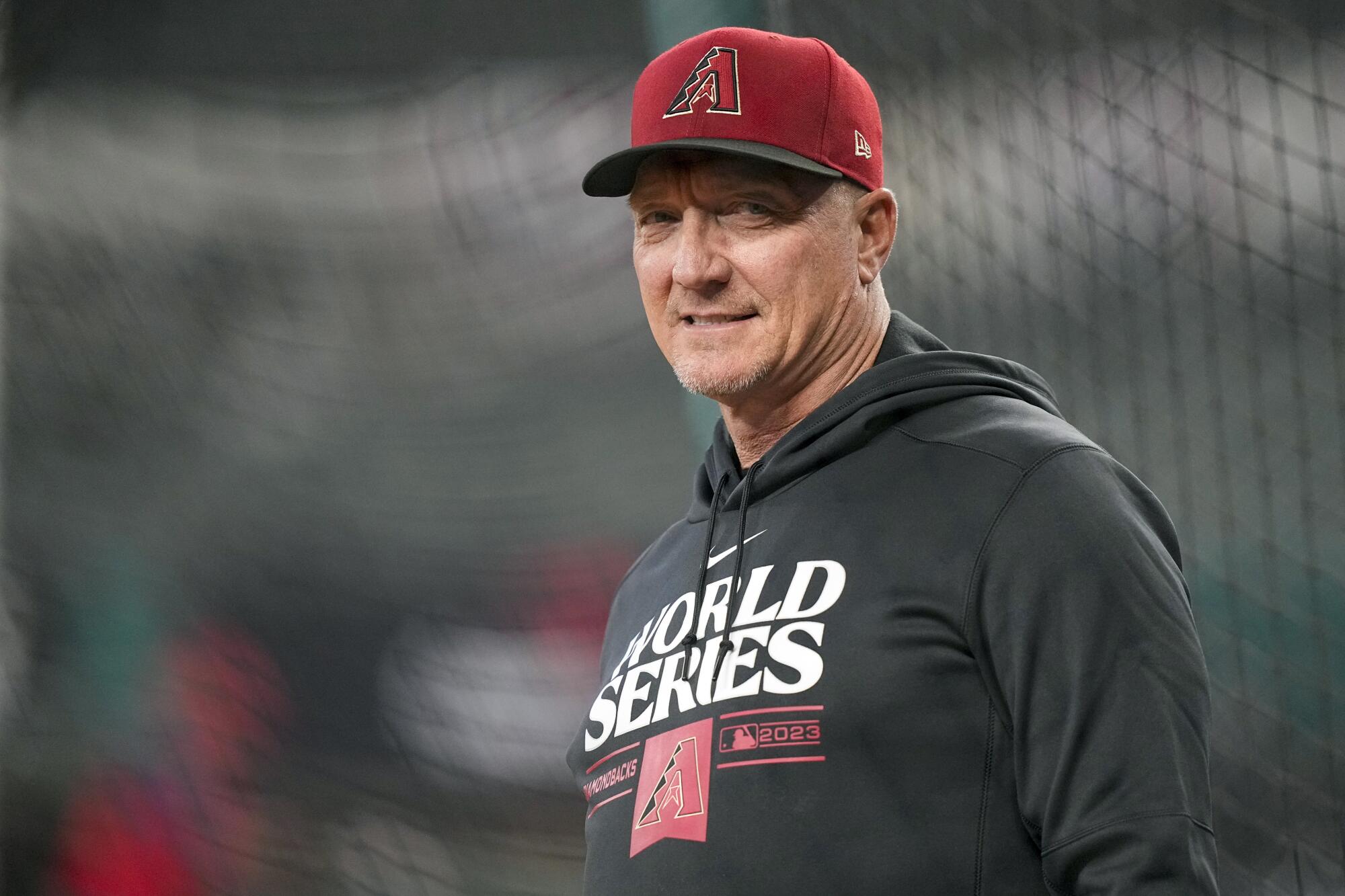
Arizona Diamondbacks bench coach Jeff Banister was part of the team that reached the World Series in 2023.
(Brynn Anderson / Associated Press)
But he’s never forgotten what it means to walk into a big-league clubhouse for the first — and maybe only — time.
“We’re not guaranteed 3,000 at-bats,” Banister, beginning his fourth season as the Diamondbacks bench coach, says. “We’re not guaranteed one.”
Jack Kruger’s big-league career was so short if you blinked, you might have missed it. Yet the climb to get there was so challenging, it’s a wonder Kruger made it at all.
On May 6, 2021, Angels manager Joe Maddon sent Kruger on to catch the ninth inning of an otherwise forgettable 8-3 loss to the Tampa Bay Rays, a game that ended with Kruger standing in the on-deck circle. Yet Kruger’s father Tim said he still gets chills thinking about that night.
“It was surreal,” he said. “It was like being in a dream. I’m sitting there with my wife, holding hands and just thinking, ‘My gosh, our son is playing in a major-league game.’”
No players’ path to the majors is easy, but few have had to overcome as many obstacles as Kruger. When he was 5, Kruger was diagnosed with Perthes disease, a rare condition in which the blood supply to the thigh is temporarily disrupted, leading to bone damage and stunting growth.
But there was a silver lining to that black cloud because after spending 18 months on crutches, Kruger was cleared by doctors for just one physical activity: hitting a baseball.

Catcher Jack Kruger played one inning of one game for the Angels on May 6, 2021.
(Kent Nishimura / Los Angeles Times)
So Tim began pitching to his son and as Jack’s bones healed and he began to grow, that practice began to pay off. As a senior year at Oaks Christian, Kruger hit .343 with seven homers and 37 RBIs. His dream, however, had never been to play in the majors, it was to serve his country. So he enrolled at West Point.
Then came the next setback. On the day he was to put on his cadet uniform for the first time, the school declared him medically ineligible because of his childhood disease. His dream was gone.
“It was devastating,” Tim Kruger said. “He had his life planned.”
So Kruger made new plans, playing one season at Oregon, one at Orange Coast College and one at Mississippi State, where he made the all-conference team and drew the attention of the Angels, who took him in the 20th round of 2016 MLB draft.
Kruger methodically climbed the minor league ladder and was in Salt Lake City for his first season in Triple A when manager Lou Marson called him at the hotel. Angels catcher Max Stassi was going on the injured list with a concussion; Kruger was to get on the next plane to Anaheim.
He was going to The Show — and Albert Pujols, a future Hall of Famer, was one of the players designated for assignment to make room for him on the roster.
The next 30 hours are still a blur, he said. He got to Angel Stadium just an hour before the first pitch, too late for batting practice and with just enough time to pull on a jersey with his name in red block letters and black trim above a dark red number No. 59. For the first eight innings he sat on the bench alongside Shohei Ohtani and Mike Trout before Maddon sent him on in the ninth to catch 20 pitches from right-hander Steve Cishek.
When he returned to the ballpark the next day a front-office staffer met him at his locker and told him he had been designated for assignment.
“It came out of nowhere,” Kruger said. “And he didn’t know my name.”
Asked about Kruger four years later Maddon, a catcher who spent four years in the low minors, remembered the ninth inning of that one-sided game. And he remembered why he sent Kruger in for the final inning, making him a major leaguer forever.
“I wanted to get him in that game,” he said. “One more hitter gets on base and he gets to hit. Never happened [but] we did our best to make it a complete experience for him. I know it’s something he’ll never forget and he absolutely deserved it.”
Kruger, 30, went on to play two more seasons with the Texas Rangers’ Triple A affiliate in Round Rock, Texas, hitting .243 in 66 games. But he never entered a big-league clubhouse again. After baseball, Kruger co-founded a company called D1 Scholarship to help athletes in multiple sports negotiate the college recruiting process.
“I did everything I could with the opportunities I was given. So I don’t necessarily have any regrets or think or wish I would have done something differently,” he said. “It was great for what it was. And then I moved on to the next thing.”
For one brief, shining September afternoon, 18-year-old John Paciorek was the best player in major league baseball.
On the final day of the 1963 season, Paciorek, went three for three with two walks, three RBIs, four runs scored and two splendid running catches in right field for Houston’s Colt .45s in a 13-4 win over the New York Mets. In his last at-bat, he got a standing ovation — if the applause from a crowd of 3,899 can be called an ovation.
“It was like a dream,” he said.
It was the only time Paciorek appeared on a big-league field.
The eldest of five brothers who grew up just outside Detroit, playing every sport that involved a ball — and some that didn’t — Paciorek accepted a $45,000 bonus to sign with the Colt .45s, the forerunners of the Astros, in 1962, while he was still in high school.
He was invited to big-league spring training the following year but hit just .219 at Modesto in the Single A California League in his first pro season. He played with verve, hustling to first after walks and sprinting on and off the field every half-inning, but he also injured his back and shoulder and developed a chronically sore throwing arm late in the year.
He was summoned to Houston that September anyway, partly to have his back checked. With the Colt .45s languishing near the bottom of the 10-team National League standings, Houston manager Harry Craft decided to start a lineup of rookies, among them Joe Morgan, Jimmy Wynn and Rusty Staub, on that final Sunday. Paciorek was soon added to that lineup.
“One of the guys asked if I would like to play,” he said. “I jumped at the opportunity. I wasn’t even thinking of my back. So I went to church and communion and everything else and got to the ballpark early.
“I knew I had to be stretched out and ready to go.”
Batting seventh, he drew a walk in the second and scored on John Bateman’s triple; drove in two runs with a single to left in the fourth; drove in another run with a single to left in the sixth; walked and scored in the sixth; then singled again in the seventh.
“The hits I got were kind of like hits on the handle,” he said. “I was physically strong enough to force the ball over the shortstop’s head.”

John Paciorek recorded three hits in his one MLB game with the Houston Colt 45’s, now the Astros.
(Photo Courtesy of the National Baseball Hall of Fame and Museum)
But it was that strength and what Paciorek did to built it that contributed to the injuries that ended his career.
“I was such a fanatic about exercise and building myself up,” he said. “I was always doing exercises and doing drills. I had no idea about what I was doing.”
Whether that contributed to a chronic back condition is hard to say; one doctor called it an abnormality from birth. What’s certain is the pain was to blame for his poor performance in Modesto, especially after he tore muscles in his upper back.
Still, his perfect game on the final day of the 1963 season got him invited back to spring training the following year to compete for the starting job in center field.
Instead, he struggled to do the most basic things.
“I’d be charging a ground ball and bend over, oh my God it’s like a knife going through my back,” he said. A couple of months later, after batting .135 over 49 games at Single A, he underwent surgery to fuse two lumbar vertebrae, then spent 10 months in a back brace.
“If I would have been more intelligently inclined and I would have known something about chiropractic application or practice, I probably would never had had the operation,” he said. “I developed all kinds of injuries because the fusion limited my movement.”
While recovering from the operation, Paciorek enrolled in the University of Houston, eventually earning a degree in physical education he would soon put to good use. After two more seasons in Houston’s minor league system, hitting .172 and striking out in more than a quarter of his at-bats, he was released and signed with Cleveland. He hit a career-best .268 with 20 homers and 73 RBIs in Single A in 1968, but a year later he was released again and retired to become a teacher at the private Clairbourn School in San Gabriel, where he worked for 41 years before he retired again in 2017, months after the school built a batting cage and named it in his honor.
A year after Paciorek quit playing, younger brother Tom made his big-league debut for the Dodgers, beginning an 18-year career that would see him play in an All-Star Game and a World Series. Another brother would play 48 games for the Milwaukee Brewers and two of John’s four sons played minor league baseball. But none of them matched the perfection of Paciorek, who remains the only major league player to retire with a 1.000 batting average in more than two at-bats.
“My record will probably never be broken,” Paciorek said. “I was just so fortunate. I must have been predestined to demonstrate perfection to a certain extent.
“Maybe that’s why I’m carrying this on for 60 years, this whole idea of perfection.”
What, after all, could be more perfect than playing in the big leagues, where the memories of one game can last a lifetime?

Sports
London descends into disorder as Morocco fans flood streets after World Cup elimination by France

NEWYou can now listen to Fox News articles!
Public unrest began in parts of London late Thursday night, and it appears Morocco’s exit from the 2026 FIFA World Cup at the hands of France is the reason.
France took down Morocco 2-0, eliminating the African country for the second consecutive tournament, this time in a quarterfinal match.
As a result, many feared Paris would erupt into riots, especially after the chaos that followed Paris Saint-Germain’s UEFA Champions League victory over Arsenal in May.
Instead, images and videos from Edgware Road in northwest London showed police clashing with large crowds as smoke billowed through the streets and debris littered the roadway.
A police vehicle is parked in a road as people from pro-Palestinian activist groups gather near the Edgware United Synagogue during a demonstration against the “Great Israeli Real Estate Event” organized by real-estate agency My Home in Israel, which markets property in Israeli settlements in the occupied West Bank, in London, Britain, June 14, 2026. (Toby Shepheard)
Riot police, equipped with shields and body armor, tried to contain the crowds as they clashed with people launching fireworks and throwing debris. One video also appeared to show an officer down.
KYLIAN MBAPPÉ, OUSMANE DEMBÉLÉ FIRE FRANCE INTO WORLD CUP SEMIFINALS WITH WIN OVER MOROCCO
It’s unknown what happened to the officer who was down on the asphalt or how he was injured.
Fans waved Moroccan flags in the middle of the streets, which held up traffic. Some even jumped on top of vehicles trying to get through the area.
Moroccan fans in the stands before a FIFA World Cup 2026 quarterfinal match between France and Morocco at Boston Stadium July 9, 2026, in Foxborough, Mass. (Richard Sellers/SportsphotoAllstar)
Similar scenes unfolded after Egypt’s World Cup exit, when Argentina rallied for a controversial 3-2 victory that featured several disputed officiating decisions.
Paris, on the other hand, looked more like a city celebrating than one on the brink of a riot. Supporters of both France and Morocco flooded the streets, slowing traffic in several parts of the city.
One video showed horns blasting from cars with French and Moroccan flags out the windows on the L’avenue des Champs-Élysées in Paris. Supporters on the side of the road, waving their own flags, joined in on the celebration.
France’s Kylian Mbappé scored his eighth goal of this World Cup, which ties him for the most with Argentina’s Lionel Messi. Ousmane Dembélé also scored in the second half for France in the 2-0 win over Morocco.
It’s the third straight semifinal appearance for France, while Morocco still made World Cup history despite the loss. After becoming the first African country to reach the quarterfinals and semifinals in World Cup history in 2022, Morocco added to that by becoming the first-ever African nation to reach more than one quarterfinal.
Moroccan fans react while attending a watch party for the World Cup round of 8 match between France and Morocco in Boston, Massachusetts, on July 9, 2026. (Joseph Prezioso/AFP)
CLICK HERE TO DOWNLOAD THE FOX NEWS APP
Morocco’s exit means there are no more African nations alive in the World Cup. France will be taking on the winner of Spain and Belgium, while England and Norway and Argentina and Switzerland face off in the quarterfinals.
Follow Fox News Digital’s sports coverage on X and subscribe to the Fox News Sports Huddle newsletter.

LONDON — A local boy sleeps in his own bed, plays in front of a king and queen and makes a Cinderella run to the Wimbledon semifinals. Sounds like a Hollywood script that might never see the silver screen.
But it’s no fairy tale — it’s Arthur Fery’s out-of-nowhere performance over the last 10 days.
Fery, a virtually unknown British wild card with a triple-digit ranking, has become the emotional heartbeat of Wimbledon while legitimately diverting some national attention from England’s World Cup quest.
The royal treatment at his matches across the All England Club has come in more ways than one.
Fery, who grew up five minutes from Wimbledon and is staying at home during the tournament, first played before grass-court king Roger Federer, Wimbledon’s eight-time singles champion, during Monday’s fourth-round victory. Two days later, he beat No. 9 seed and French Open runner-up Flavio Cobolli of Italy in the quarterfinals 6-4, 7-6 (4), 6-0 in front of Queen Camilla.
Ranked 114th, Fery had never reached the semifinals of an ATP Tour event, let alone a major, before his brief chat with the queen following the match.
“She just said, ‘Congratulations, keep going,’” 23-year-old Fery told reporters later. “I told her it was my birthday on Sunday, so it would be great to play the Wimbledon final on my birthday.”
That’s still a match away. To get there, Fery will have to get past one of the hottest players on tour: No. 2 seed Alexander Zverev, who is fresh off his first Grand Slam title at the French Open. Looming on the other side of the draw is a highly anticipated showdown between defending champion Jannik Sinner against 24-time major winner Novak Djokovic.
If Fery can continue his magical run to the end, he would become the first British wild card to win a Wimbledon title.
Arthur Fery reacts after defeating Flavio Cobolli in the Wimbledon quarterfinals on Wednesday.
(Maja Smiejkowska / Associated Press)
Born in France, Fery’s family moved to Wimbledon when he was an infant. His mother played professional tennis. He was a top British junior but chose to sharpen his game for three years in the U.S. collegiate system at Stanford, as many of his compatriots have done.
“I came out with a lot of hunger coming out of that, and I was ready to attack the pro circuit,” Fery said.
After struggling with bone bruising in his arm that limited him to playing mostly on the lower-tier Challenger circuit in recent years, Fery is finally healthy and playing consistently.
His path to the last four in London has been a masterclass in clutch come-from-behind performances. The Brit has stared down near-certain elimination in multiple matches, repeatedly breaking his opponents’ momentum with Houdini-like on-court acts.
At 5-foot-9, Fery possesses a skill set perfectly suited for low-bounding grass.
His compact strokes, low center of gravity, and elite movement allow him to hug the baseline, take time away from opponents, and confidently execute delicate volleys at the net, according to ESPN analyst Chris Eubanks.
“He defends well,” said Eubanks, a 2023 Wimbledon quarterfinalist. “He can scrap. He can claw. He can dig his way back into points. And when he ventures forward, he’s very, very comfortable at the net. This is a picture-perfect example of someone whose game is built for the surface.”
Still, it’s hard to fathom the multitude of milestones for Fery, who briefly reached the No. 1 ranking in college and earned 2023 Pac-12 Singles Player of the Year honors before leaving early to pursue a pro career.
He arrived at Wimbledon with just one main-draw victory at a major, a losing record as a professional, and only one previous ATP quarterfinal, at Queen’s Club last month. He’s now 11-8, won his first two five-set matches, and is the first British wild card to reach the Wimbledon men’s semifinals in the Open Era. The only other men’s wild-card semifinalist was Goran Ivanisevic, who won the title as a wild card in 2001.
Fery, who started the season ranked No. 185 and will climb to at least No. 36 after the tournament, said there were a “lot of first times” as he reflected on his unprecedented run. “First five-setter, longest match that I’ve ever played, first time breaking into the top 100, first second week in a slam, all at home, five minutes from where I grew up. It’s a great story for me,” he said.
The gap with his fellow semifinalists is understandably massive.

Entering Wimbledon, Djokovic, Sinner and Zverev’s combined records include 29 Grand Slam titles, 2,088 match wins and 155 tour-level titles. Fery was 6-8 in tour-level matches with zero titles.
But he has singlehandedly lifted the tournament for locals. With top hopes Jack Draper and Emma Raducanu withdrawing before the tournament and the rest of Britain’s singles prospects falling one by one — 18 men and women were eliminated by the third round — Fery became the nation’s last knight standing.
If his first name inevitably evokes Arthurian legend, Fery’s march through the draw gave Britain reason to believe again. No sword, no Round Table, just world-class shot-making, a lion’s heart and a Centre Court crowd thrilled to rally behind him.
“This is really quite something to see on home soil,” said Russell Fuller, the BBC’s tennis correspondent, who compared it with Raducanu’s stunning U.S. Open win in 2021 as a qualifier.
Fery earned every bit of it.
In the first round against Damir Dzumhur, Fery dropped the opening set and trailed by a break in the second before surging back. Against Zizou Bergs in the third round, he faced a 4-1 deficit with a double break in the fourth set, and again fell behind 4-1 in the fifth, before somehow surviving.
Then, stepping onto Centre Court for the first time against former top-10 stalwart Grigor Dimitrov of Bulgaria in the fourth round, Fery clawed out of a 2-sets-to-1 hole and a break down in the fourth set to clinch the victory in a fifth-set tiebreak.
“He carries himself with humility, but he’s a fierce competitor, and he’s got a ton of belief in himself,” said Stanford men’s coach and former top-60 player Paul Goldstein, who flew to England Tuesday to see his former charge compete against Cobolli.
While Fery attempts to outmaneuver Zverev on Friday, the other semifinal features a 2025 Wimbledon semifinal rematch between seven-time Wimbledon winner Djokovic and top-ranked Sinner, who defeated the Serb in straight sets on his way to the title. It’s also their second Grand Slam semifinal meeting in 2026. At January’s Australian Open on hard courts, Djokovic bested 24-year-old Sinner in five sets before falling to now-injured Carlos Alcaraz in the Melbourne final.

Arthur Fery hits a return during his Wimbledon quarterfinal win over Flavio Cobolli on Wednesday.
(Clive Brunskill / Getty Images)
Djokovic, 39, enters the match after surviving a grueling five-set, 5-hour-plus quarterfinal slugfest against No. 3 Félix Auger-Aliassime that concluded just minutes before Wimbledon’s 11 p.m. curfew. But the seventh-seeded Serb has a way of defying Father Time and he has had two days to recover on a surface where points are shorter and generally less taxing on the body.
Italy’s Sinner, who defeated Alcaraz in last year’s Wimbledon final, has been efficient if not at the level that saw him capture five consecutive titles before crashing out in the second round at the French Open. After a first-round scare here, the four-time Grand Slam champion has dominated opponents behind his improving serve, winning 80% of his first-serve points. He hasn’t dropped a set since the opening round. Sinner leads the head-to-head with Djokovic 6-5.
According to Eubanks, Djokovic must disrupt Sinner’s movement to break his rhythm, and take his chances.
“He’s got to play similar to how he played in Australia, where it was just all-out aggression,” Eubanks said.
For Sinner, he added: “His serve can be a neutralizing force for what Novak is going to try to do.”
On the other side of the ledger, Fery’s poise under pressure and deft use of the home crowd will be paramount to continue his surprise run against Germany’s Zverev, whom he called a “step up again” from his last five matches. Zverev, 29, is seeking his fifth major final and first at Wimbledon.
“I’m ready for it,” Fery said. “I have nothing to lose. I’m just going to go out there and … put my game on the court, do what I’ve done, believe in myself. We’ll see where that takes me.”
Home has never been closer to Centre Court. Nor has Arthur Fery ever been closer to tennis history.
Sports
Pirates star pitcher makes unfortunate history after being taken out in middle of perfect game bid

NEWYou can now listen to Fox News articles!
Jared Jones was flirting with Major League Baseball history on Wednesday night — he got it, but it was not what he originally envisioned.
The Pittsburgh Pirates pitcher retired the first 18 batters he faced, but he was taken out in the middle of his perfect game bid after six innings.
Now, the Pirates certainly have their reasons — the 24-year-old Jones hasn’t thrown more than 81 pitches in eight starts since returning May 20 after missing all of last season while undergoing ulnar collateral ligament internal brace surgery on May 21, 2025. He was yanked with 77 pitches and likely would have needed more than 100 pitches to record the 25th perfect game in MLB history.
Jared Jones of the Pittsburgh Pirates pitches during the first inning against the Atlanta Braves at PNC Park on July 8, 2026, in Pittsburgh, Pennsylvania. (Photo by Joe Sargent/Getty Images)
However, Jones left the game after getting zero run support, so when the Atlanta Braves tacked on three runs late for a 3-0 victory, Jones instead found himself in the wrong chapter of the history books.
According to Opta Stats, Jones became the first pitcher in the modern era (since 1920) to pitch at least six perfect innings and not record a win.
“It does suck. Something’s cool coming on, but I’m on what? My eighth start off of surgery? I completely understand it, and it is what it is,” Jones told reporters after the game.
Pittsburgh Pirates starting pitcher Jared Jones (17) makes his way to the field to warm up before pitching against the Atlanta Braves at PNC Park. (Charles LeClaire/Imagn Images)
JUSTIN VERLANDER ANNOUNCES HE WILL RETIRE AFTER THIS SEASON: ‘I’VE REALIZED THAT TIME HAS COME’
Jones said he didn’t entertain attempting to complete the perfect game.
“Not with the pitch count,” he said. “Not really ever expecting to go nine right now, so that was never in my head.”
Joey Bart, traded to the Braves from the Pirates on June 18, followed a double by Mike Yastrzemski with a 422-foot, two-run homer to left-center field off a slider from Dennis Santana. Drake Baldwin added an RBI single to center in the ninth for good measure.
It was the second time in less than a week that a pitcher was taken out of the game with a perfect bid through six innings — the Miami Marlins took Eury Perez out after seven innings in which he had 92 pitches. Perez, too, is in the midst of returning from injury and has surprisingly found himself right in the postseason mix.
He was pulled for Lake Bachar to start the eighth, and the Marlins allowed eight runs to the Athletics in the final two innings, but held on to win 9-8.
Jared Jones (17) of the Pittsburgh Pirates delivers a pitch during a MLB game against the Cincinnati Reds on June 27, 2026, at PNC Park in Pittsburgh, Pennsylvania. (Joe Robbins/Icon Sportswire via Getty Images)
CLICK HERE TO DOWNLOAD THE FOX NEWS APP
The Pirates are 4.0 games out of the final wild card spot, which is held by the Marlins.
The Associated Press contributed to this report.
Follow Fox News Digital’s sports coverage on X, and subscribe to the Fox News Sports Huddle newsletter.
-

 Los Angeles, Ca40 minutes ago
O.C. police prep for beach, theme park ‘takeovers’ promoted on social media
-

 Detroit, MI1 hour ago
Detroit city leaders to DHS: Stop ICE pursuits which endanger the community
-

 San Francisco, CA1 hour ago
SF Supervisor Jackie Fielder hosts listening session after medical leave
-

 Dallas, TX1 hour ago
The Stewpot artists find healing, purpose and income through art in Dallas
-

 Miami, FL1 hour ago
Can Jason Marshall push for a starting spot – The Splash Zone 7/10/26
-

 Boston, MA1 hour ago
Police investigating shooting in Downtown Crossing – Boston News, Weather, Sports | WHDH 7News
-
 Denver, CO2 hours ago
Denver mayor announces new $100 million plan to bring in 10,000 jobs
-

 San Diego, CA2 hours ago
WEBTOON Brings Top Creators for San Diego Comic-Con Panels

