News
‘Absolutely Ridiculous’: Democrats Seethe at Schumer for Backing G.O.P. Spending Bill


Many Democratic lawmakers continued to express deep frustration at Senator Chuck Schumer on Sunday for having broken with most of his party to allow a Republican spending bill to pass, as the Democratic base increasingly demands stauncher resistance to President Trump’s far-reaching agenda.
Mr. Schumer, a New York Democrat and the Senate minority leader, joined nine other Democrats in allowing the bill to come to a vote, which averted a government shutdown. It was an abrupt reversal from Wednesday, when he said he would oppose the bill.
Explaining his sudden shift in position, Mr. Schumer argued that a shutdown would empower Mr. Trump and Elon Musk’s Department of Government Efficiency. “A shutdown would shut down all government agencies, and it would solely be up to Trump and DOGE and Musk what to open again, because they could determine what was essential,” he told The New York Times in an interview. “So their goal of decimating the whole federal government, of cutting agency after agency after agency, would occur under a shutdown.”
But to critics within his own party, he had squandered the leverage provided by the standoff to negotiate a bipartisan spending bill that would reclaim some of Congress’s power.
“He is absolutely wrong,” Representative Jasmine Crockett, Democrat of Texas, told CNN on Sunday. “The idea that Chuck Schumer is the only one that’s got a brain in the room and the only one that can think through all of the pros and cons is absolutely ridiculous.”
The stream of criticism that Mr. Schumer has faced since his vote comes as the Democratic Party is divided on how best to oppose Mr. Trump’s agenda while facing dismal polling numbers. An NBC poll released on Sunday showed that just 27 percent of voters had positive views of the party, while a majority of its base expressed disappointment at the Democrats’ fractured response.
Ms. Crockett has called on her Senate colleagues to consider ousting Mr. Schumer as minority leader, suggesting that “a younger, fresher leadership” is what “many Americans may be looking for.”
Representative James E. Clyburn, Democrat of South Carolina, told MSNBC that the House minority leader, Representative Hakeem Jeffries of New York, “got blindsided” by Mr. Schumer. House Democrats — all but one opposed the bill — had voted against giving Mr. Trump “a blank check,” Mr. Clyburn said. On Friday, Mr. Jeffries dodged repeated questions on whether he still supported Mr. Schumer as the leader of Senate Democrats.
Another House Democrat, Representative Debbie Dingell of Michigan, was a little more understanding, saying that Mr. Schumer had “sent out mixed signals.” But she stressed that even the American Federation of Government Employees, the largest labor union representing federal workers, whose members would be furloughed during a government shutdown, opposed the stopgap bill.
“People are scared, and they want us to do something,” Ms. Dingell said on CBS. “They want to see Democrats fighting back.”
Senator Chris Murphy, Democrat of Connecticut, did not denounce Mr. Schumer but pleaded for a change in tactics and for a more steadfast resistance against the Trump administration.
“The way the president is acting using law enforcement to target dissidents, harassing TV stations and radio stations that criticize him, endorsing political violence, puts our democracy at immediate risk,” Mr. Murphy said on NBC. Over the past few weeks, Mr. Trump has revoked security clearances of lawyers who argued against him, dismantled congressionally funded news agencies and pardoned those convicted of attacking the Capitol on Jan. 6, 2021.
Mr. Murphy added, “If you are a Democrat in the Senate or in the House you have to start acting with urgency.”
Prominent House Democrats, including Representative Nancy Pelosi, had pressed their Senate colleagues to block the bill. But more than a handful of Democratic senators joined Mr. Schumer in helping Republicans bring the bill to a vote: Dick Durbin of Illinois, Brian Schatz of Hawaii, Catherine Cortez Masto of Nevada, John Fetterman of Pennsylvania, Kirsten Gillibrand of New York and Maggie Hassan of New Hampshire, as well as two who have announced plans to retire, Gary Peters of Michigan and Jeanne Shaheen of New Hampshire. Senator Angus King, the Maine independent who caucuses with Democrats, also voted yes.
Some Democrats, including Representatives Jake Auchincloss of Massachusetts and Haley Stevens of Michigan, refrained from openly criticizing Mr. Schumer’s shift. They said Democratic infighting after the bill’s passage would only emphasize the divisions within the party. They warned that it would also draw voters’ attention away from Trump trade policies that have dampened the stock market and imbued uncertainty into the broader economy — developments that Democrats said could play to their advantage.
Ashley Etienne, a former communications director for Vice President Kamala Harris, told CNN that Democrats should not save Mr. Trump and Republicans from themselves. “Get out of the way,” she said. “Donald Trump said he was better for the economy. Let him prove it.”



Algae turns the newly repainted Lincoln Memorial Reflecting Pool green on the National Mall on Tuesday in Washington, DC.
Chip Somodevilla/Getty Images
hide caption
toggle caption
Chip Somodevilla/Getty Images
WASHINGTON — The Lincoln Memorial reflecting pool is once again making headlines, this week for turning green.
The Washington, D.C. landmark was refilled with water earlier this month after President Trump had its neutral grey bottom repainted “American flag blue.” The multi-million dollar project produced subtle results in the eyes of many observers, even as Trump and Secretary of the Interior Doug Burgum — whose agency managed the renovation — touted its success.

In recent days, however, the pool has taken on a verdant hue — the result of algae blooms that experts say are to be expected in these conditions.
“It’s called ‘New Pond Syndrome,’” says Steve Goodale, a Canadian swimming pool specialist known online as “Swimming Pool Steve.” “It’s a known thing that happens when you take a natural, clear body of water like this that sits in an open air environment and you try to start it up, very often you end up with green water almost immediately.”
Goodale says the process took longer — a matter of days — to unfold in this case likely due to the sheer size of the pool, which measures 2,030 feet long and has a surface area of approximately 338,000 square feet.
“Excellent conditions” for algae growth
Rosalina Stancheva Christova, a professor of aquatic ecology at George Mason University in Virginia, took water samples from the pool on Tuesday. She confirmed the algae belongs to the genus Desmodesmus, which she said is “growing in excessive amounts” but is not toxic or harmful.
Christova says this kind of common green algae is found all over the region, especially this time of year. The reflecting pool in particular provides “excellent conditions” for algae growth, she said: shallow, stagnant water, strong sunlight and no shade.
“It could happen every single summer,” she added. “But it seems that the disturbance of the pond during the renovations [is] accelerating this process.”

Christova said last month’s renovations may have affected the balance of nutrients in the pool, potentially accelerating the algae blooms. Goodale similarly views the resurfacing as one of several contributing factors.
“The new, darker interior surface is going to absorb more sunlight,” Goodale says. “It is going to result in water that’s warmer, and that ultimately is going to lead to more prolific algae growth.”

A microscopic slide shows the Desmodesmus algae that quickly turned the Reflecting Pool’s water green. The new dark blue paint of the pool’s lining makes the water warmer and friendlier to the algae growth.
Rosalina Stancheva Christova, PhD.
hide caption
toggle caption
Rosalina Stancheva Christova, PhD.
The Trump administration has said the algae came from residual material in supply lines that had lain dormant for weeks. Their growth was likely exacerbated by the extreme temperatures that hit D.C. last week, bringing heat index values to 95 degrees and above.
Algae has resurfaced in the reflecting pool periodically over the years — including immediately after it reopened from its last major renovation in 2012, forcing the National Park Service to drain it, refill it and recalibrate its ozone level. And in 2019, crews had to drain four million gallons from the pool to fix a broken water line that had algae growing in it.
An Interior Department spokesperson told NPR over email that algae and other contaminants have “long plagued the Reflecting Pool since 1922,” pointing to the Obama-era renovation as an example.
“Unlike under Obama and Biden, the National Park Service is actually maintaining the beautifully completed Reflecting Pool,” they added.
Responding with tiny bubbles and big vacuums
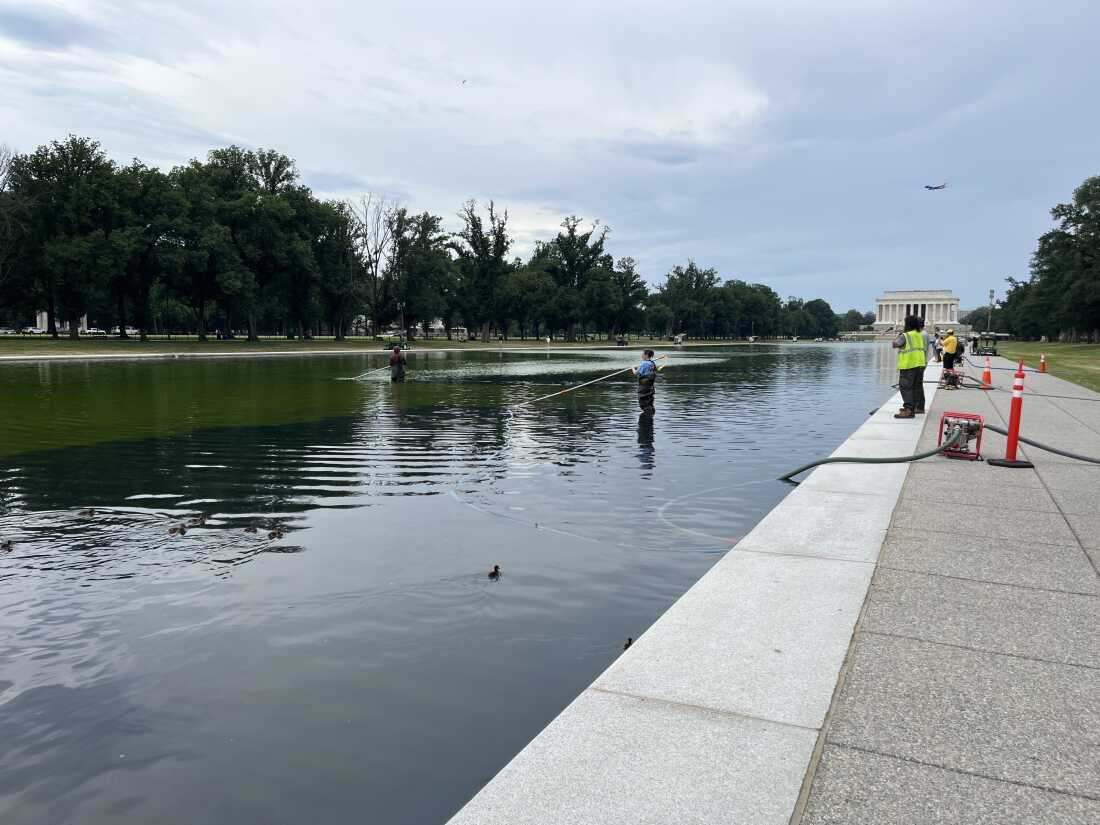
Workers battle the fast-growing common algae in the Lincoln Memorial Reflecting Pool on Thursday.
Rachel Treisman/NPR
hide caption
toggle caption
Rachel Treisman/NPR
The Trump administration is using a mix of mitigation strategies, including pouring hydrogen peroxide into the water to kill the algae.
The Interior Department says hydrogen peroxide is a “milder treatment than chlorine and is used in spas and specialty pools like natural swimming pools,” adding “there are no harmful side effects to marine life or to the environment.”
Workers are also deploying what the department calls “high-tech nanobubble ozone technology” to neutralize algae and other pathogens in the pool. The department says that approach is validated by several universities and the National Oceanic & Atmospheric Administration.
Those ozone bubbles are so tiny the human eye can’t even see them, Goodale says.
“The best way to describe it is that the bubbles are neutrally buoyant, so they won’t just rise to the surface and disappear readily,” he explains. “They can last for weeks, if not months in the water, doing their oxidizing thing and keeping the algae at bay.”
‘A monumental effort’
Goodale says it’s more complicated than treating the average backyard swimming pool, since the reflecting pool — despite its name — is actually more akin to a “manmade shallow lake.” He says it’s hard to predict just how long it will take to completely solve the algae problem, calling it “a monumental effort, literally.”
The Interior Department posted on X Wednesday that the nanobubble technology had “very effectively killed the algae,” and National Park Service crews would spend several days vacuuming up the dead algae from the bottom of the pool.
But as of Thursday morning, much of the pool — especially in the center — was still bright green.
Work continued on both ends of the pool. Nanobubble machines deposited their tubes into the water, as mobile vacuuming systems known as “trash pumps” hummed loudly from the shore. Handfuls of workers stood either in the pool or on the edge maneuvering long-handled vacuums back and forth. Their contents, including pistachio-colored water, poured out of hoses laying in the nearby grass.
The work zones were marked off by orange cones, but passersby walking the length of the pool appeared relatively unfazed. Some stopped to peer down and snap pictures of the water itself — including sections of paint that had visibly peeled off — while others were more focused on getting a photo of the Washington Monument in the background.
Loay Hidmi was walking deliberately along the edge of the pool closest to the Lincoln Memorial, hands clasped behind his back, looking over the ledge. The relatively new D.C. resident is a civil engineer who specializes in water treatment, and has been coming by the pool all week to see the progress for himself. He estimates it’s about 80% of the way there.
“I’m taking pictures of it … for the last week and I can see the gradual change,” he said. “So I’m hopeful. But we’ll have to see if it gets sustained.”
What happens next?
Hidmi worries that the algae could come back, given the favorable conditions posed by the sunny, shallow pool.
He acknowledges that’s mostly an aesthetic concern, given how much the administration has just spent on repainting the pool, but says it also raises questions about their process.
“In water systems, when you fix something, you need to look at the step before it and the step after,” he said.
Goodale agrees. He says that when a water system is taken offline, the pipes still remain full of water — “they don’t just gravity-drain away” — and need to be flushed out before any refilling. And he says eliminating algae is no substitute for dealing with underlying filtration issues.
“That’s like the equivalent of mowing the lawn when perhaps it needs to be something else that addresses the source nitrates and phosphorus, so that it’s more like pulling the weeds out by the root,” he says.

The algae doesn’t bother the ducklings swimming in the Reflecting Pool. Experts say the hydrogen peroxide used to get rid of the algae is safe for them, too.
Rachel Treisman/NPR
hide caption
toggle caption
Rachel Treisman/NPR
In the meantime, Christova, the algae expert, would like to see the water monitored weekly.
“If we don’t have any control over algal growth, we don’t know what is growing,” she said, adding that not all types of algae are as harmless as the one currently blooming in the pool.
When asked about plans for maintenance and algae prevention, White House spokesperson Taylor Rogers told NPR: “Thanks to President Trump, new lining and industrial grade materials will permanently seal the Reflecting Pool, which previously leaked 16 million gallons per year and wasted countless taxpayer dollars.”
Even after the Obama-era renovation, the reflecting pool suffered from broken pipes and water leaks requiring costly refills, according to a Department of the Interior report from fiscal year 2023. It called for new expansion joints, supply and return lines with thicker walls, saying “an improved distribution system will ensure the water can be circulated through the treatment plant, filtered, and treated with ozone.”
This latest renovation does not appear to have addressed the pipe problems, even though it did involve replacing failing expansion joints, resealing the pool, removing truckloads of garbage and “fixing the water system, drainage and so much more,” as Trump wrote on Truth Social in May.
Along the way, the cost of the project grew from Trump’s initial $2 million price tag to at least $14 million. Federal contract records show the government is paying $1.7 million to an Ohio-based company for the nanobubble technology alone.
“The scope of the Project has been greatly enlarged as we became involved because we realized how important it would be to Washington, D.C., and the record number of visitors coming to our now very safe Capital for all of the upcoming events in celebration of our 250th Anniversary,” Trump wrote.

The National Mall is hosting a number of semiquincentennial events on and around July 4, including a weekslong state fair that kicks off Wednesday evening.

Three San Francisco couples set out Monday for their annual road trip to Ashland, Ore., for the town’s famous Shakespeare festival. They drove separately and planned to meet at 6:30 p.m. on the terrace of their favorite Japanese restaurant there.
They had booked a table for six, but only four showed up for dinner.
Judith and Wylie Sheldon were found dead in their running car on the side of the road to Oregon, shocking their friends and family and leaving a hole in San Francisco’s arts and film world.
Ms. Sheldon, 84, was the daughter of William Wyler — who won three Oscars for best director — and chaired the board of the San Francisco Silent Film Festival. Mr. Sheldon, 86, was a prominent lawyer.
David Smith, who had befriended the couple more than 40 years ago, said in an interview that he and the others at the dinner table had grown nervous as time ticked on and their friends did not answer repeated calls to their cellphones. They learned they had not checked into their hotel either.
The friends eventually learned from one of the couple’s sons that the California Highway Patrol had found the couple at 5:46 p.m., both dead inside their running Jeep Compass. It was parked on the side of Interstate 5, north of Redding, Calif., more than 100 miles from their destination, the authorities said. Ms. Sheldon was driving, while Mr. Sheldon was in the passenger seat, according to the authorities.
The Redding area on Monday was under an extreme heat warning issued by the National Weather Service. Temperatures reached 109 degrees, according to the Weather Service.
Mr. Smith said he learned from the son that the couple had been found without any water or other liquids in the car. The fan was on high, but the air conditioning was not working, meaning they might have been blasted with hot air, Mr. Smith said. The windows were rolled down. The car had plenty of gas, and there were no signs of mechanical failure or foul play, Mr. Smith said the son told him.
“They didn’t crash. They stopped. They both just died there,” Mr. Smith said. “The entire thing is so bizarre. We’re still in a state of shock.”
The circumstances and cause of the couple’s death is under investigation but “appears to be medically related,” the Highway Patrol said in a statement.
Whether the heat contributed to the couple’s death “may be determined” by an autopsy, a spokesman for the Shasta County Sheriff’s Office said, adding that one had not been scheduled yet and could take several weeks to complete.
“We’ll just have to see,” the spokesman, Tim Mapes, said.
The Sheldons met at Stanford University and had two sons. They lived in a large home in San Francisco’s upscale Pacific Heights neighborhood that had views of the bay from the front and a garden out back.
They hosted many parties there on behalf of the San Francisco Silent Film Festival and sometimes let revelers pose for photos with Mr. Wyler’s Oscar statuettes. Ms. Sheldon fell in love with silent movies after first seeing those created by her father — before his better known blockbusters like “Ben-Hur” and “Roman Holiday” — only about 30 years ago, said Anita Monga, artistic director of the festival.
Stacey Wisnia, the festival’s executive director, said the couple was generous, delightful and unassuming.
Back in Ashland, Ore., Mr. Smith said the four remaining friends had distracted themselves from their grief by attending plays, including “A Midsummer Night’s Dream” and “Come From Away.” They were able to give away their friends’ tickets.
Ms. Monga had last seen Ms. Sheldon just last month at the film festival, which was held at the newly remade Castro Theater.
“This is such a shock,” Ms. Monga said of the deaths. “Also because it’s still a mystery.”

Luigi Mangione appears for a pretrial hearing at Manhattan Criminal Court in New York, June 17, 2026.
Angelina Katsanis/AP
hide caption
toggle caption
Angelina Katsanis/AP
New York — In a dramatic reversal, Luigi Mangione’s legal team on Thursday backed away from a plan to use a psychiatric defense when his case goes to trial in state court in September. Mangione has pleaded not guilty to murdering health insurance CEO Brian Thompson in 2024 on a Manhattan street.
At a hearing only a day earlier before state Judge Gregory Carro, Mangione’s attorneys confirmed that Mangione had been undergoing psychiatric evaluation. They signaled that his defense would be based at least in part on the argument that Mangione was experiencing “extreme emotional disturbance.”

But in a one-line letter sent to Carro on Thursday, Mangione’s team said that “at this time” they no longer intend to introduce psychiatric evidence during the trial. It’s unclear what sparked the shift. Mangione’s team didn’t respond to NPR’s request for comment.
Former Manhattan prosecutor and legal analyst Gary Galperin told NPR it was a “stunning reversal” for Mangione to withdraw from the psychiatric defense. “One can only speculate at this point as to the reasons,” he said.
“What remains, of course, at this point is the question of what defense they will pursue at trial,” he added.
This maneuver came after Carro ordered Mangione’s attorneys to quickly share psychiatric information with prosecutors.
“They need to know what the malady is that this defendant suffers and how that triggered extreme emotional distress,” he said, during Wednesday’s hearing. “I’m not going to let you surprise people on the eve of trial. Get it done.”
Assistant Manhattan District Attorney Joel Seidemann repeatedly complained that Mangione’s team was “stonewalling” the prosecution by withholding medical information about his psychiatric state. “We have gotten nothing,” Seidemann said.
Mangione’s lead attorney Karen Friedman Agnifilo denied her team was delaying the court process or improperly withholding information.
But legal analyst Richard Schoenstein says by withdrawing the psychiatric defense, Mangione’s team “is avoiding the court deadline to produce its psychiatric evidence.”
According to Schoenstein, this latest move “does not entirely foreclose” Mangione’s team from returning to some form of psychiatric argument during the trial, but he added that such a defense would now be far more difficult.
Mangione’s case has drawn worldwide attention. Legal experts say the 28-eight-year old has drawn an unusual level of public support because of his criticism of the health insurance industry. Thompson, a father of two, was CEO of UnitedHealthcare at the time of his murder.
During Wednesday’s hearing, Carro also indicated that a tranche of court documents would be made public that apparently relate to Mangione’s potential psychiatric defense. On Thursday, Carro reversed course.
In a signed order, he said that because Mangione will no longer present psychiatric evidence, “the court’s previous order sealing certain transcripts, emails, and documents, remains in effect.”
Mangione’s state trial is scheduled to begin in early September, with a federal trial expected to take place later.
-

 World6 minutes ago
‘Not our Europe’: Macron and Sánchez slam return hubs for migrants
-
News33 minutes ago
Algae clouded Trump’s vision for the Reflecting Pool. But scientists aren’t surprised
-

 New York2 hours ago
Video: The Democracy of The Dive Bar
-

 Los Angeles, Ca2 hours ago
Sweltering heat wave to grip Southern California next week
-

 Detroit, MI2 hours ago
Top 10 ‘Hour Detroit’ Covers, As Voted By Readers
-

 San Francisco, CA2 hours ago
Injured SFPD officer released from hospital after line-of-duty shooting
-

 Dallas, TX2 hours ago
25,000 free Dallas teen passes available June 29 for museums, zoo and more
-

 Miami, FL2 hours ago
3 wildfires burn over 20,000 acres in Miami-Dade ahead of long-awaited rain

