Politics
Trump's 1% policy wars: Transgender people, USAID funding and now Canadian fentanyl?

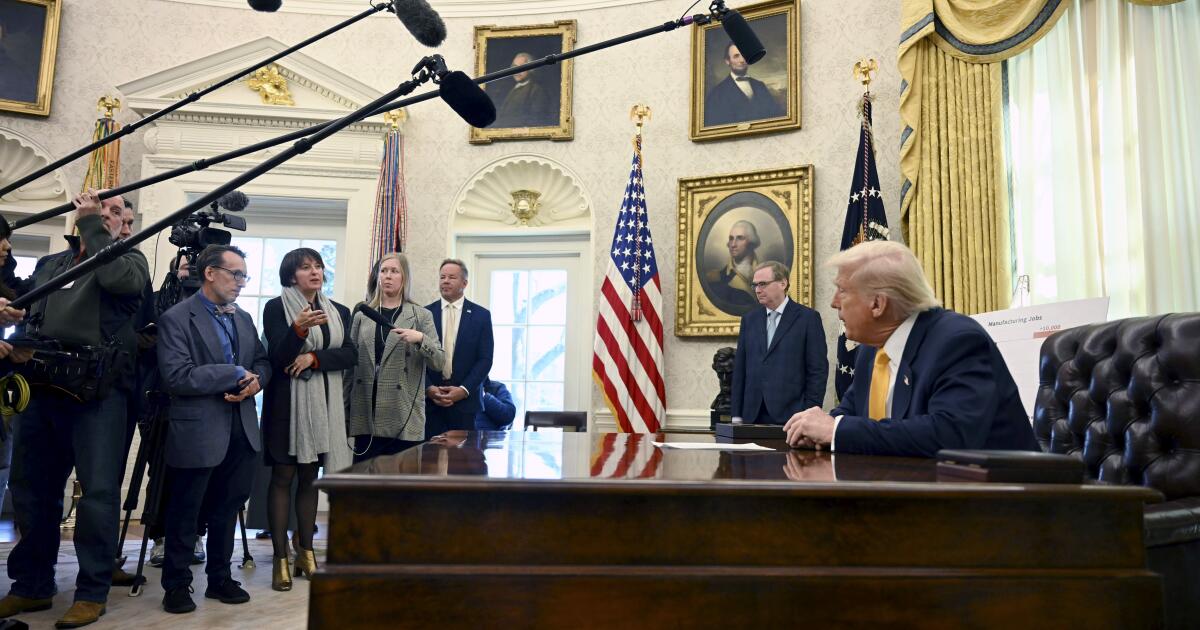
When Canadian Prime Minister Justin Trudeau called President Trump this week to discuss the imposition of stiff U.S. tariffs, Trump linked the decision to deadly fentanyl and undocumented migrants crossing into the U.S. along its northern border.
Trump said he blamed Trudeau for “weak border policies” allowing “tremendous amounts” of fentanyl and migrants to “pour into” the U.S.
“I told him that many people have died from Fentanyl that came through the Borders of Canada and Mexico, and nothing has convinced me that it has stopped,” Trump wrote on his Truth Social platform. “He said that it’s gotten better, but I said, ‘That’s not good enough.’”
The framing was on brand for Trump in that it cast him as a tough negotiator on two of his favorite political issues: illegal immigration and synthetic opioid deaths. But it also was on brand as another 1% policy war for the president, stoking fear around a proportionally tiny issue.
Seizures of fentanyl at the northern border represented less than 1% of all recent U.S. seizures of the drug nationwide, according to U.S. Customs and Border Protection data. Most fentanyl seizures occur along the southern border with Mexico.
Apprehensions of undocumented migrants at the northern border have increased in recent years, but still only represented about 1.5% of apprehensions nationwide in fiscal 2024, according to an analysis by FactCheck.org, a project of the Annenberg Public Policy Center at the University of Pennsylvania. Again, most apprehensions occur along the southern border.
Trudeau has repeatedly referenced those relatively small stakes in pushing back against Trump in recent months, calling Trump’s focus on such issues a “pretext” for a trade war that will destabilize Canada’s economy and make it easier to annex, a goal Trump has espoused.
Trump has similarly attacked transgender people, who represent about 1.3% of the U.S. population, according to recent Gallup polling, and foreign aid issued by the U.S. Agency for International Development, or USAID, which represents less than 1% of the federal budget, according to multiple analyses.
Trump and his supporters say he is pursuing an “America First” agenda that supports “common sense.” They say even small amounts of fentanyl or fraud in government spending are cause for alarm, and that transgender people represent a growing threat to women and children and deserve equal concern.
But Trump’s critics and other experts reject those defenses as alarmist, inaccurate and unduly dismissive of such policies’ downsides.
In an interview on “The View” last month, transgender actress Laverne Cox blasted Trump for spreading “propaganda and lies” about transgender people being a threat. She noted the community has no real power or influence in the lives of average Americans, and contrasted that with the outsize influence of “the other 1%” — a clear reference to the nation’s ultra-wealthy.
“At the end of the day, trans people are less than 1% of the population, and trans people are not the reason you can’t afford eggs. We’re not the reason that you can’t afford healthcare. We’re not the reason that you can’t buy a house or your rent’s too high,” Cox said. “I think they’re focused on the wrong 1%. I think the other 1% is the reason for all those things.”
LGBTQ+ rights organizations and other critics have echoed that argument, in part by highlighting Trump’s reliance on Elon Musk, the world’s richest man and head of Trump’s so-called Department of Government Efficiency, which has been trying to close out USAID.
According to an analysis by the Pew Research Center, the U.S. government spent $71.9 billion on foreign aid in fiscal 2023, which amounted to 1.2% of that year’s overall federal spending of more than $6.1 trillion. Of that $71.9 billion, less than $43.8 billion was distributed by USAID — meaning its budget was well under 1% of federal funding that year.
Rep. Robert Garcia (D-Long Beach) recently drew attention by comparing USAID’s budget to much larger expenditures by the Department of Defense, including on its F35 fighter jet program, and to the roughly $40 billion in federal contracts held by Musk and his companies, which Garcia noted could essentially cover USAID’s entire annual budget.
“The [Republican] majority isn’t talking about Elon Musk’s programs or asking him here to testify. They’re attacking USAID, and are supporting a billionaire who gets richer every single day,” Garcia said. “We gotta push back.”
Musk and Trump have largely brushed off such criticisms. Trump’s supporters have said attempts to cast Trump’s favorite targets as small issues miss the point.
They point to the fact that younger generations of Americans are identifying as LGBTQ+ in greater numbers, and suggest that means “woke” activists will “indoctrinate” even more children if they don’t intervene, which is a baseless claim used to suppress LGBTQ+ rights for generations.
They have alleged with little evidence that USAID is awash in waste and corruption and a major drain on U.S. resources, and that such waste — large or small — should be rooted out anywhere it exists. And they have noted that fentanyl is deadly in even tiny amounts like those seized at the northern border.
When recently asked about imposing such serious tariffs on Canada over such small amounts of fentanyl — just 43 pounds were seized at the northern border last year — White House Press Secretary Karoline Leavitt avoided the issue of scale and called the question “disrespectful to the families in this country who have lost loved ones at the hands of this deadly poison.”
She said Trump has spoken to those families, and they are grateful he is imposing tariffs on Canada, Mexico and China for their roles in fentanyl reaching the U.S. “There need to be consequences for that. Period,” Leavitt said.
Republican leaders also have backed the president. Senate Majority Leader John Thune of South Dakota, for instance, said fentanyl is a major issue that many Americans expect Trump to address, and Trump is using tariffs to do so.
Kathleen Hall Jamieson, director of the Annenberg Public Policy Center, said Trump’s amplification of relatively small issues into major threats to his constituents — and putting human faces to those issues, as he did at his joint address to Congress this week — is not a new political tactic, but one he uses particularly well.
“President Trump masterfully plays to his base’s fears by exaggerating the extent and significance of problems and their effects in dramatized detail,” she said.
Such plays on fear can be effective politically, but can also carry “costs that are disproportionate to any benefit,” Jamieson said.
Halting every fentanyl package from Canada would hardly make a dent in the U.S. opioid epidemic, but Trump’s tariffs will have a major negative effect on individual consumers, industry and the relationship between the two countries, she said. Cuts to USAID — couched by Trump as a simple crackdown on U.S. handouts abroad — will save relatively small amounts of money, but could have major consequences in the U.S., she said, including if infectious diseases that otherwise could have been contained abroad manage to arrive stateside.
Jamieson said placing Trump’s policies within the proper context — and on the right scale — will be important in turning down the temperature in American politics moving forward, as Americans tend to moderate their opinions when they know the facts.
For example, according to a recent KFF poll, 86% of Americans overestimate the share of federal dollars that go to foreign aid, estimating on average that the U.S. spends about a quarter of its budget on such aid.
After being told the figure is closer to 1%, however, the percentage who believe the U.S. spends too much on foreign aid “drops more than twenty percentage points,” KFF found, to just 34%.


new video loaded: Jan. 6 Rioter Hired by Pentagon
transcript
transcript
Jan. 6 Rioter Hired by Pentagon
Elias Irizarry, who pleaded guilty to climbing through a broken window at the Capitol on Jan. 6, 2021, now works for an office responsible for uncovering and defending against terrorism plots at the Pentagon.
-
“Full pardon or commutation?” “Full pardon.”
By Alisa Shodiyev Kaff
June 4, 2026

NEWYou can now listen to Fox News articles!
Democrats splintered over a resolution seeking to block the U.S. from assisting Israel’s war against Hezbollah, an Iranian-backed terrorist group, on Thursday.
The measure, offered by progressive Rep. Rashida Tlaib, D-Mich., would require President Donald Trump to withdraw U.S. forces from Lebanon. For months, Israel and Hezbollah, a U.S.-designated terrorist group and Iranian proxy, have been at war in southern Lebanon, but the United States has not joined the conflict.
A bipartisan coalition of lawmakers, including House Minority Leader Hakeem Jeffries, D-N.Y., rejected the measure. Critics argued the resolution could aid Hezbollah and potentially hamstring U.S. military operations in the country.
Tlaib’s resolution failed 92-324, with more than half of House Democrats joining nearly all Republicans to vote it down.
The Lebanon war powers resolution divided Democrats, with House Minority Leader Hakeem Jeffries, D-N.Y., joining Republicans in rejecting the measure. (Aaron Schwartz/Bloomberg)
REP RASHIDA TLAIB MOVES TO BLOCK US OPERATIONS IN LEBANON BUT IGNORES HEZBOLLAH
Rep. Thomas Massie, R-Ky., an Israel critic, was the lone Republican to support Tlaib’s measure. Meanwhile, Reps. Derek Tran, D-Calif., and Betty McCollum, D-Minn., voted present.
House Democratic leaders said shortly before the vote they would oppose Tlaib’s resolution and work with the progressive lawmaker on a narrower measure exempting some U.S. military operations in the country. Their statement also denounced Hezbollah as a “violent terrorist organization” and a “sworn enemy of the United States.”
Tlaib, who has accused Israel of committing “ethnic cleansing” in Lebanon, did not mention Hezbollah in her resolution. She and other proponents of the measure also avoided discussing the Iranian proxy force during heated floor debate over the measure.
Republicans highlighted the omission and accused the legislation’s supporters of serving as “proxies for Hezbollah.”
“Apparently they don’t want to see Israel killing Hezbollah, even though it’s Hezbollah that is killing Israeli children, Israeli adults, Israeli elders,” House Foreign Affairs Committee Chairman Brian Mast, R-Fla., said Wednesday, referring to his Democratic colleagues.
Tlaib asserted that her resolution would only affect U.S. forces actively engaged in hostilities. Republicans, however, disputed that claim and suggested it would hurt U.S. efforts to counter Hezbollah.
“It doesn’t say anything about [whether] you can keep the Marines that are in the embassy,” Mast said, referring to the U.S. embassy in Beirut. “That’s a pretty big oversight. It doesn’t say anything about whether we can keep United States armed forces that are training missions with the LAF [Lebanese Armed Forces]. Again, pretty big oversight.”
Rep. Rashida Tlaib, a Democrat from Michigan, attempted to bar U.S. forces from joining Israel’s war in Lebanon. (Tierney L. Cross/Bloomberg)
RASHIDA TLAIB HIT WITH HOUSE CENSURE THREAT, ACCUSED OF ‘CELEBRATING TERRORISM’ IN PRO-PALESTINIAN SPEECH
The debate turned personal when Rep. Max Miller, R-Ohio, a member of the House Foreign Affairs Committee, linked Tlaib to Hezbollah.
“Hezbollah is a terrorist organization … and its members are butchers that you like to hang out with to a certain extent,” the Ohio lawmaker said, referring to Tlaib.
A shouting match between the two then broke out, with Tlaib demanding that Miller’s remarks be stricken from the record.
The presiding chair ultimately complied with her request, but Miller doubled down on his remarks.
CLICK HERE TO DOWNLOAD THE FOX NEWS APP
“Yes, I said it. I own it, and I stand by it,” Mast said on behalf of Miller on the floor.
Tlaib’s failed war powers resolution comes as Iran has sought to tie Israel’s invasion of Lebanon to its ceasefire negotiations with the United States.
Hezbollah, which has long helped Iran project power in the region, rejected a ceasefire agreement between Israel and Lebanon’s government Thursday.

WASHINGTON — Initial efforts in the Senate failed Thursday to block the $1.8-billion fund that the Trump administration has sought to establish to pay people who claim the government wronged them, though further attempts were likely to come Thursday afternoon.
Republicans narrowly voted down a Democratic amendment to ban the payout fund and then Democrats killed a Republican amendment, which would have prohibited the use of federal money for the fund but would have sent $1.7 billion to the Justice Department’s fraud division.
It was the second effort in Congress to rebuke President Trump in two days, following the House vote Wednesday to rein in Trump’s war powers in Iran.
The dueling amendments were proposed by Senate Minority Leader Chuck Schumer (D-N.Y.) and Sen. Thom Tillis (R-N.C.). They were attached to the reconciliation bill that would fund Immigration and Customs Enforcement and the Border Patrol, a high priority for Republicans.
The votes came as the Senate began a “vote-a-rama,” during which lawmakers were expected to propose a stream of amendments to the immigration bill on various topics.
The Trump administration’s plan for the payment fund — widely seen as a way for Trump to compensate his political allies, including those who participated in the Jan. 6, 2021, attack on the Capitol — set off particular ire from some GOP lawmakers.
The plan has fueled growing unrest within parts of Trump’s party over his governance, compounded by the president’s endorsement of primary challengers to Sens. John Cornyn (R-Texas) and Bill Cassidy (R-La.), as well as Rep. Thomas Massie (R-Ky.), which angered some Republican senators.
Cassidy, who lost his primary and has since voiced strong opposition to Trump’s $1.8-billion fund, became a key player in the Thursday votes, voting down Schumer’s amendment but supporting Tillis’.
On Wednesday, Cassidy joined with Sen. Cory Booker (D-N.J.) to argue in a court filing that the $1.8-billion fund circumvents Congress’ authority and violates the Constitution’s spending and appropriations clauses.
“It is an unconstitutional attempt to spend the People’s money without Congressional approval,” Cassidy and Booker wrote in an amicus brief filed in the federal court case challenging the fund.
The fund was created by the Justice Department to settle a lawsuit brought by Trump against the Internal Revenue Service over the leak of his tax returns. Trump and his sons agreed to drop their personal lawsuit against the government in exchange for the creation of the $1.776-billion fund. Critics immediately questioned the plan, and it drew a rare backlash from Republicans.
In late May, GOP senators derailed plans to vote on the immigration bill over their displeasure with the payout fund and with Trump’s desire to use taxpayer funds for his planned White House ballroom. Senate Republicans removed the ballroom funding from the immigration package Wednesday, another setback for Trump.
The Trump administration sought to back away from its plans for the fund this week, following bipartisan outcry and a federal court ruling that temporarily blocked any payouts from the fund. Acting Atty. Gen. Todd Blanche said Tuesday the administration would end its plans to move ahead with the concept.
But Trump on Wednesday told reporters he didn’t know whether the fund was dead, calling it “a beautiful thing.”
After Schumer proposed the first amendment to ban the fund Thursday morning, the Senate came to a standstill as three key Republican senators deliberated. Schumer framed his effort to ban the fund Thursday as a way to force a referendum on Trump’s plan.
The amendment “offers Republicans a choice: Do you support Donald Trump’s $2 billion taxpayer-funded slush fund, or do you want to protect the American people and their paychecks?” Schumer said on the Senate floor before the vote.
Sen. Bernie Moreno (R-Ohio) urged Republicans to reject the amendment, saying Democrats were planning to “play so many games” on Thursday during the marathon session.
“We are going to fund immigration enforcement and border patrol, and I urge my Republican colleagues to stay united on that singular mission,” Moreno said.
The amendment failed after Cassidy voted against it. Republican Sens. Susan Collins of Maine, Jon Husted of Ohio and Dan Sullivan of Alaska voted in favor.
Schumer’s amendment was uniformly supported by Democrats, including California Sens. Adam Schiff and Alex Padilla.
Tillis, who also voted against Schumer’s amendment, immediately proposed his amendment. Sen. Jeff Merkley (D-Oregon) urged Democrats to oppose it, saying that the proposal would create “a new slush fund” by giving the money to the Justice Department.
“We heard over the last 48 hours that the acting attorney general said that this fund’s not moving forward. All this amendment does is codify what I believe the policy of the DOJ is,” Tillis said on the floor before voting began on his amendment. “This [fund] is unpopular, this administration has said they’re not moving forward with it; this is an opportunity for us to put it to bed.”
Responded Merkley: “Taking one slush fund and eliminating it and then creating a new slush fund still under control of the attorney general is not the way to go. The way to go is to get rid of these slush funds altogether.”
Trump has faced a recent string of failures, including the House vote Wednesday, a court ruling to remove his name from the Kennedy Center and a record-low approval rating among Americans as concern rises about economic issues, gas prices and Trump’s war with Iran.
On Wednesday, Trump lashed out against the four Republicans who backed the House war powers resolution, calling it “an unpatriotic thing” to do and calling the vote “meaningless.”
“They’re GRANDSTANDERS! They should be ashamed of themselves. MAGA!!! President DJT,” Trump wrote.
Times staff writer Ana Ceballos, in Washington, contributed to this report.
-

 Los Angeles, Ca46 minutes ago
'Top Gun: Maverick' actor identified as victim stabbed to death in Tarzana
-

 Detroit, MI1 hour ago
Storm chances return, which could impact Motor City Pride, graduations this weekend across Metro Detroit
-

 San Francisco, CA1 hour ago
Hilton campaigns in San Francisco as California primary votes still being counted
-

 Dallas, TX1 hour ago
Crews cover up AT&T branding as stadium becomes
-

 Miami, FL1 hour ago
Miami leaders gather for FIFA World Cup Host Committee Gala
-

 Boston, MA2 hours ago
Package fire outside Boston’s Museum of African American History under investigation
-

 Denver, CO2 hours ago
Rockies beat reporter Patrick Saunders to leave Denver Post
-

 Seattle, WA2 hours ago
Seattle granted NFL Franchise on this day 52 years ago

